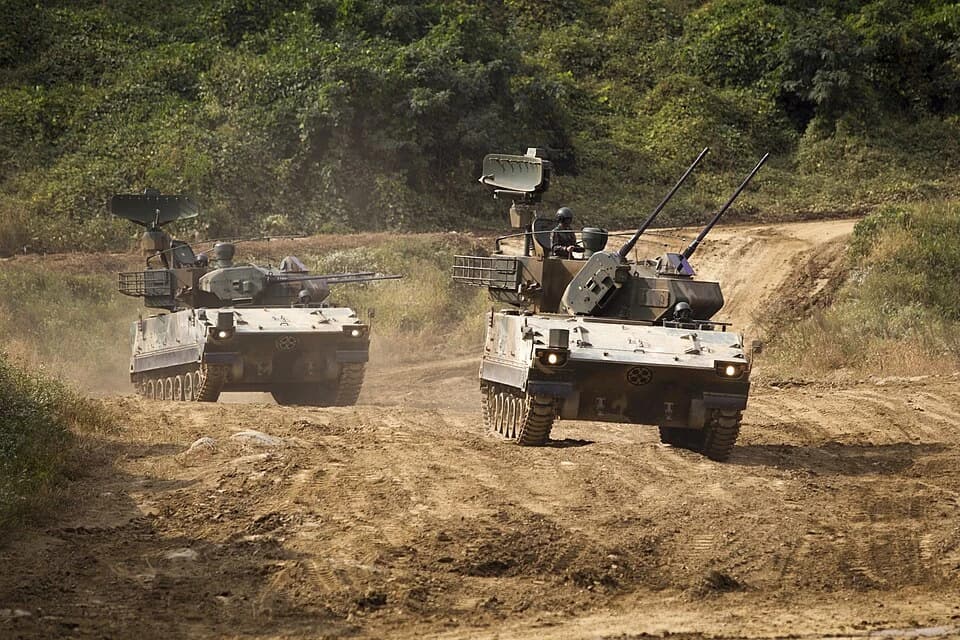

Credit
대한민국 국군 Republic of Korea Armed Forces · CC BY-SA 2.0 · Resized / optimised · CC BY-SA 2.0 · Source ↗ · Modified


Preparing your view.

At a glance
K30 Biholarger figure on 1 of 3
ZSU-57-2larger figure on 2 of 3
Counts only measures both sources give with the same scope. A larger figure is not a better system.
True scale
Side by side. From every angle. A human reference for perspective.
3.39 MB · Loads when you open it| Model | Length | Width / span | Height |
|---|---|---|---|
| K30 Biho | ≈ 6.77 m | ≈ 3.36 m (Width) | ≈ 4.2 m |
| ZSU-57-2 | ≈ 6.22 m | ≈ 2.52 m (Width) | ≈ 2.2 m |
Scaled uniformly to the sourced length of 6.77 m. Not an official model or a measured survey.
ForceTally · All rights reserved
Scaled uniformly to the sourced length of 6.22 m. Not an official model or a measured survey.
ForceTally · All rights reserved
The human reference is a generic 1.75 m figure. Models describe external size, not combat performance.
Measured figures
Length
Single source6.77 meters (22 ft 3 in)[source]
Hull
Single sourceConfiguration
| Specification | K30 Biho | ZSU-57-2 |
|---|---|---|
| Type | Self-propelled anti-aircraft gun[source] | Self-propelled anti-aircraft gun[source] |
| Place of origin | South Korea[source] | Soviet Union[source] |
| In service | 1999–present[source] | 1955–early 1970s ( USSR ) 1957–present (other countries)[source] |
| Used by | See Users[source] | See Operators[source] |
with gun in forward position (
Single source8.46 m with gun in forward position (6.22 m hull only)[source]
Operational; Operational range
Single source500 km (310 mi)[source]
Operational; Off-road
Single sourceOperational; road
Single source420 km (261 miles) (road) 320 km (199 miles) (off-road)[source]
range of up to 5,500 m[source]ZSU-57-2 · Description / Other equipment · The ZSU-57-2 is equipped with an automatic anti-aircraft sight of the plotter type with two collimators which can supervise a target with a speed of up to 350 m/s, a dive angle of between 0° and 90° and a slant range of up to 5,500 m; a simple mechanical sight is provided in case of failure.
MAN - Doosan D2840L (388 kw) diesel engine
Single sourceMAN - Doosan D2840L 520 hp (388 kw) diesel engine[source]
V-54, 4-stroke , airless ( mechanical )-injection, water-cooled 38.88 liter V12 diesel at 2,000 rpm
Single sourceV-54, 4-stroke , airless ( mechanical )-injection, water-cooled 38.88 liter V12 diesel 520 hp (388 kW) at 2,000 rpm[source]
Bars compare reported quantities only. A larger figure does not make a system better; configurations and test conditions differ.
| Designer | Agency for Defense Development[source] | Design Bureaus of Omsk Works No. 174 and Research Institute No. 58 in Kaliningrad, Moscow Oblast[source] |
|---|
| Designed | 1983–1991[source] | 1947–1954[source] |
|---|
| Manufacturer | Hanwha Aerospace LIG Defense & Aerospace[source] | Chelyabinsk Tractor Plant[source] |
|---|
| Unit cost | 13,3 billion KRW (12.1 million USD)[source] | — |
|---|
| Produced | 1996–present[source] | 1948–1955 (prototypes) 1957–1960 (serial production)[source] |
|---|
| No. built | 176[source] | More than 2,023 (USSR) 250 (North Korea, old turrets on new hulls) ? (PRC, Type 80)[source] |
|---|
| Main armament | 2 × SNT Dynamics K KCB 30×170 mm autocannon[source] | 2 × 57 mm L/76.6 S-60 anti-aircraft autocannons (57 mm S-68A variant) (300 rounds)[source] |
|---|
| Secondary armament | KP-SAM Chiron MANPADS[source] | — |
|---|
| Power/weight | 19.62 hp/t (14.63 kW/t)[source] | 18.5 hp/tonne (13.81 kW/tonne)[source] |
|---|
| Transmission | S&T Dynamics HMPT500-3EK/4EK[source] | — |
|---|
| Suspension | Torsion bar[source] | individual torsion bar with hydraulic shock absorbers on the first and last road wheels[source] |
|---|
| Source measurement | The South Korean K30 Biho ( Korean : 비호, Hanja : 飛虎; literally "Flying Tiger ") twin 30 mm self-propelled anti-aircraft weapon was developed to meet the operational requirements of the Republic of Korea Armed Forces for a highly mobile short range air defense system suited to the operational and terrain conditions of the Korean peninsula. It combines an electro-optically guided 30 mm gun system with a surveillance radar system on a K200 chassis. It supplements the K263A1 Chungung , a self-propelled 20 mm Vulcan system.[source]K30 Biho · Lead; only the objects and conditions stated in this passage The K30 was first announced as a project in 1983 with 600 personnel conducting research and around 10 billion won spent on R&D. In September 2001, the production of prototypes were done under Tong-il Heavy Industries before Doosan Infracore concluded a contract with Korea's Defense Acquisition Program in 2007. An initial order was made in 2002 to supply the K30.[source]K30 Biho · History; only the objects and conditions stated in this passage A K30 Biho system consists of twin KCB 30 mm guns, a TPS-830K surveillance and fire-control radar, an electro-optical targeting system (EOTS), panoramic periscope , forward looking infrared system (FLIR), laser rangefinder (LRF), thermal sight , a TV camera, and a digital fire-control system . The combined targeting system of EOTS, FLIR, and LRF has a targeting range of over 10 km (6.2 mi). The TPS-830K radar can detect and track a 2 m 2 (22 ft 2 )-RCS target from a range of 17 km (11 mi). The cannons have a cyclic rate of fire of 600 rpm and an effective anti-aircraft range of 3,000 m (1.9 mi), and each is loaded with 300 rounds of (30×170 mm KCB) ammunition. In December 2013, DAPA announced that the Biho had been integrated with the Shingung surface-to-air missile to increase its coverage to 7 km. Two pods each containing two missiles are mounted, one of each side of the turret. Design integration with the missiles was completed in 2014, and by October 2015 the system was in full-rate production. The upgraded vehicle was in service by late 2018.[source]K30 Biho · General characteristics; only the objects and conditions stated in this passage The TPS-830K radar of K30 is an X-band (8 to 12.5 GHz) surveillance and fire-control pulse-Doppler radar , specialized for use against low-flying aircraft. Its features include real-time early warning, multiple target detection, an integral L-band (1 to 2 GHz) Identification Friend or Foe (IFF) subsystem, pulse compression, frequency agility, and adaptive moving target indication as an anti-chaff measure. It supplies ballistic computation data to the digital fire-control system to direct the aim of the electro-optical targeting system, which then aligns the 30 mm guns with the target for accurate fire. The radar can be installed on a separate vehicle (usually a 5-ton six-wheeled truck with a self-towed generator unit) to serve as an independent surveillance platform for other short range air defense systems. The secondary FLIR system and laser rangefinder supplements the TPS-830K radar to provide additional targeting means in case the radar is rendered inoperative, or is turned off to retain the element of surprise against aircraft that are equipped with radar warning receivers .[source]K30 Biho · General characteristics; only the objects and conditions stated in this passage The K30 adapts the chassis of the K200 infantry fighting vehicle, but has some differences. It has an extra roadwheel in its suspension and uses a D2840L engine instead of the D2848T engine of the K200, with an increase in engine power from 350 horsepower to 520 horsepower, necessary since the K30 weighs almost twice as much as the K200. Allison Transmission 's X200-5K transmission is likewise replaced by S&T Dynamics ' HMPT500-3EK/4EK to accommodate the more powerful engine. The modified chassis largely retains the protection and amphibious capability of the original chassis.[source]K30 Biho · General characteristics; only the objects and conditions stated in this passage | The ZSU-57-2 Ob'yekt 500 is a Soviet self-propelled anti-aircraft gun (SPAAG), armed with two 57 mm autocannons . 'ZSU' stands for Zenitnaya Samokhodnaya Ustanovka ( Russian : Зенитная Самоходная Установка ), meaning "anti-aircraft self-propelled mount", '57' stands for the bore of the armament in millimetres and '2' stands for the number of gun barrels . It was the first Soviet mass-produced tracked SPAAG after World War II. In the USSR, it had the unofficial nickname Sparka (Russian: Спарка ), meaning "twin mount," referring to the twin autocannon with which the vehicle is armed.[source]ZSU-57-2 · Lead; only the objects and conditions stated in this passage In 1942, Soviet engineers developed the T-60-3. The vehicle, based on the T-60 light tank chassis, was armed with two 12.7 mm DShK heavy machine guns; but the prototype did not go into production because of flaws in the design. The SU-72 SPAAG and several other experimental vehicles based on the T-60 or T-70 light tank chassis and armed with 37 mm autocannon were also tested in 1942–1943. The ZSU-37 was based on the chassis of the SU-76M self-propelled gun (SPG) and armed with one 37 mm 61K anti-aircraft autocannon in an open-top rotating armoured turret. The vehicle entered production in February 1945 and was in small-scale production until 1948.[source]ZSU-57-2 · Development history / Origins; only the objects and conditions stated in this passage After World War II it became clear that the firepower of a single 37 mm AA gun was insufficient to destroy the high-speed, low-altitude targets, which airplanes started to become at the time. SPAAGs based on light tank chassis had poor maneuverability in difficult terrain, slow off-road speed and insufficient range in comparison with medium tanks and SPGs. Thus the ZSU-37s were retired from service by the end of the 1940s.[source]ZSU-57-2 · Development history / Origins; only the objects and conditions stated in this passage For several years after World War II there were no new SPAAG models in the USSR except for the BTR-152A (which were armed with two or four 14.5mm KPV heavy machine guns , designated ZTPU-4) and the BTR-40A (ZTPU-2) wheeled SPAAGs. Two of the USSR's potential enemies – the United States and Great Britain, had high-quality air forces with substantial ground-attack experience. The need for a new tracked AA vehicle was apparent. |
|---|
| Wars | — | See Service history and Combat history[source] |
|---|
| Armor | — | 8–15 mm[source] |
|---|
| Ground clearance | — | 425 mm[source] |
|---|
| Fuel capacity | — | 830 L (including two externally mounted fuel tanks, 95 L each)[source] |
|---|
| Former operator · People's Republic of Angola | — | People's Republic of Angola[source] |
|---|
| Former operator · United Arab Republic | — | United Arab Republic[source] |
|---|
| Former operator · People's Republic of Bulgaria | — | People's Republic of Bulgaria[source] |
|---|
| Former operator · Republic of Bosnia and Herzegovina | — | Republic of Bosnia and Herzegovina[source] |
|---|
| Former operator · China | — | China[source] |
|---|
| Former operator · Derg | — | Derg[source] |
|---|
| Former operator · Finland | — | Finland[source] |
|---|
| Former operator · East Germany | — | East Germany[source] |
|---|
| Former operator · Germany | — | Germany[source] |
|---|
| Former operator · Hungarian People's Republic | — | Hungarian People's Republic[source] |
|---|
| Former operator · Ba'athist Iraq | — | Ba'athist Iraq[source] |
|---|
| Former operator · Democratic People's Republic of Korea | — | Democratic People's Republic of Korea[source] |
|---|
| Former operator · Pahlavi Iran | — | Pahlavi Iran[source] |
|---|
| Former operator · People's Republic of Mozambique | — | People's Republic of Mozambique[source] |
|---|
| Former operator · Polish People's Republic | — | Polish People's Republic[source] |
|---|
| Former operator · Republika Srpska | — | Republika Srpska[source] |
|---|
| Former operator · Socialist Republic of Romania | — | Socialist Republic of Romania[source] |
|---|
| Former operator · Russia | — | Russia[source] |
|---|
| Former operator · Serbia | — | Serbia[source] |
|---|
| Former operator · Slovenia | — | Slovenia[source] |
|---|
| Former operator · Ba'athist Syria | — | Ba'athist Syria[source] |
|---|
| Former operator · Soviet Union | — | Soviet Union[source] |
|---|
| Former operator · North Vietnam | — | North Vietnam[source] |
|---|
| Former operator · South Vietnam | — | South Vietnam[source] |
|---|
| Former operator · Vietnam | — | Vietnam[source] |
|---|
| Former operator · Yugoslavia | — | Yugoslavia[source] |
|---|
| Role | — | Soviet self-propelled anti-aircraft gun (SPAAG), armed[source] |
|---|
| Reported operators |
|---|
In February 1946, the Design Bureau of Works No. 174 in Omsk and the Research Institute No. 58 in Kaliningrad, Moscow Oblast submitted a joint project for a SPAAG based on the T-34 tank chassis, to be armed with four 37 mm AA guns, to the Technical Council of the Ministry of Transport. However, the project did not proceed due to the desire to concentrate attention on the newest tank chassis available.[source]ZSU-57-2 · Development history / ZSU-57-2 prototypes; only the objects and conditions stated in this passage
The Design Bureau of Research Institute No. 58 (NII-58) (formerly known as the Central Artillery Design Bureau, TsAKB), under the supervision of V.G. Grabin , began the development of a twin 57 mm S-68 automatic anti-aircraft gun based on the 57mm S-60 in the spring of 1947. The first S-68 prototype (with ESP-76 diesel-electric drive), was ready in 1948. It was initially mounted on a S-79A four-wheel carriage; that system passed various tests but did not go into production.[source]ZSU-57-2 · Development history / ZSU-57-2 prototypes; only the objects and conditions stated in this passage
The final project of the ZSU-57-2 (Ob'yekt 500), armed with twin S-68s and based on a light-weight T-54 tank chassis, was finished in 1948. The first prototype ZSU-57-2 was built in June 1950, the second in December 1950. After official tests, taking place between 27 January and 15 March 1951 in which the vehicle was driven for 1,500 km (932 miles) and 2,000 rounds were fired from its guns, six more prototypes were built for service tests. These prototypes had some improvements included, such as an increased ammunition load (300 rounds), but development stopped again due to the absence of improved S-68A guns. Various updates continued in 1952 and 1953. The service tests, in which two vehicles participated, took place in December 1954. This was due to delays in the development of drives for the S-68 guns. The ZSU-57-2 officially entered service in the Soviet Army on 14 February 1955. With the Warsaw Pact, all Russian allied countries were given a number of the ZSU-57-2.[source]ZSU-57-2 · Development history / ZSU-57-2 prototypes; only the objects and conditions stated in this passage
Based on past experiences with SPAAG designs, Soviet engineers designed a vehicle that used a modified T-54 chassis, with four twin road wheels per side instead of five, and much thinner armour in order to not overwork the inbuild V-54 4-stroke diesel V12 engine of the T-54. The vehicle was armed with twin 57 mm S-68 autocannon in a new, large, rotating, open-topped turret. The ZSU-57-2 consists of three compartments: driver's in the front, fighting in the middle and engine-transmission at the rear. The hull is more spacious in comparison with the T-54 because of the thinner armour and has different locations for some equipment. The general layout, with transverse mounting of the engine, is the same.[source]ZSU-57-2 · Description / Overview; only the objects and conditions stated in this passage
The open-topped box-type welded turret has a ball-bearing race ring 1850 mm in diameter. The turret rear can be removed, which makes replacement of the guns easier. The turret can be covered in the travelling position by a tarpaulin which has 16 plexiglass windows.[source]ZSU-57-2 · Description / Turret; only the objects and conditions stated in this passage
To fire the guns, the breeches must first be opened. The left and right loaders , located in the forward part of the turret on both sides of the main armament, load clips into the magazines of their respective weapons. The loaders' travel seats should be stowed in clamps on the turret sides before opening fire. The gunner, seated on the left hand side in the middle of the turret, aims ("lays") the gun and opens fire using an electric trigger, which fires both barrels, or two-foot pedals, which can fire either barrel independently. If manual mechanical backup gunlaying is used instead of electro-hydraulic drive, three crew members instead of two should work with the sight. The commander, who sits on the right hand side in the middle of the turret, lays the gun in azimuth, the gunner in elevation and the sight adjuster enters data into the sight. The loaders feed clips into the twin autocannon manually as needed, similar to the Bofors 40mm .[source]ZSU-57-2 · Description / Turret; only the objects and conditions stated in this passage
The twin S-68s are recoil-operated and weigh 4,500 kg. Their construction was based on two 57 mm S-60 AA autocannons . The guns have a recoil of between 325 and 370 mm. The individual weapons cannot be swapped from one side to the other as they are mirror images. Each air-cooled gun barrel is 4365 mm long (76.6 calibers ) and is fitted with a muzzle brake . They can be elevated or depressed between −5° and +85° at a speed of between 0.3° and 20° per second, the turret can traverse 360° at a speed of between 0.2° and 36° per second. Drive is from a direct current electric motor and universal hydraulic speed gears (a manual mechanical drive is also provided in case of electrohydraulic failure; with the use of mechanical drive, elevation speed is 4.5° per second and the turret traverse speed is 4° per second).[source]ZSU-57-2 · Description / Armament; only the objects and conditions stated in this passage
The guns firing together are capable of firing up to 210–240 fragmentation and armour-piercing tracer (AP-T) shells per minute, with a practical rate of fire of between 100 and 140 rounds per minute, which gives a fire time of 2–3 minutes before running out of ammo. Muzzle velocity is 1,000 m/s. Each clip has 4 rounds, each of which weighs 6.6 kg; the charge in each round consists of 1.2 kg of 11/7 nitrocellulose powder, a projectile weighs 2.8 kg. Maximum horizontal range is 12 km / 7 miles (with an effective range against ground targets of up to 4 km / 2.5 miles. Maximum vertical range is 8.8 km / 28,871 ft with a maximum effective vertical range of 4.5 km / 14,750 ft). Fragmentation rounds have a safety-destructor which activates between 12 and 16 seconds after being fired to ensure the shells will not fall back to ground, so the maximum slant range of anti-aircraft fire is 6.5–7 km / 4-4.3 miles. BR-281 armour-piercing rounds are able to penetrate 110 mm armour at 500 m or 70 mm armour at 2,000 m (at 90° impact angle).[source]ZSU-57-2 · Description / Armament; only the objects and conditions stated in this passage
The S-68 autocannon was the most powerful AA gun installed on SPAAGs at that time. According to the statistical data of the Air Defence Research Institute No. 2, a direct hit of a single 57 mm shell could destroy a contemporary jet aircraft. In order to shoot down a jet bomber of the Canberra type, an average of 1.7 hits were deemed necessary.[source]ZSU-57-2 · Description / Armament; only the objects and conditions stated in this passage
The ZSU-57-2's armour is welded rolled steel sufficient to protect the vehicle from 7.62mm armour-piercing bullets at 250 meters.[source]ZSU-57-2 · Description / Armour protection; only the objects and conditions stated in this passage
Hull front: (upper) – 13.5 mm; (lower) – 15 mm; at 60 degrees upper[source]ZSU-57-2 · Description / Armour protection; only the objects and conditions stated in this passage
Hull sides: (upper) – 15 mm; (lower) – 13.5 mm[source]ZSU-57-2 · Description / Armour protection; only the objects and conditions stated in this passage
Hull rear: 8 – 10.6 mm at 45 degrees[source]ZSU-57-2 · Description / Armour protection; only the objects and conditions stated in this passage
Hull roof: 15 mm[source]ZSU-57-2 · Description / Armour protection; only the objects and conditions stated in this passage
Hull bottom: 13.5 mm[source]ZSU-57-2 · Description / Armour protection; only the objects and conditions stated in this passage
Turret sides: 13.5 mm[source]ZSU-57-2 · Description / Armour protection; only the objects and conditions stated in this passage
Gun mantlet: 15 mm[source]ZSU-57-2 · Description / Armour protection; only the objects and conditions stated in this passage
The ZSU-57-2 has a maximum road speed of 50 kilometres per hour (31 miles per hour), which is reduced to around 30 km/h off-road(19 mph). The vehicle has better acceleration compared with the T-54 because of its better power-to-weight ratio (18.6 hp per tonne). It has an operational range of 420 km(261 miles) on roads and 320 km(199 miles) across country. The vehicle can cross 0.8 m high vertical obstacles, 2.7 m wide trenches , ford 1.4 m deep water obstacles and climb 30° gradients.[source]ZSU-57-2 · Description / Maneuverability; only the objects and conditions stated in this passage
The ZSU-57-2 uses the same engine as the T-54. It is a water-cooled V-54 4-stroke diesel V12 engine with a displacement of 38.88 litres, which develops 520 hp (388 kW) at 2,000 rpm. The engine itself weighs 895 kg. Fuel capacity is 830 litres carried in three fuel tanks inside the hull (640 L total) and two external fuel tanks on the right fender each of 95 L; fuel capacity was increased in comparison with the T-54. External rear-mounted supplemental fuel tanks can increase the road range to 595 km (370 miles).[source]ZSU-57-2 · Description / Maneuverability; only the objects and conditions stated in this passage
The mechanical transmission in the rear part of the hull consists of a change gear quadrant, a primary multiplate clutch unit with metallic friction pads, a manual gearbox with five forward gears, two multiplate planetary steering clutches with band brakes and two in-line final drive groups.[source]ZSU-57-2 · Description / Maneuverability; only the objects and conditions stated in this passage
The chassis has four twin rubber-tyred road wheels with individual torsion bar suspension , a rear drive sprocket with detachable sprocket rings (lantern-wheel gear) and an idler wheel on each side. The first and last road wheels each have a hydraulic rotary shock absorber . The track is 12.33 m long, 580 mm wide and has 90 links; despite having four road wheels instead of five the ground contact area of the track is the same as the T-54 (3.84 m). Track center distance is 2.64 m The vehicle has a ground pressure of 0.63 kg/cm 2 .[source]ZSU-57-2 · Description / Maneuverability; only the objects and conditions stated in this passage
The ZSU-57-2's electrical power unit partially differs from the T-54, in that it consists of a more powerful G-74 direct current generator which develops 3 kW (108 A at 27–29 V) at 2100 rpm and six 24 volt 6-STEN-140M or 6-MST-140 accumulator batteries (total battery capacity is 420 A-h), the batteries are used for starting the engine and an electrical power supply when the generator is shut down.[source]ZSU-57-2 · Description / Other equipment; only the objects and conditions stated in this passage
The ZSU-57-2 is equipped with an automatic anti-aircraft sight of the plotter type with two collimators which can supervise a target with a speed of up to 350 m/s, a dive angle of between 0° and 90° and a slant range of up to 5,500 m; a simple mechanical sight is provided in case of failure. There is also an optical sight for direct fire at ground targets.[source]ZSU-57-2 · Description / Other equipment; only the objects and conditions stated in this passage
The 10RT-26E portable radio transceiver is located on the right hand side of the turret interior. It has a range of 9–20 km(5–12 miles) when the vehicle is stationary, and from 7–15 km(4–9 miles) when the vehicle is on the move. It was later replaced by R-113 or R-113 radio transceivers. The TPU-4-47 intercom system was later replaced by R-120 or R-124 intercom systems.[source]ZSU-57-2 · Description / Other equipment; only the objects and conditions stated in this passage
Small arms for the crew members include two AK-47 assault rifles and a 26 mm signalling pistol .[source]ZSU-57-2 · Description / Other equipment; only the objects and conditions stated in this passage
Although the ZSU-57-2 had the highest firepower among production SPAAGs of its time, the anti-aircraft fire efficiency of a battery of four vehicles was even lower than that of a battery of six towed 57 mm S-60 anti-aircraft guns controlled by the PUAZO-6 anti-aircraft artillery director with the SON-9 fire control radar or later by the RPK-1 Vaza radar.[source]ZSU-57-2 · Description / Weaknesses; only the objects and conditions stated in this passage
Aircraft technology had improved to the point that a SPAAG required a much higher rate of fire, turret traverse speeds of 50–100° per second and a fully automatic radar-controlled fire control system.[source]ZSU-57-2 · Description / Weaknesses; only the objects and conditions stated in this passage
Works No. 174 started a modernization programme for the ZSU-57-2 in parallel with the beginning of its serial production in 1957, but this programme was rejected due to the development of new radar-guided SPAAGs armed with small-bore autocannons and another tracked chassis.[source]ZSU-57-2 · Description / Weaknesses; only the objects and conditions stated in this passage
Nevertheless, its Western counterparts that were operationally available in the 1950s, such as the US M19 Multiple Gun Motor Carriage (based on the M24 Chaffee light tank) and the M42 Duster SPAAGs (both armed with the famous 40 mm Bofors M2A1 twin AA gun ), had similar problems and were armed with less powerful weapons. The M42 Duster was tested with a T50 radar system in 1956 though it was a failure (production of the ZSU-57-2 had not started at this point).[source]ZSU-57-2 · Description / Weaknesses; only the objects and conditions stated in this passage
Although the vehicle entered service in 1955 and in the same year the No. 174 Works located in Omsk began producing the hulls and turrets, the first vehicles were completed in 1957 after the first 249 57 mm twin S-68 guns were produced by the Artillery Works No. 946 located in Krasnoyarsk . A total of 5,300 of these weapons were produced by the end of the 1950s. The hulls and turrets were produced by No. 174 Works where the final assembly also took place while the Krasnoyarsk Works, belonging to the Ministry of Heavy Engineering, participated in some production stages. The ZSU-57-2 remained in production until 1960 when the No. 174 Works stopped producing the hulls and turrets for ZSU-57-2. More than 2,023 ZSU-57-2 s were produced in Soviet Union.[source]ZSU-57-2 · Production history; only the objects and conditions stated in this passage
Initially, tank regiments had a single battery equipped with four SPAAGs, later increased to two batteries, each equipped with four SPAAGs. The vehicle was also used by some motor rifle regiments (which in the 1960s had one battery equipped with four SPAAGs or, more likely, with six 23 mm ZU-23 towed twin AA guns). The anti-aircraft performance of the ZSU-57-2, however, was quickly found to be unsatisfactory and, because of rapid air force development, the vehicle was deemed obsolete by the early 1960s.[source]ZSU-57-2 · Service history / Former USSR; only the objects and conditions stated in this passage
Poland received its 129 ZSU-57-2s between 1957 and 1961. They were also offered a production license for twin S-68 AA autocannons, but declined it. Eventually, Poland replaced all its ZSU-57-2s with ZSU-23-4s. Seven Polish ZSU-57-2s are preserved, one at the Lubuskie Military Museum in Drzonów, one in Wicko Morskie, the largest anti-aircraft artillery firing range in Poland, one at the Land Forces Museum in Warsaw, one at the History and Tradition of Suvalkai Soldiers Museum in Suwalszczyzna , one in Koszalin and two at the Polish Army Museum in Warsaw .[source]ZSU-57-2 · Service history / Foreign service / Poland; only the objects and conditions stated in this passage
The Socialist Federal Republic of Yugoslavia ordered 100 ZSU-57-2s in 1963. Deliveries were completed between 1963 and 1964. They were passed on to the successor states during the 1992 breakup of the federal state. They were then used by the Federal Republic of Yugoslavia. There were 54 of those vehicles in service as of 1999, but this number decreased to 36 in the subsequent decade; they were withdrawn from active service by 2003. A number of ZSU-57-2 remained in Serbia national inventories until 2008. Two vehicles captured by Croatian forces during the Croatian War of Independence and were later also scrapped.[source]ZSU-57-2 · Service history / Foreign service / Former Yugoslavia; only the objects and conditions stated in this passage
Finland imported 12 ZSU-57-2 SPAAGs between 1960 and 1961 alongside other kinds of Soviet equipment. The ZSU-57-2 s were designated 57 ItPsv SU 57-2, some of them remained in service to the end of the century. A ZSU-57-2M modernization programme was being developed in Finland which would equip the vehicle with radar and configurable ammunition. However, after the prototype was produced the project was abandoned because of high costs. ItPsv SU-57 s were withdrawn from service in 2006.[source]ZSU-57-2 · Service history / Foreign service / Finland; only the objects and conditions stated in this passage
Unlike the production ZSU-57-2, the prototype weighted 26.172 tonnes, carried only 252 rounds: 172 rounds in clips inside the turret and 80 separate rounds in the nose part of the hull in a special ammunition stowage, had thinner armour (8–10 mm) and antennae mounted at the rear of the turret upper right side instead of in the middle.[source]ZSU-57-2 · Variants / Former USSR; only the objects and conditions stated in this passage
Type 80 (WZ305) – Chinese SPAAG. It has the same turret as the ZSU-57-2, but it is armed with the Type 59 twin anti-aircraft autocannon (a copy of the Soviet S-68), mounted on the chassis of a Chinese Type 69-II MBT. It is heavier than the ZSU-57-2 at 30 tonnes.[source]ZSU-57-2 · Variants / People's Republic of China; only the objects and conditions stated in this passage
ItPsv SU-57 – Finnish designation for ZSU-57-2. ItPsv SU-57 with a machine gun mounted on the front of the turret. ZSU-57-2M – Finnish ZSU-57-2 modernization which equips the vehicle with radar and configurable ammunition. Only one prototype was produced and the project was abandoned because of high costs.[source]ZSU-57-2 · Variants / Finland; only the objects and conditions stated in this passage