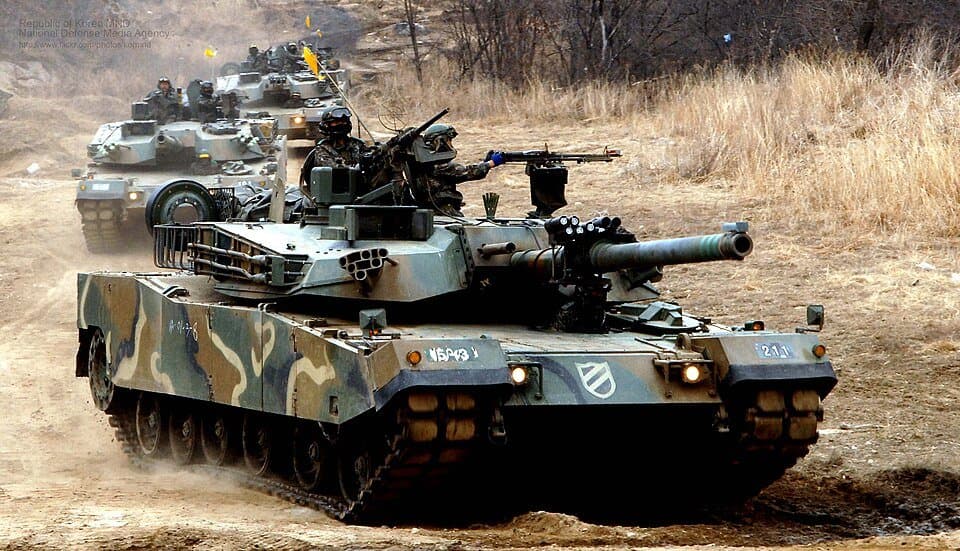

Credit
대한민국 국군 Republic of Korea Armed Forces · CC BY-SA 2.0 · Resized · CC BY-SA 2.0 · Source ↗ · Modified


Preparing your view.


At a glance
K1 tanklarger figure on 1 of 2
Measured figures
K1A1 gun forward
Single sourceK1 gun forward
Single sourceConfiguration
| Specification | K1 tank | Type 80/88 main battle tank |
|---|---|---|
| Type | Main battle tank[source] | Main battle tank[source] |
| Place of origin | South Korea[source] | China[source] |
| In service | K1: 1987–present K1E1: 2014–present K1A1: 2001–2024 K1A2: 2013–present[source] | 1988–present[source] |
| Used by | See operators[source] | See Operators |
Type 80/88 main battle tanklarger figure on 1 of 2
Counts only measures both sources give with the same scope. A larger figure is not a better system.
K1: 9.67 m (gun forward) K1A1: 9.71 m (gun forward)[source]
gun forward; Type 80/88
Single sourcegun forward; Type 85-III
Single sourcevehicle hull
Single source6.325 m (vehicle hull) 9.336m (gun forward; Type 80/88) 10.369m (gun forward; Type 85-III)[source]
K1
Single sourceK1A1
Single sourceK1A2
Single sourceK1: 51.1 metric tons K1A1: 53.2 metric tons K1A2: 54.5 metric tons[source]
Type 80/88
Single sourceType 85
Single sourceSTX Engine / MTU Friedrichshafen MB871Ka-501 8-cylinder water-cooled turbocharged diesel engine @ 2,600 rpm
Single sourceSTX Engine / MTU Friedrichshafen MB871Ka-501 8-cylinder water-cooled turbocharged diesel engine 1,200 hp (890 kW) @ 2,600 rpm[source]
12150ZL Diesel
Single source12150ZL Diesel 730 hp (537 kW)[source]
Bars compare reported quantities only. A larger figure does not make a system better; configurations and test conditions differ.
| Designer | Chrysler Defense General Dynamics Land Systems Hyundai Precision Industry Agency for Defense Development[source] | — |
|---|
| Designed | K1: 1978–1985 K1A1: 1991–1996[source] | 1978 (Type 80) 1981–1987 (Type 88)[source] |
|---|
| Manufacturer | Hyundai Precision Industry (1985–2000) Hyundai Mobis (2000–2001) Rotem Co., Ltd. (2001–2007) Hyundai Rotem (2007–present)[source] | Norinco[source] |
|---|
| Unit cost | K1: ₩ 2.3 billion (1994) K1A1: ₩4.4 billion (2001) K1A2: ₩6.0 billion[source] | — |
|---|
| Produced | K1: 1987–1997 K1E1: 2013–present K1A1: 1999–2011 K1A2: 2013–2024[source] | — |
|---|
| No. built | K1/E1: 1,027 K1A1/A2: 484[source] | — |
|---|
| Armor | K1: Special Armor Package (SAP) K1A1: Korean Special Armor Plate (KSAP)[source] | Type 80: Cast Steel Turret Type 85II/Type 88: Welded Steel/Composite Armor Turret. May be fitted with Explosive Reactive Armor[source] |
|---|
| Main armament | K1, K1E1: KM68A1 105 mm (47 rounds) K1A1, K1A2: KM256 120 mm (32 rounds), or Hyundai WIA CN03 120 mm (32 rounds)[source] | ZPL-79 105mm rifled gun (Type 80) ZPL-83 105mm rifled gun (Type 88) ZPL-83A 105mm rifled gun (Type 85/88B) ZPL-94 105mm rifled gun (Type 88A) ZPT-88C 125mm smoothbore gun (Type 85IIA/Type 88C)[source] |
|---|
| Secondary armament | M2 or K6 12.7x99 mm NATO HMG (commander's mount) M60D 7.62×51mm NATO GPMG (loader's mount) M60E2-1 7.62×51mm NATO GPMG (coaxial)[source] | Type 59 7.62 mm coaxial machine gun Type 59 12.7 mm air-defence machine gun[source] |
|---|
| Power/weight | K1: 23.4 hp/ton (17.44 kW/t) K1A1: 22.5 hp/ton (16.77 kW/t) K1A2: 22 hp/ton (16.40 kW/t)[source] | 18.9hp/ton (Type 80/85/88)[source] |
|---|
| Transmission | Hyundai Transys/ ZF Friedrichshafen LSG 3000 Automatic, 4 forward, 2 reverse[source] | — |
|---|
| Suspension | Hydropneumatic (wheel 1, 2, 6), torsion bar (wheel 3, 4, 5)[source] | — |
|---|
| Ground clearance | 460 mm (18 in) longitudinal slope: 60 % lateral slope: 30 % vertical: 1.1 m trench: 2.74 m fording: 1.2 m (without snorkel) or 2.2 m (with snorkel)[source] | — |
|---|
| Wars | — | See Operational history[source] |
|---|
| Variants | — | Type 80 Type 85 Type 88[source] |
|---|
| Fuel capacity | — | 1433L[source] |
|---|
| Role | — | family of Chinese second-generation main battle tanks (MBTs)[source] |
|---|
| Source measurement | — | In a trial between the Type 80-II and the AMX-32 , the Type 80-II required 8 hours to change its engine, while the AMX-32 only required an hour.[source]Type 80/88 main battle tank · History / Type 80 and Type 85 development; only the objects and conditions stated in this passage Due to export restrictions, the Chinese were unable to use an imported 105mm gun on the Type 85 tank.[source]Type 80/88 main battle tank · History / Type 80 and Type 85 development; only the objects and conditions stated in this passage This led to the development of the first locally designed 105mm gun.[source]Type 80/88 main battle tank · History / Type 80 and Type 85 development; only the objects and conditions stated in this passage This led to further upgrades in the Type 85 to its engine from 730 hp to 800 hp and changing to a semi-auto transmission.[source]Type 80/88 main battle tank · History / Type 80 and Type 85 development; only the objects and conditions stated in this passage The Type 80 inherited the design philosophy of the Type 69/79 which combined a Soviet-style chassis and turret with Western technology. Like the Type 69 series, the initial Type 80 design possessed a hemispherical turret similar to the T-54/55 . Another similarity was that the driver sat in the left forward section of the hull. However, the Type 80 used a licence-built L7 rifled gun instead of the Soviet 100 mm rifled gun .[source]Type 80/88 main battle tank · Design / Overview; only the objects and conditions stated in this passage The Type 85-I (Storm-1) series had a new welded turret design that was angular instead of the familiar bowl-shape. The Type 85IIAP/M was the first tank in the series to be equipped with a 125 mm smoothbore gun.[source]Type 80/88 main battle tank · Design / Overview; only the objects and conditions stated in this passage Type 80 served as a testbed for the imported ZPL-79 105 mm rifled gun. On Type 88 and Type 88B, the main armament is a dual-axis stabilized ZPL-83 and ZPL-83A 105 mm rifled gun with a fume extractor at its midway point. On Type 88A, the main gun is replaced by a longer, 62-caliber ZPL-94 , offering longer range, higher accuracy, and capability to launch laser-guided gun-launched missiles. The main gun has an elevation of -5 to 18 degrees and an electronic turret drive of 20°/s for horizontal control and 6°/s for vertical. The main gun on Type 80 is loaded manually and has a rate of fire of approximately 7 rounds per minute. On Type 88B, a form of assist loader is introduced for quicker and easier reload operations with a reportedly 13 rounds per minute maximum rate of fire.[source]Type 80/88 main battle tank · Design / Armaments; only the objects and conditions stated in this passage Secondary armaments for all variants are the same, including one Type 59 12.7 mm heavy machine gun mounted on the turret roof, and one Type 59 7.62 mm coaxial machine gun. The Type 80 and Type 88 can store 44 rounds of ammunition for the main gun. On Type 88B and Type 88A, the tank features redesigned ammo racks with 48 rounds of ammunition. The 12.7 mm heavy machine gun has 300 rounds of ammo, while the coaxial machine gun has 2250 rounds.[source]Type 80/88 main battle tank · Design / Armaments; only the objects and conditions stated in this passage All versions of the Type 80/85/88 tanks are fitted with thermal suppression camouflage paint, a collective NBC protection system, an air filtration and ventilation system, an automatic fire/after-effect suppression system, and 2 sets of four 76mm smoke grenade dischargers.[source]Type 80/88 main battle tank · Design / Protection; only the objects and conditions stated in this passage Type 80 and Type 88 tanks are powered by 12150ZL diesel engine developing 730 hp (537 kW). The maximum road speed is 57 km/h and the average off-road speed is 32 km/h. The power-to-weight ratio is about 18.9 hp/ton. The transmission has 5 forward gears and 1 reverse gear. It has a maximum cruising range of 500 km and can negotiate a gradient of 61% and a side slope of 58%. It can cross a vertical obstacle of 0.8 m and a trench of 2.7m.[source]Type 80/88 main battle tank · Design / Mobility; only the objects and conditions stated in this passage Prototype Chinese second-generation tank design which did not enter production. Uses an older-style round steel cast turret with a new chassis. Four-man crew. Came with NBC protection. The vehicle served as a testbed for the imported ZPL-79 105mm rifled gun. Main difference between Type 80 and Type 80-I was in the fire control system with the original range finding laser mounted on the gun mantlet incorporated into the tank commander's gun sight.[source]Type 80/88 main battle tank · Variants / Type 80; only the objects and conditions stated in this passage Type 80 was developed for export purposes. Type 80-II had a new 12150ZL(G) engine developing 790 hp (588 kW), new transmission, air ventilation system, improved vehicle radio system, and thermal smoke generator.[source]Type 80/88 main battle tank · Variants / Type 80; only the objects and conditions stated in this passage Type 80-II chassis with welded turret. Also known as Storm-I. Had a 730 hp engine.[source]Type 80/88 main battle tank · Variants / Type 85/Storm; only the objects and conditions stated in this passage Type 80/88 chassis with welded turret. Also known as Storm-II. Featured a locally developed ZPL-94 105mm gun, 800 hp engine and semi-automatic transmission.[source]Type 80/88 main battle tank · Variants / Type 85/Storm; only the objects and conditions stated in this passage Upgraded variant of the Type 85-II/Storm-2 to suit Pakistan's specifications. The 105mm gun was changed to a 125 mm smooth-bore gun with an autoloader. The original four-man crew was reduced to a three-man crew. Pakistan had originally wanted a 1000 hp engine, but this was not available in China at the time. Export designation to Pakistan was Type 85-IIM or Type 85-IIAP (The "P" standing for "Pakistan").[source]Type 80/88 main battle tank · Variants / Type 85/Storm; only the objects and conditions stated in this passage Developed in 1993. Upgrade for the Storm-II/Type 85-IIM with 1000 hp engine, ERA, improved FCS, and thermal night sight. It used the transmission from the T-72 tank. In 1994, when China competed against the Ukrainian T-84 for export to a tropical country, the Type 85-III performed better but suffered a higher number of faults and was thus not chosen.[source]Type 80/88 main battle tank · Variants / Type 85/Storm; only the objects and conditions stated in this passage Despite the name, Type 88B was the first mass-produced Type 88 variant. The Type 80 underwent further development and was accepted into PLA service in 1988, hence its designation was changed to Type 88. It was mounted with ZPL-83A 105mm gun which could fire all 105mm NATO gun ammunition.[source]Type 80/88 main battle tank · Variants / Type 88; only the objects and conditions stated in this passage Later variant of the Type 88B. Distinguished from Type 88B by type of 105 mm gun mounted. The Type 88A mounts a 62 caliber ZPL-94 105mm gun that is longer than the NATO L7 cannon and is capable of firing ATGMs .[source]Type 80/88 main battle tank · Variants / Type 88; only the objects and conditions stated in this passage Type 85-III was produced for domestic service in the PLA. Uses an angular welded turret. Armed with a 125 mm ZPT-98 smoothbore gun with an autoloader. Equipped with JSFCS-212 fire control system (FCS) (with laser rangefinder, ballistics computer, stabilized gunner's sight and dual-axis gun stabilization), and Type 889B radio with range of up to 30 km. Later renamed to Type 96 .[source]Type 80/88 main battle tank · Variants / Type 88C; only the objects and conditions stated in this passage Type 85-IIM variant with 125mm gun[source]Type 80/88 main battle tank · Variants / Type 88C; only the objects and conditions stated in this passage |
|---|
| Country of origin | — | China[source]Inventory Origin column; table 8, row 6, cell 4; revision 1373722962; retrieved 2026-10-02 |
|---|
Type 85-III
Single source38 tonne (Type 80/88) 39.5 tonne (Type 85) 44 tonne (Type 85-III)[source]