
Credit
Ministerie van Defensie · CC BY-SA 4.0 · Resized · CC BY-SA 4.0 · Source ↗ · Modified


Preparing your view.


At a glance
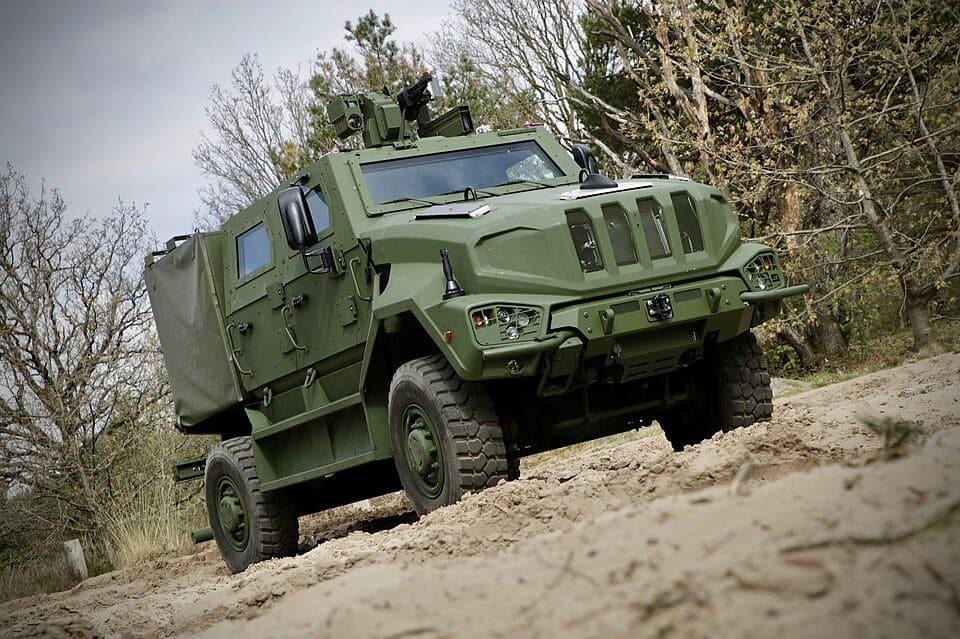
Iveco MTVlarger figure on 0 of 2
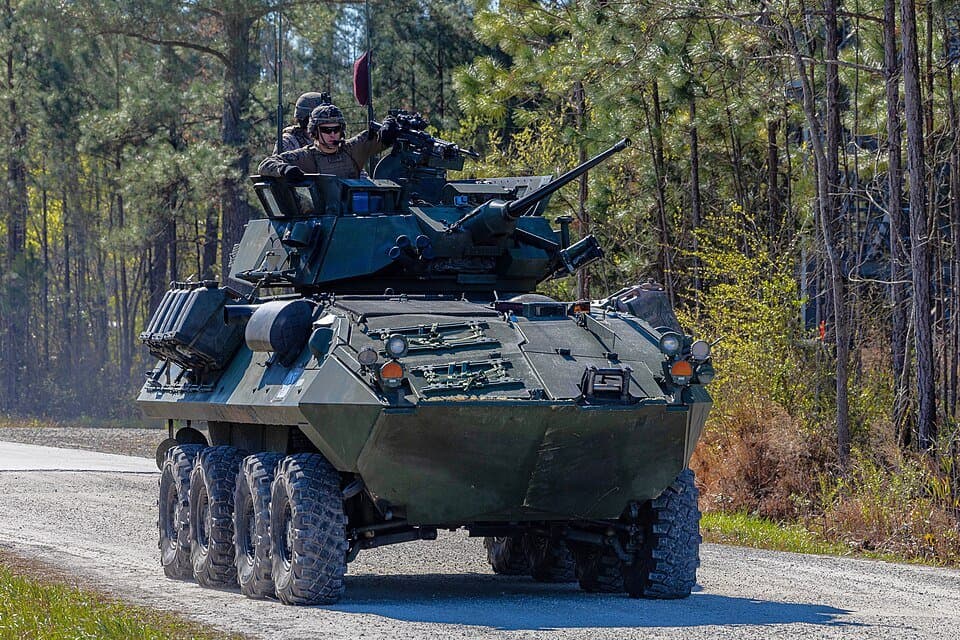
LAV-25larger figure on 2 of 2
Counts only measures both sources give with the same scope. A larger figure is not a better system.
Measured figures
Length
Single source5,900 mm (230 in)[source]
Length
Single sourceConfiguration
| Specification | Iveco MTV | LAV-25 |
|---|---|---|
| Crew | Iveco variant: 1 driver + up to 7 pax Hardtop: 2 crew + 2 pax Softtop: 2 crew + 2 pax Utility: 2 Ambulance: 2 crew + 2 injured Military police: 2 + 6[source] | 3+6[source] |
| Type | Infantry mobility vehicle[source] | Armored reconnaissance vehicle – infantry fighting vehicle[source] |
| Place of origin | Italy[source] | Canada/United States[source] |
| In service | 2024–present[source] | 1983–present |
6.39 m (21 ft 0 in)[source]
FPT NEF N67 280 (6.7 litres, inline-six , turbo-diesel engine , Euro III) Power Torque: 1,000 N⋅m (740 ft⋅lb)
Single sourceFPT NEF N67 280 (6.7 litres, inline-six , turbo-diesel engine , Euro III) Power: 276 hp (206 kW) Torque: 1,000 N⋅m (740 ft⋅lb))[source]
Detroit Diesel 6V53T
Single sourceDetroit Diesel 6V53T 300 hp (205 kW )[source]
Bars compare reported quantities only. A larger figure does not make a system better; configurations and test conditions differ.
| Used by | Netherlands Armed Forces[source] | — |
|---|
| Designer | Iveco Defence Vehicles[source] | General Motors Diesel (later General Dynamics Land Systems )[source] |
|---|
| No. built | 200 (as of October 2024, with a total of 1,185 on order)[source] | — |
|---|
| Variants | See variants[source] | — |
|---|
| Main armament | Hardtop: FN deFNder RCWS equipped with an FN MAG ( 7.62×51mm NATO ) Softtop variant, manned ring mount with optionally: M2 Browning ( 12.7×99mm NATO HMG ) H&K GMG ( 40×53 mm HV , AGL ) Spike LR / LR2 ( ATGM )[source] | M242 Bushmaster 25 mm chain gun with 210 rounds of ammunition[source] |
|---|
| Secondary armament | Softtop variant: lateral swing mount for the softtop variant, with a FN MAG ( 7.62×51mm NATO , GPMG )[source] | Two M240 7.62 mm machine guns with 660 rounds of ammunition, one mounted co-axially and one pintle-mounted on the roof[source] |
|---|
| Power/weight | 23 hp/t (17 kW/t)[source] | LAV-25: 21.26 hp/st (16.02 kW/t) LAV-25A2: 18.89 hp/st (14.24 kW/t)[source] |
|---|
| Payload capacity | Payload: > 2.0 t (4,400 lb) Towing capacity: 3.5 t (7,700 lb)[source] | — |
|---|
| Transmission | Automatic High-low transfer case Permanent 4×4 wheel-drive 3 fully lockable differentials[source] | Allison MT653[source] |
|---|
| Ground clearance | 350 mm (14 in) (vertical obstacle)[source] | — |
|---|
| Manufacturer | Iveco Defence Vehicles[source] | General Motors Diesel (later GDLS)[source] |
|---|
| Wars | — | U.S. invasion of Panama Persian Gulf War Operation Uphold Democracy War in Afghanistan Iraq War[source] |
|---|
| Armor | — | Welded steel[source] |
|---|
| Suspension | — | 8×8 wheeled[source] |
|---|
| Source measurement | — | The Marine Corps evaluated the three LAV submissions. In September 1982, the General Motors submission was selected. GM was awarded initial production contract for 969 LAVs. The Army type designated the 25 mm gun variant as the M1047. The Army sought 2,350 of the 12.7 mm (.50) caliber-armed light squad carrier variant, and at one point was expected to be the LAV's biggest buyer. Congress canceled funds for the LAV-25, causing the Army to drop out of the program. The Marine Corps managed to secure enough funding to buy 758 LAVs in six variants.[source]LAV-25 · History; only the objects and conditions stated in this passage In April 2021, the Marines revealed they had shifted focus to new capabilities for performing reconnaissance rather than specific types of platforms, and that the LAV-25 replacement may not be a new armored vehicle. Nevertheless, proposals for Advanced Reconnaissance Vehicle prototypes were due in May 2021; requirements were for a vehicle with a tethered unmanned aircraft system (UAS) and an open architecture approach allowing for integration of capabilities including battle management systems and communications suites, weighing less than 18.5 tons and being small enough to fit four on a Ship-to-Shore Connector . Vendors that submitted proposals include General Dynamics Land Systems, Textron , and BAE Systems . The Marine Corps plans to make up to three awards for ARV prototypes for testing and evaluation, then choose up to two to continue into a competitive engineering and manufacturing development phase in 2024, after which a decision will be made as to whether production will be pursued.[source]LAV-25 · History / Replacement; only the objects and conditions stated in this passage There are planned to be six ARV variants: command, control, communications and computers -unmanned aerial system (C4/UAS); organic precision fire-mounted; counter-UAS; 30 mm autocannon and ATGM; logistics; and recovery.[source]LAV-25 · History / Replacement; only the objects and conditions stated in this passage Developed from the AVGP family built by General Dynamics Land Systems, the LAV-25 is powered by a 6V53T Detroit Diesel turbo-charged engine, they are four-wheel drive (rear wheels) transferable to Eight-wheel drive . These vehicles are also amphibious, meaning they have the ability to "swim" but are limited to non-surf bodies of water (no oceans). While engaged in amphibious operations, the maximum speed is approximately 12 km/h (7.5 mph) using equipped propellers. The current Service Life Extension Program (SLEP) modifications will hinder or eliminate amphibious operations.[source]LAV-25 · Design; only the objects and conditions stated in this passage Typical land speeds are approximately 100 km/h (62.5 mph) in either 4- or 8-wheel drive; however, fuel economy decreases in 8-wheel drive. The vehicles operate on diesel fuel . They are equipped with a 25 mm M242 Bushmaster autocannon, two 7.62 mm M240 machine guns , and two four-barrel smoke grenade launchers located on the forward left and right sides of the turret. The crew is three; vehicle commander, gunner, and driver; and four passengers (scouts) with combat gear.[source]LAV-25 · Design; only the objects and conditions stated in this passage The LAV-25 is a lightly armored vehicle. The base model is protected by light gauge high hardness steel armor (MIL-A-46100), varying in nominal thickness from 4.71 mm to 9.71 mm. This level of high-hardness steel armor is intended only to offer protection against small arms rounds such as the common 7.62x39mm M1943 ball used by Kalashnikov rifles such as the AKM , to achieve the lowest possible weight and cost.[source]LAV-25 · Design / Armor; only the objects and conditions stated in this passage The standard LAV is fitted with a turret with 360° traverse, armed with an M242 25 mm chain gun with 420 rounds of 25 mm ammunition, both M791 APDS-T (Armour Piercing Discarding Sabot-Tracer) and M792 HEI-T (High Explosive Incendiary-Tracer), of which half is ready for use. 150 rounds are ready for use from one stowage bin, 60 from another stowage bin, the other 210 rounds are stowed elsewhere in the vehicle. A coaxial M240C machine gun is mounted alongside the M242, and a pintle-mounted M240B/G machine gun, with 1,320 rounds of 7.62 mm ammunition, is mounted on the turret roof. The Canadian Army uses an upgraded version of this chassis for its Coyote Armoured Reconnaissance Vehicle.[source]LAV-25 · Variants / LAV-25; only the objects and conditions stated in this passage The new armor will provide protection from 14.5 mm armor-piercing rounds, and include an anti-spall lining on the inside to further protect crew members. It will be similar to the protection found on the U.S. Army's LAV III " Stryker " variant.[source]LAV-25 · Variants / LAV-25A2; only the objects and conditions stated in this passage LAV fitted with an Emerson 901A1 TOW-2 anti-tank guided missile launcher, the same turret that was fitted on the M901 ITV . It is also armed with a pintle-mounted M240E1 or M240B general-purpose machine gun. It carries a total of 16 TOW missiles and 1,000 rounds of 7.62 mm ammunition.[source]LAV-25 · Variants / Other Variants; only the objects and conditions stated in this passage LAV fitted with opening doors on the top, inside it is fitted with an 81 mm M252 mortar , with 360° traverse, and a pintle-mounted M240E1 machine gun. It carries 90 81 mm mortar shells, and 1,000 rounds of 7.62 mm ammunition. It carries a crew of five (driver, commander, gunner, loader, and ammo handler). Each LAR company has two LAV-Ms.[source]LAV-25 · Variants / Other Variants; only the objects and conditions stated in this passage LAV fitted with a boom crane, and recovery winch, for use in recovery of vehicles, specifically other LAVs. the LAV-R also has an air compressor for pneumatic tools, a filter/transfer pump, floodlights, and additional stowage capabilities. It serves as the primary maintenance vehicle and is used to recover/tow dead lined LAVs, as well as to perform organizational and limited intermediate field level maintenance. The LAV-R has a 6,600 lb-rated extendable rotating boom and a 30,000 lb-rated rearward winch. The LAV-R provides repair and recovery services at the organizational and intermediate field maintenance levels. It is armed with a pintle-mounted M240E1/G machine gun, and carries 1,000 rounds of 7.62 mm ammunition. It has a crew of three (driver, commander, and rigger). Each LAR company has one LAV-R, except for H&S company, which has 3 to support the battalion.[source]LAV-25 · Variants / Other Variants; only the objects and conditions stated in this passage LAV with a raised roof to accommodate several VHF, UHF and HF radios. It is armed with a pintle-mounted M240E1/G machine gun, and carries 1,000 rounds of 7.62 mm ammunition. The vehicle carries a suite of radios, a portable shelter, and an auxiliary power unit (also referred to as APU) to substitute for vehicle power when needed. The LAV-C2A2 has the capability to effectively command and control the battalion, company, or combat team. Each LAR company has two LAV-C2s, except for H&S company, which has 6 to support the battalion. Generally referred to as the C 2 ("C-square" or "C-two").[source]LAV-25 · Variants / Other Variants; only the objects and conditions stated in this passage LAV variant that provides transportation for personnel, communications equipment, limited CASEVAC (2 litters ), ammunition, fuel, and other supplies. It is armed with a pintle-mounted machine gun, 7.62 mm, M240B and has a cargo capacity of 5,600 lb (2,500 kg). It carries a crew of three (driver, commander, and logistics crewmember). Each LAR company has four LAV-Ls, except for H&S company, which has 6 to support the battalion[source]LAV-25 · Variants / Other Variants; only the objects and conditions stated in this passage LAV-AT with the 901A1 TOW-2 in 1997[source]LAV-25 · Variants / Other Variants; only the objects and conditions stated in this passage LAV fitted with an electric turret mounting a General Dynamics GAU-12 Equalizer 25 mm (0.984 in) 5-barreled Gatling cannon , and two missile pods each with 4 FIM-92 Stinger missiles for short range air defense duties. Manned by a crew of 3 and with a capacity for 990 rounds of 25 mm ammunition, and 16 (including 8 reload rounds) FIM-92 Stinger missiles. A variant using the Mistral missile in place of Stingers was developed for the export market. The LAV-AD can also mount a pod of 70mm Hydra-70 rockets, replacing the one Stinger pod mounted above the GAU-12 , to counter attack helicopters operating beyond the Stinger ’s range, but their effectiveness against moving targets was debated. Originally intended as a near-term solution, the Hydra-70’s ability to reliably hit standoff threats was controversial.[source]LAV-25 · Variants / Other Variants; only the objects and conditions stated in this passage LAV-AG (Assault Gun) In 1987, General Motors tested an EX35 105 mm gun on a LAV chassis. In June 1990, the Marine Corps awarded Cadillac Gage Textron a contract to provide three LAVs, designated the LAV-105, with the EX35 gun. This project was canceled in 1991 due to a lack of funds. However, funding was restored by Congress under the stipulation that the Army and Marine Corps integrate the turret and gun of the LAV-105 with the Armored Gun System chassis. Amid concerns about the potential mismatch between the two components, Congress later nixed this requirement. The Marine Corps revived the LAV-105 in 1993. None were ultimately ordered, though the vehicle did perform well during testing.[source]LAV-25 · Variants / Other Variants; only the objects and conditions stated in this passage Proposed replacement for LAV-M, LAV fitted with provisions to use Dragon Fire , a 120 mm recoil mortar system.[source]LAV-25 · Variants / Other Variants; only the objects and conditions stated in this passage |
|---|