
Credit
User:Fat yankey · CC BY-SA 2.5 · Resized · CC BY-SA 2.5 · Source ↗ · Modified


Preparing your view.
At a glance
True scale
Side by side. From every angle. A human reference for perspective.
3.29 MB · Loads when you open it| Model | Length | Width / span | Height |
|---|---|---|---|
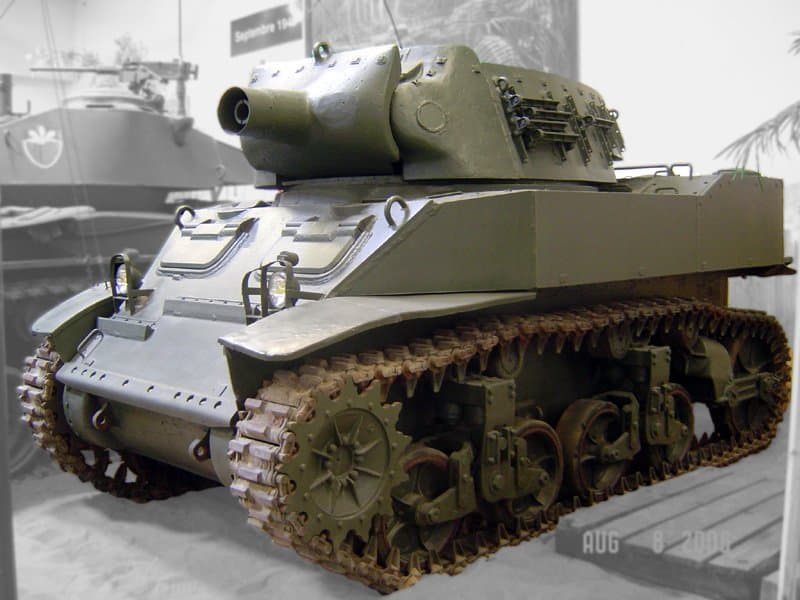
| Howitzer Motor Carriage M8 | ≈ 4.98 m | ≈ 2.32 m (Width) | ≈ 2.96 m |
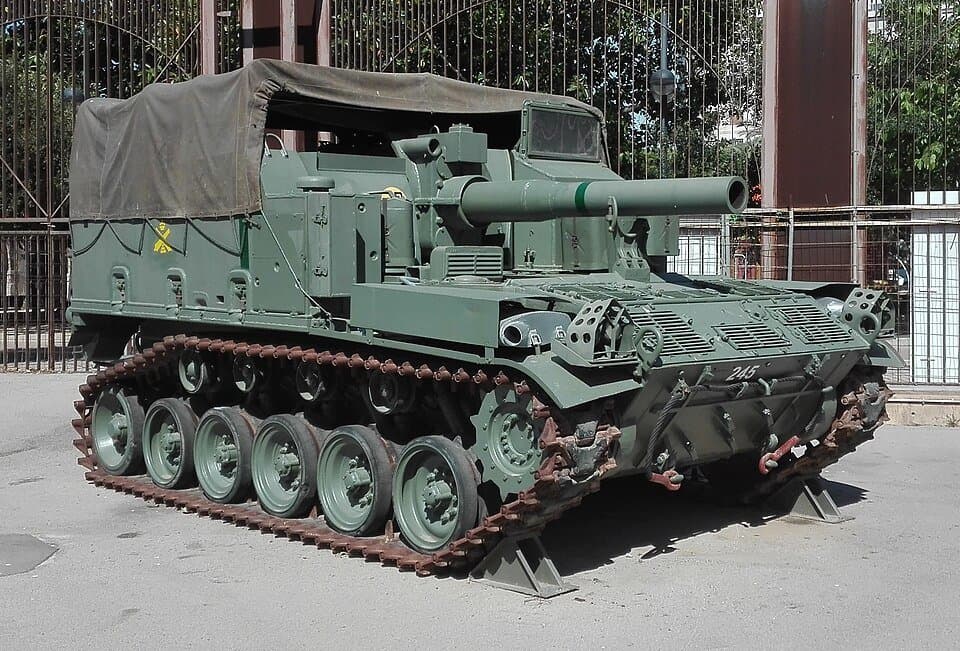
| M44 self-propelled howitzer | ≈ 6.16 m | ≈ 3.24 m (Width) | ≈ 3.32 m |
Scaled uniformly to the sourced length of 4.98 m. The width was fitted to the sourced 2.324 m. Not an official model or a measured survey.
ForceTally · All rights reserved
Scaled uniformly to the sourced length of 6.16 m. The width was fitted to the sourced 3.24 m. Not an official model or a measured survey.
ForceTally · All rights reserved
The human reference is a generic 1.75 m figure. Models describe external size, not combat performance.
Measured figures
with sand shields
Single source16 ft 4 in (4.98 m) with sand shields[source]
Configuration
| Specification | Howitzer Motor Carriage M8 | M44 self-propelled howitzer |
|---|---|---|
| Type | Self-propelled artillery[source] | Self-propelled artillery[source] |
| Place of origin | United States[source] | United States[source] |
| In service | 1942–1962[source] | — |
| Used by | See Users[source] | — |
| Wars |
Length
6.16 metres (20 ft 3 in)[source]
Operational; On road
Single source100 mi (160 km) on road[source]
L/23 caliber
Single source155 mm L/23 caliber[source]
Rapid
Single sourceSustained
Single sourceSustained: 1 rpm Rapid: 4 rpm[source]
Muzzle velocity
Single source1,850 ft/s (560 m/s)[source]
Bars compare reported quantities only. A larger figure does not make a system better; configurations and test conditions differ.
World War II First Indochina War Laotian Civil War Algerian War[source] |
Kurdish–Turkish conflict[source] |
| Designer | U.S. Army Ordnance Department[source] | — |
|---|
| Designed | 1942[source] | — |
|---|
| Manufacturer | Cadillac division of General Motors[source] | Massey Harris[source] |
|---|
| Produced | September 1942–January 1944[source] | — |
|---|
| No. built | 1,778[source] | — |
|---|
| Variants | M8, M8A1 (not produced)[source] | — |
|---|
| Armor | 0.374–1.75 in (9.5–44.5 mm)[source] | 12 millimetres (0.47 in)[source] |
|---|
| Main armament | 75 mm Howitzer M2/M3 in Mount M7 46 rounds[source] | M114 155mm howitzer[source] |
|---|
| Secondary armament | .50 caliber (12.7 mm) Browning M2HB machine gun 400 rounds[source] | M2HB .50 caliber machine gun[source] |
|---|
| Power/weight | 14.02 hp (10.45 kW)/metric ton[source] | — |
|---|
| Transmission | Twin Hydramatic , 4 speeds forward, 1 reverse[source] | — |
|---|
| Suspension | Vertical volute spring suspension (VVSS)[source] | torsion bar[source] |
|---|
| Ground clearance | 14 in (360 mm)[source] | — |
|---|
| Fuel capacity | 89 US gal (340 L)[source] | — |
|---|
| Steering system | Controlled differential, steering levers[source] | — |
|---|
| Role | self-propelled howitzer vehicle of the United States in use during World War II[source] | American-made self-propelled 155 mm howitzer[source] |
|---|
| Source measurement | The 75 mm howitzer motor carriage M8 "Scott" was a self-propelled howitzer vehicle of the United States in use during World War II . It was developed on the chassis of the M5 Stuart tank and was equipped with a M116 howitzer in an M7 mount. The vehicle is also known by the nickname General Scott , or just Scott , which was originally assigned to the vehicle by the Ordnance Department in November 1944 for publicity purposes, such as in newspapers, but does not appear to have been used by troops in the field during the war.[source]Howitzer Motor Carriage M8 · Lead; only the objects and conditions stated in this passage Experiments with a close-support version of the M3 Stuart began with the T18 howitzer motor carriage . This essentially combined an M3 light tank chassis with the gun mount of a M3 Grant medium tank mounting the much smaller 75mm pack howitzer . This produced a tall design with the gun well forward, which led to the tank being nose-heavy. They also found the fighting compartment was too cramped and the cut-down sides provided no protection to the crew for shots anywhere but the front.[source]Howitzer Motor Carriage M8 · Development and design / Prototypes; only the objects and conditions stated in this passage The T18 was cancelled in 1942 in favor of a new design, the T41. This moved to the updated M5 chassis, differing from the M3 mostly in its engine, while introducing a new fighting compartment with a well-sloped front that provided more room and much better protection. However, the new layout also moved the gun even further forward and produced wear on the front wheels that was considered unacceptable. A further revision moved the gun to one side to free up room and change the balance, which was successful enough to consider production on surplus M3 chassis. By this time a competing concept had proved superior and production was cancelled in favor of the new T47. Some further work was carried out on a T41 with the 105 mm M2A1 ; this work was later spun off as the T82 project.[source]Howitzer Motor Carriage M8 · Development and design / Prototypes; only the objects and conditions stated in this passage The T47 was also developed on the basis of the M5 chassis, but replaced the fixed fighting compartment with a new manually-turned turret mounting the same gun. This not only provided much better protection for the crew, but also offered far better tactical freedom than any fixed-mount system. The prototype was designated the 75 mm howitzer motor carriage T17E1 .[source]Howitzer Motor Carriage M8 · Development and design / Prototypes; only the objects and conditions stated in this passage After a mock-up had been produced, it was ordered into production as the 75 mm howitzer motor carriage M8 . Like the M5, the M8 had a crew of four; commander, gunner, driver, and assistant driver/loader. When the M8 was in action, the commander positioned himself at the antiaircraft machine gun and directed his crew, the gunner sat in the turret on the right side of the howitzer, the assistant driver/loader moved up from his seat in the right front hull, and the driver stayed at his position.[source]Howitzer Motor Carriage M8 · Development and design / Production; only the objects and conditions stated in this passage The M8 HMC was based upon the light tank M5 (itself a descendant of the light tank M3), and so had relatively thin armor. The lower hull armor ranged from 1 in (25 mm) to 1.125 in (28.6 mm) on the sides to 1.75 in (44 mm) on the lower front and 1.0 in (25 mm) on the lower rear. The lower hull sides were vertical, while the lower hull front was sloped at 18 degrees from the vertical, and the lower hull rear, which protected the engine and radiator, was sloped at 17 degrees from the vertical. The hull floor ranged from 0.5 in (13 mm) thick at the front to 0.375 in (9.5 mm) thick at the rear. The glacis plate of the M8 was sloped at 45 degrees from the vertical and was 1.125 in (28.6 mm) thick. The upper hull sides, like the lower hull sides, were vertical and 1.125 in (28.6 mm) thick at the front, thinning to 1 in (25 mm) thick at the rear. The upper rear hull was a vertical plate, 1 in (25 mm). The plate sloped at 50 degrees for a short distance before it met the hull roof, which was uniformly 0.5 in (13 mm) thick, and flat.[source]Howitzer Motor Carriage M8 · Development and design / Armor; only the objects and conditions stated in this passage The turret of the M8 was of cast steel. It was 1.5 in (38 mm) thick at the front, which was rounded, sloping from 0 to 63 degrees from the vertical. The sides and rear were 1 in (25 mm) thick and sloped at 20 degrees from the vertical. The cast gun shield , which covered the barrel of the 75 mm Howitzer M2/M3, was 1.5 in (38 mm) thick and rounded.[source]Howitzer Motor Carriage M8 · Development and design / Armor; only the objects and conditions stated in this passage The armament of the M8 HMC consisted of a new open-topped turret armed with a 75 mm M2 howitzer, later a 75 mm M3 howitzer. The M8 carried 46 rounds of 75 mm ammunition; 11 rounds at the right rear of the fighting compartment, 20 rounds at the left rear of the fighting compartment, 9 rounds in the left hull sponson, and 6 "ready" rounds stored between the driver and assistant driver's positions. The most common types of ammunition carried were the M89 white phosphorus shell and the M48 high explosive shell. Unlike the standard M5 light tank, the M8 featured no hull-mounted or coaxial Browning M1919A4 .30 caliber machine gun. A Browning M2HB .50 caliber machine gun with 400 rounds was mounted on the right rear corner of the turret for local defense and anti-aircraft purposes. For self-defense, the vehicle driver was provided with a Thompson submachine gun , while the other three crew members were issued M1 carbines .[source]Howitzer Motor Carriage M8 · Development and design / Armament; only the objects and conditions stated in this passage 1,778 of the 77 mm howitzer motor carriage M8 were produced by the Cadillac division of General Motors from September 1942 to January 1944.[source]Howitzer Motor Carriage M8 · Production; only the objects and conditions stated in this passage M8 HMCs were issued to Headquarters companies in medium tank battalions. Starting in early 1944 they were replaced by the 105 mm howitzer variant of the M4 Sherman tank. The 75 mm howitzer motor carriage M8 was assigned to the Assault Gun Troops of Cavalry Reconnaissance Squadrons in order to give them close support against enemy fortified positions. The high elevation (+40/−20 degrees) of the howitzer was useful for hitting enemies emplaced on the sides of hills.[source]Howitzer Motor Carriage M8 · Combat service; only the objects and conditions stated in this passage | The M44 was an American-made self-propelled 155 mm howitzer based on the M41 Walker Bulldog tank chassis, first introduced in the early 1950s. Flaws in its design prevented it from seeing action in the Korean War , but the type went on to serve in the armies of the United States, West Germany, Italy, and the United Kingdom into the late Cold War period, and even longer in Turkish service.[source]M44 self-propelled howitzer · Lead; only the objects and conditions stated in this passage After WWII the US Army sought to replace the M41 Howitzer Motor Carriage with a better SPH using the drive train of the future light tank then developed (originally T37, later T41 and finally M41 ), giving it increased battlefield mobility. Unlike the M41 and the earlier M12 Gun Motor Carriage , the T99 was to have an enclosed gun compartment, giving the five-man crew some armor protection even when firing the cannon. The 155mm cannon, designated T97, was to be a radically new design, with a muzzle brake , bore evacuator and new, separately-loaded ammunition with metal cartridge cases. T99 should also have had a revolutionary gun control system.[source]M44 self-propelled howitzer · History; only the objects and conditions stated in this passage In 1986, 222 Turkish Army M44s were extensively upgraded with 36 caliber 155mm howitzers by Rheinmetall with an increased range of 24.7 km. An MTU MB 833 Aa-501 V-6 water-cooled diesel developing 450 hp at 2,300 rpm coupled to the original Allison CD-500-3 transmission via a ZF gearbox was fitted. There were numerous other improvements such as upgraded suspension, tracks and fire control and increased fuel capacity. The driver's position was moved into the hull. The last was delivered in 1992. Some sources claim they have now been withdrawn, but two were seen in a video by the Russian news agency RT , allegedly firing into Northern Syria from a border post inside Türkiye in 2015.[source]M44 self-propelled howitzer · History / Turkish M44T; only the objects and conditions stated in this passage M44A1: M44s upgraded with AOS-895-6 engine, increasing range to 82 miles. |
|---|
| Shell | — | separate loading, bagged charge[source] |
|---|
| Breech | — | interrupted screw[source] |
|---|
| Elevation | — | −5 to 65 degrees[source] |
|---|
| Traverse | — | 30 degrees[source] |
|---|
| Reported operators |
|---|
M44T: 222 Turkish vehicles upgraded with 36 caliber 155 mm howitzers with range of 24.7 km, new engines with greatly increased range, reconfigured driver's seat, fire control and other upgrades. Upgrades conducted between 1986 and 1992.[source]M44 self-propelled howitzer · Variants; only the objects and conditions stated in this passage