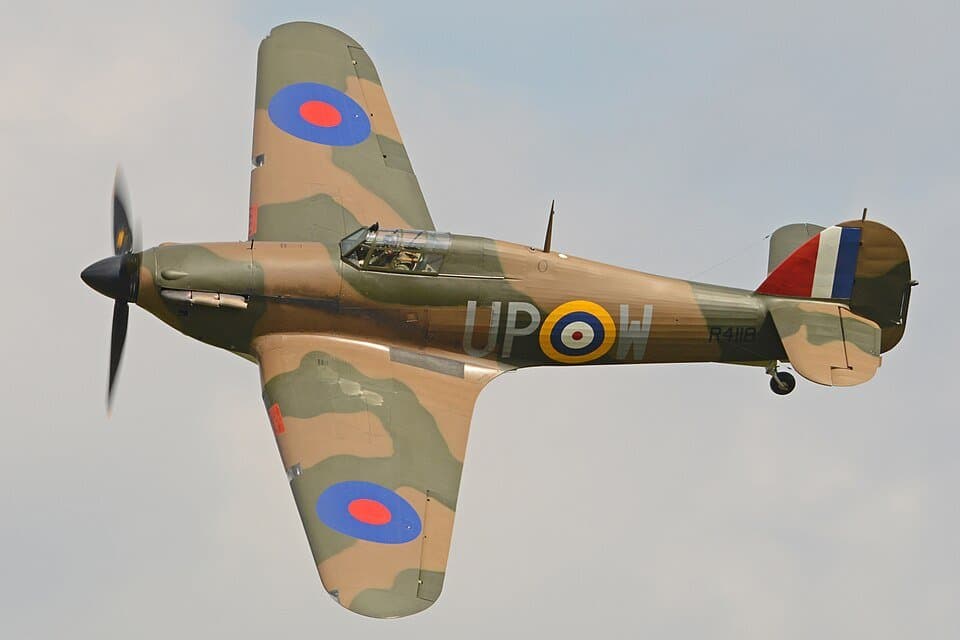

Credit
Alan Wilson from Stilton, Peterborough, Cambs, UK · CC BY-SA 2.0 · Resized · CC BY-SA 2.0 · Source ↗ · Modified


Preparing your view.
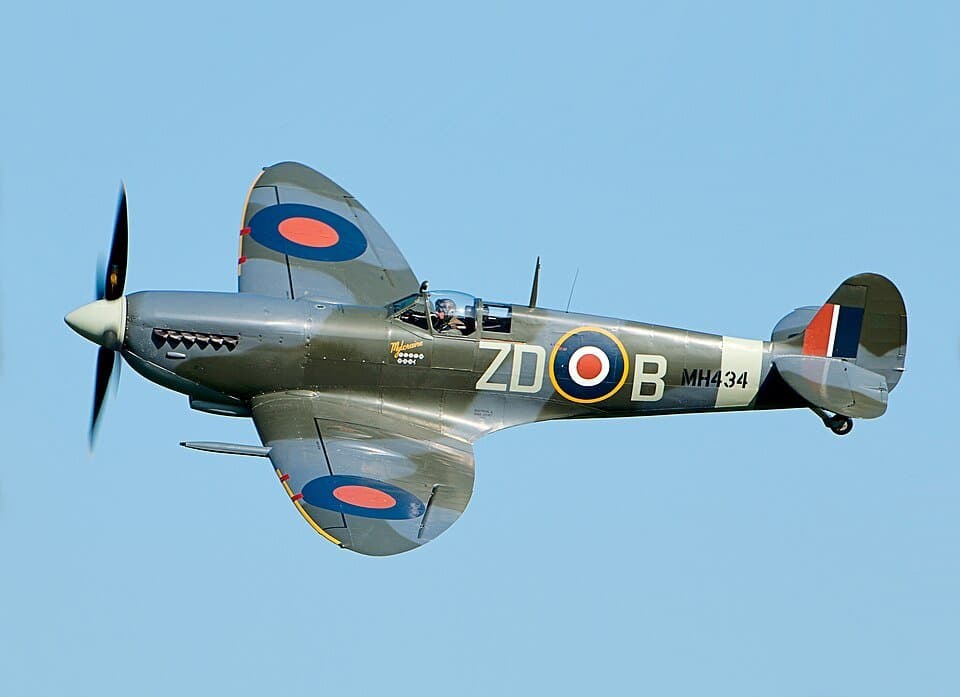
At a glance
True scale
Side by side. From every angle. A human reference for perspective.
3.10 MB · Loads when you open it| Model | Length | Width / span | Height |
|---|---|---|---|
| Hawker Hurricane | ≈ 9.83 m | ≈ 12.19 m (Wingspan) | ≈ 4.42 m |
| Supermarine Spitfire | ≈ 9.12 m | ≈ 11.23 m (Wingspan) | ≈ 3.48 m |
Scaled uniformly to the sourced length of 9.83 m. The shape was turned square to the axes; the width was fitted to the sourced 12.19 m wingspan. Not an official model or a measured survey.
ForceTally · All rights reserved
Scaled uniformly to the sourced length of 9.12 m. The shape was turned square to the axes; the height was fitted to the sourced 3.48 m; the width was fitted to the sourced 11.23 m wingspan. Not an official model or a measured survey.
ForceTally · All rights reserved
The human reference is a generic 1.75 m figure. Models describe external size, not combat performance.
Measured figures
Hurricane Mk.IIC · Length
Single source32 ft 3 in (9.83 m)[source]
Configuration
| Specification | Hawker Hurricane | Supermarine Spitfire |
|---|---|---|
| Type | Fighter aircraft[source] | Fighter / Interceptor aircraft[source] |
| National origin | United Kingdom[source] | United Kingdom[source] |
| Manufacturer | Hawker Aircraft[source] | Supermarine[source] |
| Designer | Sydney Camm[source] | R. J. Mitchell |
Spitfire Mk Vb · Length
29 ft 11 in (9.12 m)[source]
Empty; Hurricane Mk.IIC · Empty weight
Single sourceGross; Hurricane Mk.IIC · Gross weight
Single sourceMaximum take-off; Hurricane Mk.IIC · Max takeoff weight
Single source5,745 lb (2,606 kg)[source]
7,670 lb (3,479 kg)[source]
8,710 lb (3,951 kg)[source]
Empty; Spitfire Mk Vb · Empty weight
Single sourceGross; Spitfire Mk Vb · Gross weight
Single sourceSpitfire Mk Vb · Combat range
Single source248 mi (399 km, 216 nmi)[source]
Hurricane Mk.IIC · 1 × Rolls-Royce Merlin XX V-12 liquid-cooled piston engine at 21,000 ft (6,400 m)
Single source1 × Rolls-Royce Merlin XX V-12 liquid-cooled piston engine, 1,185 hp (884 kW) at 21,000 ft (6,400 m)[source]
Spitfire Mk Vb · 1 × Rolls-Royce Merlin 45 V-12 liquid-cooled piston engine
Single source1 × Rolls-Royce Merlin 45 V-12 liquid-cooled piston engine, 1,470 hp (1,100 kW)[source]
Bars compare reported quantities only. A larger figure does not make a system better; configurations and test conditions differ.
| Built by | Austin Motor Company Avions Fairey Canadian Car and Foundry Gloster Aircraft Company Rogožarski Zmaj Aircraft[source] | — |
|---|
| Primary users | Royal Air Force Royal Canadian Air Force Royal Navy Soviet Air Forces[source] | Royal Air Force Royal Canadian Air Force Free French Air Force United States Army Air Forces[source] |
|---|
| Number built | 14,487 (UK and Canada)[source] | More than 20,351[source] |
|---|
| Manufactured | 1937–1944[source] | 1938–1948[source] |
|---|
| Introduction date | December 1937[source] | 4 August 1938[source] |
|---|
| First flight | 6 November 1935[source] | 5 March 1936[source] |
|---|
| Airfoil | root: Clark YH (19%); tip: Clark YH (12.2%)[source] | root: NACA 2213 ; tip: NACA 2209.4[source] |
|---|
| Propellers | 3-bladed[source] | 3-bladed Rotol constant-speed propeller[source] |
|---|
| Wing loading | 29.8 lb/sq ft (145 kg/m 2 )[source] | 27.35 lb/sq ft (133.5 kg/m 2 )[source] |
|---|
| Power/mass | 0.15 hp/lb (0.25 kW/kg)[source] | 0.22 hp/lb (0.36 kW/kg)[source] |
|---|
| Guns | 4 × 20 mm (0.79 in) Hispano Mk II cannon[source] | A wing 8 × .303 in Browning Mk II* machine guns (350 rounds per gun) B wing 2 × 20 mm Hispano Mk II (60 rounds per gun) 4 × .303 in Browning Mk II* machine guns (350 rounds per gun) C wing 4 × 20 mm Hispano Mk II cannon (120 rounds per gun) C wing (Alt.) 2 × 20 mm Hispano Mk II (120 rounds per gun) 4 × .303 in Browning Mk II* machine guns (350 rounds per gun) E wing 2 × 20 mm Hispano Mk II cannon (120 rounds per gun) 2 × .50 in M2 Browning machine guns (250 rounds per gun)[source] |
|---|
| Bombs | 2 × 250 or 500 lb (110 or 230 kg) bombs[source] | — |
|---|
| Role | British single-seat fighter aircraft of the 1930s–40s[source] | British single-seat fighter aircraft[source] |
|---|
| Source measurement | In 1934, the British Air Ministry issued Specification F.5/34 in response to demands within the RAF for a new generation of fighter aircraft. During 1933, British aircraft designer Sydney Camm had conducted discussions with Major John Buchanan of the Directorate of Technical Development on a monoplane based on the existing Fury. Mason attributes Camm's discussions with figures within the RAF, such as Squadron Leader Ralph Sorley , as having provoked the specification and some of its details, such as the preference for armaments being installed within the wings instead of within the aircraft's nose.[source]Hawker Hurricane · Development / Background; only the objects and conditions stated in this passage An outline of the "Fury Monoplane" armed with two guns in the wings and two in the nose and powered by the Goshawk engine was prepared and discussed with Roger Liptrot of the Air Ministry in December 1933. The design was reworked with the PV.12, following detailed work working drawings of the "Interceptor Monoplane" were begun in May 1934. The complete design was presented to the Air Ministry on 4 September.[source]Hawker Hurricane · Development / Background; only the objects and conditions stated in this passage Camm's initial submission in response to the earlier fighter specification F.7/30 was a development of the Fury, the Hawker P.V.3 , However, the P.V.3 was not among the proposals which the Air Ministry selected to be built as prototype to official contract. After the rejection of the P.V.3 proposal, Camm started work on a new design involving a cantilever monoplane arrangement with a fixed undercarriage, armed with four machine guns and powered by the Rolls-Royce Goshawk engine. The original 1934 armament specifications for what evolved into the Hurricane were for a similar armament fitment to the Gloster Gladiator - four machine guns, two in the wings and two in the fuselage, synchronised to fire through the propeller arc. By January 1934, the proposal's detail drawings had been finished, but these failed to impress the Air Ministry enough for a prototype to be ordered.[source]Hawker Hurricane · Development / Background; only the objects and conditions stated in this passage "Gunner" Hill presented his calculation showing that future fighters must carry no fewer than eight machine guns, each capable of firing 1,000 rounds per minute. / Hill's assistant in making his calculations was his 13-year-old daughter Hazel Hill .[source]Hawker Hurricane · Development / Background; only the objects and conditions stated in this passage In the course of RAF trials, despite the problems with the Merlin engine, which had suffered numerous failures necessitating several changes, enthusiastic reports were produced on the aircraft and its performance. The trials had proved the aircraft to possess a maximum level speed of 315 mph (507 km/h) at an altitude of 16,200 ft (4,900 m), climb to 15,000 ft (4,600 m) in 5.7 minutes, and a stall speed of 57 mph (92 km/h) (only marginally higher than the Gladiator biplane), the last achieved using its flaps .[source]Hawker Hurricane · Development / Prototype and trials; only the objects and conditions stated in this passage In 1939, production of 100 Hurricanes was initiated in Yugoslavia by Zmaj and Rogožarski . Of these, 20 were built by Zmaj by April 1941. Recognising that the supply of British-made Merlin engines might not be guaranteed, one of the Yugoslavian Hurricanes was fitted with a Daimler-Benz DB 601 engine, instead. This aircraft was flown in 1941. In 1938, a contract for 80 Hurricanes was placed with Fairey's Belgian subsidiary Avions Fairey SA for the Belgian Air Force , and it was intended to arm these aircraft with four 13.2 mm (0.52 in) Browning machine guns . Three were built and two flown with this armament by the time of the German invasion of Belgium in May 1940, with at least 12 more constructed by Avions Fairey armed with the conventional eight rifle-calibre machine-gun armament.[source]Hawker Hurricane · Development / Production; only the objects and conditions stated in this passage An all-metal, stressed-skin wing of duraluminium (a DERD specification similar to AA2024) was introduced in April 1939 and was used for all of the later marks. "The metal-skinned wings allowed a diving speed that was 80 mph (130 km/h) higher than the fabric-covered ones. They were very different in construction but were interchangeable with the fabric-covered wings; one trials Hurricane, L1877 , was even flown with a fabric-covered port wing and metal-covered starboard wing. The great advantage of the metal-covered wings over the fabric ones was that the metal ones could carry far greater stress loads without needing as much structure." Several fabric-wing Hurricanes were still in service during the Battle of Britain, although a good number had had their wings replaced during servicing or after repair. Changing the wings required only three hours' work per aircraft.[source]Hawker Hurricane · Design; only the objects and conditions stated in this passage The prototype and early production Hurricanes were fitted with a Watts two-bladed, fixed-pitch, wooden propeller. Flight commented of this arrangement: "Many have expressed surprise that the Hurricane is not fitted with variable-pitch airscrews". The original two-bladed propeller was found to be inefficient at low airspeeds, and the aircraft required a long ground run to get airborne, which caused concern at Fighter Command. Accordingly, trials with a de Havilland variable-pitch propeller demonstrated a reduction in the Hurricane's take-off run from 1,230 to 750 ft (370 to 230 m). Deliveries of these began in April 1939; this was later replaced by the hydraulically operated, constant-speed Rotol propeller, which came into service in time for the Battle of Britain.[source]Hawker Hurricane · Design; only the objects and conditions stated in this passage Throughout the bad days of 1940, 87 Squadron had maintained a proficient formation aerobatic team, the precise flying controls and responsive engines permitting precision formation through loops, barrel rolls, 1 g semistall turns and rolls off half-loops ... My Hurricane was never hit in the Battles of France and Britain, and in over 700 hr on type I never experienced an engine failure.[source]Hawker Hurricane · Operational history / Phoney War; only the objects and conditions stated in this passage While the opening months of the war were characterised by little air activity in general, sporadic engagements and aerial skirmishes happened between the two sides. On 30 October 1939 Hurricanes saw action over France. That day, Pilot Officer P. W. O. "Boy" Mould of 1 Squadron, flying Hurricane L1842, shot down a Dornier Do 17 P from 2(F)/123. The German aircraft, sent to photograph Allied airfields close to the border, fell in flames about 10 mi (16 km) west of Toul . Mould was the first RAF pilot to down an enemy aircraft on the European continent in the Second World War. According to Mason, the experiences gained in these early engagements proved invaluable in developing tactics that became tried and tested and rapidly spread throughout Fighter Command.[source]Hawker Hurricane · Operational history / Phoney War; only the objects and conditions stated in this passage Initial engagements with the Luftwaffe showed the Hurricane to be a tight-turning and steady platform, but the Watts two-bladed propeller was clearly unsuitable. At least one pilot complained of how a Heinkel 111 was able to pull away from him in a chase, yet by this time, the Heinkel was obsolete. At the start of the war, the engine ran on standard 87 octane aviation spirit . From early 1940, increasing quantities of 100 octane fuel imported from the U.S. became available. In February 1940, Hurricanes with the Merlin II and III engines began to receive modifications to allow for an additional 6 psi (41 kPa) of supercharger boost for five minutes (although accounts were made of its use for 30 minutes continuously).[source]Hawker Hurricane · Operational history / Operation Dynamo; only the objects and conditions stated in this passage The extra supercharger boost, which increased engine output by nearly 250 hp (190 kW), gave the Hurricane an approximate increase in speed of 25 to 35 mph (40 to 56 km/h), under 15,000 ft (4,600 m) altitude and greatly increased the aircraft's climb rate. "Overboost" or "pulling the plug", a form of war emergency power as it was called in later Second World War aircraft, was an important wartime modification that allowed the Hurricane to be more competitive against the Bf 109E and to increase its margin of superiority over the Bf 110C , especially at low altitude. With the +12 psi (83 kPa) "emergency boost", the Merlin III was able to generate 1,310 hp (980 kW) at 9,000 ft (2,700 m).[source]Hawker Hurricane · Operational history / Operation Dynamo; only the objects and conditions stated in this passage Flight Lieutenant Ian Gleed of 87 Squadron wrote about the effect of using the extra boost on the Hurricane while chasing a Bf 109 at low altitude on 19 May 1940: "Damn! We're flat out as it is. Here goes with the tit. A jerk – boost's shot up to 12 pounds; speed's increased by 30 mph. I'm gaining ground – 700, 600, 500 yards. Give him a burst. No, hold your fire you fool! He hasn't seen you yet..." Gleed ran out of ammunition before he could shoot the 109 down, although he left it heavily damaged and flying at about 50 ft (15 m).[source]Hawker Hurricane · Operational history / Operation Dynamo; only the objects and conditions stated in this passage This version was capable of a maximum speed of 342 mph (550 km/h).[source]Hawker Hurricane · Operational history / Battle of Britain; only the objects and conditions stated in this passage Hurricanes served with several British Commonwealth squadrons in the Desert Air Force . They suffered heavy losses over North Africa after the arrival of Bf 109E and -F variants and were progressively replaced in the air-superiority role from June 1941 by Curtiss Tomahawks/Kittyhawks . However, fighter-bomber variants ("Hurribombers") retained an edge in the ground attack role, due to their impressive armament of four 20 mm (0.79 in) cannon and a 500 lb (230 kg) bomb load.[source]Hawker Hurricane · Operational history / North Africa; only the objects and conditions stated in this passage During and following the five-day Second Battle of El Alamein artillery barrage that commenced on the night of 23 October 1942, six squadrons of Hurricanes, including the 40 mm (1.57 in) cannon -armed Hurricane Mk.IID version, claimed to have destroyed 39 tanks, 212 lorries and armoured troop-carriers, 26 bowsers , 42 guns, 200 various other vehicles, and four small fuel and ammunition dumps, flying 842 sorties with the loss of 11 pilots. Whilst performing in a ground-support role, Hurricanes based at RAF Castel Benito , Tripoli , knocked out six tanks, 13 armoured vehicles, 10 lorries, five half-tracks , a gun and trailer, and a wireless van on 10 March 1943, with no losses to themselves.[source]Hawker Hurricane · Operational history / North Africa; only the objects and conditions stated in this passage The "Soviet" IIB Hurricane as a multirole fighter-bomber had quite a few drawbacks. First, it was 25–31 mph (40–50 km/h) slower than its main opponent, the Bf 109E interceptor, at low and medium altitudes, and had a slower rate of climb. The Messerschmitt could outdive the Hurricane because of the thicker wing profile of the British fighter, but the main source of complaints was the Hurricane's armament. On occasion, the eight- or 12-rifle-calibre machine guns did not damage the sturdy and heavily armoured German aircraft; consequently, Soviet ground crews started to remove the Brownings. Retaining only four or six of the 12 machine guns, two 12.7 mm (0.50 in) Berezin UBs or two or even four 20 mm (0.79 in) ShVAK cannons were substituted, but overall performance deteriorated as a result.[source]Hawker Hurricane · Operational history / Air defence in the Soviet Union; only the objects and conditions stated in this passage Thanks to the efforts of No. 151 Maintenance Unit RAF, the 51 Hurricanes were assembled and ready for testing within 48 hours, and of these, 21 were ready for operational service within three days. The Hurricanes, originally intended for the Middle East theatre, were fitted with bulky Vokes dust filters under the nose and were armed with 12, rather than eight, machine guns. The additional weight and drag made them slow to climb and unwieldy to manoeuvre at altitude, although they were more effective bomber killers.[source]Hawker Hurricane · Operational history / Southeast Asia; only the objects and conditions stated in this passage First production version, with fabric-covered wings, a wooden two-bladed, fixed- pitch propeller (first 435) or three blade two - pitch propeller , powered by the 1,030 hp (770 kW) Rolls-Royce Merlin Mk.II (first 364) or III engines and armed with eight .303 in (7.7 mm) Browning machine guns . Produced between 1937 and 1939.[source]Hawker Hurricane · Variants; only the objects and conditions stated in this passage Hurricane Mk.I powered by the improved Merlin XX engine with two-speed supercharger. This new engine used a coolant mix of 30% glycol and 70% water. Pure glycol is flammable, so not only was the new mix safer, but the engine also ran approximately 21 °C (38 °F) cooler, which gave longer engine life and greater reliability. The new engine was longer than the earlier Merlin and so the Hurricane gained a 4.5 in "plug" in front of the cockpit, which made the aircraft slightly more stable due to the slight forward shift in centre of gravity. First flew on 11 June 1940 and went into squadron service in September 1940. Hawker built 418 and Gloster Aircraft Company 33. The series 1 may refer to the first production batch which did not have all the proposed changes incorporated, becoming series 2 when the changes were made. 33 Mk. IIA built by Gloster, 418 by Hawker.[source]Hawker Hurricane · Variants; only the objects and conditions stated in this passage Carrying four additional wing-mounted .303 in (7.7 mm) Browning machine guns; for a total of 12 guns, 230 were factory fitted with racks allowing them to carry two 250 lb (110 kg) or two 500 lb (230 kg) bombs. This lowered the top speed of the Hurricane to 301 mph (484 km/h), but by this point mixed sweeps of Hurricanes carrying bombs, protected by a screen of fighter Hurricanes were not uncommon. The same racks allowed the Hurricane to carry two 45 imp gal (200 L) drop tanks instead of the bombs, nearly doubling the Hurricane's fuel load.[source]Hawker Hurricane · Variants; only the objects and conditions stated in this passage Replaced the machine-gun armament with four 20 mm (0.79 in) Hispano Mk.II cannons, two per wing. The new wings later included a hardpoint for a 500 or 250 lb (230 or 110 kg) bomb and, later again, fuel tanks. By then performance was inferior to the latest German fighters, and the Hurricane changed to the ground-attack role, sometimes referred to as the Hurribomber . The Mk. IIC also served as a night fighter and intruder with about three quarters converted to fighter bombers. There were 4,751 IICs built by Hawker between February 1941 and July 1944.[source]Hawker Hurricane · Variants; only the objects and conditions stated in this passage Armed with two 40 mm (1.57 in) anti-tank autocannon in a gondola-style pod , one under each wing and a single Browning machine gun in each wing loaded with tracers for aiming purposes. The first aircraft flew on 18 September 1941 and deliveries started in 1942. Had additional armour for the pilot, radiator and engine, and were armed with a Rolls-Royce gun with 12 rounds, later changed to the 40 mm (1.57 in) Vickers S gun with 15 rounds. The outer wing attachments were strengthened so that 4G could be pulled at a weight of 8,540 lb (3,870 kg). The weight of guns and armour protection marginally impaired the aircraft's performance. These Hurricanes were nicknamed "Flying Can Openers", perhaps a play on the logo of No. 6 Squadron, which flew the Hurricane starting in 1942. A total of 296 built by Hawker from January 1942 to February 1943.[source]Hawker Hurricane · Variants; only the objects and conditions stated in this passage The last major change to the Hurricane was the introduction of the "universal wing", a single design able to mount two 250 or 500 lb (110 or 230 kg) bombs, or two 40 mm (1.57 in) Vickers S guns, or two 40 mm (1.57 in) Rolls-Royce B.H. type guns, two SBC (small bomb containers) or SCI (smoke curtain installation), or two 45 or 90 gallon drop tanks or eight "60 pounder" RP-3 rockets. Two .303 in (7.7 mm) Brownings were fitted to aid aiming of the heavier armament. Despite persistent reports, Mk.IVs were actually fitted with the same Merlin XX as the Mk.II. All Merlin 27s were modified to Merlin 25 and used in Mosquitoes, there were only 16 production Merlin 24s by the time over 300 Mk.IV had been delivered. The individual aircraft cards held by the RAF museum reports the final Mk.IV had a Merlin XX. The radiator was deeper and armoured. Additional armour was also fitted around the engine. 524 built by Hawker between December 1942 and March 1944.[source]Hawker Hurricane · Variants; only the objects and conditions stated in this passage The final variant to be produced. Only one was purpose built and two Mk.IV converted, though the variant never reached full-scale production. This was planned to be powered by a Merlin 27 but also tested with a Merlin 32 boosted engine to give 1,700 hp (1,300 kW) at low level and was intended as a dedicated ground-attack aircraft to use in Burma . All three prototypes had four-bladed propellers. The Mk. V replaced the twin 7.7mm machine guns on the Mk. IV with two 20mm cannons, only completed on the third prototype. Speed was 326 mph (525 km/h) at 500 ft (150 m)[source]Hawker Hurricane · Variants; only the objects and conditions stated in this passage Canadian-built variant. On 19 August 1941, the Canadian government placed an order with Canadian Car and Foundry for 400 Hurricanes, with 100 meant for the Netherlands and 300 for China, the Netherlands order was amended to 72, the Chinese decided to buy American, which resulted in 328 being offered to the USSR, to be shipped across the Pacific. Amended to all 400 for the RCAF. Originally designated the Mk.IIB (Can), designation changed to Mk.XII in April 1943. Single-seat fighter and fighter-bomber, powered by a 1,300 hp (970 kW) Packard Merlin 29, armed with twelve 0.303 in (7.7 mm) machine guns, production starting in June 1942, 250 served with the RCAF and 150 were sent to Britain in 1943 either without an engine or fitted with a Merlin 28 which was replaced by a Merlin XX on arrival and they became Mk.IIs[source]Hawker Hurricane · Variants; only the objects and conditions stated in this passage Canadian-built variant. The survivors of a batch of 30 RAF order Mk.I airframes retained in Canada in late 1941 that were fitted with Merlin III and propellers from Fairey Battles, became Mk. XIIA when fitted with Merlin 29. Armed with eight 0.303 in (7.7 mm) machine guns[source]Hawker Hurricane · Variants; only the objects and conditions stated in this passage The Sea Hurricane I used during Operation Pedestal had their Merlin III engines modified to accept 16 psi (110 kPa) boost, and could generate more than 1,400 hp (1,000 kW) at low altitude. Lt. R. J. Cork was credited with five kills while flying a Sea Hurricane I during Operation Pedestal .[source]Hawker Hurricane · Variants; only the objects and conditions stated in this passage 60 built by Hawker between November 1942 and May 1943, version equipped with naval radio gear; other standard Mk.IICs were converted and used on fleet carriers. The Merlin XX engine on the Sea Hurricane generated 1,460 hp (1,090 kW) at 6,250 ft (1,900 m) and 1,435 hp (1,070 kW) at 11,000 ft (3,400 m). Top speed was 322 mph (518 km/h) at 13,500 ft (4,100 m) and 342 mph (550 km/h) at 22,000 ft (6,700 m). Another 47 mark IIB converted to Sea mark II, with 45 of them given C wings as part of the conversion.[source]Hawker Hurricane · Variants; only the objects and conditions stated in this passage The Service Depot at Heliopolis in Egypt converted several Hurricanes Is for photo reconnaissance. The first three were converted in January 1941. Two carried a pair of F24 cameras with 8-inch focal length lenses. The third carried one vertical and two oblique F24s with 14-inch focal length lenses mounted in the rear fuselage, close to the trailing edge of the wing, and a fairing was built up over the lenses aft of the radiator housing. A further five Hurricanes were modified in March 1941, and two were converted in a similar manner in Malta during April 1941. During October 1941 a batch of six Hurricane Mk.IIs were converted to PR Mk.II status and a final batch, thought to be of 12 aircraft, was converted in late 1941. The PR Mk.II was said to be capable of slightly over 350 mph (560 km/h) and was able to reach 38,000 ft (12,000 m).[source]Hawker Hurricane · Variants; only the objects and conditions stated in this passage Length: 32 ft 3 in (9.83 m)[source]Hawker Hurricane · Specifications (Hurricane Mk.IIC); only the objects and conditions stated in this passage Wingspan: 40 ft 0 in (12.19 m)[source]Hawker Hurricane · Specifications (Hurricane Mk.IIC); only the objects and conditions stated in this passage Height: 13 ft 1.5 in (4.001 m)[source]Hawker Hurricane · Specifications (Hurricane Mk.IIC); only the objects and conditions stated in this passage Wing area: 257.5 sq ft (23.92 m 2 )[source]Hawker Hurricane · Specifications (Hurricane Mk.IIC); only the objects and conditions stated in this passage Empty weight: 5,745 lb (2,606 kg)[source]Hawker Hurricane · Specifications (Hurricane Mk.IIC); only the objects and conditions stated in this passage Gross weight: 7,670 lb (3,479 kg)[source]Hawker Hurricane · Specifications (Hurricane Mk.IIC); only the objects and conditions stated in this passage Max takeoff weight: 8,710 lb (3,951 kg)[source]Hawker Hurricane · Specifications (Hurricane Mk.IIC); only the objects and conditions stated in this passage Powerplant: 1 × Rolls-Royce Merlin XX V-12 liquid-cooled piston engine, 1,185 hp (884 kW) at 21,000 ft (6,400 m)[source]Hawker Hurricane · Specifications (Hurricane Mk.IIC); only the objects and conditions stated in this passage Maximum speed: 340 mph (550 km/h, 300 kn) at 21,000 ft (6,400 m)[source]Hawker Hurricane · Specifications (Hurricane Mk.IIC); only the objects and conditions stated in this passage Range: 600 mi (970 km, 520 nmi)[source]Hawker Hurricane · Specifications (Hurricane Mk.IIC); only the objects and conditions stated in this passage Service ceiling: 36,000 ft (11,000 m)[source]Hawker Hurricane · Specifications (Hurricane Mk.IIC); only the objects and conditions stated in this passage Rate of climb: 2,780 ft/min (14.1 m/s)[source]Hawker Hurricane · Specifications (Hurricane Mk.IIC); only the objects and conditions stated in this passage Guns: 4 × 20 mm (0.79 in) Hispano Mk II cannon[source]Hawker Hurricane · Specifications (Hurricane Mk.IIC); only the objects and conditions stated in this passage Bombs: 2 × 250 or 500 lb (110 or 230 kg) bombs[source]Hawker Hurricane · Specifications (Hurricane Mk.IIC); only the objects and conditions stated in this passage In May 1940 a Messerschmitt Bf 109E3 captured by French forces was tested against a Hurricane, both flown by British pilots. The pilots reported that the Messerschmitt was faster than the Hurricane, and could out-climb and out-dive it, but could not turn as well. In climbing and diving turns at high speed, although the Bf 109 was placed line astern to start with, it could not keep the Hurricane in its gunsights and the latter was able to get onto its tail in only four turns. However, these trials were restricted to below 15,000 feet owing to lack of oxygen equipment.[source]Hawker Hurricane · Turn performance / Turning radius of Hurricane and other Battle of Britain fighters; only the objects and conditions stated in this passage Much has been written of the relative manouevrability of the four principal Battle of Britain fighters. Published here for the first time are comparative turning radii attainable, resolved to a combat altitude of 10,000 feet—the most common area of combat chosen by the Hurricane pilots in 1940 ... if and when the choice was theirs. True airspeed, 300 m.p.h.[source]Hawker Hurricane · Turn performance / Turning radius of Hurricane and other Battle of Britain fighters; only the objects and conditions stated in this passage C L 1 ⁄ 2 ρ v 2 Wing loading at half-fuel weight "Available g" Turning Radius Hurricane I 1.0 170 22 lb./sq. ft. 7.5 800 feet Spitfire I 1.0 170 24 lb./sq. ft. 7.0 880 feet Bf 109E 1.0 170 25 lb./sq. ft. 8.1 750 feet Bf 110C 1.0 170 32 lb./sq. ft. 5.2 1,210 feet[source]Hawker Hurricane · Turn performance / Turning radius of Hurricane and other Battle of Britain fighters; only the objects and conditions stated in this passage According to them, to arrive at those values Mason had assumed the aircraft were flown at 300 m.p.h. while in a sustained angle of bank so steep - about 80° - that the g forces would have been "beyond the limits of any pilot at that time and most probably beyond the structural limits of the aircraft". Further, none of the aircraft engines could have delivered the required thrust, since far more power is required to overcome aircraft drag in a very steep turn.[source]Hawker Hurricane · Turn performance / Turning radius of Hurricane and other Battle of Britain fighters; only the objects and conditions stated in this passage Recalculating for thrusts actually achievable with those engines, and assuming the aircraft were flown at maximum power as near to the stall as possible, again at 10,000 feet, Ackroyd and Lamont arrived at the following among other parameter values:[source]Hawker Hurricane · Turn performance / Turning radius of Hurricane and other Battle of Britain fighters; only the objects and conditions stated in this passage | Smith oversaw the Spitfire's development through many variants , from the Mk 1 to the Rolls-Royce Griffon-engined Mk 24, using several wing configurations and guns. The original airframe was designed to be powered by a Rolls-Royce Merlin engine producing 1,030 hp (768 kW). It was strong enough and adaptable enough to use increasingly powerful Merlins, and in later marks, Rolls-Royce Griffon engines producing up to 2,340 hp (1,745 kW). As a result, the Spitfire's performance and capabilities improved over the course of its service life.[source]Supermarine Spitfire · Lead; only the objects and conditions stated in this passage In 1931, the Air Ministry released specification F7/30 , calling for a modern fighter capable of a flying speed of 250 mph (400 km/h) to replace the Gloster Gauntlet biplane. R. J. Mitchell designed the Supermarine Type 224 to fill this role in competition with the Blackburn F.3 and Westland F.7/30 and privately funded designs from Gloster. The 224 was an open-cockpit monoplane with bulky gull wings and a large, fixed, spatted undercarriage powered by the 600-horsepower (450 kW), evaporatively cooled Rolls-Royce Goshawk engine. It made its first flight in February 1934. Of the seven designs tendered to F7/30, the Gloster Gladiator biplane was accepted for service.[source]Supermarine Spitfire · Development and production / Origins; only the objects and conditions stated in this passage The Type 224 was a big disappointment to Mitchell and his design team, who immediately embarked on a series of "cleaned-up" designs, using their experience with the Schneider Trophy seaplanes as a starting point. This led to the Type 300, with retractable undercarriage and a wingspan reduced by 6 ft (1.8 m). This design was submitted to the Air Ministry in July 1934, but was not accepted. It then went through a series of changes, including the incorporation of an enclosed cockpit, oxygen-breathing apparatus, smaller and thinner wings, and the newly developed, more powerful Rolls-Royce PV XII V-12 engine, which was later named the "Merlin". In November 1934, Mitchell, with the backing of Supermarine's owner Vickers-Armstrong , started detailed design work on this refined version of the Type 300.[source] |
|---|
| Country of origin | United Kingdom[source]Inventory Origin column; table 3, row 5, cell 2; revision 1376452447 | — |
|---|
| Variants | — | Supermarine Spitfire (Griffon-powered variants) Supermarine Spitfire (early Merlin-powered variants) Supermarine Spitfire (late Merlin-powered variants) Supermarine Seafire[source] |
|---|
| Developed into | — | Supermarine Spiteful[source] |
|---|
| Rockets | — | 2 RP-3 rockets (1 under each wing)[source] |
|---|
| Reported operators |
|
|---|
Maximum take-off; Spitfire Mk Vb · Max takeoff weight
Single sourceOn 1 December 1934, the Air Ministry issued contract AM 361140/34, providing £10,000 for the construction of Mitchell's improved Type 300 design. In April 1935 Ralph Sorley spoke to Mitchell about the new specification F10/35 which called for armament of at least six and preferably eight guns while at the same time removing bomb carry requirement and reducing fuel capacity. Mitchell foresaw no problem adding the guns and welcomed the reduction which would reduce weight. A specification for an eight-gun fighter, F5/34 had come from a recommendation by Squadron Leader Ralph Sorley of the Operational Requirements section at the Air Ministry. In the redesign the change was made from Vickers machine guns to .303 in (7.7 mm) Brownings ), and the fuel tankage dropped to 75 gallons from 94.[source]Supermarine Spitfire · Development and production / Origins; only the objects and conditions stated in this passage
On 5 March 1936, the prototype ( K5054 ) , fitted with a fine-pitch propeller to give more power for take-off, took off on its first flight from Eastleigh Aerodrome . At the controls was Captain Joseph "Mutt" Summers , chief test pilot for Vickers, who is quoted as having said, "don't touch anything" on landing. This eight-minute flight came four months after the maiden flight of the contemporary Hurricane.[source]Supermarine Spitfire · Development and production / Origins; only the objects and conditions stated in this passage
The rudder was oversensitive, and the top speed was just 330 mph (528 km/h), little faster than Sydney Camm 's new Merlin-powered Hurricane.[source]Supermarine Spitfire · Development and production / Origins; only the objects and conditions stated in this passage
A new and better-shaped, two-bladed, wooden propeller allowed the Spitfire to reach 348 mph (557 km/h) in level flight in mid-May, when Summers flew K5054 to RAF Martlesham Heath and handed the aircraft over to Squadron Leader Anderson of the Aeroplane & Armament Experimental Establishment (A&AEE).[source]Supermarine Spitfire · Development and production / Origins; only the objects and conditions stated in this passage
In spite of promises that the factory would be producing 60 per week starting in April, by May 1940, Castle Bromwich had not yet built its first Spitfire. On 17 May, Minister of Aircraft Production Lord Beaverbrook telephoned Lord Nuffield and manoeuvred him into handing over control of the Castle Bromwich plant to his ministry. Beaverbrook immediately sent in experienced management staff and workers from Supermarine, and gave control of the factory to Vickers-Armstrong's. Although resolving the problems took time, in June 1940, 10 Mk IIs were built; 23 rolled out in July, 37 in August, and 56 in September. By the time production ended at Castle Bromwich in June 1945, a total of 12,129 Spitfires, comprising 921 Mk IIs, 4,489 Mk Vs, 5,665 Mk IXs, and 1,054 Mk XVIs had been built.[source]Supermarine Spitfire · Development and production / Manufacturing at Castle Bromwich, Birmingham; only the objects and conditions stated in this passage
During the Battle of Britain, the Luftwaffe made concerted efforts to destroy the main manufacturing plants at Woolston and Itchen , near Southampton. The first bombing raid, which missed the factories, came on 23 August 1940. Over the next month, other raids were mounted, until, on 26 September 1940, both factories were destroyed, with 92 people killed and a large number injured. Most of the casualties were experienced aircraft-production workers.[source]Supermarine Spitfire · Development and production / Production dispersal; only the objects and conditions stated in this passage
Henshaw wrote that he would climb at full throttle at 2,850 rpm to the rated altitude, then dive at full power and 3,000 rpm, and trim the plane to fly by itself at 460 mph (740 km/h).[source]Supermarine Spitfire · Development and production / Flight testing; only the objects and conditions stated in this passage
A production test usually consisted of an initial circuit of under 10 minutes, and a main flight of 20 to 30 minutes.[source]Supermarine Spitfire · Development and production / Flight testing; only the objects and conditions stated in this passage
The wing section used was from the NACA 2200 series , which had been adapted to create a thickness-to-chord ratio of 13% at the root, reducing to 9.4% at the tip. A dihedral of 6° was adopted to give increased lateral stability.[source]Supermarine Spitfire · Design / Elliptical wing design; only the objects and conditions stated in this passage
The trailing edge of the wing twisted slightly upward along its span, the angle of incidence decreasing from +2° at its root to -½° at its tip.[source]Supermarine Spitfire · Design / Elliptical wing design; only the objects and conditions stated in this passage
The Spitfire had detachable wing tips which were secured by two mounting points at the end of each main wing assembly. When the Spitfire took on a role as a high-altitude fighter (Marks VI and VII and some early Mk VIIIs), the standard wing tips were replaced by extended, "pointed" tips which increased the wingspan from 36 ft 10 in (11.23 m) to 40 ft 2 in (12.24 m). The other wing-tip variation, used by several Spitfire variants, was the "clipped" wing; the standard wing tips were replaced by wooden fairings which reduced the span by 3 ft 6 in (1.07 m). The wing tips used spruce formers for most of the internal structure with a light alloy skin attached using brass screws.[source]Supermarine Spitfire · Design / Elliptical wing design; only the objects and conditions stated in this passage
The light alloy split flaps at the trailing edge of the wing were also pneumatically operated via a finger lever on the instrument panel. Only two positions were available; fully up or fully down (85°). Flaps were normally lowered only during the final approach and for landing, and the pilot was to retract them before taxiing.[source]Supermarine Spitfire · Design / Elliptical wing design; only the objects and conditions stated in this passage
As the Spitfire gained more power and was able to manoeuvre at higher speeds, the possibility that pilots would encounter aileron reversal increased, and the Supermarine design team set about redesigning the wings to counter this. The original wing design had a theoretical aileron reversal speed of 580 mph (500 kn; 930 km/h), which was somewhat lower than that of some contemporary fighters. The Royal Aircraft Establishment noted that, at 400 mph (350 kn; 640 km/h) indicated airspeed , roughly 65% of aileron effectiveness was lost due to wing twist.[source]Supermarine Spitfire · Design / Improved late wing designs; only the objects and conditions stated in this passage
The new wing of the Spitfire F Mk 21 and its successors was designed to help alleviate this problem. Its stiffness was increased by 47%, and a new aileron design using piano hinges and geared trim tabs meant the theoretical aileron reversal speed was increased to 825 mph (717 kn; 1,328 km/h). Alongside the redesigned wing, Supermarine also experimented with the original wing, raising the leading edge by 1 inch (25 mm), with the hope of improving pilot view and reducing drag. This wing was tested on a modified F Mk 21, also called the F Mk 23, (sometimes referred to as "Valiant" rather than "Spitfire"). The increase in performance was minimal and this experiment was abandoned.[source]Supermarine Spitfire · Design / Improved late wing designs; only the objects and conditions stated in this passage
Supermarine developed a new laminar-flow wing based on new aerofoil profiles developed by the National Advisory Committee for Aeronautics in the United States, with the objective of reducing drag and improving performance. These laminar-flow airfoils were the Supermarine 371-I used at the root and the 371-II used at the tip. Supermarine estimated that the new wing could give an increase in speed of 55 mph (48 kn; 89 km/h) over the Spitfire Mk 21. The new wing was initially fitted to a Spitfire Mk XIV. Later, a new fuselage was designed, with the new fighter becoming the Supermarine Spiteful .[source]Supermarine Spitfire · Design / Improved late wing designs; only the objects and conditions stated in this passage
Even if the eight Brownings worked perfectly, pilots soon discovered that they were not sufficient to destroy larger aircraft. Combat reports showed that an average of 4,500 rounds were needed to shoot down an enemy aircraft. The main cause of this was the way the guns were mounted in the wing, allowing a dispersion of 1.1 metres at only 100 metres range. Perfectly aimed fire just missed the target because of this. In November 1938, tests against armoured and unarmoured targets had already indicated that the introduction of a weapon with a calibre of at least 20 mm was urgently needed. A variant on the Spitfire design with four 20 mm Oerlikon cannon had been tendered to specification F37/35, but the order for prototypes had gone to the Westland Whirlwind in January 1939.[source]Supermarine Spitfire · Design / Armament; only the objects and conditions stated in this passage
In June 1939, a Spitfire was fitted with a drum-fed Hispano in each wing, an installation that required large blisters on the wing to cover the 60-round drum, reducing speed by 8 mph (7.0 kn; 13 km/h). The cannon suffered frequent stoppages, mostly because the guns were mounted on their sides to fit as much of the magazine as possible within the wing. In January 1940, P/O George Proudman flew this prototype in combat, but the starboard gun stopped after firing a single round, while the port gun fired 30 rounds before seizing.[source]Supermarine Spitfire · Design / Armament; only the objects and conditions stated in this passage
In the Mediterranean, the Spitfire blunted the heavy attacks on Malta by the Regia Aeronautica and Luftwaffe, and from early 1943, helped pave the way for the Allied invasions of Sicily and Italy. On 7 March 1942, 15 Mk Vs carrying 90 imp gal (410 L; 110 US gal) fuel tanks under their bellies took off from HMS Eagle off the coast of Algeria on a 600-mile (970 km) flight to Malta. Those Spitfire Vs were the first to see service outside Britain. The Spitfire served on the Eastern Front with the Soviet Air Force (VVS) . The first deliveries of the Spitfire Mk VB variant took place at the start of 1943, with the first batch of 35 aircraft delivered via sea to the city of Basra , Iraq. A total of 143 aircraft and 50 furnished hulls (to be used for spare parts) followed by March of the same year. Though some aircraft were used for front line duty in 1943, most of them saw service with the Protivo-Vozdushnaya Oborona (English: "Anti-air Defence Branch").[source]Supermarine Spitfire · Operational history / Service operations; only the objects and conditions stated in this passage
Tobin, reached 606 mph (527 kn; 975 km/h) (Mach 0.891) in a 45° dive.[source]Supermarine Spitfire · Operational history / Speed and altitude records; only the objects and conditions stated in this passage
Martindale blacked out under the 11 g loading, but when he resumed consciousness, he found the aircraft at about 40,000 feet with its (originally straight) wings now slightly swept back.[source]Supermarine Spitfire · Operational history / Speed and altitude records; only the objects and conditions stated in this passage
Martindale successfully glided the Spitfire 20 mi (32 km) back to the airfield and landed safely.[source]Supermarine Spitfire · Operational history / Speed and altitude records; only the objects and conditions stated in this passage
RAE Bedford (RAE) modified a Spitfire for high-speed testing of the stabilator (then known as the "flying tail") of the Miles M.52 supersonic research aircraft. RAE test pilot Eric Brown stated that he tested this successfully during October and November 1944, attaining Mach 0.86 in a dive.[source]Supermarine Spitfire · Operational history / Speed and altitude records; only the objects and conditions stated in this passage
On 5 February 1952, a Spitfire 19 of 81 Squadron based at Kai Tak in Hong Kong reached probably the highest altitude ever achieved by a Spitfire. The pilot, Flight Lieutenant Edward "Ted" Powles , was on a routine flight to survey outside air temperature and report on other meteorological conditions at various altitudes in preparation for a proposed new air service through the area. He climbed to 50,000 ft (15,000 m) indicated altitude, with a true altitude of 51,550 ft (15,710 m). The cabin pressure fell below a safe level, and in trying to reduce altitude, he entered an uncontrollable dive which shook the aircraft violently. He eventually regained control somewhere below 3,000 ft (900 m) and landed safely with no discernible damage to his aircraft. Evaluation of the recorded flight data suggested he achieved a speed of 690 mph (600 kn; 1,110 km/h), (Mach 0.96) in the dive, which would have been the highest speed ever reached by a propeller-driven aircraft if the instruments had been considered more reliable.[source]Supermarine Spitfire · Operational history / Speed and altitude records; only the objects and conditions stated in this passage
Different wings, featuring a variety of weapons, were fitted to most marks; the A wing used eight .303 in (7.7 mm) machine guns, the B wing had four .303 in (7.7 mm) machine guns and two 20 mm (.79 in) Hispano cannons , and the C, or universal, wing could mount either four 20 mm (.79 in) cannons or two 20 mm (.79 in) and four .303 in (7.7 mm) machine guns.[source]Supermarine Spitfire · Variants / Overview; only the objects and conditions stated in this passage
Another armament variation was the E wing which housed two 20 mm (.79 in) cannons and two .50 in (12.7 mm) Browning machine guns .[source]Supermarine Spitfire · Variants / Overview; only the objects and conditions stated in this passage
The first Rolls-Royce Griffon-engined Mk XII flew in August 1942, and first flew operationally with 41 Squadron in April 1943. This mark could nudge 400 mph (350 kn; 640 km/h) in level flight and climb to an altitude of 33,000 ft (10,000 m) in under nine minutes.[source]Supermarine Spitfire · Variants / Griffon-engined variants; only the objects and conditions stated in this passage
In late 1962, Air Marshal Sir John Nicholls instigated a trial when he flew Spitfire PM631 , a PR Mk 19 in the custody of the Battle of Britain Memorial Flight , against an English Electric Lightning F 3 (a supersonic jet-engined interceptor) in mock combat at RAF Binbrook .[source]Supermarine Spitfire · Variants / Griffon-engined variants; only the objects and conditions stated in this passage
At the end of the trials, RAF pilots found that Firestreak infra-red guided missiles had trouble acquiring the Spitfire due to a low exhaust temperature, and decided that the twin ADEN 30 mm (1.2 in) cannons were the only weapons suited to the task, which was complicated by the tight turning circle of the Spitfire, and the Lightning's proclivity for over-running the Spitfire.[source]Supermarine Spitfire · Variants / Griffon-engined variants; only the objects and conditions stated in this passage
Length: 29 ft 11 in (9.12 m)[source]Supermarine Spitfire · Specifications (Spitfire Mk Vb); only the objects and conditions stated in this passage
Wingspan: 36 ft 10 in (11.23 m)[source]Supermarine Spitfire · Specifications (Spitfire Mk Vb); only the objects and conditions stated in this passage
Height: 11 ft 5 in (3.48 m)[source]Supermarine Spitfire · Specifications (Spitfire Mk Vb); only the objects and conditions stated in this passage
Wing area: 242.1 sq ft (22.49 m 2 )[source]Supermarine Spitfire · Specifications (Spitfire Mk Vb); only the objects and conditions stated in this passage
Empty weight: 5,065 lb (2,297 kg)[source]Supermarine Spitfire · Specifications (Spitfire Mk Vb); only the objects and conditions stated in this passage
Gross weight: 6,622 lb (3,004 kg)[source]Supermarine Spitfire · Specifications (Spitfire Mk Vb); only the objects and conditions stated in this passage
Max takeoff weight: 6,700 lb (3,039 kg)[source]Supermarine Spitfire · Specifications (Spitfire Mk Vb); only the objects and conditions stated in this passage
Powerplant: 1 × Rolls-Royce Merlin 45 V-12 liquid-cooled piston engine, 1,470 hp (1,100 kW)[source]Supermarine Spitfire · Specifications (Spitfire Mk Vb); only the objects and conditions stated in this passage
Maximum speed: 370 mph (600 km/h, 320 kn)[source]Supermarine Spitfire · Specifications (Spitfire Mk Vb); only the objects and conditions stated in this passage
Range: 479 mi (771 km, 416 nmi)[source]Supermarine Spitfire · Specifications (Spitfire Mk Vb); only the objects and conditions stated in this passage
Combat range: 248 mi (399 km, 216 nmi)[source]Supermarine Spitfire · Specifications (Spitfire Mk Vb); only the objects and conditions stated in this passage
Ferry range: 1,100 mi (1,800 km, 960 nmi) with fuel tank[source]Supermarine Spitfire · Specifications (Spitfire Mk Vb); only the objects and conditions stated in this passage
Service ceiling: 36,500 ft (11,100 m)[source]Supermarine Spitfire · Specifications (Spitfire Mk Vb); only the objects and conditions stated in this passage
Rate of climb: 2,600 ft/min (13 m/s)[source]Supermarine Spitfire · Specifications (Spitfire Mk Vb); only the objects and conditions stated in this passage
Guns: A wing 8 × .303 in Browning Mk II* machine guns (350 rounds per gun) B wing 2 × 20 mm Hispano Mk II (60 rounds per gun) 4 × .303 in Browning Mk II* machine guns (350 rounds per gun) C wing 4 × 20 mm Hispano Mk II cannon (120 rounds per gun) C wing (Alt.) 2 × 20 mm Hispano Mk II (120 rounds per gun) 4 × .303 in Browning Mk II* machine guns (350 rounds per gun) E wing 2 × 20 mm Hispano Mk II cannon (120 rounds per gun) 2 × .50 in M2 Browning machine guns (250 rounds per gun)[source]Supermarine Spitfire · Specifications (Spitfire Mk Vb); only the objects and conditions stated in this passage