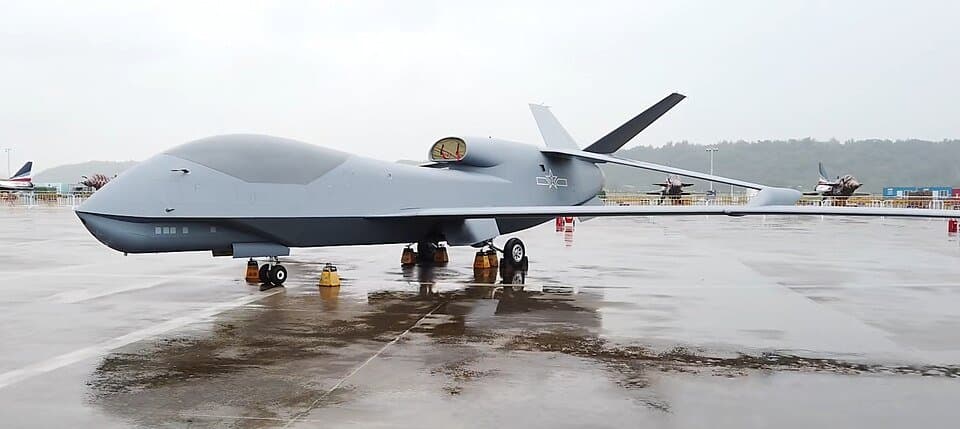

Credit
Infinty 0 · CC BY-SA 4.0 · Resized · CC BY-SA 4.0 · Source ↗ · Modified


Preparing your view.

BDrones & UAVs
Maritime unmanned surveillance and reconnaissance aerial vehicle and patrol aircraft
At a glance
Measured figures
Soaring Dragon prototype · Length
Single source14.33 m (47 ft 0 in)[source]
Configuration
| Specification | Guizhou WZ-7 Soaring Dragon | Northrop Grumman MQ-4C Triton |
|---|---|---|
| Crew | None[source] | Unmanned – 4 personnel fly aircraft from ground station[source] |
| Type | Unmanned maritime surveillance and patrol aircraft[source] | Maritime unmanned surveillance and reconnaissance aerial vehicle and patrol aircraft[source] |
| National origin | People's Republic of China[source] | United States[source] |
| Manufacturer | Guizhou Aircraft Industry Corporation |
Length
MQ-4C · Length
Single sourceMaximum take-off; Max takeoff weight
Single source7,500 kg[source]
Empty; MQ-4C · Empty weight
Single sourceGross; MQ-4C · Gross weight
Single sourceMaximum take-off; Max design gross take-off · Max design gross take-off
Single source14,945 lb (6,781 kg)[source]
32,250 lb (14,630 kg)[source]
Max design gross take-off: 32,250 pounds (14,628.4 kilograms)[source]Max design gross take-off
Soaring Dragon prototype · Combat range
Single source2,000 km (1,200 mi, 1,100 nmi)[source]
Soaring Dragon prototype · 1 × Guizhou WP-13 turbojet or unknown type of turbofan thrust
Single source1 × Guizhou WP-13 turbojet or unknown type of turbofan, 43.1 kN (9,700 lbf) thrust[source]
MQ-4C · 1 × Rolls-Royce AE 3007 turbofan engine thrust
Single source1 × Rolls-Royce AE 3007 turbofan engine, 6,495–8,917 lbf (28.89–39.66 kN) thrust[source]
Bars compare reported quantities only. A larger figure does not make a system better; configurations and test conditions differ.
Northrop Grumman[source] |
| Designer | Chengdu Aircraft Industry Group[source] | — |
|---|
| Status | In production[source] | Limited service[source] |
|---|
| Primary users | People's Liberation Army Air Force People's Liberation Army Navy[source] | United States Navy Royal Australian Air Force[source] |
|---|
| Number built | 20[source] | US: 68 (planned) + 2 prototypes Australia: 3 delivered out of 4 ordered[source] |
|---|
| Manufactured | 2015/2016 - ?[source] | 48 as of 2024[source] |
|---|
| Introduction date | 2018[source] | May 2018[source] |
|---|
| Thrust/weight | 5.8[source] | — |
|---|
| Role | high-altitude long endurance unmanned aerial vehicle (UAV)[source] | American high-altitude long endurance unmanned aerial vehicle (UAV)[source] |
|---|
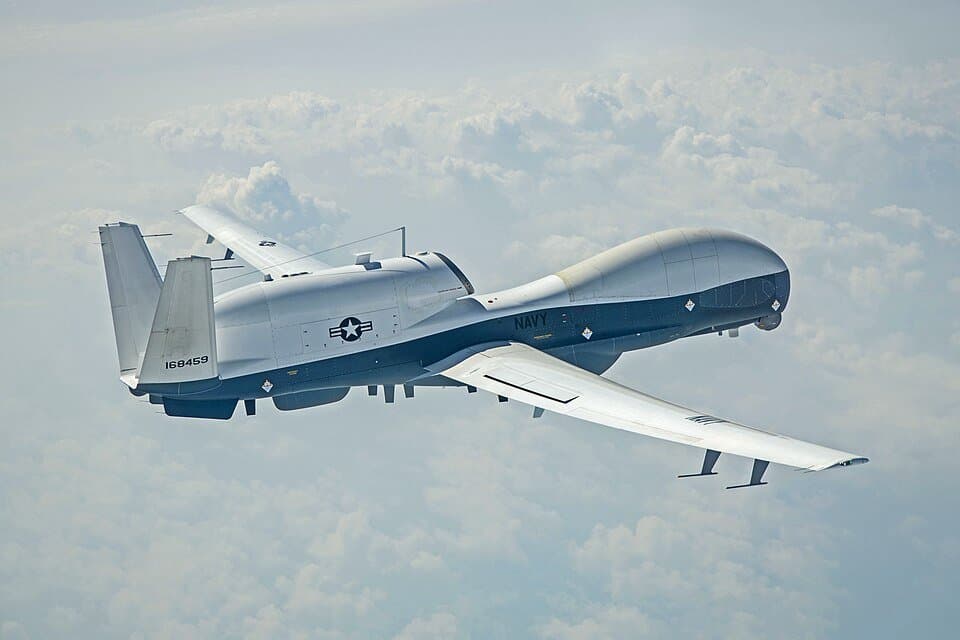
| Source measurement | The operational WZ-7 has a significantly modified shape. The single vertical tail on the prototype was changed to a pair of canted tails. A turbofan engine was installed on the production model. Due to the different engine and aerodynamics, the endurance of the production model is unknown. The aircraft could cruise significantly longer than the 10 hours advertised for the prototype.[source]Guizhou WZ-7 Soaring Dragon · Design; only the objects and conditions stated in this passage Length: 14.33 m (47 ft 0 in)[source]Guizhou WZ-7 Soaring Dragon · Specifications (Soaring Dragon prototype); only the objects and conditions stated in this passage Wingspan: 24.86 m (81 ft 7 in)[source]Guizhou WZ-7 Soaring Dragon · Specifications (Soaring Dragon prototype); only the objects and conditions stated in this passage Height: 5.41 m (17 ft 9 in)[source]Guizhou WZ-7 Soaring Dragon · Specifications (Soaring Dragon prototype); only the objects and conditions stated in this passage Powerplant: 1 × Guizhou WP-13 turbojet or unknown type of turbofan, 43.1 kN (9,700 lbf) thrust[source]Guizhou WZ-7 Soaring Dragon · Specifications (Soaring Dragon prototype); only the objects and conditions stated in this passage Cruise speed: 750 km/h (466 mph, 405 kn)[source]Guizhou WZ-7 Soaring Dragon · Specifications (Soaring Dragon prototype); only the objects and conditions stated in this passage Range: 7,000 km (4,300 mi, 3,800 nmi)[source]Guizhou WZ-7 Soaring Dragon · Specifications (Soaring Dragon prototype); only the objects and conditions stated in this passage Combat range: 2,000 km (1,200 mi, 1,100 nmi)[source]Guizhou WZ-7 Soaring Dragon · Specifications (Soaring Dragon prototype); only the objects and conditions stated in this passage Endurance: 10 hours (at maximum speed; with turbojet)[source]Guizhou WZ-7 Soaring Dragon · Specifications (Soaring Dragon prototype); only the objects and conditions stated in this passage Service ceiling: 18,000 m (59,000 ft)[source]Guizhou WZ-7 Soaring Dragon · Specifications (Soaring Dragon prototype); only the objects and conditions stated in this passage | 51,000-hour airframe life[source]Northrop Grumman MQ-4C Triton · Development / Key features; only the objects and conditions stated in this passage The MQ-4C can remain aloft more than 30 hours at 55,000 ft (17,000 m) at speeds of up to 330 knots (380 mph; 610 km/h). Its surveillance sensor is the AN/ZPY-3 Multi-Function Active Sensor (MFAS) X-band AESA radar with a 360-degree field-of-regard, capable of surveying 2,700,000 mi 2 (7,000,000 km 2 ) of sea (as well as shoreline or land) in a 24-hour period, or 2,000 mi 2 (5,200 km 2 ) in a single sweep. Using the radar in inverse synthetic aperture mode, the MFAS can identify a target in all weather conditions.[source]Northrop Grumman MQ-4C Triton · Design; only the objects and conditions stated in this passage The MQ-4C Triton performed its first flight on 22 May 2013 from United States Air Force Plant 42 / Palmdale Regional Airport , California. The flight lasted 1 hour 20 minutes and the aircraft reached an altitude of 20,000 ft.[source]Northrop Grumman MQ-4C Triton · Operational history / Flight testing; only the objects and conditions stated in this passage On 6 January 2014, Northrop Grumman announced that the MQ-4C had completed 9 test flights with 46 hours of flight time. Half of its envelope expansion testing, which included evaluating the aircraft at different altitudes, speeds, and weights, had been completed. Some flights lasted over 9 hours and reached 50,000 ft. A second Triton aircraft was to fly by March or April 2014. Initial envelope expansion testing was completed in March 2014 through 13 flights, 81 flight hours, and reaching altitudes of 59,900 ft.[source]Northrop Grumman MQ-4C Triton · Operational history / Flight testing; only the objects and conditions stated in this passage |
|---|
| First flight | — | 22 May 2013 ( 2013-05-22 )[source] |
|---|
| Developed from | — | Northrop Grumman RQ-4 Global Hawk[source] |
|---|
| Alternative designation | — | MQ-4C Triton[source] |
|---|
| Propulsion | — | Rolls-Royce AE3007H[source] |
|---|
On 18 September 2014, the Triton successfully conducted an 11-hour cross-country flight from Northrop Grumman's Palmdale, California facility to Naval Air Station Patuxent River in Maryland. The cross-country flight test had been previously postponed twice due to bad weather. The aircraft flew a pre-approved instrument route along the southern U.S. border, crossing the Gulf of Mexico and Florida, then was directed north along the Atlantic coast and up the Chesapeake Bay, a distance of 3,290 nmi (3,790 mi; 6,090 km) at 50,000 ft (15,000 m) to avoid commercial air traffic.[source]Northrop Grumman MQ-4C Triton · Operational history / Flight testing; only the objects and conditions stated in this passage
A test fleet of three Tritons completed 15 flights demonstrating speed and altitude capabilities prior to the transcontinental mission. With the completion of the cross-country flight, the MQ-4C program transitions from initial safety flight testing to validating its ability to perform operational missions over the ocean. Operations from Patuxent River in the coming weeks will test the aircraft's sensors, communications, interoperability, and expanded envelope flight coverage. The three test Tritons are scheduled to fly a total of 2,000 hours before reaching initial operating capability.[source]Northrop Grumman MQ-4C Triton · Operational history / Flight testing; only the objects and conditions stated in this passage
Crew: Unmanned – 4 personnel fly aircraft from ground station[source]Northrop Grumman MQ-4C Triton · Specifications (MQ-4C); only the objects and conditions stated in this passage
Length: 47 ft 7 in (14.5 m)[source]Northrop Grumman MQ-4C Triton · Specifications (MQ-4C); only the objects and conditions stated in this passage
Wingspan: 130 ft 11 in (39.9 m)[source]Northrop Grumman MQ-4C Triton · Specifications (MQ-4C); only the objects and conditions stated in this passage
Height: 15 ft 5 in (4.6 m)[source]Northrop Grumman MQ-4C Triton · Specifications (MQ-4C); only the objects and conditions stated in this passage
Empty weight: 14,945 lb (6,781 kg)[source]Northrop Grumman MQ-4C Triton · Specifications (MQ-4C); only the objects and conditions stated in this passage
Gross weight: 32,250 lb (14,630 kg)[source]Northrop Grumman MQ-4C Triton · Specifications (MQ-4C); only the objects and conditions stated in this passage
Powerplant: 1 × Rolls-Royce AE 3007 turbofan engine, 6,495–8,917 lbf (28.89–39.66 kN) thrust[source]Northrop Grumman MQ-4C Triton · Specifications (MQ-4C); only the objects and conditions stated in this passage
Maximum speed: 357 mph (575 km/h, 320 kn)[source]Northrop Grumman MQ-4C Triton · Specifications (MQ-4C); only the objects and conditions stated in this passage
Range: 9,400 mi (15,200 km, 8,200 nmi)[source]Northrop Grumman MQ-4C Triton · Specifications (MQ-4C); only the objects and conditions stated in this passage
Endurance: 30 hours[source]Northrop Grumman MQ-4C Triton · Specifications (MQ-4C); only the objects and conditions stated in this passage
Service ceiling: 56,000 ft (17,000 m)[source]Northrop Grumman MQ-4C Triton · Specifications (MQ-4C); only the objects and conditions stated in this passage