


Preparing your view.

At a glance
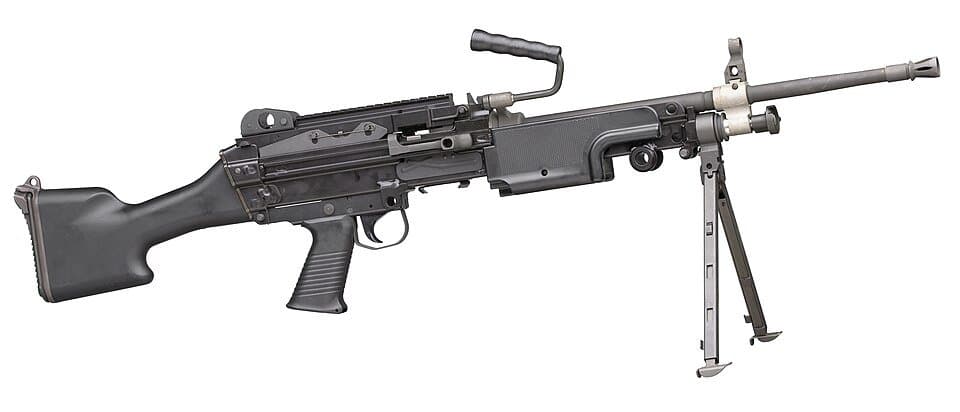
FN Minimilarger figure on 2 of 4
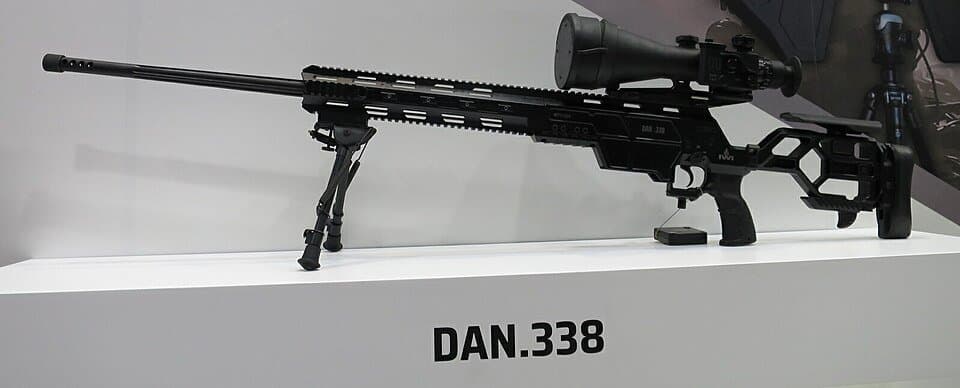
IWI Danlarger figure on 2 of 4
Counts only measures both sources give with the same scope. A larger figure is not a better system.
Measured figures
Length
Single source1,040 mm (40.9 in)[source]
Length
Single sourceConfiguration
| Specification | FN Minimi | IWI Dan |
|---|---|---|
| Type | Light machine gun Squad automatic weapon[source] | Sniper rifle[source] |
| Place of origin | Belgium[source] | Israel[source] |
| In service | 1980–present[source] | — |
| Used by | See Users[source] | — |
| Wars | United States invasion of Panama Tuareg rebellion (1990–1995) Gulf War Burundian Civil War Kosovo War War in Afghanistan (2001–2021) Moro conflict Iraq War Mexican drug war Communist rebellion in the Philippines Militias-Comando Vermelho conflict Second Ivorian Civil War Libyan Civil War Syrian Civil War Northern Mali Conflict War in Iraq (2013–2017) ISIL insurgency in Tunisia Yemeni Civil War (2014–present) Saudi Arabian-led intervention in Yemen Russo-Ukrainian War Russian invasion of Ukraine |
stock folded
Single source1,280 mm (50.4 in) 1,030 mm (40.6 in) stock folded[source]
Rate of fire
Single source700–1,150 rounds/min[source]
Bars compare reported quantities only. A larger figure does not make a system better; configurations and test conditions differ.
| — |
| Designer | Ernest Vervier[source] | Nehemia Sirkis[source] |
|---|
| Designed | Early 1970s[source] | — |
|---|
| Manufacturer | FN Herstal FN USA Thales Australia Beretta Bofors Carl Gustav Caracal International Pindad Sumitomo Heavy Industries[source] | Israel Weapon Industries[source] |
|---|
| Produced | 1977–present[source] | 2014–present[source] |
|---|
| Variants | See Variants[source] | — |
|---|
| Cartridge | 5.56×45mm NATO / 7.62×51mm NATO[source] | .338 Lapua Magnum[source] |
|---|
| Action | Gas-actuated , open bolt[source] | Bolt-action[source] |
|---|
| Feed system | 100 or 200-round belt contained in a 100-round or 200-round soft pouch, or 200-round box or 30-round M16 -type STANAG magazine to 60-round STANAG casket magazine[source] | 10-round detachable box magazine[source] |
|---|
| Sights | Rear aperture, front post[source] | day or night optical sights back-up iron sights[source] |
|---|
| Former operator · Afghanistan | Afghanistan[source] | — |
|---|
| Role | Belgian 5.56mm or 7.62mm light machine gun , also classified as a squad automatic weapon[source] | — |
|---|
| Source measurement | The FN Minimi (short for French : mini-mitrailleuse ; "mini machine gun") is a Belgian 5.56mm or 7.62mm light machine gun , also classified as a squad automatic weapon developed by Ernest Vervier for FN Herstal . Introduced in the late 1970s, it is in service in more than 75 countries. The weapon is manufactured at the FN facility in Herstal and their U.S. subsidiary FN Manufacturing LLC.[source]FN Minimi · Lead; only the objects and conditions stated in this passage The Minimi has a manually adjustable gas valve with two positions, normal and adverse. The adverse setting increases the cyclic rate of fire from 700 to 850 rounds per minute to 950–1,150 rounds per minute and is used only in extreme environmental conditions or when heavy fouling is present in the weapon's gas tube. The spring extractor is located inside the bolt, while the tilting lever ejector is contained inside the receiver housing. Spent casings are removed through a port located at the bottom of the right side of the receiver, protected from debris with a spring-loaded dust cover. The Minimi is striker-fired and the bolt carrier functions as the striker mechanism.[source]FN Minimi · Design details / Features; only the objects and conditions stated in this passage The Minimi features a welded receiver made from stamped steel . Both the standard and Para variants are equipped with a fixed, folding bipod mounted to the gas tube and stowed under the handguard. The bipod can be adjusted in height and each leg has three height settings. The bipod also offers a 15° range of rotation to either side. With the bipod fully extended, the bore axis is elevated to a height of 465 mm (18.3 in). The Minimi can also be fired from the Belgian FN360° tripod or the American M122 mount using an M60 pintle. The vehicle-mounted Minimi is fitted with an electrically powered trigger that enables it to be fired remotely from within an armoured fighting vehicle.[source]FN Minimi · Design details / Features; only the objects and conditions stated in this passage The standard light machine gun version has a 465 mm (18.3 in) barrel and a skeletonized aluminium stock with a folding wire shoulder strap. The shortened Para model has a 349 mm (13.7 in) barrel and a collapsible metal stock, while the vehicle-mounted model has a 465 mm (18.3 in) barrel but does not have a stock or iron sights . All models can alternatively be fitted with a fixed synthetic stock, the same used on the M249, which contains a hydraulic buffer that contributes to stabilizing the rate of fire and reducing recoil forces.[source]FN Minimi · Design details / Features; only the objects and conditions stated in this passage The weapon is fed from the left-hand side by disintegrating-link M27 ammunition belts (a miniaturized version of the 7.62mm M13 belt), from either an unsupported loose belt, enclosed in a polymer ammunition box with a 200-round capacity attached to the base of the receiver, or from detachable STANAG magazines , used in other NATO 5.56 mm assault rifles such as the M16 and FNC .[source]FN Minimi · Design details / Feeding; only the objects and conditions stated in this passage The ammunition belt is introduced into the feed tray, magazines are seated inside the magazine port at a 45° angle, located beneath the feed tray port.[source]FN Minimi · Design details / Feeding; only the objects and conditions stated in this passage The barrels used in the Minimi have an increased heat capacity for sustained fire, feature a chrome -lined rifled bore (six right-hand grooves) and are manufactured in two versions: with a 178 mm (1:7 in) twist rate used to stabilize the heavier Belgian 5.56×45mm SS109 projectile, or a 305 mm (1:12 in) twist for use with American M193 ammunition. The barrels have a quick-change capability; a lever is provided on the left side of the weapon that unlocks the barrel allowing the shooter to push it forward removing it from its trunnion. A carrying handle is also fixed to the barrel and assists in the barrel change process. A trained soldier can perform a barrel change and ready the weapon for aimed fire in 6 to 7 seconds. Early models of the Minimi had a flash suppressor with side ports as seen on the FN FAL , FN CAL , and FN FNC rifles; new production guns have a shorter, cone -shaped slotted flash suppressor.[source]FN Minimi · Design details / Barrel; only the objects and conditions stated in this passage Both the standard and Para models come with a rear sight, adjustable for windage and elevation, that provides a peep aperture for ranges from 300–1,000 m (980–3,280 ft), in 100 m (330 ft) increments. The sight line radius is 490 millimeters (19.3 in). The hooded front sight is installed in a post on the gas block and is also adjustable for elevation and windage. Early models of the Minimi had the rear sight mounted forward of the feed cover and the front post secured to the barrel, closer to the muzzle end. An adapter can also be used that allows the use of standard NATO night and day sights.[source]FN Minimi · Design details / Sights; only the objects and conditions stated in this passage As part of the US military's M249 Product Improvement Program (PIP), the M249 was updated with: a new synthetic stock and modified buffer assembly, a single-position gas regulator, a so-called birdcage type flash hider/compensator from the M16A2, a polymer barrel heat guard, and a folding carry handle. As a result, the weapon's weight increased to 7.47 kg (16.5 lb). Many of the PIP upgrades were later incorporated by FN for the Minimi.[source]FN Minimi · Variants / M249; only the objects and conditions stated in this passage The Minimi prototype was originally designed in 7.62×51mm NATO , and later redesigned for the 5.56 mm cartridge.[source]FN Minimi · Variants / Minimi 7.62; only the objects and conditions stated in this passage When the USSOCOM issued the requirements for the Mk 48 Mod 0 in the early 2000s, the original plans for the Minimi were retrieved and used to develop this new model. As a result of favourable reviews of the Mk 48 Mod 0 and increasing demand for a more powerful variant of the Minimi, FN Herstal introduced the Minimi 7.62. In November 2006, a FN Herstal press release said the Minimi 7.62 had recently been "launched onto the market" and was available "with a fixed or telescopic buttstock and a standard or triple rail handguard".[source]FN Minimi · Variants / Minimi 7.62; only the objects and conditions stated in this passage The Minimi 7.62 also has a different sight setup calibrated for the larger cartridge. The rear sight is adjustable from 300–1,000 m (980–3,280 ft), in 100 m (330 ft) increments. The sight can also be corrected for windage. The Minimi 7.62 TR is a variant equipped with a Picatinny rail handguard from the factory.[source]FN Minimi · Variants / Minimi 7.62; only the objects and conditions stated in this passage The stock is 5-position adjustable that is also adjustable for cheek rest height with a folding shoulder rest and hydraulic buffer. The feed tray has retaining pawls to hold ammunition from the belt in place while loading. The handguard has three forward picatinny rails. A new bipod is 3-position height adjustable and seamlessly integrates into the shape of the handguard when folded back regardless of accessories that may be attached. Others features include a more ergonomic cocking handle and an optional heat shield, enabled by an added on long pin, to protect from barrel heat. The Minimi 7.62 Mk3 can be converted to fire 5.56×45mm rounds.[source]FN Minimi · Variants / Minimi Mk3; only the objects and conditions stated in this passage The Japan Self-Defense Forces (JSDF) adopted the locally produced Minimi under the name "5.56mm Machine Gun MINIMI" ( Japanese : 5.56mm機関銃MINIMI ) since the 1993 fiscal year as a successor to the Type 62 7.62mm machine gun until 2019.[source]FN Minimi · Variants / Production in other countries / License-built versions / Japanese variant / 5.56mm機関銃MINIMI; only the objects and conditions stated in this passage The license-produced MINIMI can be equipped with the Type 62 GPMG tripod using a special attachment, and is used when precise shooting is required. Additionally, for long-range shooting, a “direct sight scope” (scope) may be mounted. The model adopted by the JSDF is the so-called standard type with a metal tube stock, and it has unique modifications such as a different shape for the barrel change lever. The side of the gun body is marked with 5.56mm Machine Gun MINIMI.[source]FN Minimi · Variants / Production in other countries / License-built versions / Japanese variant / 5.56mm機関銃MINIMI; only the objects and conditions stated in this passage On December 18, 2013, the Ministry of Defense announced that Sumitomo Heavy Industries had falsified inspection data over several decades and had delivered machine guns that did not meet the required performance standards. As a result, the company was placed under a 5-month suspension of designation. It is reported that at least 5,350 units, including 12.7mm heavy machine guns, 7.62mm machine guns, and 5.56mm machine guns, were delivered since 1979. Even before the data falsification was discovered, personnel in the field had recognized that the Minimi produced by Sumitomo Heavy Industries was of low performance.[source]FN Minimi · Variants / Production in other countries / License-built versions / Japanese variant / 5.56mm機関銃MINIMI; only the objects and conditions stated in this passage In April 2021, Sumitomo Heavy Industries announced its withdrawal from the production of machine guns and the development of 5.56mm machine guns due to budget constraints and reduced order volumes. However, the company stated it would continue producing parts for maintenance and repair.[source]FN Minimi · Variants / Production in other countries / License-built versions / Japanese variant / 5.56mm機関銃MINIMI; only the objects and conditions stated in this passage Due to the obsolescence of the Minimi Mk1 and the cessation of procurement, the JGSDF conducted a selection for its next machine gun. The JGSDF decided to continue using the 5.56mm caliber and chose the MINIMI Mk3 over Germany's Heckler & Koch MG4 . The “5.56mm Machine Gun MINIMI(B)” is being procured not through domestic production, but via imports. The procurement plan includes 3,100 units of MINIMI(B), which will replace the existing Minimi Mk1 over time.[source]FN Minimi · Variants / Production in other countries / License-built versions / Japanese variant / 5.56mm機関銃MINIMI; only the objects and conditions stated in this passage | — |
|---|
| Country of origin | United States[source]Inventory Origin column; table 1, row 11, cell 3; revision 1375383109; retrieved 2026-10-02 | — |
|---|
| Unit cost | — | $9,000[source] |
|---|
| Reported operators |
| — |
|---|