


Preparing your view.

At a glance
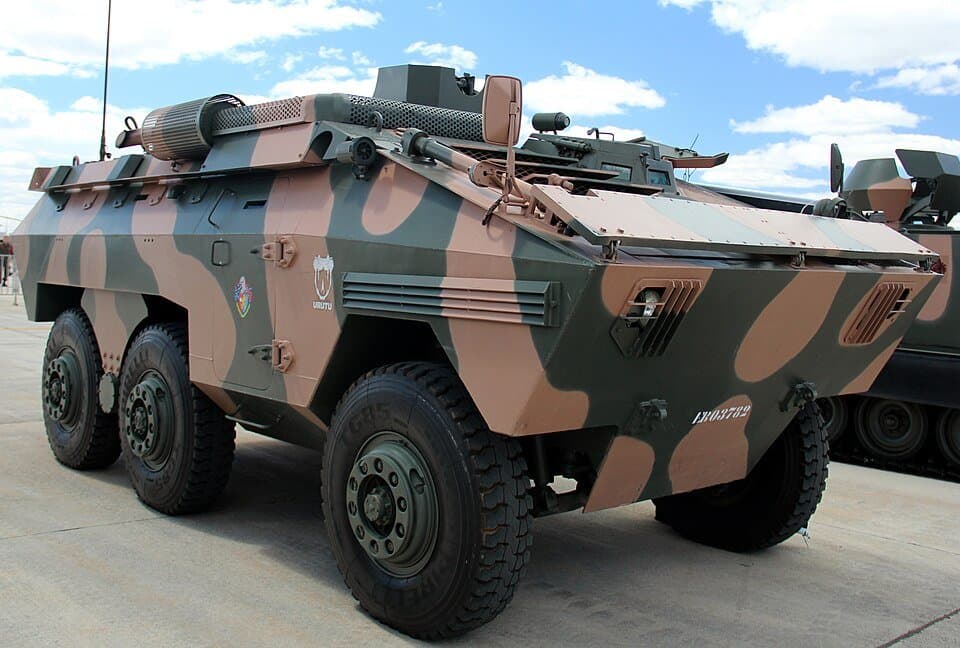
EE-11 Urutularger figure on 0 of 1
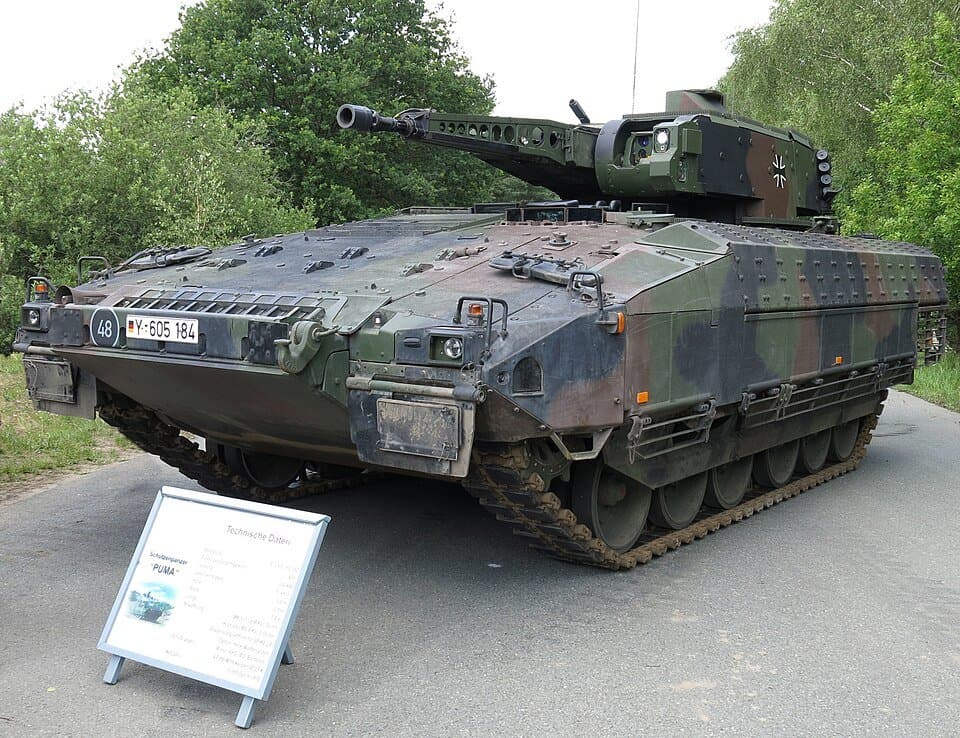
Puma (German infantry fighting vehicle)larger figure on 1 of 1
Counts only measures both sources give with the same scope. A larger figure is not a better system.
Measured figures
Width
Single source2.85 m (9 ft 4 in)[source]
Maximum; Maximum speed
Single sourceMaximum; water
Single source90 km/h (55 mph), 8 km/h (water)[source]
Maximum; Official specification · puma; 70 km/h
Manufacturer claimMaximum; On road
Single sourceDetroit Diesel 6V-53T 6-cylinder water-cooled diesel
Single sourceDetroit Diesel 6V-53T 6-cylinder water-cooled diesel 212 hp (158 kW)[source]
MTU Fried. MT 892 Ka-501 v10 11.1-litre (at 3,800 rpm), 2,200 N⋅m (1,623 ft⋅lb)
Single sourceOfficial specification · puma; 800 kW
Manufacturer claimMTU Fried. MT 892 Ka-501 v10 11.1-litre 1,088 PS (800 kW) (at 3,800 rpm), 2,200 N⋅m (1,623 ft⋅lb)[source]
800 kW[source]
1.088 PS[source]Schützenpanzer Puma · MotorleistungSource text · numeric interpretation needs review
Bars compare reported quantities only. A larger figure does not make a system better; configurations and test conditions differ.
Configuration
| Specification | EE-11 Urutu | Puma (German infantry fighting vehicle) |
|---|---|---|
| Type | Amphibious wheeled Armored personnel carrier[source] | Infantry fighting vehicle[source] |
| Place of origin | Brazil[source] | Germany[source] |
| Used by | See Operators[source] | Bundeswehr[source] |
| Wars | Chadian–Libyan conflict Iran–Iraq War Gulf War Colombian conflict Brazilian drug war Libyan Civil War (2011) Iraqi Civil War (2014–2017) 2024 Ecuadorian conflict[source] | — |
| Designer | José Luiz Whitaker Ribeiro[source] | Krauss-Maffei Wegmann Rheinmetall Landsysteme[source] |
| Designed | 1970[source] | 1995–2009[source] |
| Manufacturer | Engesa[source] | Rheinmetall AG, KNDS Deutschland[source] |
| Unit cost | USD $149,100 (new)[source] | — |
| Produced | 1974–1990[source] | 2009–present[source] |
| No. built | 1,719[source] | 350 as of December 2022[source] |
| Variants | See Variants[source] | — |
| Main armament | 12.7mm M2 Browning machine gun (1,000 stowed rounds)[source] | Autocanon MK 30-2/ABM ( 30 mm , 200 rounds ready to fire, 200 in storage)[source] |
| Power/weight | 18.6hp /tonne (13.8 kW/tonne)[source] | 18.6 kW/t[source] |
| Transmission | Allison MT-643 Automatic; 4 forward and 1 reverse gears[source] | Renk HSWL 256[source] |
| Suspension | Independent suspension with double-action telescopic shock dampers (front) Double axle boomerang with walking beams (rear)[source] | Horstman hydrostruts[source] |
| Ground clearance | 0.38 m (1 ft 3 in)[source] | — |
| Fuel capacity | 380 litres[source] | 900 L (240 U.S. gal; 200 imp gal)[source] |
| Former operator · Chile | Chile[source] | — |
| Role | Brazilian amphibious armored personnel carrier[source] | — |
| Source measurement | The Urutu was the first fully amphibious armored vehicle developed in Brazil: it can propel itself through water at speeds of 8 km/h via twin propellers. Urutus proved to be extremely popular in the Middle East , particularly with Libya and Iraq , both of which purchased large numbers to complement their fleets of Cascavel armored cars. Iraq deployed its Urutus during the Iran–Iraq War , which became, in effect, a proving ground for the vehicle type. A number of specialized variants were later developed for internal security purposes, vehicle recovery, air defense, cargo transport, and medical evacuation. One hybrid variant was modified to accept the same 90 mm turret-mounted cannon as its Cascavel counterpart; this was marketed unsuccessfully to the United States Army as the Uruvel . Urutus were once operated by over thirty national armies and security forces worldwide.[source]EE-11 Urutu · Lead; only the objects and conditions stated in this passage The Urutu benefited greatly from the initial export success of the EE-9 Cascavel, with a number of national armies ordering both vehicle types to simplify logistics. Chile purchased 37 in 1975 to complement its preexisting Cascavel fleet; this was followed by similar orders from Libya and Iraq. By the late 1980s, both Libya and Iraq may have purchased hundreds of Urutus each, some of which were re-exported to other states and regional militant movements.[source]EE-11 Urutu · Development history; only the objects and conditions stated in this passage In 1980, the US Army issued a requirement for a new wheeled armored vehicle for a proposed new mobile deployment force, able to bring to bear air-portable firepower in the event of a crisis in the Middle East or Asia. In response, Engesa proposed an Urutu with a large turret ring and the same 90 mm gun as its Cascavel counterpart; this hybrid vehicle was known as the Uruvel . At least one modified Urutu was delivered to the US for trials. If the US Army adopted the Uruvel, a little over half the vehicle's production would be undertaken in the US by the FMC Corporation . In anticipation of a successful bid, FMC even purchased licenses from Engesa to manufacture both the Urutu and the Cascavel, along with their associated parts. The program was shelved during the late 1980s, and the Uruvel was not adopted by any country except Tunisia , which ordered 12.[source]EE-11 Urutu · Development history; only the objects and conditions stated in this passage The basic layout of all Urutu variants is the same: the driving compartment is located to the front left of the hull, with the engine compartment to the front right and the troop compartment to the immediate rear. The driver is provided with a hatch and three driving periscopes in the sharply angled vehicle glacis. Passengers may debark from doors on either side of the hull or from the rear; they are also afforded four emergency hatches in the hull roof. The troop compartment is fitted with vision blocks and firing ports as standard to allow passengers situational awareness while embarked. An Urutu's hull is composed of two distinct layers of welded ballistic steel able to resist point-blank small arms fire, including 7.62×39mm armor-piercing ammunition.[source]EE-11 Urutu · Description; only the objects and conditions stated in this passage The Urutu was fitted with a 12.7mm Browning M2 heavy machine gun as standard. The machine gun is operated by a gunner seated directly behind the driver in the left of the hull. In all late production models, the gunner's station is also provided with day/night sights with five power magnification and a stadiametric rangefinder. Some of the more common Urutu variants replaced the Browning heavy machine gun with a single turret or pintle-mounted 7.62mm general-purpose machine gun. Depending on the size of the turret ring, it was also possible to fit heavier turrets carrying gun-mortars or low-pressure cannon for direct fire support.[source]EE-11 Urutu · Description; only the objects and conditions stated in this passage Urutus had a very distinct hull with a sharply angled glacis; the front of the hull slopes back to just forward of the rear wheels at 60°. The hull sides are vertical until halfway to the roof line, at which point they slope slightly inwards. Hull doors are visible to the rear of the first wheel station on either side of the vehicle, although the final production run of Urutus produced by Engesa eliminated the door on the right to create a more spacious engine compartment.[source]EE-11 Urutu · Description / External; only the objects and conditions stated in this passage Urutu Mk I : First production model to enter service with the Brazilian Army in 1975. Powered by a 174 hp (130 kW) Mercedes-Benz engine with a manual Clark transmission. This variant also lacked propellers; water propulsion was accomplished by use of the wheels.[source]EE-11 Urutu · Variants / Production marks; only the objects and conditions stated in this passage Urutu Mk IV : The final production model introduced by Engesa, which offered the option of a 190 hp (142 kW) Mercedes-Benz OM 352 engine and an Allison AT-540 automatic gearbox. Other possible options included various Mercedes engine and Allison gearbox combinations.[source]EE-11 Urutu · Variants / Production marks; only the objects and conditions stated in this passage Uruvel : Also known as the Urutu Armored Fire Support Vehicle , the Uruvel was developed for a US Army program during the 1980s aimed at creating a multi-purpose, air-portable wheeled armored vehicle capable of delivering direct fire support as needed. It was a baseline Urutu modified with a large turret ring to accommodate the Cockerill Mk.III 90 mm cannon and EC-90 turret of the EE-9 Cascavel. The Uruvel was first publicly unveiled in 1985; it could seat four infantrymen in addition to a driver and two-man turret crew.[source]EE-11 Urutu · Variants / Other variants; only the objects and conditions stated in this passage EE-11 Mortar Carrier : Urutu modified with an 81 mm mortar in the troop compartment; the mortar is fired through a hatch in the hull roof. The mortar could be elevated from +40° to +80° and was designed for quick disassembly as needed. A 7.62mm general-purpose machine gun is mounted on the hull roof for self-defense.[source]EE-11 Urutu · Variants / Other variants; only the objects and conditions stated in this passage EE-11 Anti-Tank : Urutu fitted with a one-man turret housing a 25 mm autocannon capable of firing 600 rounds per minute and a bank for TOW anti-tank guided missiles. This variant was developed for the United Arab Emirates ; it could also be fitted with MILAN anti-tank guided missiles as needed.[source]EE-11 Urutu · Variants / Other variants; only the objects and conditions stated in this passage EE-11 Cargo Transporter : Urutu designed as a general transporter for hauling or towing heavy loads. This variant had an internal load capacity of up to 2,000 kg.[source]EE-11 Urutu · Variants / Other variants; only the objects and conditions stated in this passage EE-11 Air Defense : Urutu carrying twin 20 mm autocannon in a French-designed Electronique Serge Dassault TA20/RA20 turret.[source]EE-11 Urutu · Variants / Other variants; only the objects and conditions stated in this passage 60mm mortar : A version that carries a 60 mm mortar, firing HE, HEAT and other munitions. The direct fire range is 300 m and indirect fire range is 2,600 m. An option is available for a 7.62 mm machine gun with 1,200 rounds, or a 12.7 mm machine gun with 600 rounds.[source]EE-11 Urutu · Variants / Other variants; only the objects and conditions stated in this passage There were also Urutu prototypes modified to carry turrets armed with twin general-purpose machine guns, twin heavy machine guns, a single HS804 20 mm autocannon.[source]EE-11 Urutu · Variants / Other variants; only the objects and conditions stated in this passage The Colombian Urutu derivatives shared the same transmission, electrical system, and engine of the baseline Urutu but utilized a four-wheeled chassis which eliminated the vehicle's articulated boomerang suspension. Their hulls were externally identical to that of the Urutu, retaining the same hatch and door configuration; however, the interior dimensions were different. For example, the engine compartment of the Aymara was located in the center of the hull rather than at the front and to the right like the Urutu. The prototypes were all at least five tonnes heavier than the standard Urutu and lacked amphibious capability.[source]EE-11 Urutu · Variants / Colombian derivatives; only the objects and conditions stated in this passage | — |
| Country of origin | Brazil[source]Inventory Origin column; table 2, row 9, cell 2; revision 1365890955; retrieved 2026-10-02 | — |
| In service | — | 2015–present[source] |
| Passengers | — | |
| Armor | — | AMAP modular composite armor composite armour[source] |
| Secondary armament | — | Base variant: HK MG4 ( 5.56×45mm NATO ) S1 variant: Spike LR (MELLS) ATGM Multishot grenade launcher for close-in defense[source] |
| Reported occupants | — | 3+6[source]Schützenpanzer Puma · BesatzungSource text · numeric interpretation needs review |
| Reported operators |
| — |