


Preparing your view.

BDrones & UAVs
Maritime unmanned surveillance and reconnaissance aerial vehicle and patrol aircraft
Measured figures
MQ-4C · Length
Single source47 ft 7 in (14.5 m)[source]
Configuration
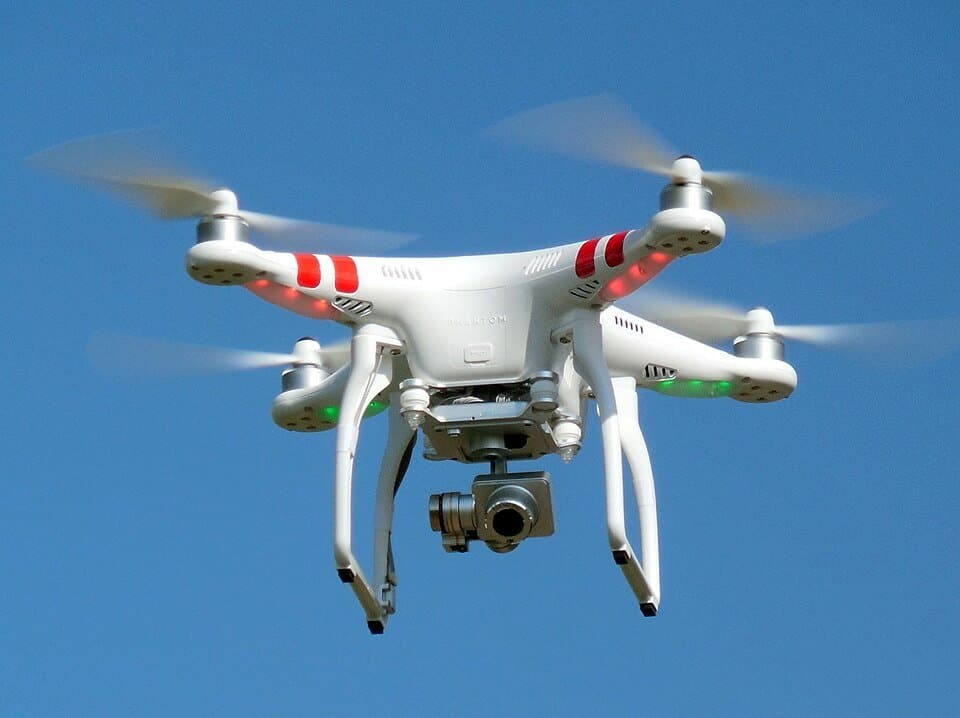
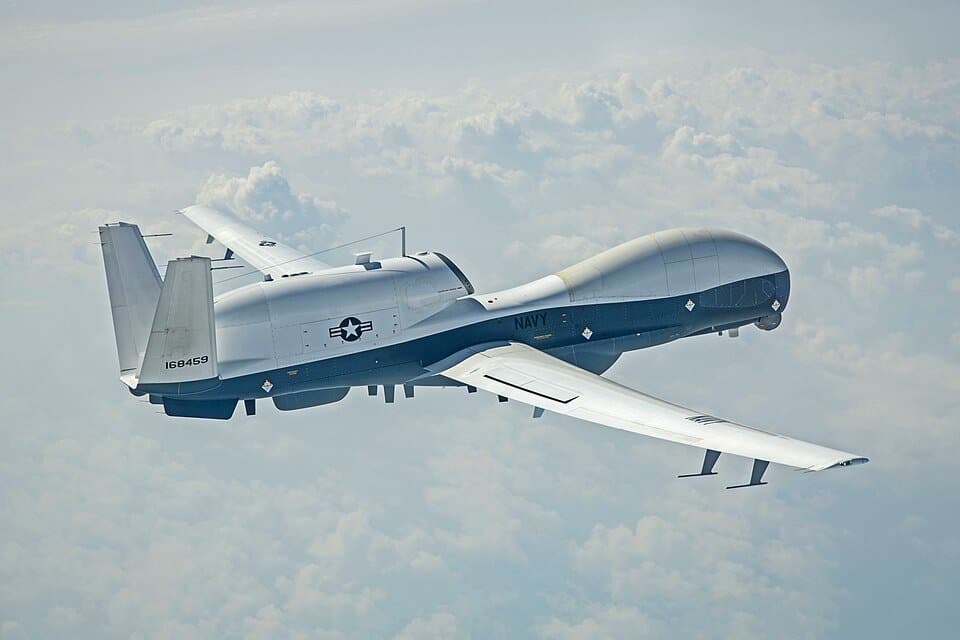
| Specification | DJI Phantom | Northrop Grumman MQ-4C Triton |
|---|---|---|
| Crew | — | Unmanned – 4 personnel fly aircraft from ground station[source] |
| Type | Unmanned aerial vehicle[source] | Maritime unmanned surveillance and reconnaissance aerial vehicle and patrol aircraft[source] |
| National origin | China[source] | United States[source] |
| Manufacturer | DJI[source] | Northrop Grumman[source] |
Phantom 4 Pro V2.0 · diagonal
Single source0.350 m (1 ft 2 in) diagonal[source]
MQ-4C · Wingspan
Single source130 ft 11 in (39.9 m)[source]
MQ-4C · Height
Single source15 ft 5 in (4.6 m)[source]
MQ-4C · Range
Single source9,400 mi (15,200 km, 8,200 nmi)[source]
MQ-4C · 1 × Rolls-Royce AE 3007 turbofan engine thrust
Single source1 × Rolls-Royce AE 3007 turbofan engine, 6,495–8,917 lbf (28.89–39.66 kN) thrust[source]
Phantom 4 Pro V2.0 · 1,182 ft/min
Single source6.0 m/s (1,182 ft/min)[source]
Bars compare reported quantities only. A larger figure does not make a system better; configurations and test conditions differ.
| Manufactured | 2013– c. 2023[source] | 48 as of 2024[source] |
|---|
| Introduction date | January 2013[source] | May 2018[source] |
|---|
| Battery capacity | 5870 mAh[source] | — |
|---|
| Propellers | 2-bladed Model 9455S low-noise propellers[source] | — |
|---|
| Camera | 20MP Sony Exmor R with 1" CMOS sensor[source] | — |
|---|
| GNSS compatibility | GPS GLONASS[source] | — |
|---|
| Transmission system | OcuSync[source] | — |
|---|
| Role | series of quadcopter unmanned aerial vehicles (UAVs)[source] | — |
|---|
| Source measurement | The Phantom 1, originally known as the Phantom, was released on January 7, 2013. It uses 2.4 GHz for control and is powered by a 2200 mAh LiPo battery , giving it a flight time of about 15 minutes. It did not include a built-in camera, but it can be fitted with an optional mount for a GoPro HERO camera. The drone uses a GPS-enabled NAZA-M autopilot system allowing it to hover with automatic wind resistance.[source]DJI Phantom · Design and development / Phantom 1 series; only the objects and conditions stated in this passage After the success of the Phantom 2 Vision, DJI released a camera-equipped version of the Phantom 1 as the Phantom FC40. The drone features a FC40 camera on a fixed mount capable of capturing 720p video at 30 FPS . The aircraft uses 5.8 GHz for control allowing the 2.4 GHz band to be allocated for FPV downlink. It uses an iOS / Android app for control and comes with Wi-Fi and GPS modules. Using a 2.4 GHz Wi-Fi connection, it provides almost real-time aerial video on a mobile device, allowing the pilot to capture images and videos as is. The camera angle is manually set before each flight.[source]DJI Phantom · Design and development / Phantom 1 series; only the objects and conditions stated in this passage Released in October 2013, the Phantom 2 Vision was the first model to feature a built-in camera. The camera is mounted on a one-dimensional gimbal and is capable of recording 1080p video at either 30 or 60 FPS or taking 14-megapixel stills onto a microSD card . The motorized gimbal gives the camera 60 degrees of vertical motion. The drone also features a Wi-Fi module, a GPS-enabled position holding, return-to-home capability, a Naza-M flight control system, and self-tightening propellers. The drone connects to iOS or Android devices via an app, allowing the operator to control the camera and view flight data. Battery capacity was increased to 5200 mAh, giving the drone a flight time of 25 minutes.[source]DJI Phantom · Design and development / Phantom 2 series; only the objects and conditions stated in this passage Released in April 2014, the Phantom 2 Vision+ replaced the Vision's single-axis gimbal with a self-stabilizing three-axis unit. The gimbal mounts a redesigned camera with the same specifications as the Vision and has 90 degrees of vertical tilt, allowing the Vision+ to point the camera straight down. An upgraded version was released in late-2014 as the Phantom 2 Vision+ V3.0 with more powerful motors and electronic speed controllers (ESC), Model 9450 propellers, and an improved compass module.[source]DJI Phantom · Design and development / Phantom 2 series; only the objects and conditions stated in this passage In April 2015, DJI released the first two third-generation Phantom models; the Phantom 3 Professional and Phantom 3 Advanced. The Phantom 3 introduced a visual positioning system, allowing it to hold its position without GPS and improving positioning indoors and outdoors. The drone uses a Lightbridge video transmission system, allowing for stable connection up to 5km and replacing the Wi-Fi system of previous models, though range limitations vary by market. Both models feature a Sony Exmor 1/2.3" camera, with the Professional being capable of shooting 4K video at 30 FPS while the Advanced is limited to 2.7K video at 30 FPS. Both models are also capable of shooting 1080p video at 60 FPS, use GPS and GLONASS for navigation, and are powered by a 4480 mAh battery, giving them a flight time of approximately 23 minutes.[source]DJI Phantom · Design and development / Phantom 3 series; only the objects and conditions stated in this passage The Phantom 3 SE was originally released exclusively in China in early March 2017, though a worldwide release came in August of that year to select markets. An improved version of the Phantom 3 4K, the SE's video transmission system was upgraded to transmit live 720p video to the controller, up from the 4K's 480p live video. The drone's range was also increased from 1.2 km (0.75 mi) to 4 km (2.5 mi), though this is restricted in some markets. The SE uses the same 4480 mAh battery as previous models, though flight time was slightly increased to 25 minutes.[source]DJI Phantom · Design and development / Phantom 3 series; only the objects and conditions stated in this passage The Phantom 4, released in March 2016, introduced a new outer shell design as well as a push-and-release propeller locking mechanism. An obstacle avoidance system was added, which uses four cameras (two facing forward and two downward) and an ultrasonic sensor. The drone also introduced the ActiveTrack and TapFly features, with the former allowing the drone to autonomously track moving objects, including people, with its camera while the latter allowing the drone to be controlled by tapping on the video stream in the DJI app. The drone is equipped with a 1/2.3" camera with an electronic shutter capable of shooting 4K video at 30 FPS or 1080p video at 120 FPS, while a new 5350 mAh battery gives it a flight time of approximately 28 minutes.[source]DJI Phantom · Design and development / Phantom 4 series; only the objects and conditions stated in this passage The Phantom 4 Pro was released in November 2016 with a new 20-megapixel Exmor R camera featuring a 1-inch (25 mm) CMOS sensor. The obstacle avoidance system was also upgraded rearward-facing sensors as well as infrared sensors on both sides. The Phantom 4 Pro+, offered alongside the Pro, features a controller with a 5.5-inch screen and an integrated flight app, allowing it to be flown without a separate mobile device. The Pro uses Model 9450S propellers and is powered by a 5870 mAh battery, giving it a fight time of approximately 30 minutes. During the 2017 IFA Berlin trade show, DJI announced a new version of the Pro/Pro+ as the Phantom 4 Pro Obsidian and Pro+ Obsidian, respectively. The Pro/Pro+ Obsidian is largely identical to the baseline Pro/Pro+, differing only in that both the drone and remote have a matte black color and that the camera and gimbal are made of magnesium and have an electroplated anti-fingerprint coating.[source]DJI Phantom · Design and development / Phantom 4 series; only the objects and conditions stated in this passage The Phantom 4 Advanced was announced on 13 April 2017 as a replacement for the Phantom 4. The drone features an upgraded camera with a 1-inch CMOS sensor and a mechanical shutter, capable of shooting 4K video at 60 FPS. The drone is capable of processing H.264 video at 60 FPS and H.265 video at 30 FPS. Like the Pro, the Advanced was also offered with a controller with a 5.5-inch screen as the Phantom 4 Advanced+.[source]DJI Phantom · Design and development / Phantom 4 series; only the objects and conditions stated in this passage An agricultural model of the Phantom 4 was announced on 25 September 2019 as the P4 Multispectral, dropping the Phantom name. Based on the Phantom 4 RTK, the P4 Multispectral integrates a six-sensor camera array, which includes an RGB camera and five narrow-band sensors, being the first drone to do so. The P4 Multispectral uses Model 9455S low-noise propellers as standard, though standard Phantom 4 propellers are also compatible at the cost of reduced performance. Battery capacity remained at 5870 mAh, but flight time was slightly reduced to approximately 27 minutes.[source]DJI Phantom · Design and development / Phantom 4 series; only the objects and conditions stated in this passage In 2018, leaked photos of silver-colored Phantom drones circulated, with the drones speculated to be prototypes of a Phantom 5 variant. However, DJI denied that the photos were of Phantom 5 prototypes, stating that they were a one-off order for a customer. In April 2019, rumors circulated that the planned replacement for the Phantom 4 series, the Phantom 5, had been canceled, with the project manager being reassigned to another device. These rumors were also denied by DJI, with the company's communications director Adam Lisberg stating "As for the Phantom 5 rumors, we've never said we considered making a Phantom 5 in the first place, so there's nothing to cancel." Instead of continuing the Phantom series, DJI replaced the Phantom 4 Pro with the Mavic 3 Pro .[source]DJI Phantom · Design and development / Phantom 5 rumors and replacement; only the objects and conditions stated in this passage Later Phantom 1 , company designation Model P330 . Original variant with a NAZA-M autopilot system, 2.4 GHz control frequency, and a 2200 mAh battery giving it a flight time of approximately 15 minutes. Released on January 7, 2013.[source]DJI Phantom · Variants / Phantom 1; only the objects and conditions stated in this passage Company designation Model P330D . As the Phantom but with 5.8 GHz control frequency and a built-in FC40 camera mounted on a ground-adjustable gimbal.[source]DJI Phantom · Variants / Phantom 1; only the objects and conditions stated in this passage Original Phantom 2 variant with a camera mounted on a one-axis gimbal 60 degrees of vertical motion and a 5200 mAh battery giving it a flight time of 25 minutes. Released in October 2013.[source]DJI Phantom · Variants / Phantom 2; only the objects and conditions stated in this passage Also known as the Phantom 2 Vision+ V2.0 , company designation Model PV331 . As Phantom 2 Vision but with a redesigned camera mounted on a self-stabilizing three-axis gimbal with 90 degrees of vertical motion. Released in April 2014.[source]DJI Phantom · Variants / Phantom 2; only the objects and conditions stated in this passage Company designation Model W322 , W322A , and W322B . First Phantom 3 variant with a Sony Exmor 1/2.3" camera limited to 2.7K video at 30 FPS, a visual positioning system, a Lightbridge video transmission system, GPS and GLONASS navigation, and a 4480 mAh battery giving it a flight time of approximately 23 minutes. Released alongside the Professional in April 2015.[source]DJI Phantom · Variants / Phantom 3; only the objects and conditions stated in this passage Company designation Model W328 . As Phantom 3 4K but with an upgraded video transmission system, increased range, and a flight time of 25 minutes. Released in China in March 2017 and worldwide in August 2017.[source]DJI Phantom · Variants / Phantom 3; only the objects and conditions stated in this passage Company designation Model WM330A . Redesigned variant with a new outer shell, push-and-release propellers, an obstacle avoidance system with four forward/downward-facing cameras and an ultrasonic sensor, a 4K 1/2.3" camera with an electronic shutter, and a 5350 mAh battery giving it a flight time of approximately 28 minutes. Released in March 2016.[source]DJI Phantom · Variants / Phantom 4; only the objects and conditions stated in this passage Company designation Model WM331A . As Phantom 4 but with a 20-megapixel 1" Exmor R camera, an upgraded obstacle avoidance system with rearward-facing cameras and infrared side sensors, Model 9450S propellers, and a 5870 mAh battery giving it a fight time of approximately 30 minutes. The Pro+ differs from the Pro in that it has a controller with a built-in 5.5" screen and integrated flight app. Released in November 2016.[source]DJI Phantom · Variants / Phantom 4; only the objects and conditions stated in this passage Company designation Model WM336 . Agricultural variant of the Phantom 4 RTK with a flight time of 27 minutes, Model 9455S low-noise propellers, and a six-sensor camera array with an RGB camera and five narrow-band sensors. Announced on 25 September 2019.[source]DJI Phantom · Variants / Phantom 4; only the objects and conditions stated in this passage Argentine Army introduced the Phantom 4 in 2019.[source]DJI Phantom · Operators / Military operators; only the objects and conditions stated in this passage Australian Army introduced the Phantom 4 in August 2018. As of 2019, 350 Phantoms were in service.[source]DJI Phantom · Operators / Military operators; only the objects and conditions stated in this passage Brazilian Army introduced the Phantom 3 in 2015.[source]DJI Phantom · Operators / Military operators; only the objects and conditions stated in this passage Sea Battalion introduced the Phantom in 2016, with 30 in service as of 2019.[source]DJI Phantom · Operators / Military operators; only the objects and conditions stated in this passage Lithuanian Land Forces introduced the Phantom 4 in 2017.[source]DJI Phantom · Operators / Military operators; only the objects and conditions stated in this passage Russian Ground Forces introduced the Phantom in 2019, with 10 in service as of that year.[source]DJI Phantom · Operators / Military operators; only the objects and conditions stated in this passage Sri Lanka Army introduced the Phantom 4 in 2016, with two in service with the 15th Unmanned Aerial Vehicle Regiment for training as of 2019.[source]DJI Phantom · Operators / Military operators; only the objects and conditions stated in this passage National Army introduced the Phantom in 2017, with 22 in service as of 2019 for emergency response operations.[source]DJI Phantom · Operators / Military operators; only the objects and conditions stated in this passage In response to the incident, DJI released a firmware update for the Phantom 2 family to prevent them from flying within 25 km (16 mi) of Washington, D.C. , centered around the Washington Monument .[source]DJI Phantom · Accidents and incidents; only the objects and conditions stated in this passage Aviation had been heavily restricted within 10 nmi (19 km) of Ronald Reagan Washington National Airport since the September 11 attacks , though Usman stated that he was unaware that the restrictions also applied to small drones.[source]DJI Phantom · Accidents and incidents; only the objects and conditions stated in this passage A civilian Phantom 4 collided with a UH-60 Black Hawk helicopter in the evening over the eastern shore of Staten Island , New York City, United States. The helicopter was one of two with the 82nd Airborne Division flying out of Fort Bragg on duty for the United Nations General Assembly . The helicopters were able to continue flying and landed at Linden Airport . Nobody was hurt, but part of the UAV was found at the bottom of the main rotor system. In December 2017, the National Transportation Safety Board issued an accident report into the collision, finding the pilot of the UAV at fault. The UAV operator deliberately flew the UAV 2.5 miles away from himself and was unaware of the helicopters' presence. The operator did not know of the collision until contacted by the NTSB and when interviewed by them showed only a general cursory awareness of the regulations. There was also a temporary flight restriction in place, from which the Black Hawk (but not the UAV) was exempt. UAVs are prohibited from flying beyond the pilot's line of sight under FAA regulations.[source]DJI Phantom · Accidents and incidents; only the objects and conditions stated in this passage Width: 0.350 m (1 ft 2 in) diagonal[source]DJI Phantom · Specifications (Phantom 4 Pro V2.0); only the objects and conditions stated in this passage Empty weight: 1.375 kg (3 lb)[source]DJI Phantom · Specifications (Phantom 4 Pro V2.0); only the objects and conditions stated in this passage Maximum speed: 72 km/h (45 mph, 39 kn)[source]DJI Phantom · Specifications (Phantom 4 Pro V2.0); only the objects and conditions stated in this passage Endurance: ≈30 minutes[source]DJI Phantom · Specifications (Phantom 4 Pro V2.0); only the objects and conditions stated in this passage Service ceiling: 6,000 m (19,685 ft)[source]DJI Phantom · Specifications (Phantom 4 Pro V2.0); only the objects and conditions stated in this passage Rate of climb: 6.0 m/s (1,182 ft/min)[source]DJI Phantom · Specifications (Phantom 4 Pro V2.0); only the objects and conditions stated in this passage | — |
|---|
| Status | — | Limited service[source] |
|---|
| Primary users | — | United States Navy Royal Australian Air Force[source] |
|---|
| Number built | — | US: 68 (planned) + 2 prototypes Australia: 3 delivered out of 4 ordered[source] |
|---|
| First flight | — | 22 May 2013 ( 2013-05-22 )[source] |
|---|
| Developed from | — | Northrop Grumman RQ-4 Global Hawk[source] |
|---|
| Alternative designation | — | MQ-4C Triton[source] |
|---|