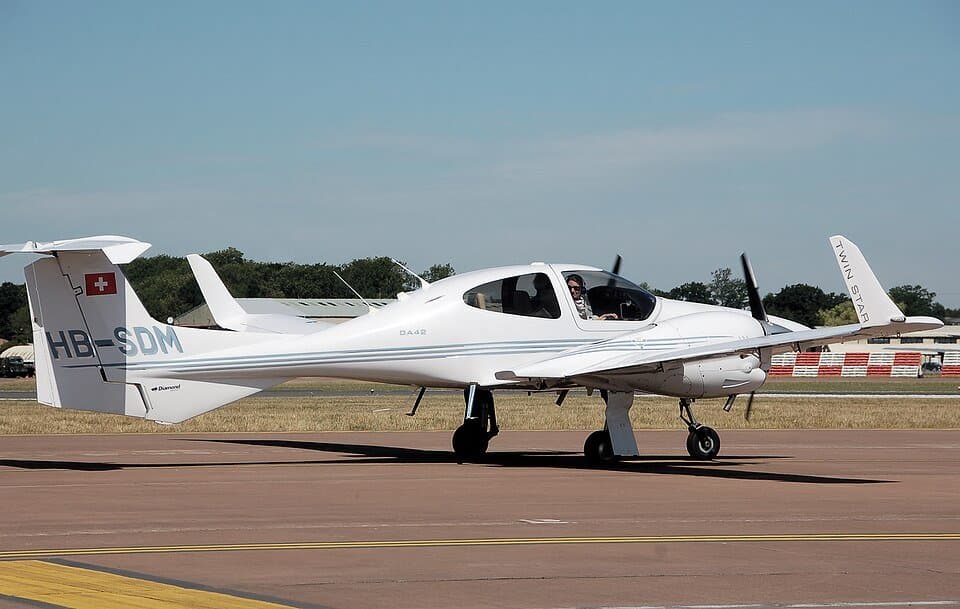

Credit
Photographed by myself (Adrian Pingstone) · Public domain · Resized · Public domain · Source ↗ · Modified


Preparing your view.
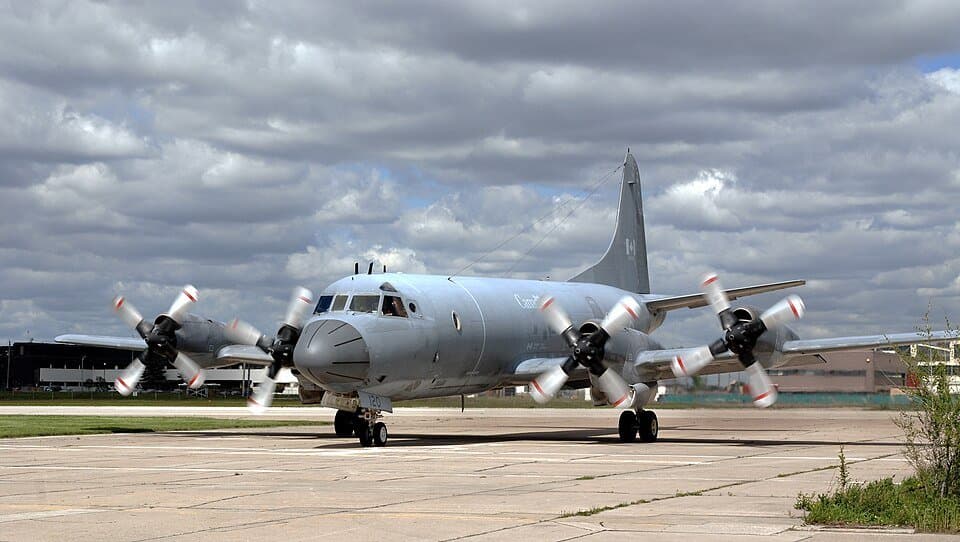

BTrainer aircraft
Maritime patrol aircraft (CP-140) MPA trainer aircraft (CP-140A)
At a glance
Measured figures
DA42 Twin Star · Length
Single source8.56 m (28 ft 1 in)[source]
CP-140 Aurora · Length
Configuration
| Specification | Diamond DA42 Twin Star | Lockheed CP-140 Aurora |
|---|---|---|
| Type | Light twin-engined utility and trainer aircraft[source] | Maritime patrol aircraft (CP-140) MPA trainer aircraft (CP-140A)[source] |
| National origin | Austria[source] | — |
| Manufacturer | Diamond Aircraft Industries[source] | Lockheed Corporation[source] |
| Status | In production[source] | Active (CP-140M only) |
CP-140 · Length
Single sourceCruise; DA42 Twin Star · Cruise speed
Single sourceMaximum; DA42 Twin Star · Maximum speed
Single source365 km/h (227 mph, 197 kn)[source]
326 km/h (203 mph, 176 kn)[source]
Maximum; CP-140 Aurora · Maximum speed · Maximum speed
Single sourceMaximum; CP-140 · below cruise ceiling
Single sourceDA42 Twin Star · 2 × Austro Engine E4 turbocharged diesel engine each
Single source2 × Austro Engine E4 turbocharged diesel engine , 125 kW (168 hp) each[source]
CP-140 · 4 × Allison T56-A-14-LFE turboprop engines each
Single source4 × Allison T56-A-14-LFE turboprop engines, 4,909 hp (3,661 kW) each[source]
DA42 Twin Star · 1,280 ft/min
Single source7.9 m/s (1,280 ft/min)[source]
CP-140 · on station at 1,000 nmi (1,151 mi; 1,852 km) radius
Single source8 hours 12 minutes on station at 1,000 nmi (1,151 mi; 1,852 km) radius[source]
CP-140 · Hardpoints: 8 in weapons bay; 10 under-wing from capacity with a capacity of
Single sourceCP-140 · total in weapons bay, with provisions to carry combinations of
Single sourceHardpoints: 8 in weapons bay; 10 under-wing from 611 to 2,450 lb (277 to 1,111 kg) capacity with a capacity of 4,800 lb (2,177 kg) total in weapons bay, with provisions to carry combinations of:[source]
Bars compare reported quantities only. A larger figure does not make a system better; configurations and test conditions differ.
| Number built | 600+ (2010)[source] | 21 (18 CP-140M + 3 CP-140A)[source] |
|---|
| Manufactured | 2002–present[source] | — |
|---|
| Introduction date | 2004[source] | 1980[source] |
|---|
| First flight | 9 December 2002[source] | 22 March 1979 (CP-140)[source] |
|---|
| Variant | Aeronautics Defense Dominator[source] | — |
|---|
| Capacity | 3 passengers[source] | — |
|---|
| Fuel capacity | 289 litres (64 imp gal; 76 US gal)[source] | 7,661 imp gal (9,200 US gal; 34,828 L) usable fuel in one fuselage tank and four wing integral tanks[source] |
|---|
| Source measurement | During August 2004, the DA42 Twin Star piloted by Gérard Guillaumaud became the first diesel-powered fixed-wing aircraft to perform a non-stop crossing of the North Atlantic, taking 12.5 hours while operating with an average fuel consumption of 21.73 litres (4.78 imp gal; 5.74 US gal) per hour (10.86 litres (2.39 imp gal; 2.87 US gal) per hour per engine). In June 2010, a DA42 powered by Austro AE300 engines became the first aircraft to be publicly flown on algae -derived jet fuel.[source]Diamond DA42 Twin Star · Development / Origins; only the objects and conditions stated in this passage The DA42 typically accommodates four people in two rows of seating. All of the seats have been designed for crashworthiness and are complete with automotive-style three-point seat belts; while the seats themselves are fixed in position, the position of the rudder-pedals is adjustable. The front pair of seats are accessed via a front-hinged canopy while a top-hinged door located on the left side provides access to the rear seats. The pilots are housed under a sizable canopy which provides generous external visibility, save for the use of a large fixed sunscreen. Additionally, separate baggage compartments, which are accessible via external hatches, are contained within internal space in the aircraft's nose.[source]Diamond DA42 Twin Star · Design / Overview; only the objects and conditions stated in this passage The stall characteristics are also relatively benign, being described by Flight International as "probably the most docile of any aircraft I can remember". On the DA42, stall conditions are forewarned by the sounding of a warning horn at 5 to 7 kn (9 to 13 km/h) above stall, as well as by elevating levels of airframe buffeting and a 5–10° drop of the nose. The aircraft is relatively difficult to stall outside of substantial mishandling or deliberate intention. Both longitudinal and lateral stability can be maintained with a relatively low level of effort, not necessitating continuous trimming while the aircraft is accelerating. Active use of the rudder is necessary for effective turns and counteracting sideslip tendencies.[source]Diamond DA42 Twin Star · Design / Performance; only the objects and conditions stated in this passage While the DA42 is a twin-engined aircraft, this is predominantly a measure for safety. It is readily capable of sustained flight using only a single engine. DA42 NG climbs at up to 270 ft/min at sea level in standard conditions on a single engine, with performance degrading with higher altitudes and temperatures. The DA42 possesses considerable endurance, being capable of performing 13 hour-long flights without carrying additional fuel tanks; this is partially due to its high fuel efficiency of its Austro engines, which consume 13.6 US gallons per hour when operated at 75 per cent power, lower than some of its single-engined rivals. The digital FADEC (full authority digital engine controls) serves to lower operational difficulty, constantly performing tasks such as managing rpm and fault-checking. The propellers are clockwise-rotating as viewed by the pilot, so the left engine is the critical engine .[source]Diamond DA42 Twin Star · Design / Performance; only the objects and conditions stated in this passage The original model of the DA42 was powered by a pair of Thielert Aircraft Engines-built TAE 125-01 Centurion 1.7 engines. However, Thielert ended its production of the 1.7 litre Centurion engines in favour of a new 2.0 litre engine, marketed as the TAE 125-02-99; as a result of the engine production change, Diamond began installing the TAE 125-02-99 engine during early 2007. Although engine displacement had increased, it was deliberately de-rated in order to produce the same power 101 kW (135 hp) and torque 409 N⋅m (302 lbf⋅ft) as the earlier 1.7 L. engine.[source]Diamond DA42 Twin Star · Design / Powerplants; only the objects and conditions stated in this passage The DA42NG "New Generation" is powered by Diamond's third generation Austro AE 300 turbo diesel engine. The Lycoming IO-360 engine is also available as an option. The 125 kW (168 hp) AE 300 engine replaces the earlier Thielert Centurion 1.7 and 2.0 engines and is known for its good fuel efficiency, using 12.1 litres (2.7 imp gal; 3.2 US gal) per hour while loitering at maximum endurance or 30 litres (7 imp gal; 8 US gal) per hour at maximum continuous power (92%). It is also available with optional "on top" exhaust mufflers that reduce noise levels to below 59 decibels at a height of 500 feet (150 m). The Austro engine produces 20% more power than the previous Thielert engines and also results in a higher gross weight and increased performance. Diamond has claimed that the Austro engine is about 46% more fuel efficient than its gasoline rivals. It runs on diesel fuel or jet fuel , both of which are typically cheaper than aviation gasoline .[source]Diamond DA42 Twin Star · Design / Powerplants; only the objects and conditions stated in this passage The DA42, particularly its use in the surveillance sector, became Diamond's most important business. A dedicated surveillance model of the aircraft, designated as the DA 42 MPP , was developed; during 2008, Diamond delivered 17 DA 42 MPPs and anticipated a demand for between 50 and 60 such aircraft per year. During the latter part of 2008 and early 2009, a pair of Royal Air Force DA42 MPPs were deployed for eight months to provide combat support to coalition forces operating in Iraq ; during the deployment, these aircraft flew a combined 2,000h in the surveillance role, for which it had been outfitted with Cineflex high-definition cameras, Riegl laser scanners and Scotty satellite communications kit.[source]Diamond DA42 Twin Star · Operational history / DA42 MPP; only the objects and conditions stated in this passage Lycoming IO-360 134 kW (180 hp) equipped version using 100LL fuel instead of Jet-A1 . This model is intended for the North American flight training market.[source]Diamond DA42 Twin Star · Variants; only the objects and conditions stated in this passage Austro Engine AE 300 127 kW (170 hp) equipped version. EASA certified March 2009; FAA certified April 2010; Transport Canada certified 16 April 2012. Production aircraft have been built in Austria, Canada, China and Russia.[source]Diamond DA42 Twin Star · Variants; only the objects and conditions stated in this passage Aurora Flight Sciences developed an Optionally Piloted Aircraft (OPA) as an Intelligence, Surveillance and Reconnaissance (ISR) platform and can be operated as either unmanned or with pilots on board. One in service with the Swiss military procurement agency Armasuisse .[source]Diamond DA42 Twin Star · Variants; only the objects and conditions stated in this passage Aeronautics Defense Systems Ltd developed an UAV version of the DA42, designated as the Aeronautics Defense Dominator and first flown in July 2009. Has an endurance of 28 hours with a 408 kg (899 lb) payload and speed of 140–354 km/h (75–190 knots) to a maximum altitude of 9,144 m (30,000 ft).[source]Diamond DA42 Twin Star · Variants; only the objects and conditions stated in this passage Royal Air Force – 2 x DA42MPP operated in 2008 and 2009 in surveillance role.[source]Diamond DA42 Twin Star · Operators / Military operators; only the objects and conditions stated in this passage Capacity: 3 passengers[source]Diamond DA42 Twin Star · Specifications (DA42 Twin Star); only the objects and conditions stated in this passage Length: 8.56 m (28 ft 1 in)[source]Diamond DA42 Twin Star · Specifications (DA42 Twin Star); only the objects and conditions stated in this passage Wingspan: 13.55 m (44 ft 5 in)[source]Diamond DA42 Twin Star · Specifications (DA42 Twin Star); only the objects and conditions stated in this passage Height: 2.49 m (8 ft 2 in)[source]Diamond DA42 Twin Star · Specifications (DA42 Twin Star); only the objects and conditions stated in this passage Wing area: 16.29 m 2 (175.3 sq ft)[source]Diamond DA42 Twin Star · Specifications (DA42 Twin Star); only the objects and conditions stated in this passage Empty weight: 1,420 kg (3,131 lb)[source]Diamond DA42 Twin Star · Specifications (DA42 Twin Star); only the objects and conditions stated in this passage Gross weight: 1,999 kg (4,407 lb)[source]Diamond DA42 Twin Star · Specifications (DA42 Twin Star); only the objects and conditions stated in this passage Fuel capacity: 289 litres (64 imp gal; 76 US gal)[source]Diamond DA42 Twin Star · Specifications (DA42 Twin Star); only the objects and conditions stated in this passage Powerplant: 2 × Austro Engine E4 turbocharged diesel engine , 125 kW (168 hp) each[source]Diamond DA42 Twin Star · Specifications (DA42 Twin Star); only the objects and conditions stated in this passage Maximum speed: 365 km/h (227 mph, 197 kn)[source]Diamond DA42 Twin Star · Specifications (DA42 Twin Star); only the objects and conditions stated in this passage Cruise speed: 326 km/h (203 mph, 176 kn)[source]Diamond DA42 Twin Star · Specifications (DA42 Twin Star); only the objects and conditions stated in this passage Range: 2,250 km (1,400 mi, 1,210 nmi)[source]Diamond DA42 Twin Star · Specifications (DA42 Twin Star); only the objects and conditions stated in this passage Service ceiling: 5,486 m (18,000 ft)[source]Diamond DA42 Twin Star · Specifications (DA42 Twin Star); only the objects and conditions stated in this passage Rate of climb: 7.9 m/s (1,280 ft/min)[source]Diamond DA42 Twin Star · Specifications (DA42 Twin Star); only the objects and conditions stated in this passage | Once AIMP was completed the CP-140 was designated as CP-140M.[source]Lockheed CP-140 Aurora · Design and development / Aurora Incremental Modernization Project; only the objects and conditions stated in this passage Several options had been suggested for a CP-140M replacement. These included the Boeing P-8 Poseidon and the Raytheon Sentinel , based on the Bombardier Global Express -6500, as well as late entrant PAL Aerospace Global Express 6500-based P-6.[source]Lockheed CP-140 Aurora · Operational history / Replacement; only the objects and conditions stated in this passage The RCAF had planned to downsize the fleet from eighteen to fourteen aircraft, with three already being withdrawn and a fourth test aircraft to be retired in the near future. The retirement of the CP-140 was originally expected around 2030, and could have resulted in a capability gap as the RCAF did not anticipate replacements to be delivered until 2032 to 2038. The RCAF's Weapon System Manager (WSM) had prepared plans to have the CP-140M operational until 2035 to 2040.[source]Lockheed CP-140 Aurora · Operational history / Replacement; only the objects and conditions stated in this passage Royal Canadian Air Force 404 Long Range Patrol and Training Squadron , CFB Greenwood , Nova Scotia 4 × CP-140M Aurora 405 Long Range Patrol Squadron , CFB Greenwood , Nova Scotia 11 × CP-140M Aurora and 1 × CP-140 Aurora to be retained as a test aircraft until retirement in the near future. 415 Long Range Patrol Force Development Squadron , CFB Greenwood , Nova Scotia 407 Long Range Patrol Squadron , CFB Comox , British Columbia 3 × CP-140M Aurora[source]Lockheed CP-140 Aurora · Operators; only the objects and conditions stated in this passage Length: 116 ft 10 in (35.61 m) |
|---|
| Origin reported by inventory | Germany United States[source]Inventory Origin column; table 1, row 20, cell 4; revision 1374084968; retrieved 2026-10-01 | — |
|---|
| Primary user | — | Royal Canadian Air Force[source] |
|---|
| Retired | — | 2011 (CP-140A only)[source] |
|---|
| Developed from | — | Lockheed P-3 Orion[source] |
|---|
| Aspect ratio | — | 7.5[source] |
|---|
| Airfoil | — | root: NACA 0014 (modified) ; tip: NACA 0012 (modified)[source] |
|---|
| Propellers | — | 4-bladed Hamilton Standard 54H60, 13 ft 6 in (4.11 m) diameter constant-speed fully-feathering reversible-pitch propellers[source] |
|---|
| Maximum transit speed | — | 395 kn (455 mph; 732 km/h) at optimum altitude[source] |
|---|
| FAR balanced field length | — | 7,900 ft (2,408 m)[source] |
|---|
| Take-off distance to 50 ft (15 m) | — | 6,000 ft (1,829 m)[source] |
|---|
| Landing distance from 50 ft (15 m) | — | 3,200 ft (975 m) at 114,000 lb (51,710 kg) landing weight[source] |
|---|
| Hardpoints | — | 8 in weapons bay; 10 under-wing from 611 to 2,450 lb (277 to 1,111 kg) capacity with a capacity of 4,800 lb (2,177 kg) total in weapons bay, with provisions to carry combinations of:[source] |
|---|
| Other | — | signal chargers, smoke markers , illumination flares[source] |
|---|
| Rockets | — | air-to-surface rockets can be fitted after a minor retrofit.[source] |
|---|
| Bombs | — | Mk 46 Mod V torpedoes, conventional bombs[source] |
|---|
| Role | — | maritime patrol aircraft[source] |
|---|
| Country of origin | — | United States[source] United States[source] United States[source]Inventory Origin column; table 1, row 7, cell 2; revision 1376991819; retrieved 2026-10-02 |
|---|
375 kn (432 mph, 694 km/h) below cruise ceiling[source]
750 km/h[source]CP-140 Aurora · Maximum speed
Wingspan: 99 ft 8 in (30.38 m)[source]Lockheed CP-140 Aurora · Specifications (CP-140); only the objects and conditions stated in this passage
Height: 33 ft 8.5 in (10.274 m)[source]Lockheed CP-140 Aurora · Specifications (CP-140); only the objects and conditions stated in this passage
Wing area: 1,300 sq ft (120 m 2 )[source]Lockheed CP-140 Aurora · Specifications (CP-140); only the objects and conditions stated in this passage
Gross weight: 61,362 lb (27,833 kg)[source]Lockheed CP-140 Aurora · Specifications (CP-140); only the objects and conditions stated in this passage
Powerplant: 4 × Allison T56-A-14-LFE turboprop engines, 4,909 hp (3,661 kW) each[source]Lockheed CP-140 Aurora · Specifications (CP-140); only the objects and conditions stated in this passage
Propellers: 4-bladed Hamilton Standard 54H60, 13 ft 6 in (4.11 m) diameter constant-speed fully-feathering reversible-pitch propellers[source]Lockheed CP-140 Aurora · Specifications (CP-140); only the objects and conditions stated in this passage
Maximum speed: 375 kn (432 mph, 694 km/h) below cruise ceiling[source]Lockheed CP-140 Aurora · Specifications (CP-140); only the objects and conditions stated in this passage
Maximum transit speed: 395 kn (455 mph; 732 km/h) at optimum altitude[source]Lockheed CP-140 Aurora · Specifications (CP-140); only the objects and conditions stated in this passage
Range: 5,000 nmi (5,800 mi, 9,300 km)[source]Lockheed CP-140 Aurora · Specifications (CP-140); only the objects and conditions stated in this passage
Endurance: 8 hours 12 minutes on station at 1,000 nmi (1,151 mi; 1,852 km) radius[source]Lockheed CP-140 Aurora · Specifications (CP-140); only the objects and conditions stated in this passage
Service ceiling: 35,100 ft (10,700 m)[source]Lockheed CP-140 Aurora · Specifications (CP-140); only the objects and conditions stated in this passage
FAR balanced field length: 7,900 ft (2,408 m)[source]Lockheed CP-140 Aurora · Specifications (CP-140); only the objects and conditions stated in this passage
Take-off distance to 50 ft (15 m): 6,000 ft (1,829 m)[source]Lockheed CP-140 Aurora · Specifications (CP-140); only the objects and conditions stated in this passage
Landing distance from 50 ft (15 m): 3,200 ft (975 m) at 114,000 lb (51,710 kg) landing weight[source]Lockheed CP-140 Aurora · Specifications (CP-140); only the objects and conditions stated in this passage
Hardpoints: 8 in weapons bay; 10 under-wing from 611 to 2,450 lb (277 to 1,111 kg) capacity with a capacity of 4,800 lb (2,177 kg) total in weapons bay, with provisions to carry combinations of: Other: signal chargers, smoke markers , illumination flares[source]Lockheed CP-140 Aurora · Specifications (CP-140); only the objects and conditions stated in this passage