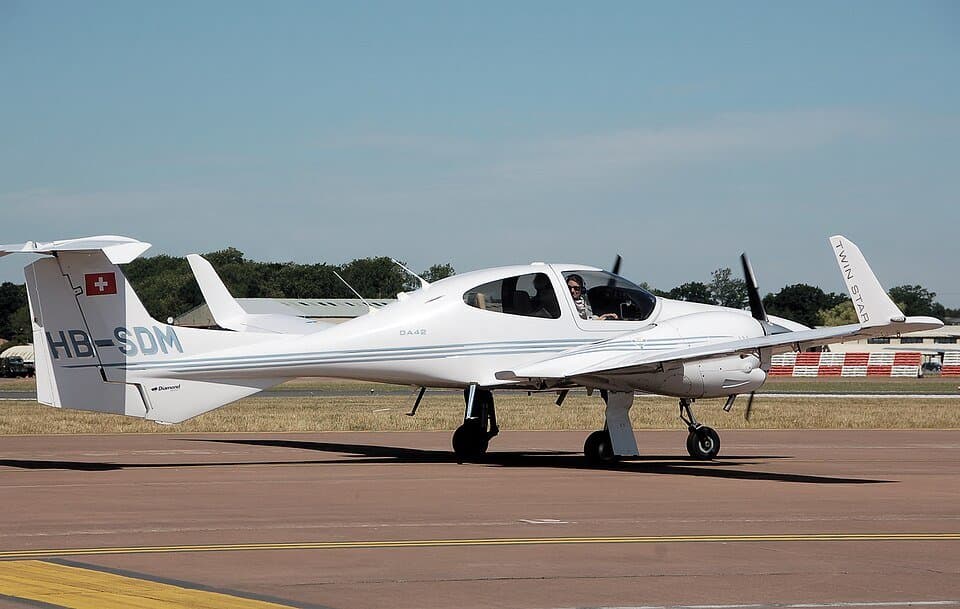

Credit
Photographed by myself (Adrian Pingstone) · Public domain · Resized · Public domain · Source ↗ · Modified


Preparing your view.

At a glance
Measured figures
DA42 Twin Star · Length
Single source8.56 m (28 ft 1 in)[source]
Configuration
| Specification | Diamond DA42 Twin Star | Humbert Tétras |
|---|---|---|
| Type | Light twin-engined utility and trainer aircraft[source] | Two seat ultralight or kit build[source] |
| National origin | Austria[source] | France[source] |
| Manufacturer | Diamond Aircraft Industries[source] | Humbert Aviation[source] |
| Status | In production[source] | In production |
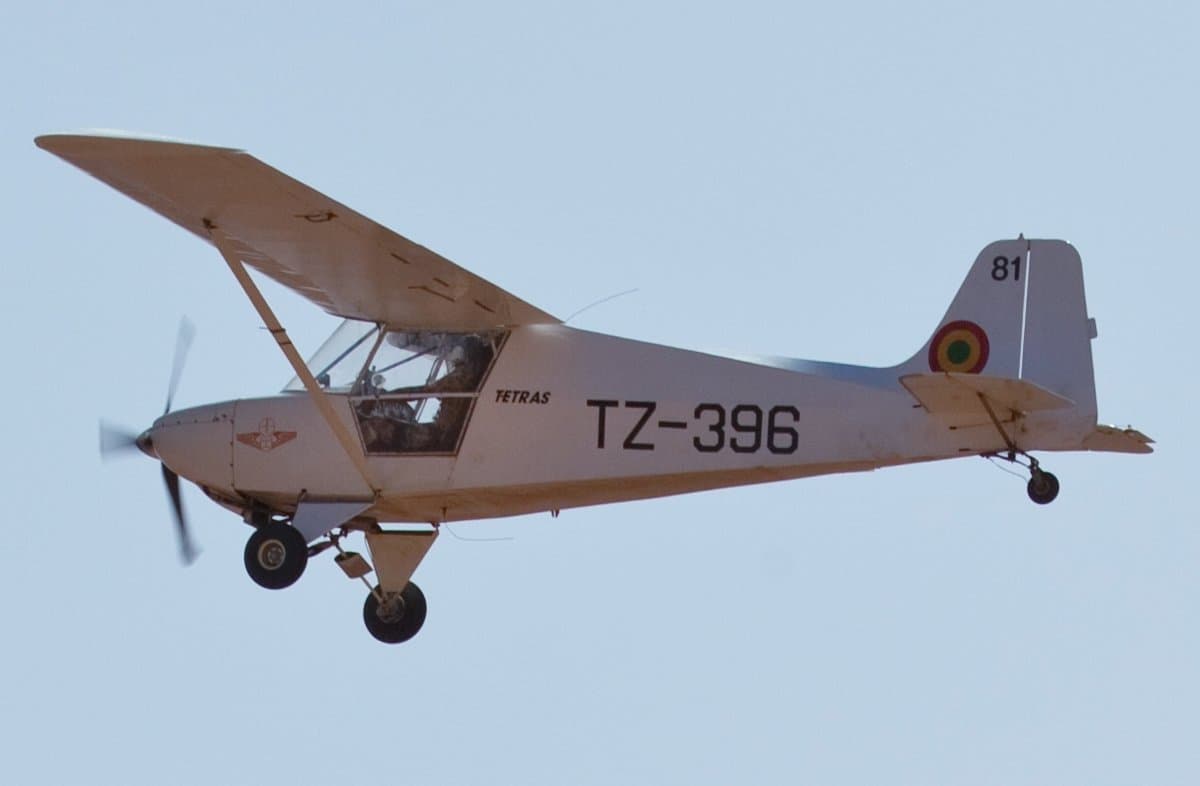
Humbert 'Tetras' · own Aviafrance technical table (Jane's All the World Aircraft 2004–2005)
Tétras B · Length
Single source6.50 m (21 ft 4 in)[source]
6.50 m[source]Humbert 'Tetras' · own Aviafrance technical table (Jane's All the World Aircraft 2004–2005)
DA42 Twin Star · Wingspan
Single source13.55 m (44 ft 5 in)[source]
DA42 Twin Star · Height
Single source2.49 m (8 ft 2 in)[source]
Empty; DA42 Twin Star · Empty weight
Single sourceGross; DA42 Twin Star · Gross weight
Single sourceMaximum take-off; Manufacturer standard equipped DA42 specifications on page illustrated as DA42-VI; source states approximately specifications and may change without notice · Manufacturer standard equipped DA42 specifications on page illustrated as DA42-VI; source states approximately specifications and may change without notice · source measurement 1
Single sourceMaximum take-off; Manufacturer standard equipped DA42 specifications on page illustrated as DA42-VI; source states approximately specifications and may change without notice · Manufacturer standard equipped DA42 specifications on page illustrated as DA42-VI; source states approximately specifications and may change without notice · source measurement 2
Single source1,420 kg (3,131 lb)[source]
1,999 kg (4,407 lb)[source]
1,999 kg 4,407 lbs[source]Manufacturer standard equipped DA42 specifications on page illustrated as DA42-VI; source states approximately specifications and may change without notice
Empty; Humbert 'Tetras' · own Aviafrance technical table (Jane's All the World Aircraft 2004–2005)
Single sourceEmpty; Tétras B · Empty weight
Single sourceCruise; DA42 Twin Star · Cruise speed
Single sourceMaximum; DA42 Twin Star · Maximum speed
Single source365 km/h (227 mph, 197 kn)[source]
326 km/h (203 mph, 176 kn)[source]
Cruise; Tétras B · at 75% power and 3,048 m (10,000 ft)
Single sourceMaximum; Humbert 'Tetras' · own Aviafrance technical table (Jane's All the World Aircraft 2004–2005)
Single sourceDA42 Twin Star · Range
Single source2,250 km (1,400 mi, 1,210 nmi)[source]
Humbert 'Tetras' · own Aviafrance technical table (Jane's All the World Aircraft 2004–2005)
Single sourceTétras B · with standard fuel capacity
Single source700 km (430 mi, 380 nmi) with standard fuel capacity[source]
610 km[source]Humbert 'Tetras' · own Aviafrance technical table (Jane's All the World Aircraft 2004–2005)
DA42 Twin Star · Service ceiling
Single source5,486 m (18,000 ft)[source]
Bars compare reported quantities only. A larger figure does not make a system better; configurations and test conditions differ.
| Number built | 600+ (2010)[source] | c.150 by 2010[source] |
|---|
| Manufactured | 2002–present[source] | 1992-present[source] |
|---|
| Introduction date | 2004[source] | 1994[source] |
|---|
| First flight | 9 December 2002[source] | c.1992[source] |
|---|
| Variant | Aeronautics Defense Dominator[source] | — |
|---|
| Capacity | 3 passengers[source] |
|---|
| Fuel capacity | 289 litres (64 imp gal; 76 US gal)[source] | 60 L (15.9 USgal, 13.2 Impgal) standard. Can be increased to 85 L (22.5 USgal, 18.7 Impgal) outside France.[source] |
|---|
| Source measurement | During August 2004, the DA42 Twin Star piloted by Gérard Guillaumaud became the first diesel-powered fixed-wing aircraft to perform a non-stop crossing of the North Atlantic, taking 12.5 hours while operating with an average fuel consumption of 21.73 litres (4.78 imp gal; 5.74 US gal) per hour (10.86 litres (2.39 imp gal; 2.87 US gal) per hour per engine). In June 2010, a DA42 powered by Austro AE300 engines became the first aircraft to be publicly flown on algae -derived jet fuel.[source]Diamond DA42 Twin Star · Development / Origins; only the objects and conditions stated in this passage The DA42 typically accommodates four people in two rows of seating. All of the seats have been designed for crashworthiness and are complete with automotive-style three-point seat belts; while the seats themselves are fixed in position, the position of the rudder-pedals is adjustable. The front pair of seats are accessed via a front-hinged canopy while a top-hinged door located on the left side provides access to the rear seats. The pilots are housed under a sizable canopy which provides generous external visibility, save for the use of a large fixed sunscreen. Additionally, separate baggage compartments, which are accessible via external hatches, are contained within internal space in the aircraft's nose.[source]Diamond DA42 Twin Star · Design / Overview; only the objects and conditions stated in this passage The stall characteristics are also relatively benign, being described by Flight International as "probably the most docile of any aircraft I can remember". On the DA42, stall conditions are forewarned by the sounding of a warning horn at 5 to 7 kn (9 to 13 km/h) above stall, as well as by elevating levels of airframe buffeting and a 5–10° drop of the nose. The aircraft is relatively difficult to stall outside of substantial mishandling or deliberate intention. Both longitudinal and lateral stability can be maintained with a relatively low level of effort, not necessitating continuous trimming while the aircraft is accelerating. Active use of the rudder is necessary for effective turns and counteracting sideslip tendencies.[source]Diamond DA42 Twin Star · Design / Performance; only the objects and conditions stated in this passage While the DA42 is a twin-engined aircraft, this is predominantly a measure for safety. It is readily capable of sustained flight using only a single engine. DA42 NG climbs at up to 270 ft/min at sea level in standard conditions on a single engine, with performance degrading with higher altitudes and temperatures. The DA42 possesses considerable endurance, being capable of performing 13 hour-long flights without carrying additional fuel tanks; this is partially due to its high fuel efficiency of its Austro engines, which consume 13.6 US gallons per hour when operated at 75 per cent power, lower than some of its single-engined rivals. The digital FADEC (full authority digital engine controls) serves to lower operational difficulty, constantly performing tasks such as managing rpm and fault-checking. The propellers are clockwise-rotating as viewed by the pilot, so the left engine is the critical engine .[source]Diamond DA42 Twin Star · Design / Performance; only the objects and conditions stated in this passage The original model of the DA42 was powered by a pair of Thielert Aircraft Engines-built TAE 125-01 Centurion 1.7 engines. However, Thielert ended its production of the 1.7 litre Centurion engines in favour of a new 2.0 litre engine, marketed as the TAE 125-02-99; as a result of the engine production change, Diamond began installing the TAE 125-02-99 engine during early 2007. Although engine displacement had increased, it was deliberately de-rated in order to produce the same power 101 kW (135 hp) and torque 409 N⋅m (302 lbf⋅ft) as the earlier 1.7 L. engine.[source]Diamond DA42 Twin Star · Design / Powerplants; only the objects and conditions stated in this passage The DA42NG "New Generation" is powered by Diamond's third generation Austro AE 300 turbo diesel engine. The Lycoming IO-360 engine is also available as an option. The 125 kW (168 hp) AE 300 engine replaces the earlier Thielert Centurion 1.7 and 2.0 engines and is known for its good fuel efficiency, using 12.1 litres (2.7 imp gal; 3.2 US gal) per hour while loitering at maximum endurance or 30 litres (7 imp gal; 8 US gal) per hour at maximum continuous power (92%). It is also available with optional "on top" exhaust mufflers that reduce noise levels to below 59 decibels at a height of 500 feet (150 m). The Austro engine produces 20% more power than the previous Thielert engines and also results in a higher gross weight and increased performance. Diamond has claimed that the Austro engine is about 46% more fuel efficient than its gasoline rivals. It runs on diesel fuel or jet fuel , both of which are typically cheaper than aviation gasoline .[source]Diamond DA42 Twin Star · Design / Powerplants; only the objects and conditions stated in this passage The DA42, particularly its use in the surveillance sector, became Diamond's most important business. A dedicated surveillance model of the aircraft, designated as the DA 42 MPP , was developed; during 2008, Diamond delivered 17 DA 42 MPPs and anticipated a demand for between 50 and 60 such aircraft per year. During the latter part of 2008 and early 2009, a pair of Royal Air Force DA42 MPPs were deployed for eight months to provide combat support to coalition forces operating in Iraq ; during the deployment, these aircraft flew a combined 2,000h in the surveillance role, for which it had been outfitted with Cineflex high-definition cameras, Riegl laser scanners and Scotty satellite communications kit.[source]Diamond DA42 Twin Star · Operational history / DA42 MPP; only the objects and conditions stated in this passage Lycoming IO-360 134 kW (180 hp) equipped version using 100LL fuel instead of Jet-A1 . This model is intended for the North American flight training market.[source]Diamond DA42 Twin Star · Variants; only the objects and conditions stated in this passage Austro Engine AE 300 127 kW (170 hp) equipped version. EASA certified March 2009; FAA certified April 2010; Transport Canada certified 16 April 2012. Production aircraft have been built in Austria, Canada, China and Russia.[source]Diamond DA42 Twin Star · Variants; only the objects and conditions stated in this passage Aurora Flight Sciences developed an Optionally Piloted Aircraft (OPA) as an Intelligence, Surveillance and Reconnaissance (ISR) platform and can be operated as either unmanned or with pilots on board. One in service with the Swiss military procurement agency Armasuisse .[source]Diamond DA42 Twin Star · Variants; only the objects and conditions stated in this passage Aeronautics Defense Systems Ltd developed an UAV version of the DA42, designated as the Aeronautics Defense Dominator and first flown in July 2009. Has an endurance of 28 hours with a 408 kg (899 lb) payload and speed of 140–354 km/h (75–190 knots) to a maximum altitude of 9,144 m (30,000 ft).[source]Diamond DA42 Twin Star · Variants; only the objects and conditions stated in this passage Royal Air Force – 2 x DA42MPP operated in 2008 and 2009 in surveillance role.[source]Diamond DA42 Twin Star · Operators / Military operators; only the objects and conditions stated in this passage Capacity: 3 passengers[source]Diamond DA42 Twin Star · Specifications (DA42 Twin Star); only the objects and conditions stated in this passage Length: 8.56 m (28 ft 1 in)[source]Diamond DA42 Twin Star · Specifications (DA42 Twin Star); only the objects and conditions stated in this passage Wingspan: 13.55 m (44 ft 5 in)[source]Diamond DA42 Twin Star · Specifications (DA42 Twin Star); only the objects and conditions stated in this passage Height: 2.49 m (8 ft 2 in)[source]Diamond DA42 Twin Star · Specifications (DA42 Twin Star); only the objects and conditions stated in this passage Wing area: 16.29 m 2 (175.3 sq ft)[source]Diamond DA42 Twin Star · Specifications (DA42 Twin Star); only the objects and conditions stated in this passage Empty weight: 1,420 kg (3,131 lb)[source]Diamond DA42 Twin Star · Specifications (DA42 Twin Star); only the objects and conditions stated in this passage Gross weight: 1,999 kg (4,407 lb)[source]Diamond DA42 Twin Star · Specifications (DA42 Twin Star); only the objects and conditions stated in this passage Fuel capacity: 289 litres (64 imp gal; 76 US gal)[source]Diamond DA42 Twin Star · Specifications (DA42 Twin Star); only the objects and conditions stated in this passage Powerplant: 2 × Austro Engine E4 turbocharged diesel engine , 125 kW (168 hp) each[source]Diamond DA42 Twin Star · Specifications (DA42 Twin Star); only the objects and conditions stated in this passage Maximum speed: 365 km/h (227 mph, 197 kn)[source]Diamond DA42 Twin Star · Specifications (DA42 Twin Star); only the objects and conditions stated in this passage Cruise speed: 326 km/h (203 mph, 176 kn)[source]Diamond DA42 Twin Star · Specifications (DA42 Twin Star); only the objects and conditions stated in this passage Range: 2,250 km (1,400 mi, 1,210 nmi)[source]Diamond DA42 Twin Star · Specifications (DA42 Twin Star); only the objects and conditions stated in this passage Service ceiling: 5,486 m (18,000 ft)[source]Diamond DA42 Twin Star · Specifications (DA42 Twin Star); only the objects and conditions stated in this passage Rate of climb: 7.9 m/s (1,280 ft/min)[source]Diamond DA42 Twin Star · Specifications (DA42 Twin Star); only the objects and conditions stated in this passage | The Tétras has been fitted with a variety of engines; originally the 54 kW (72 hp) Humbert-Volkswagen HW 2000 was used. More recently two flat fours from the Rotax range, the 60 kW (80 hp) 912 UL or the 74 kW (98 hp) 912 ULS, have become standard choices.[source]Humbert Tétras · Design and development; only the objects and conditions stated in this passage Standard version, introduced 1998. Early examples had the HW 2000 engine but the 80 hp (60 kW) Rotax 912UL , or optionally the 100 hp (75 kW) Rotax 912ULS engine, is currently (2015) fitted. Currently available.[source]Humbert Tétras · Variants; only the objects and conditions stated in this passage Introduced 2007 with a 600 mm (23.6 in) shorter span wing. 912 ULS engine. Marketed 2008-9.[source]Humbert Tétras · Variants; only the objects and conditions stated in this passage Length: 6.50 m (21 ft 4 in)[source]Humbert Tétras · Specifications (Tétras B); only the objects and conditions stated in this passage Wingspan: 10.10 m (33 ft 2 in)[source]Humbert Tétras · Specifications (Tétras B); only the objects and conditions stated in this passage Height: 2.06 m (6 ft 9 in)[source]Humbert Tétras · Specifications (Tétras B); only the objects and conditions stated in this passage |
|---|
| Designer | — | Humbert Aviation[source] |
|---|
| Airfoil | — | NACA 23012[source] |
|---|
| Propellers | — | 2-bladed DUC FC composite, 1.75 m (5 ft 9 in) diameter[source] |
|---|
| Stall speed | — | 55 km/h (34 mph, 30 kn) flaps down[source] |
|---|
| g limits | — | +4/-2[source] |
|---|
| Engines | — | 1 Rotax 912 de 80 ch[source]Humbert 'Tetras' · own Aviafrance technical table (Jane's All the World Aircraft 2004–2005) |
|---|
Gross; Humbert 'Tetras' · own Aviafrance technical table (Jane's All the World Aircraft 2004–2005)
Single sourceMaximum take-off; Tétras B · Max takeoff weight
Single sourceMaximum take-off; Tétras B · where permitted
Single source256 kg (564 lb)[source]
450 kg (992 lb) ; where permitted, 495 kg (1,091 lb)[source]
260 kg[source]Humbert 'Tetras' · own Aviafrance technical table (Jane's All the World Aircraft 2004–2005)
450 kg[source]Humbert 'Tetras' · own Aviafrance technical table (Jane's All the World Aircraft 2004–2005)
Maximum; Tétras B · Maximum speed
Single source194 km/h (121 mph, 105 kn)[source]
180 km/h (110 mph, 97 kn) at 75% power and 3,048 m (10,000 ft)[source]
194 km/h à 0 m[source]Humbert 'Tetras' · own Aviafrance technical table (Jane's All the World Aircraft 2004–2005)
Wing area: 15.70 m 2 (169.0 sq ft)[source]Humbert Tétras · Specifications (Tétras B); only the objects and conditions stated in this passage
Empty weight: 256 kg (564 lb)[source]Humbert Tétras · Specifications (Tétras B); only the objects and conditions stated in this passage
Max takeoff weight: 450 kg (992 lb) ; where permitted, 495 kg (1,091 lb)[source]Humbert Tétras · Specifications (Tétras B); only the objects and conditions stated in this passage
Powerplant: 1 × Rotax 912 UL flat four , 59.6 kW (79.9 hp)[source]Humbert Tétras · Specifications (Tétras B); only the objects and conditions stated in this passage
Propellers: 2-bladed DUC FC composite, 1.75 m (5 ft 9 in) diameter[source]Humbert Tétras · Specifications (Tétras B); only the objects and conditions stated in this passage
Maximum speed: 194 km/h (121 mph, 105 kn)[source]Humbert Tétras · Specifications (Tétras B); only the objects and conditions stated in this passage
Cruise speed: 180 km/h (110 mph, 97 kn) at 75% power and 3,048 m (10,000 ft)[source]Humbert Tétras · Specifications (Tétras B); only the objects and conditions stated in this passage
Stall speed: 55 km/h (34 mph, 30 kn) flaps down[source]Humbert Tétras · Specifications (Tétras B); only the objects and conditions stated in this passage
Range: 700 km (430 mi, 380 nmi) with standard fuel capacity[source]Humbert Tétras · Specifications (Tétras B); only the objects and conditions stated in this passage
Rate of climb: 7.5 m/s (1,480 ft/min) maximum at sea level[source]Humbert Tétras · Specifications (Tétras B); only the objects and conditions stated in this passage