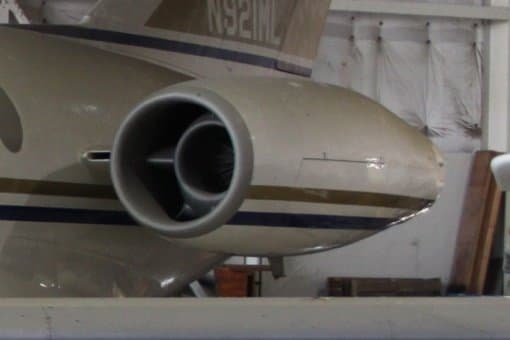

Credit
Aeroprints.com · CC BY-SA 3.0 · Resized · CC BY-SA 3.0 · Source ↗ · Modified


Preparing your view.
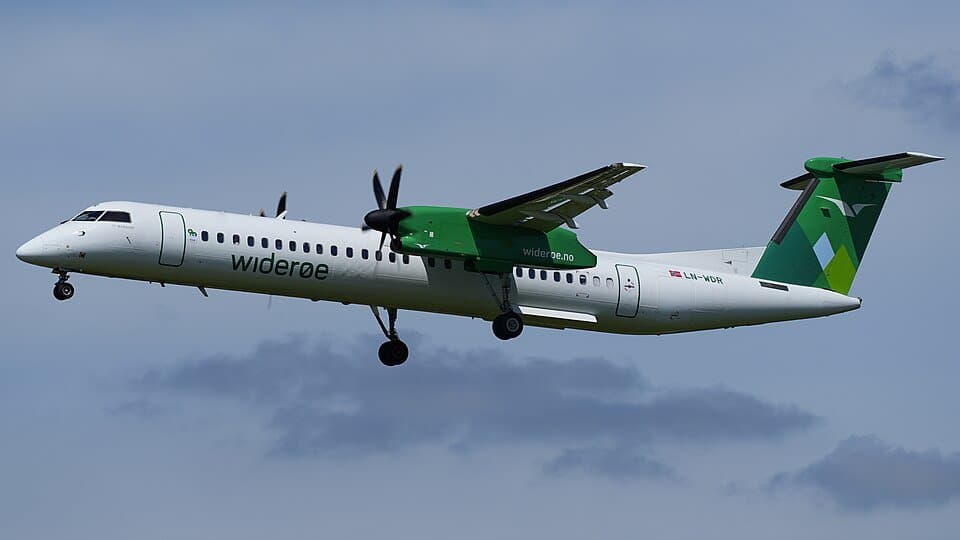

At a glance
Measured figures
Falcon 20F · Length
Single source17.15 m (56 ft 3 in)[source]
Length
Single sourceConfiguration
| Specification | Dassault Falcon 20 | De Havilland Canada Dash 8 |
|---|---|---|
| Type | Business jet[source] | Turboprop regional airliner[source] |
| Manufacturer | Dassault Aviation[source] | de Havilland Canada (1983–1992) Bombardier Aerospace (1992–2019) De Havilland Canada (2019–2022)[source] |
| Status | Out of production, in active service[source] | Production suspended since 2022, pending new facility[source] |
| Primary users | Federal Express (formerly) French Navy United States Coast Guard |
73 ft (22.25 m)[source]
Fuselage cabin
Single sourceWidth
Single sourceFuselage 8 ft 10 in (2.69 m), cabin 8 ft 3 in (2.52 m)[source]
Cruise; Falcon 20F · at 12,200 m (40,000 ft) (econ. cruise)
Single sourceMaximum; Falcon 20F · at 7,620 m (25,000 ft) (max cruise)
Single source862 km/h (536 mph, 465 kn) at 7,620 m (25,000 ft) (max cruise)[source]
750 km/h (470 mph, 400 kn) at 12,200 m (40,000 ft) (econ. cruise)[source]
100
Single sourceEngine power
Single source2,150 hp (1,600 kW) -100: 1,800 hp (1,300 kW)[source]
Falcon 20F · 2 × General Electric CF700 -2D-2 turbofans thrust each
Single source2 × General Electric CF700 -2D-2 turbofans , 20 kN (4,500 lbf) thrust each[source]
Bars compare reported quantities only. A larger figure does not make a system better; configurations and test conditions differ.
QantasLink WestJet Encore Widerøe Voyageur Airways[source] |
| Number built | 512[source] | 1,258 (as of March 31, 2019)[source] |
|---|
| Manufactured | 1965–1991[source] | 1983–2005 (-100) 1995–2009 (-200) 1989–2009 (-300) 1999–2022 (-400)[source] |
|---|
| Introduction date | 3 June 1965[source] | 1984 with NorOntair[source] |
|---|
| First flight | 4 May 1963[source] | June 20, 1983[source] |
|---|
| Developed into | Dassault Falcon 10 Dassault Falcon 50[source] | — |
|---|
| Capacity | 8–14 passengers[source] | — |
|---|
| Aspect ratio | 6.4:1[source] | — |
|---|
| Fuel capacity | 5,200 L (1,100 imp gal; 1,400 US gal)[source] | — |
|---|
| Stall speed | 152 km/h (94 mph, 82 kn)[source] | — |
|---|
| Role | French business jet[source] | series of turboprop -powered regional airliners , introduced[source] |
|---|
| National origin | France[source] | Canada[source] |
|---|
| Source measurement | During the 1950s and 1960s, the French government, which had taken a significant interest in the re-establishment and growth of its national aviation industries in the aftermath of the Second World War , developed a detailed request for a combined liaison / trainer aircraft, to be equipped with twin-turbofan engines. Among those companies that took interest in the government request was French aircraft manufacturer Dassault Aviation . In December 1961, French aircraft designer and head of Dassault Aviation, Marcel Dassault , gave the go-ahead to proceed with work towards the production of an eight- to 10-seat executive jet /military liaison aircraft, which was initially named as the Dassault-Breguet Mystère 20 . The emerging design was of a low-wing monoplane, which drew upon the aerodynamics of the transonic Dassault Mystère IV fighter-bomber , and was equipped with a pair of rear-mounted 14.68 kN (3,300 lbf) Pratt & Whitney JT12A-8 turbojet engines.[source]Dassault Falcon 20 · Development / Origins; only the objects and conditions stated in this passage Progress between Dassault and Pan Am was rapid, moving from engineering evaluations of the type to the formation of general agreements between the two companies. In response to feedback received from Pan American, the aircraft was re-engined with a pair of General Electric CF700 engines and several dimensions were increased. Accordingly, Pan American formed an agreement with Dassault to distribute the Mystère 20 in the western hemisphere; the firm placed an initial order for 40 aircraft along with options for a further 120. On 10 July 1964, the re-engined aircraft made its first flight. On 1 January 1965, the first production aircraft performed its maiden flight; in June 1965, both French and American type certifications were awarded. On 10 June 1965, French aviator Jacqueline Auriol achieved the women's world speed record using the first Mystère 20 prototype, having flown at an average recorded speed of 859 km/h over a distance of 1000 km.[source]Dassault Falcon 20 · Development / Origins; only the objects and conditions stated in this passage In 1973, FedEx's Falcons, designation FA-20-DC, cost $1.2 million each and were modified with a 55-by-74.5-inch forward cargo door with independent power supply, higher mtow, reinforced floor, plugged windows, and bigger brakes.[source]Dassault Falcon 20 · Development / Origins; only the objects and conditions stated in this passage An improved model of the aircraft, designated the Falcon 200 , was developed, which featured more advanced jet engines and other major improvements to increase range, capacity, and comfort. The Falcon 200, along with the Falcon 20G and HU-25 models, were powered by a pair of Garrett ATF3 engines. According to the magazine Flying , the Falcon 200 variant was more comparable to the newer Falcon 50 trijet than the original Falcon 20 model.[source]Dassault Falcon 20 · Development / Further development; only the objects and conditions stated in this passage During 2013, the FAA modified 14 CFR part 91 rules to prohibit the operation of jets weighing 75,000 pounds or less that were not Stage 3 noise compliant after 31 December 2015. The Falcon 20 was listed explicitly in Federal Register 78 FR 39576 . Any examples of the type that had not been modified, either by the installation of Stage 3 noise-compliant engines or have had hush kits installed upon noncompliant engines, were no longer permitted to fly anywhere in the contiguous 48 states after 31 December 2015. However, 14 CFR §91.883 Special flight authorizations for jet airplanes weighing 75,000 pounds or less – lists special flight authorizations that may be granted for operation after 31 December 2015.[source]Dassault Falcon 20 · Development / Further development; only the objects and conditions stated in this passage Prototype, one built. F-WLKB, initially powered by two 14.68 kN (3,300 lbf) Pratt & Whitney JT12A-8 turbojet engines. Now stored at Musée Air et Espace Aéroport Paris – Le Bourget.[source]Dassault Falcon 20 · Variants; only the objects and conditions stated in this passage Initial production version, with lengthened fuselage compared to first prototype and with 10–12 seats. Powered by 4,200 lbf (19 kN) CF700-2B engines.[source]Dassault Falcon 20 · Variants; only the objects and conditions stated in this passage Falcon 20CC (s/n 073)[source]Dassault Falcon 20 · Variants; only the objects and conditions stated in this passage Falcon 20G[source]Dassault Falcon 20 · Variants; only the objects and conditions stated in this passage Falcon 20H[source]Dassault Falcon 20 · Variants; only the objects and conditions stated in this passage Improved variant, powered by two 2360-kg (5,200-lb) Garrett ATF3-6A-4C turbofan engines and with more fuel. First flown on 30 April 1980.[source]Dassault Falcon 20 · Variants; only the objects and conditions stated in this passage United States Coast Guard version of the Falcon 20G. 41 built. Equipped with two Garrett AiResearch Garrett ATF3-6-2C turbofan engines.[source]Dassault Falcon 20 · Variants; only the objects and conditions stated in this passage Enlarged, 30-passenger commuter airliner derivative of Falcon 20, powered by two 27.0 kN (6,070 lbf) Lycoming ALF 502 D turbofans. One prototype built, first flying on 11 May 1973. No further production of Falcon 30 or proposed 40-passenger, shorter-range Mystére 40-100 .[source]Dassault Falcon 20 · Variants; only the objects and conditions stated in this passage Pakistan Air Force – 3 in service, including 2 DA-20s in EW , ECM , ESM roles[source]Dassault Falcon 20 · Operators / Current military operators; only the objects and conditions stated in this passage Royal Australian Air Force – Three in service from 1967 to 1989. No. 34 Squadron RAAF[source]Dassault Falcon 20 · Operators / Former military operators; only the objects and conditions stated in this passage Capacity: 8–14 passengers[source]Dassault Falcon 20 · Specifications (Falcon 20F); only the objects and conditions stated in this passage Length: 17.15 m (56 ft 3 in)[source]Dassault Falcon 20 · Specifications (Falcon 20F); only the objects and conditions stated in this passage Wingspan: 16.30 m (53 ft 6 in)[source]Dassault Falcon 20 · Specifications (Falcon 20F); only the objects and conditions stated in this passage Height: 5.32 m (17 ft 5 in)[source]Dassault Falcon 20 · Specifications (Falcon 20F); only the objects and conditions stated in this passage Wing area: 41.00 m 2 (441.3 sq ft)[source]Dassault Falcon 20 · Specifications (Falcon 20F); only the objects and conditions stated in this passage Empty weight: 7,530 kg (16,601 lb)[source]Dassault Falcon 20 · Specifications (Falcon 20F); only the objects and conditions stated in this passage Max takeoff weight: 13,000 kg (28,660 lb)[source]Dassault Falcon 20 · Specifications (Falcon 20F); only the objects and conditions stated in this passage Powerplant: 2 × General Electric CF700 -2D-2 turbofans , 20 kN (4,500 lbf) thrust each[source]Dassault Falcon 20 · Specifications (Falcon 20F); only the objects and conditions stated in this passage Maximum speed: 862 km/h (536 mph, 465 kn) at 7,620 m (25,000 ft) (max cruise)[source]Dassault Falcon 20 · Specifications (Falcon 20F); only the objects and conditions stated in this passage Cruise speed: 750 km/h (470 mph, 400 kn) at 12,200 m (40,000 ft) (econ. cruise)[source]Dassault Falcon 20 · Specifications (Falcon 20F); only the objects and conditions stated in this passage Stall speed: 152 km/h (94 mph, 82 kn)[source]Dassault Falcon 20 · Specifications (Falcon 20F); only the objects and conditions stated in this passage Range: 3,350 km (2,080 mi, 1,810 nmi)[source]Dassault Falcon 20 · Specifications (Falcon 20F); only the objects and conditions stated in this passage Service ceiling: 12,800 m (42,000 ft) (absolute ceiling)[source]Dassault Falcon 20 · Specifications (Falcon 20F); only the objects and conditions stated in this passage | In 1980, de Havilland responded by dropping the short-field performance requirement and adapting the basic Dash 7 layout to use only two, more powerful engines. Its favoured engine supplier, Pratt & Whitney Canada , developed the new PW100 series engines for the role, more than doubling the power from its PT6 . Originally designated the PT7A-2R engine, it later became the PW120. When the Dash 8 rolled out on April 19, 1983, more than 3,800 hours of testing had been accumulated over two years on five PW100 series test engines. The Dash 8 first flight was on June 20, 1983.[source]De Havilland Canada Dash 8 · Development / Initial development; only the objects and conditions stated in this passage The production of the Dash 8 Series 100 stopped in 2005, and that of the Series 200 and 300 in 2009.[source]De Havilland Canada Dash 8 · Development / Production; only the objects and conditions stated in this passage At the February 2016 Singapore Airshow , Bombardier announced a high-density, 90-seat layout of the Q400, which would enter service in 2018; keeping the 28 in (71 cm) seat pitch of the Nok Air 86-seats, an extra row of seats is allowed by changing the configuration of the front right door and moving back the aft pressure bulkhead . The payload is increased by 2,000 pounds (910 kg) and the aircraft maintenance check intervals are increased: 800 hours from 600 for an A-check and 8,000 hours from 6,000 for a C-check. By August 2018, the 90-seat variant was certified before delivery to launch customer SpiceJet later in the same year. In March 2021, EASA certified the 90-seat variant for European operations; DHC believed that there were opportunities with prospective European customers as of 2021 .[source]De Havilland Canada Dash 8 · Development / High-density, 90-seat Q400; only the objects and conditions stated in this passage The Dash 8 design has better cruise performance than the Dash 7, is less expensive to operate, and is much less expensive to maintain, due largely to having only two engines. It is a little noisier than the Dash 7 and cannot match the STOL performance of its earlier DHC forebears, although it is still able to operate from small airports with runways 3,000 ft (910 m) long, compared to the 2,200 ft (670 m) required by a fully laden Dash 7. |
|---|
| Country of origin | France[source]Inventory Origin column; table 1, row 54, cell 4; revision 1377423821; retrieved 2026-10-02 | — |
|---|
| Developed from | — | de Havilland Canada Dash 7[source] |
|---|
| Variant | — | De Havilland Canada E-9A Widget[source] |
|---|
36,300 lb (16,466 kg) -100: 34,500 lb (15,600 kg)[source]
The aircraft has been delivered in four series. The Series 100 has a maximum capacity of 39, the Series 200 has the same capacity but offers more powerful engines, the Series 300 is a stretched, 50-seat version, and the Series 400 is further stretched to a maximum of 90 passengers. Models delivered after 1997 have cabin noise suppression and are designated with the prefix "Q". Production of the Series 100 ceased in 2005, followed by the 200 and 300 in 2009, leaving the Q400 as the only series still in production.[source]De Havilland Canada Dash 8 · Variants; only the objects and conditions stated in this passage
The Series 100 was the original 37-39 passenger version of the Dash 8 that entered service in 1984. The original engine was the Pratt & Whitney Canada PW120 and later units used the PW121. Rated engine power is 1,800 shp (1,340 kW).[source]De Havilland Canada Dash 8 · Variants / Series 100; only the objects and conditions stated in this passage
1984 variant powered by either two PW120 or PW120A engines and a 33,000 lb (15,000 kg) takeoff weight.[source]De Havilland Canada Dash 8 · Variants / Series 100; only the objects and conditions stated in this passage
1986 variant powered by either two PW120A or PW121 engines and a 34,500 lb (15,650 kg) takeoff weight.[source]De Havilland Canada Dash 8 · Variants / Series 100; only the objects and conditions stated in this passage
1987 variant powered by two PW121 engines and a 34,500 lb (15,650 kg) takeoff weight (can be modified for a 35,200 lb [15,950 kg] take-off weight).[source]De Havilland Canada Dash 8 · Variants / Series 100; only the objects and conditions stated in this passage
1992 variant powered by two PW121 engines and a 36,300 lb (16,450 kg) takeoff weight.[source]De Havilland Canada Dash 8 · Variants / Series 100; only the objects and conditions stated in this passage
DHC-8-100 converted to a freighter by Voyageur Aviation, with a 10,000 lb (4,536 kg) cargo capacity.[source]De Havilland Canada Dash 8 · Variants / Series 100; only the objects and conditions stated in this passage
DHC-8M-100[source]De Havilland Canada Dash 8 · Variants / Series 100; only the objects and conditions stated in this passage
A United States Air Force range control aircraft that ensures that the overwater military ranges in the Gulf of Mexico are clear of civilian boats and aircraft during live fire tests of air-launched missiles and other hazardous military activities. The E-9A Widget is equipped with AN/APS-143(V)-1 radar that can detect an object in the water as small as a person in a life raft, from up to 25 mi (40 km) away. Aircraft operate out of Tyndall Air Force Base , Florida, with two aircraft assigned to the 82nd Aerial Targets Squadron for the support of training missions.[source]De Havilland Canada Dash 8 · Variants / Series 100; only the objects and conditions stated in this passage
The Series 200 aircraft maintained the same 37–39 passenger airframe as the original Series 100, but was re-engined for improved performance. The Series 200 used the more powerful Pratt & Whitney Canada PW123 engines rated at 2,150 shp (1,600 kW).[source]De Havilland Canada Dash 8 · Variants / Series 200; only the objects and conditions stated in this passage
The Series 300 introduced a longer airframe that was stretched 3.43 metres (11.3 ft) over the Series 100/200 and has a passenger capacity of 50–56. The Series 300 also used the Pratt & Whitney Canada PW123 engines. Rated engine power is between 2,380 shp (1,774 kW) and 2,500 shp (1,864 kW). Design service life is 80,000 flight cycles. Under an extended service program launched in 2017, the service life of Dash 8-300 is extended by 50 percent, or approximately 15 years, to 120,000 flight cycles.[source]De Havilland Canada Dash 8 · Variants / Series 300; only the objects and conditions stated in this passage
The Series 400 introduced an even longer airframe that was stretched 6.83 metres (22.4 ft) over the Series 300 (10.26 metres (33.7 ft) over the Series 100/200), had slightly more wing span due to a larger wing section inboard of the engines, a stouter T-tail and had a passenger capacity of 68–90. The Series 400 uses Pratt & Whitney Canada PW150A engines rated at 4,850 shp (3,620 kW). The aircraft has a cruise speed of 360 knots (667 km/h), which is 60–90 knots (111–166 km/h) higher than its predecessors. The maximum operating altitude is 25,000 ft (7,600 m) for the standard version, although a version with drop-down oxygen masks is offered, which increases maximum operating altitude to 27,000 ft (8,200 m).[source]De Havilland Canada Dash 8 · Variants / Series 400; only the objects and conditions stated in this passage
1999 variant with a maximum of 68 passengers.[source]De Havilland Canada Dash 8 · Variants / Series 400; only the objects and conditions stated in this passage
1999 variant with a maximum of 70 passengers.[source]De Havilland Canada Dash 8 · Variants / Series 400; only the objects and conditions stated in this passage
1999 variant with a maximum of 78 passengers.[source]De Havilland Canada Dash 8 · Variants / Series 400; only the objects and conditions stated in this passage
In 2013, an Extra Capacity variant was introduced, capable of carrying a maximum of 86 passengers. The Extra Capacity variant was updated in 2016 with more closely spaced seats to carry up to 90 passengers. The first 90-seat aircraft was delivered to launch customer SpiceJet in September 2018.[source]De Havilland Canada Dash 8 · Variants / Series 400; only the objects and conditions stated in this passage
Over sixteen Q400 aircraft have been adapted to the aerial firefighting role as an airtanker. This aircraft is also called the Dash 8-400AT (airtanker only) or Dash 8-400MRE (multi-role airtanker). The French Sécurité Civile operate eight multi-role airtankers, while Conair Group is currently operating a fleet of airtanker-only variants in Canada, the US, Australia and France. Conair manufactures the airtanker-only variant from their hangars in Abbotsford , Canada. This tanker can carry 2642 US gallons or 10,000 litres of retardant, foam or water and travel at 340 knots (630 km/h).[source]De Havilland Canada Dash 8 · Variants / Series 400; only the objects and conditions stated in this passage
2008 converted pallet freighter variant with a payload of 9,000 kg (20,000 lb).[source]De Havilland Canada Dash 8 · Variants / Series 400; only the objects and conditions stated in this passage
Cargo combi. Seats 50 passengers plus 3,720 kg (8,200 lb) of payload. First delivered to launch customer Ryukyu Air Commuter in 2015.[source]De Havilland Canada Dash 8 · Variants / Series 400; only the objects and conditions stated in this passage
November 23, 2009: a DHC-8-200, being operated on behalf of United States Africa Command , made an emergency landing at Tarakigné , Mali , and was substantially damaged when the undercarriage collapsed and the starboard wing was ripped off. The accident was caused by the aircraft running out of fuel 29 seconds before the crash. The captain had opted not to refuel at the previous departure airport.[source]De Havilland Canada Dash 8 · Accidents and incidents / Hull losses; only the objects and conditions stated in this passage
April 9, 2012: Air Tanzania Dash 8 (registration 5H-MWG) was written off at Kigoma Airport , Tanzania, in an aborted take off. All 39 people on board survived.[source]De Havilland Canada Dash 8 · Accidents and incidents / Hull losses; only the objects and conditions stated in this passage
September 30, 2015: Luxair Flight 9562 experienced an aborted takeoff accident at Saarbrücken Airport in Germany. The Bombardier Q400 LX-LGH was damaged beyond repair when it settled back onto the runway after the gear was raised prematurely. The aircraft slid 2,400 feet and came to a stop with more than 1,100 feet remaining of the 6,562-foot paved runway. None of the 20 occupants were injured.[source]De Havilland Canada Dash 8 · Accidents and incidents / Hull losses; only the objects and conditions stated in this passage
May 8, 2019: Biman Bangladesh Airlines Flight 60 , a Dash-8 Q400 slid off Runway 21 at Yangon International Airport , Burma, and broke into three pieces as it performed a go-around on landing. The flight originated in Dhaka, Bangladesh . Poor weather was cited as a contributing factor. At least 17 people were injured.[source]De Havilland Canada Dash 8 · Accidents and incidents / Hull losses; only the objects and conditions stated in this passage
On September 9, 2007, the crew of SAS Flight 1209, en route from Copenhagen to Aalborg , reported problems with the locking mechanism of the right side landing gear, and Aalborg Airport was prepared for an emergency landing. Shortly after touchdown, the right main gear collapsed and the airliner skidded off the runway while fragments of the right propeller shot against the cabin, and the right engine caught fire. Of 69 passengers and four crew on board, 11 were sent to hospital, five with minor injuries. The accident was filmed by a local news channel (TV2-Nord) and broadcast live on national television.[source]De Havilland Canada Dash 8 · Accidents and incidents / Major landing gear accidents / Accidents in 2007; only the objects and conditions stated in this passage
On October 27, 2007, Scandinavian Airlines Flight 2867 en route from Bergen to Copenhagen had severe problems with the landing gear during landing in Kastrup Airport. The right wing gear did not deploy properly (or partially), and the aircraft skidded off the runway in a controlled emergency landing. The Q400 was carrying 38 passengers, two infants, and four crew members on board. No injuries were reported. The next day, SAS permanently removed its entire Dash 8 Q400 fleet from service. In a press release on October 28, 2007, the company's president said: "Confidence in the Q400 has diminished considerably and our customers are becoming increasingly doubtful about flying in this type of aircraft. Accordingly, with the Board of Directors' approval, I have decided to immediately remove Dash 8 Q400 aircraft from service." The preliminary Danish investigation determined the latest Q400 incident was unrelated to the airline's earlier corrosion problems, in this particular case caused by a misplaced O-ring found blocking the orifice in the restrictor valve .[source]De Havilland Canada Dash 8 · Accidents and incidents / Major landing gear accidents / Accidents in 2007; only the objects and conditions stated in this passage
In all, eight Q400s had landing gear failures while landing during 2007: four in Denmark, one in Germany, one in Japan, one in Lithuania, and one in South Korea. In November 2007, it was revealed that the Swedish Civil Aviation Administration had begun an investigation and found Scandinavian Airlines System culpable of cutting corners in its maintenance department. The airline reportedly made 2,300 flights in which safety equipment was not up to standard. On March 10, 2008, SAS ordered 27 more aircraft from Bombardier in a compensation deal: 14 Q400 NextGen turboprops and 13 CRJ900 jets.[source]De Havilland Canada Dash 8 · Accidents and incidents / Major landing gear accidents / Accidents in 2007; only the objects and conditions stated in this passage
On October 13, 2011, Airlines PNG Flight 1600 , Dash 8-103 P2-MCJ, was on approach to Madang Airport when the first officer accidentally pulled the power levers through the flight idle setting and into the beta setting while trying to reduce airspeed. In beta, which is intended for ground operations and slowing the aircraft after landing, the variable-pitch props transition to flat pitch. High-speed airflow through the improperly configured props caused them to overspeed and drive the engines, which caused engine damage and a total loss of engine power. The aircraft crashed during the ensuing off-airport forced landing attempt; both pilots, the flight attendant, and a single passenger survived with injuries, while the other 28 passengers died.[source]De Havilland Canada Dash 8 · Accidents and incidents / Propeller overspeed incidents; only the objects and conditions stated in this passage