

Preparing your view.

At a glance
Measured figures
Length
Single source40 in (1,016 mm)[source]
Remington Model 870 · Length · Length
Single sourceConfiguration
| Specification | CETME rifle | Remington Model 870 |
|---|---|---|
| Type | Battle rifle[source] | Pump-action shotgun[source]Remington Model 870 · Type |
| Place of origin | Francoist Spain / Spanish transition to democracy[source] | United States[source]Remington Model 870 · Place of origin |
| In service | 1961–present[source] | 1950–present[source]Remington Model 870 · In service |
| Used by | See Users |
26.3 in (670 mm) to 50.5 in (1,280 mm)[source]Remington Model 870 · Length
Barrel length
Single source17.7 in (450 mm)[source]
Remington 870 · 410 Turkey TSS · Barrel length
Single sourceRemington 870 · Fieldmaster · 28, 26, 21, 18.75, 26 and 711, 660, 533, 476, 660 and
Single sourceRemington 870 · Fieldmaster · Barrel length
Single sourceRemington 870 · FieldMaster Deer · Barrel length
Single sourceRemington 870 · Fieldmaster Fully Rifled Cantilever · Barrel length
Single sourceRemington 870 · Fieldmaster Synthetic · 28, 26, 21, 21 and 710, 660, 530, 530 and
Single sourceRemington 870 · Fieldmaster Synthetic · Barrel length
Single sourceRemington 870 · Special Purpose Marine Magnum · Barrel length
Single sourceRemington 870 · SPS Super Mag Turkey Predator · Barrel length
Single sourceRemington 870 · SPS Superslug · Barrel length
Single sourceRemington 870 · Super Magnum Flyaway · Barrel length
Single sourceRemington 870 · Super Magnum Turkey/Waterfowl Camo · Barrel length
Single sourceRemington 870 · Turkey Camo · Barrel length
Single sourceRemington 870 · Wingmaster · Barrel length
Single sourceRemington Model 870 · Barrel length · Barrel length
Single source14 in (360 mm) to 30 in (760 mm)[source]Remington Model 870 · Barrel length
20 in (510 mm)[source]Remington 870 · FieldMaster Deer
25 in (640 mm)[source]Remington 870 · 410 Turkey TSS
21 in (530 mm)[source]Remington 870 · Turkey Camo
25 + 1 ⁄ 2 in (650 mm)[source]Remington 870 · SPS Superslug
28, 26, 21, 18.75, 26 and 20 in (711, 660, 533, 476, 660 and 508 mm)[source]Remington 870 · Fieldmaster
28, 26, 21, 21 and 20 in (710, 660, 530, 530 and 510 mm)[source]Remington 870 · Fieldmaster Synthetic
18 + 1 ⁄ 2 in (470 mm)[source]
Full-auto
Single sourceFull-auto: 550-650 rounds per minute[source]
2580 ft/sec (
Single source2580 ft/sec (786 m/s)[source]
Bars compare reported quantities only. A larger figure does not make a system better; configurations and test conditions differ.
See Users[source]Remington Model 870 · Used by |
| Wars | Ifni War Basque conflict Algerian War Congo Crisis Nigerian Civil War Zemla Intifada Sahrawi insurgency Western Sahara War Lebanese Civil War[source] | Vietnam War Rhodesian Bush War Lebanese Civil War War in Afghanistan Iraq War[source]Remington Model 870 · Wars |
|---|
| Designer | Ludwig Vorgrimler[source] | L.Ray Crittendon, Phillip Haskell, Ellis Hailston, G.E. Pinckney[source]Remington Model 870 · Designer |
|---|
| Designed | 1948–1950[source] | 1950[source]Remington Model 870 · Designed |
|---|
| Manufacturer | Centro de Estudios Técnicos de Materiales Especiales (CETME)[source] | Remington Arms[source]Remington Model 870 · Manufacturer |
|---|
| Produced | 1950–1983[source] | 1951–present[source]Remington Model 870 · Produced |
|---|
| Cartridge | 7.92×41mm CETME (Model A) 7.62×51mm CETME (early Model B) 7.62×51mm NATO (other models)[source] | 12 gauge , 16 gauge , 20 gauge , 28 gauge , or .410 bore[source]Remington Model 870 · Cartridge 12-gauge[source]Remington 870 · FieldMaster Deer .410-bore[source]Remington 870 · 410 Turkey TSS 12-gauge[source]Remington 870 · Turkey Camo 12-gauge[source]Remington 870 · SPS Superslug 12-gauge, 20-gauge[source]Remington 870 · Fieldmaster 12-gauge, 20-gauge[source]Remington 870 · Fieldmaster Synthetic 12-gauge[source]Remington 870 · Special Purpose Marine Magnum 12-gauge ( 2 + 3 ⁄ 4 ", 3" and 3 + 1 ⁄ 2 ")[source]Remington 870 · SPS Super Mag Turkey Predator 12-gauge ( 2 + 3 ⁄ 4 ", 3" and 3 + 1 ⁄ 2 ")[source]Remington 870 · Super Magnum Flyaway 12-gauge ( 2 + 3 ⁄ 4 ", 3" and 3 + 1 ⁄ 2 ")[source]Remington 870 · Super Magnum Turkey/Waterfowl Camo 12-gauge ( 2 + 3 ⁄ 4 " and 3"), 20-gauge, and .410-bore[source]Remington 870 · Wingmaster 12-gauge[source]Remington 870 · Fieldmaster Fully Rifled Cantilever |
|---|
| Action | Roller-delayed blowback[source] | Pump-action[source]Remington Model 870 · Action |
|---|
| Feed system | 20-round detachable box magazine[source] | 3+1, 4+1, 5+1, 6+1, or 7+1 round internal tube magazine , or an external 6+1 box magazine[source]Remington Model 870 · Feed system |
|---|
| Sights | Iron sights[source] | Bead, twin bead, adjustable open sights, or ghost ring (all iron sights ). Also cantilever and receiver-mounts for scopes[source]Remington Model 870 · Sights |
|---|
| Role | stamped-steel, select-fire battle rifle[source] | — |
|---|
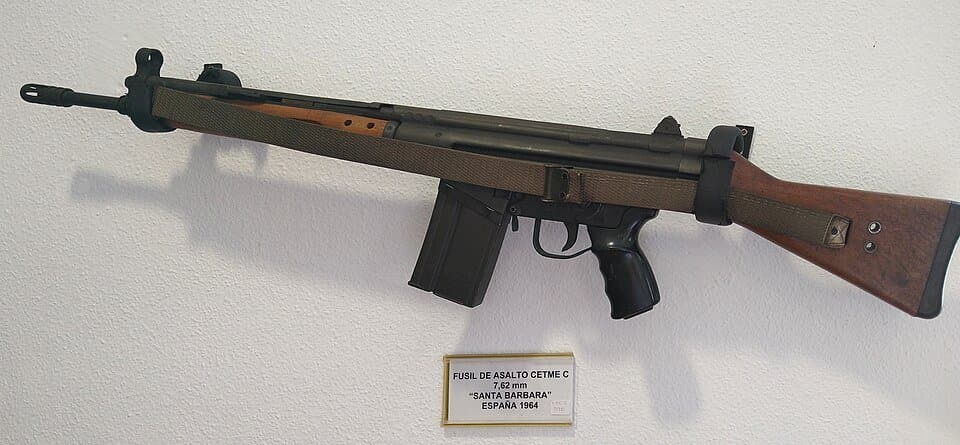
| Source measurement | The CETME Model 58 is a stamped-steel, select-fire battle rifle produced by the Spanish armaments manufacturer Centro de Estudios Técnicos de Materiales Especiales (CETME) . The Model 58 used a 20-round box magazine and was chambered for the 7.62×51mm NATO round (although originally designed for the 7.92×41mm CETME cartridge and later for the reduced power Spanish 7.62×51mm cartridge). The CETME 58 would become the foundation of the widely deployed German Heckler & Koch G3 battle rifle. Semi-automatic variants were also produced for the civilian market.[source]CETME rifle · Lead; only the objects and conditions stated in this passage The requirements for the original design specified that the rifle weigh no more than 4.1 kg, had an effective range of 1,000 metres and a large magazine capacity. This required an ambitious development of rifle technology but the CETME engineers, based on earlier German experiments, believed this would be possible using an unconventional projectile.[source]CETME rifle · Development; only the objects and conditions stated in this passage Thus the 7.92×41mm CETME, CA-001 cartridge was developed and unveiled in 1953.[source]CETME rifle · Development; only the objects and conditions stated in this passage The rounds weighed 6.8 grams and had a muzzle velocity of 800 m/s.[source]CETME rifle · Development; only the objects and conditions stated in this passage Sources from the time indicate that at 1,000 metres, the dispersion characteristics of the bullet were equal to those of normal rifle projectiles despite its light weight.[source]CETME rifle · Development; only the objects and conditions stated in this passage In addition, sources state that at 1,000 metres, the projectile could perforate Spanish, Russian, Italian, Czech and German helmets.[source]CETME rifle · Development; only the objects and conditions stated in this passage Later on in development, the Bundesgrenzschutz informed CETME that they were interested in the rifle but requested the cartridge diameter be reduced from 7.92mm to 7.62mm and that the same 41mm cartridge case should be used. This was accomplished after considerable time and effort, with the new round being designated the 7.62×41mm CETME, CA-002. Despite the rifle performing excellently with this cartridge, the Bundesgrenzschutz later stated that they could only adopt it if it was rechambered for the 7.62×51mm NATO cartridge due to standardisation agreements and thus the weapon was redesigned for this NATO cartridge, designated by the Spanish as Modelo B.[source]CETME rifle · Development; only the objects and conditions stated in this passage The first prototype rifles fired the same 7.92×33mm Kurz round as the StG45, and a variety of experimental 7.92 and 7.62mm cartridges were tested before settling on the 7.62×51mm CETME . This round, chosen due to requirements of the then-interested West German Bundesgrenzschutz , was dimensionally identical to 7.62×51mm NATO , but with a lighter bullet and powder charge to reduce recoil, making the fully automatic fire more controllable. In December 1956, the West German Bundeswehr received 400 CETME A rifles for intensive trials. Due to the tests performed by the Bundesamt für Wehrtechnik und Beschaffung , the ergonomy of the rifle was improved. With feedback from Heckler & Koch , the rifle was able to fire the fully powered 7.62×51mm NATO round due to the better quality of its steel. The Model B went on to be the foundation of the widely deployed Heckler & Koch G3 battle rifle.[source]CETME rifle · Development; only the objects and conditions stated in this passage The CETME B rifle in 7.62×51mm CETME was adopted as the Fusil de Asalto CETME Modelo 1958 de 7,62mm by the Spanish Army in September 1957 and its production began in Spain during 1961. The CETME series of battle rifles were manufactured in four basic models; the A, B, C and E models. The primary difference in the production models is the modes of fire, the absence of bipod and lighter weight for later models.[source]CETME rifle · Development; only the objects and conditions stated in this passage From 1957, the Dutch company Nederlandse Wapen en Munitiefabriek also demonstrated the CETME/H&K Model B rifle to the Royal Netherlands Army , the Netherlands Marine Corps , Finland (chambered in 7.62×39mm ), Ecuador and Dominican Republic , but no gun was produced nor ordered.[source]CETME rifle · Development / Trials; only the objects and conditions stated in this passage The Model As were the developmental prototypes. These models were unusual in that they fired from the closed bolt in semi-automatic and from the open bolt in full-auto mode. Later production models fire from only the closed bolt. The Model As are easily identified by the position of rear sight and bipod folded back to form the fore-stock. In 1954, the rifle saw limited introduction in the Spanish Army. They used the 7.92×41mm CETME.[source]CETME rifle · Models / Model A; only the objects and conditions stated in this passage The Model B was the first production model. It had a perforated steel handguard and chambered for the 7.62×51mm CETME round. The 7.62×51mm CETME differed from the standard 7.62×51mm NATO round by having a lighter full-metal-jacketed, plastic-cored lead bullet and a reduced propellant charge. The parts for the Model B are for most part interchangeable with the later Model C rifles.[source]CETME rifle · Models / Model B; only the objects and conditions stated in this passage The Spanish Army adopted a variant of the Model B re-engineered for the more powerful 7.62×51mm NATO round. The reliable functioning of roller-delayed blowback mechanisms is limited by specific ammunition and arm parameters like bullet weight, propellant charge, barrel length and amount of wear. The Model B could be converted to fire the 7.62×51mm NATO round if the bolt group and return spring were replaced with that of the Model C. These modified rifles were known as Model 58-64-C and by 1971 all the Spanish CETME B rifles had been upgraded.[source]CETME rifle · Models / Model B; only the objects and conditions stated in this passage The Model C was a lightweight version that was chambered for the 7.62×51mm NATO round and had wooden fore-stocks. The Model C is virtually identical to the Model B. However, certain components had been strengthened to better deal with the increased forces and stress exerted by the application of the standard 7.62×51mm NATO round. It had become the Spanish standard rifle by 1964.[source]CETME rifle · Models / Model C; only the objects and conditions stated in this passage The CETME Model L was a downsized variant of the CETME system, chambered for the 5.56×45mm NATO cartridge. It was adopted by the Spanish Army in 1984 and was in service until it was replaced by the Heckler and Koch G36 rifle in 1999.[source]CETME rifle · Variants / CETME L and LC; only the objects and conditions stated in this passage NATO 7.62×51mm ammunition may safely be used in the CETME sporter, while commercial .308 ammunition is not recommended for use due to the tendency of the extractor to tear off the rims of the softer civilian brass.[source]CETME rifle · Civilian versions; only the objects and conditions stated in this passage | — |
|---|
| Unit cost | — | $ 350[source]Remington Model 870 · Unit cost |
|---|
| No. built | — | 11,000,000+[source]Remington Model 870 · No. built |
|---|
| Variants | — | See Variants[source]Remington Model 870 · Variants |
|---|
| Barrel type | — | Fully rifled[source]Remington 870 · FieldMaster Deer Vent Rib, Rem Choke[source]Remington 870 · 410 Turkey TSS Vent Rib, Rem Choke[source]Remington 870 · Turkey Camo Fully rifled extra heavy (fluted)[source]Remington 870 · SPS Superslug Vent rib Rem Choke and fully rifled[source]Remington 870 · Fieldmaster Vent rib Rem Choke and fully rifled[source]Remington 870 · Fieldmaster Synthetic Cylinder choke[source]Remington 870 · Special Purpose Marine Magnum Rem Choke[source]Remington 870 · SPS Super Mag Turkey Predator Vent rib, Rem Choke[source]Remington 870 · Super Magnum Flyaway Vent rib, Rem Choke[source]Remington 870 · Super Magnum Turkey/Waterfowl Camo Vent Rib, Rem Choke[source]Remington 870 · Wingmaster Fully rifled[source]Remington 870 · Fieldmaster Fully Rifled Cantilever |
|---|
| Reported operators |
| — |
|---|
20 in (510 mm)[source]Remington 870 · SPS Super Mag Turkey Predator
28 in (710 mm)[source]Remington 870 · Super Magnum Flyaway
26 in (660 mm)[source]Remington 870 · Super Magnum Turkey/Waterfowl Camo
25–28 in (640–710 mm)[source]Remington 870 · Wingmaster
20 in (510 mm)[source]Remington 870 · Fieldmaster Fully Rifled Cantilever