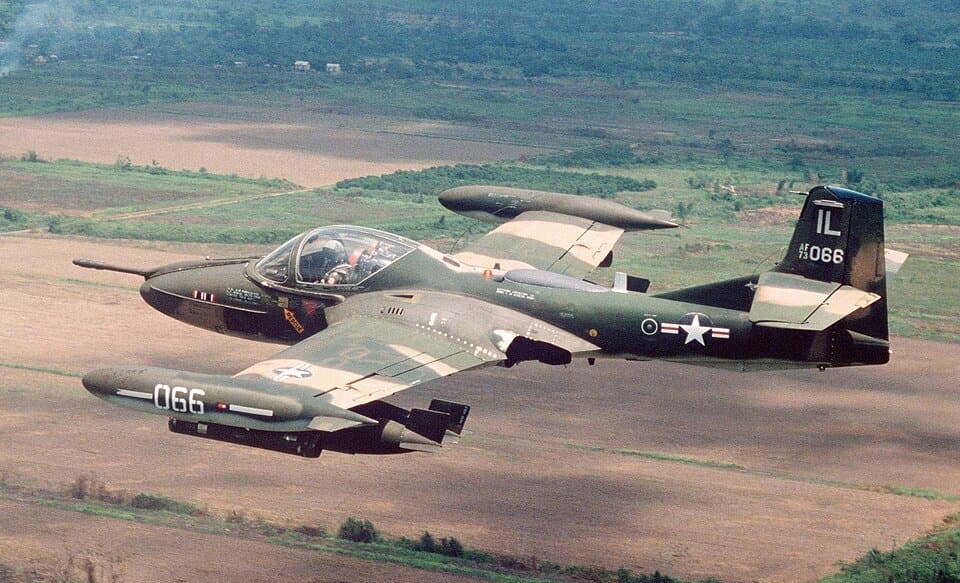

Credit
TSGT KEN HAMMOND · Public domain · Resized · Public domain · Source ↗ · Modified


Preparing your view.

At a glance
Measured figures
A-37B Dragonfly · Length
Single source28 ft 3 + 1 ⁄ 4 in (8.617 m)[source]
KAAN development aircraft; manufacturer technical data, configuration not stated · Length
Configuration
| Specification | Cessna A-37 Dragonfly | TAI TF Kaan |
|---|---|---|
| Type | Light ground-attack aircraft[source] | Stealth multirole / air superiority fighter[source] |
| National origin | United States[source] | Turkey[source] |
| Manufacturer | Cessna[source] | Turkish Aerospace Industries[source] |
| Status | Limited service in Central American and South American air forces[source] |
Preliminary specifications (KAAN development aircraft) · Length
Single source20.3 m (66 ft 7 in)[source]Preliminary specifications; development aircraft, not a verified production Block 10 configuration
20,3 m (66 ft)[source]KAAN development aircraft; manufacturer technical data, configuration not stated
A-37B Dragonfly · over tip tanks
Single source35 ft 10 + 1 ⁄ 2 in (10.935 m) (over tip tanks)[source]
KAAN development aircraft; manufacturer technical data, configuration not stated · Wingspan
Single sourcePreliminary specifications (KAAN development aircraft) · Wingspan
Single source13.4 m (44 ft 0 in)[source]Preliminary specifications; development aircraft, not a verified production Block 10 configuration
13,4 m (44 ft)[source]KAAN development aircraft; manufacturer technical data, configuration not stated
A-37B Dragonfly · Height
Single source8 ft 10 + 1 ⁄ 2 in (2.705 m)[source]
KAAN development aircraft; manufacturer technical data, configuration not stated · Height
Single sourcePreliminary specifications (KAAN development aircraft) · Height
Single source5 m (16 ft 5 in)[source]Preliminary specifications; development aircraft, not a verified production Block 10 configuration
5 m (16 ft)[source]KAAN development aircraft; manufacturer technical data, configuration not stated
Empty; A-37B Dragonfly · Empty weight
Single sourceMaximum take-off; A-37B Dragonfly · Max takeoff weight
Single source6,211 lb (2,817 kg)[source]
14,000 lb (6,350 kg)[source]
Maximum take-off; Preliminary specifications (KAAN development aircraft) · Maximum takeoff weight
Single source34,750 kg (76,500 lb)[source]Preliminary specifications; development aircraft, not a verified production Block 10 configuration
34.750 kg (76,500 lb)[source]KAAN development aircraft; manufacturer technical data, configuration not stated
Ferry; A-37B Dragonfly · with 4× 100 US gal (83 imp gal; 380 L) drop tanks
Single source1,012 mi (1,629 km, 879 nmi) (with 4× 100 US gal (83 imp gal; 380 L) drop tanks[source]
A-37B Dragonfly · with maximum payload
Single source460 mi (740 km, 400 nmi) (with maximum payload)[source]
A-37B Dragonfly · 2 × General Electric J85 -GE-17A turbojet thrust each
Single source2 × General Electric J85 -GE-17A turbojet , 2,850 lbf (12.7 kN) thrust each[source]
Preliminary specifications (KAAN development aircraft) · 2 × General Electric F110-GE-129 Turbofan thrust each dry
Single sourcePreliminary specifications (KAAN development aircraft) · with afterburner
Single source2 × General Electric F110-GE-129 Turbofan , 76.3 kN (17.155 lbf) thrust each dry, 131 kN (29,000 lbf) with afterburner[source]Preliminary specifications; development aircraft, not a verified production Block 10 configuration
2 x 13.150 kgf (2 x 29,000 lb)[source]KAAN development aircraft; manufacturer technical data, configuration not stated
A-37B Dragonfly · Wing area
Single source183.9 sq ft (17.08 m 2 )[source]
KAAN development aircraft; manufacturer technical data, configuration not stated · Wing area
Single sourcePreliminary specifications (KAAN development aircraft) · Wing area
Single source71.6 m 2 (770 sq ft)[source]Preliminary specifications; development aircraft, not a verified production Block 10 configuration
71,6 m2 (771 ft2)[source]KAAN development aircraft; manufacturer technical data, configuration not stated
A-37B Dragonfly · Service ceiling
Single source41,765 ft (12,730 m)[source]
KAAN development aircraft; manufacturer technical data, configuration not stated · Service ceiling
Manufacturer claimPreliminary specifications (KAAN development aircraft) · Service ceiling
Single source16,764 m (55,000 ft)[source]Preliminary specifications; development aircraft, not a verified production Block 10 configuration
16.764 m (55,000 ft)[source]KAAN development aircraft; manufacturer technical data, configuration not stated
A-37B Dragonfly · 6,990 ft/min (
Single source6,990 ft/min (35.5 m/s)[source]
Bars compare reported quantities only. A larger figure does not make a system better; configurations and test conditions differ.
Under development[source] |
| Primary users | United States Air Force (historical) Republic of Vietnam Air Force (historical) Chilean Air Force (historical) Peruvian Air Force[source] | — |
|---|
| Number built | 577[source] | — |
|---|
| Manufactured | 1963–1975[source] | — |
|---|
| First flight | October 1964[source] | 21 February 2024[source] |
|---|
| Developed from | Cessna T-37 Tweet[source] | — |
|---|
| Aspect ratio | 6.2:1[source] | — |
|---|
| Airfoil | NACA 2418 (modified) at root, NACA 2412 (modified) at tip[source] | — |
|---|
| Fuel capacity | 507 US gal (422 imp gal; 1,920 L) usable internal fuel (including tip tanks)[source] | — |
|---|
| Stall speed | 113 mph (182 km/h, 98 kn) at maximum landing weight, wheels and flaps down[source] | — |
|---|
| Never exceed speed | 524 mph (843 km/h, 455 kn)[source] | — |
|---|
| Guns | 1 × 7.62 mm (0.300 in) GAU-2B/A minigun in nose with 1500 rounds Provision for SUU-11/A gun pods under wings[source] | 30x113 mm[source]Preliminary specifications; development aircraft, not a verified production Block 10 configuration |
|---|
| Hardpoints | 8 with a capacity of inner four: 860 lb (390 kg), two intermediate: 600 lb (270 kg), two outer: 500 lb (230 kg)[source] | 8 internal; 3 per wing, total 6 external[source]Preliminary specifications; development aircraft, not a verified production Block 10 configuration |
|---|
| Rockets | LAU-3/A rocket pods[source] | — |
|---|
| Missiles | AIM-9 Sidewinder[source] | Air-to-air missiles : GÖKTUĞ missile program: Gökdoğan BVR active radar homing Gökhan ramjet engine powered BVR active radar homing Bozdoğan short-range infrared homing Air-to-surface missiles : SOM Cruise Missile (B1, B2, and J variants) KUZGUN-TJ, Turbojet-powered Air-to-surface missile KUZGUN-KY, Solid fuel Rocket-powered Air-to-surface missile KUZGUN-ER, Turbojet-powered , Air-to-surface missile (According to TUBITAK-SAGE, this missile will be equivalent to Penguin Missiles .) KUZGUN-EW, KUZGUN-EW will be able to carry miniaturised EW payload which will act as a stand-in jammer and suppress enemy air defences to significantly increase the survivability of the aircraft of the Turkish Air Force . AKBABA, Air-to-surface , Anti-radiation Missile (ARM) ROKETSAN ÇAKIR Missile Family , Anti-ship , Air-to-surface , surface-to-surface Cruise Missile .[source]Preliminary specifications; development aircraft, not a verified production Block 10 configuration |
|---|
| Bombs | 250 lb (110 kg) Mark 81 , 500 lb (230 kg) Mark 82 or 750 lb (340 kg) M117 bombs BLU-32B or BLU-1C/B fire bombs CBU-12, CBU-22 or CBU-24 cluster bombs SUU-14 bomb dispenser[source] | Teber-81 ( Mark 81 bomb w/ ROKETSAN Laser Guidance Kit) HGK-82 ( Mark 82 bomb w/ TUBITAK-SAGE Precision Guidance Kit ) KGK-82 ( Mark 82 bomb w/ TUBITAK-SAGE Wing Assisted Guidance Kit) Teber-82 ( Mark 82 bomb w/ ROKETSAN Laser Guidance Kit) HGK-83 ( Mark 83 bomb w/ TUBITAK-SAGE Precision Guidance Kit ) KGK-83 ( Mark 83 bomb w/ TUBITAK-SAGE Wing Assisted Guidance Kit) HGK-84 ( Mark 84 bomb w/ TUBITAK-SAGE Precision Guidance Kit ) LHGK-84 ( Mark 84 bomb w/ TUBITAK-SAGE Laser Sensitive Guidance Kit) SARB-83, Bunker buster NEB-84, Bunker buster MAM (Smart Micro Munition) (MAM-T variant) KUZGUN-SS, Glide bomb ASELSAN Miniature Bomb[source]Preliminary specifications; development aircraft, not a verified production Block 10 configuration |
|---|
| Role | jet-powered, light attack aircraft[source] | — |
|---|
| Source measurement | The USAF determined the T-37 to be a promising COIN aircraft and expressed its interest in a prospective improved version that would be able to carry a much larger payload along with greater endurance and better short-field performance. These requirements meant the aircraft would have to be considerably heavier and thus necessitate the use of more powerful engines . To account for the drastic increase in airframe weight along with the need to a significant payload, as well, Cessna opted to double the aircraft's engine power by replacing its twin Continental J-69 engines with General Electric J85 -J2/5 turbojet engines, each capable of generating up to 2,400 lbf (11 kN) of thrust. During 1963, the USAF awarded a contract to Cessna to produce two prototype aircraft, designated YAT-37D; these were essentially heavily modified T-37s.[source]Cessna A-37 Dragonfly · Design and development; only the objects and conditions stated in this passage Specific alterations made for the YAT-37D included the adoption of strengthened wings, the use of larger wingtip fuel tanks of 360 litres (95 US gal) capacity, additional avionics suitable for battlefield communications, navigation, and targeting, toughened landing gear that was suitable for rough-field operation, and the fitting of a General Electric -supplied GAU-2B/A 7.62 mm (0.300 in) "Minigun" Gatling-style machine gun capable of a rate of fire of 3,000 rounds/minute and 1,500 rounds of ammunition that was installed in the right side of the aircraft's nose behind a large access panel, along with an accompanying gunsight and gun camera . Perhaps most importantly, three stores pylons were installed on each wing that were compatible with a wide range of munitions.[source]Cessna A-37 Dragonfly · Design and development; only the objects and conditions stated in this passage The A-37A had a gross takeoff weight of 12,000 lb (5,400 kg), of which 2,700 lb (1,200 kg) were ordnance. It was a relatively simple aircraft, avoiding any advanced weapon systems or the need for a complex training program to operate. The A-37A retained the dual controls of its T-37B ancestor, allowing it to be used as an operational trainer. In combat FAC operations, the second seat was occupied by an observer. Only a single crewman normally flew in the aircraft for close-support missions, which permitted a slight increase in ordnance.[source]Cessna A-37 Dragonfly · Design and development; only the objects and conditions stated in this passage The A-37Bs were all newly built airframes that were considerably stronger than those of the A-37A, capable of pulling six g instead of five, and were built to have a longer fatigue life of 4,000 hours. Field experience would demonstrate that 7,000 hours between overhauls could be tolerated. The A-37B weighed almost twice as much as the T-37C; a remarkable fraction of the loaded weight, 5,800 lb (2,600 kg), could be external stores. In practice, the A-37B usually operated with at least two and sometimes four underwing fuel tanks to improve combat endurance. The A-37B added a refueling probe to the nose, leading to pipes wrapped around the lower lip of the canopy, for probe-and-drogue aerial refueling . This was an unusual fit for USAF aircraft, which traditionally are configured for boom refueling. Other improvements included updated avionics, a redesigned instrument panel to make the aircraft easier to fly from either seat, an automatic engine inlet de-icing system, and revised landing gear. Like its predecessors, the A-37B was not pressurized.[source]Cessna A-37 Dragonfly · Operational history / Vietnam War; only the objects and conditions stated in this passage To accommodate the increased weight, the A-37B was powered by General Electric J85-GE-17A engines, providing 2,850 lbf (12.7 kN) thrust each. These engines were canted slightly outward and downward to improve single-engine handling. Air commando pilots in Vietnam operating the A-37A had found single-engine cruise an effective means of improving their flight endurance. Modifications were made to control surfaces to improve handling. To improve aircraft and crew survivability, the A-37B was fitted with redundant elevator control runs that were placed as far apart as possible. The ejection seats were armored, the cockpit was lined with nylon flak curtains, and foam-filled self-sealing fuel tanks were installed. To extend endurance, pilots were authorized to fly the A-37 on only one active engine, an uncommon practice outside of emergency situations at that time.[source]Cessna A-37 Dragonfly · Operational history / Vietnam War; only the objects and conditions stated in this passage The 20 mm (0.787 in) GPU-2/A and AMD 30 mm (1.18 in) cannon pods were tested with favorable results on the A-37B, but reports indicate that such pods were either seldom or never used in operation.[source]Cessna A-37 Dragonfly · Operational history / Vietnam War; only the objects and conditions stated in this passage The A-37 proved to excel at the close air support mission. It was able to engage targets at speeds roughly 100 miles per hour slower than swept-wing fighters, which improved its bombing accuracy; pilots were reportedly able to achieve an average accuracy of 45 feet (14 m). While the aircraft's slow speed was feared to make it more vulnerable to hostile ground fire, the A-37's relatively small size, atypical speeds, and relatively low altitudes combined to make it somewhat hard to hit effectively with gunfire. The A-37 required a relatively low level of maintenance compared to contemporary fighters—only two hours of maintenance for each hour of flight time, one-sixth as much as that of the McDonnell F-101 Voodoo , partially due to the convenient placement of multiple access panels at strategic locations.[source]Cessna A-37 Dragonfly · Operational history / Vietnam War; only the objects and conditions stated in this passage The Guatemalan Air Force flew the A-37 in extensive counter-insurgency operations throughout the 1970s-1990s, losing one aircraft in action in 1985. The type has also been widely used for counter-narcotics operations.[source]Cessna A-37 Dragonfly · Operational history / Other Latin American countries; only the objects and conditions stated in this passage (Cessna Model 318D) T-37B rebuilt with two J-85-GE-5 engines, a 7.62 mm Minigun in nose and eight underwing stores pylons, 39 conversions.[source]Cessna A-37 Dragonfly · Variants; only the objects and conditions stated in this passage Salvadoran Air Force - 13 in service as of December 2022.[source]Cessna A-37 Dragonfly · Operators / Current; only the objects and conditions stated in this passage Length: 28 ft 3 + 1 ⁄ 4 in (8.617 m)[source]Cessna A-37 Dragonfly · Specifications (A-37B Dragonfly); only the objects and conditions stated in this passage Wingspan: 35 ft 10 + 1 ⁄ 2 in (10.935 m) (over tip tanks)[source]Cessna A-37 Dragonfly · Specifications (A-37B Dragonfly); only the objects and conditions stated in this passage Height: 8 ft 10 + 1 ⁄ 2 in (2.705 m)[source]Cessna A-37 Dragonfly · Specifications (A-37B Dragonfly); only the objects and conditions stated in this passage Wing area: 183.9 sq ft (17.08 m 2 )[source]Cessna A-37 Dragonfly · Specifications (A-37B Dragonfly); only the objects and conditions stated in this passage Empty weight: 6,211 lb (2,817 kg)[source]Cessna A-37 Dragonfly · Specifications (A-37B Dragonfly); only the objects and conditions stated in this passage Max takeoff weight: 14,000 lb (6,350 kg)[source]Cessna A-37 Dragonfly · Specifications (A-37B Dragonfly); only the objects and conditions stated in this passage Powerplant: 2 × General Electric J85 -GE-17A turbojet , 2,850 lbf (12.7 kN) thrust each[source]Cessna A-37 Dragonfly · Specifications (A-37B Dragonfly); only the objects and conditions stated in this passage Maximum speed: 507 mph (816 km/h, 441 kn)[source]Cessna A-37 Dragonfly · Specifications (A-37B Dragonfly); only the objects and conditions stated in this passage Cruise speed: 489 mph (787 km/h, 425 kn) (max. cruise)[source]Cessna A-37 Dragonfly · Specifications (A-37B Dragonfly); only the objects and conditions stated in this passage Stall speed: 113 mph (182 km/h, 98 kn) at maximum landing weight, wheels and flaps down[source]Cessna A-37 Dragonfly · Specifications (A-37B Dragonfly); only the objects and conditions stated in this passage Never exceed speed : 524 mph (843 km/h, 455 kn)[source]Cessna A-37 Dragonfly · Specifications (A-37B Dragonfly); only the objects and conditions stated in this passage Combat range: 460 mi (740 km, 400 nmi) (with maximum payload)[source]Cessna A-37 Dragonfly · Specifications (A-37B Dragonfly); only the objects and conditions stated in this passage Ferry range: 1,012 mi (1,629 km, 879 nmi) (with 4× 100 US gal (83 imp gal; 380 L) drop tanks[source]Cessna A-37 Dragonfly · Specifications (A-37B Dragonfly); only the objects and conditions stated in this passage Service ceiling: 41,765 ft (12,730 m)[source]Cessna A-37 Dragonfly · Specifications (A-37B Dragonfly); only the objects and conditions stated in this passage Rate of climb: 6,990 ft/min (35.5 m/s)[source]Cessna A-37 Dragonfly · Specifications (A-37B Dragonfly); only the objects and conditions stated in this passage Guns: 1 × 7.62 mm (0.300 in) GAU-2B/A minigun in nose with 1500 rounds Provision for SUU-11/A gun pods under wings[source]Cessna A-37 Dragonfly · Specifications (A-37B Dragonfly); only the objects and conditions stated in this passage Hardpoints: 8 with a capacity of inner four: 860 lb (390 kg), two intermediate: 600 lb (270 kg), two outer: 500 lb (230 kg)[source]Cessna A-37 Dragonfly · Specifications (A-37B Dragonfly); only the objects and conditions stated in this passage Bombs: 250 lb (110 kg) Mark 81 , 500 lb (230 kg) Mark 82 or 750 lb (340 kg) M117 bombs BLU-32B or BLU-1C/B fire bombs CBU-12, CBU-22 or CBU-24 cluster bombs SUU-14 bomb dispenser[source]Cessna A-37 Dragonfly · Specifications (A-37B Dragonfly); only the objects and conditions stated in this passage | — |
|---|
| Other name | — | TF or MMU[source] |
|---|
| Designer | — | BAE Systems TAI[source] |
|---|
| Primary user | — | Turkish Air Force[source] |
|---|
| Prototypes | — |
|---|
| Flights | — |
|---|
| Introduction date | — | 2030s (planned)[source] |
|---|
| Initiated | — | 2010[source] |
|---|
| g limits | — | +9,0 g & −3,5 g[source]Preliminary specifications; development aircraft, not a verified production Block 10 configuration |
|---|
| Wing loading | — | 485 kg/m 2 (99 lb/sq ft)[source]Preliminary specifications; development aircraft, not a verified production Block 10 configuration |
|---|
| Thrust/weight | — | 0,75[source]Preliminary specifications; development aircraft, not a verified production Block 10 configuration |
|---|
| Integrated RF System (IRFS) | — | MURAD-600A AESA radar Radar warning receiver[source]Preliminary specifications; development aircraft, not a verified production Block 10 configuration |
|---|
| Integrated Electro-Optical System (IEOS) | — | KARAT-200 Infrared Search and Track (IRST) TOYGUN Electro-optical reconnaissance, surveillance and targeting system İRİS-300 Missile approach warning system (IR-MWS/360° day/night imaging) YILDIRIM-300 Directional Infrared Counter Measures (DIRCM) LİAS-300 Laser warning receiver (LWS)[source]Preliminary specifications; development aircraft, not a verified production Block 10 configuration |
|---|
| Integrated Communications Navigation and IFF (ICNI) | — | ICNAir-ASQ9683 communications suite ARVEN radio-navigation equipment IdentIFF Mode-5 identification friend or foe[source]Preliminary specifications; development aircraft, not a verified production Block 10 configuration |
|---|
| Advanced Cockpit / Human Machine Interface | — | TULGAR Helmet-mounted display (HMDS) LAD-208 Large area display (LAD)[source]Preliminary specifications; development aircraft, not a verified production Block 10 configuration |
|---|
| Positive / Negative G Limit | — | +9 / -3,5 G[source]KAAN development aircraft; manufacturer technical data, configuration not stated |
|---|