
ASupport aircraft
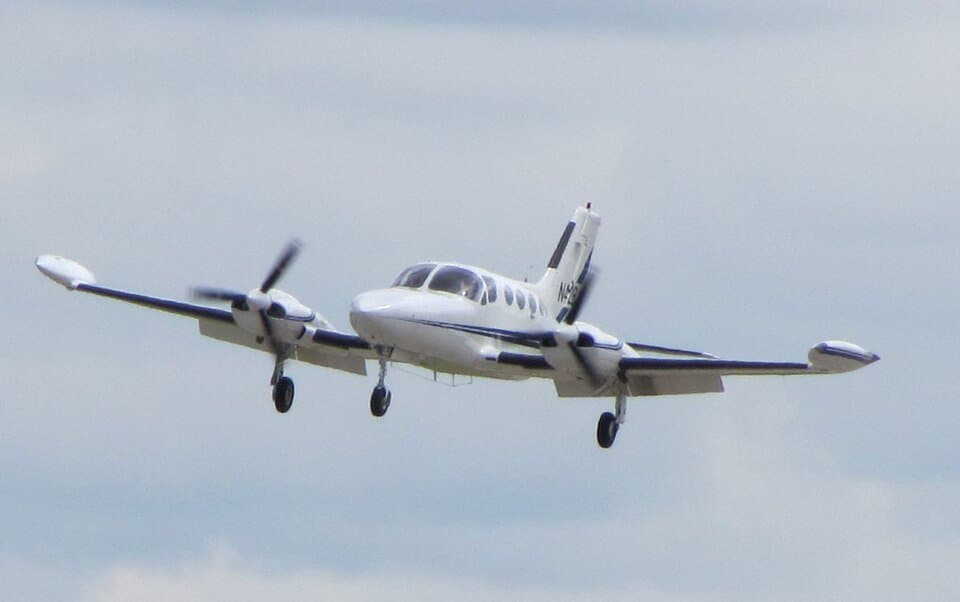
Cessna 421 Golden Eagle
American six or seven seat twin-engined light transport aircraft,
Credit
FlugKerl2 · CC BY-SA 3.0 · Resized · CC BY-SA 3.0 · Source ↗ · Modified


Preparing your view.
ASupport aircraft
American six or seven seat twin-engined light transport aircraft,

At a glance
Measured figures
421C · Length
Single source36 ft 4 + 5 ⁄ 8 in (11.09 m)[source]
Falcon 20F · Length
Single sourceConfiguration
| Specification | Cessna 421 Golden Eagle | Dassault Falcon 20 |
|---|---|---|
| Type | Light transport[source] | Business jet[source] |
| National origin | United States[source] | France[source] |
| Manufacturer | Cessna[source] | Dassault Aviation[source] |
| Number built | 1,916[source] |
17.15 m (56 ft 3 in)[source]
Cruise; 421C · at 25,000 ft (7,600 m) (75% power)
Single sourceMaximum; 421C · at 20,000 ft (6,100 m)
Single source256 kn (295 mph, 474 km/h) at 20,000 ft (6,100 m)[source]
240 kn (280 mph, 440 km/h) at 25,000 ft (7,600 m) (75% power)[source]
Cruise; Falcon 20F · at 12,200 m (40,000 ft) (econ. cruise)
Single sourceMaximum; Falcon 20F · at 7,620 m (25,000 ft) (max cruise)
Single source421C · 2 × Continental GTSIO-520-L turbocharged, fuel injected and geared flat-six engines each
Single source2 × Continental GTSIO-520-L turbocharged, fuel injected and geared flat-six engines, 375 hp (280 kW) each[source]
Falcon 20F · 2 × General Electric CF700 -2D-2 turbofans thrust each
Single source2 × General Electric CF700 -2D-2 turbofans , 20 kN (4,500 lbf) thrust each[source]
421C · 1,940 ft/min (
Single source1,940 ft/min (9.9 m/s)[source]
Bars compare reported quantities only. A larger figure does not make a system better; configurations and test conditions differ.
512[source] |
| Manufactured | 1967–1985[source] | 1965–1991[source] |
|---|
| Introduction date | 1968[source] | 3 June 1965[source] |
|---|
| First flight | October 14, 1965[source] | 4 May 1963[source] |
|---|
| Developed from | Cessna 411[source] | — |
|---|
| Developed into | Cessna 425[source] | Dassault Falcon 10 Dassault Falcon 50[source] |
|---|
| Capacity | Six passengers[source] | 8–14 passengers[source] |
|---|
| Fuel capacity | 206 US gal (172 imp gal; 780 L) normal (usable capacity), 262 US gal (218 imp gal; 990 L) with optional wing tanks[source] | 5,200 L (1,100 imp gal; 1,400 US gal)[source] |
|---|
| Propellers | 3-bladed McCauley constant-speed propellers[source] | — |
|---|
| Takeoff distance to 50 ft (15m) | 2,323 ft (708 m)[source] | — |
|---|
| Landing distance from 50 ft (15 m) | 2,293 ft (699 m)[source] | — |
|---|
| Role | American six or seven seat twin-engined light transport aircraft,[source] | French business jet[source] |
|---|
| Source measurement | The next year, 1969, the design was refined, with a three-inch stretch of the fuselage, five more gallons of fuel capacity, and a 40-pound increase in gross weight. The plane was redesignated the Cessna 421A.[source]Cessna 421 Golden Eagle · Development; only the objects and conditions stated in this passage In 1971, the design was again improved. Both empty and gross weight increased, the wingspan was increased by two feet, raising the service ceiling by 5,000 feet. The nose was stretched two feet to accommodate a larger nose baggage section. This new plane is designated the Cessna 421B.[source]Cessna 421 Golden Eagle · Development; only the objects and conditions stated in this passage Type approved 1 May 1967, powered by two Continental GTSIO-520-Ds of 375 hp (280 kW) each, maximum takeoff weight 6,800 lb (3,084 kg). 200 built.[source]Cessna 421 Golden Eagle · Variants; only the objects and conditions stated in this passage Type approved 19 November 1968, powered by two Continental GTSIO-520-Ds of 375 hp (280 kW) each, maximum takeoff weight 6,840 lb (3,103 kg). 158 built.[source]Cessna 421 Golden Eagle · Variants; only the objects and conditions stated in this passage Eight-seat light passenger transport aircraft. Type approved 28 April 1970, powered by two Continental GTSIO-520-Hs of 375 hp (280 kW) each, maximum takeoff weight 7,250 lb (3,289 kg), later models 7,450 lb (3,379 kg). 699 built.[source]Cessna 421 Golden Eagle · Variants; only the objects and conditions stated in this passage Model with new wing and landing gear. Type approved 28 October 1975, powered by two Continental GTSIO-520-Ls or Continental GTSIO-520-Ns of 375 hp (280 kW) each, maximum takeoff weight 7,450 lb (3,379 kg). 859 built.[source]Cessna 421 Golden Eagle · Variants; only the objects and conditions stated in this passage Conversion of Cessna 421C aircraft by fitting two 750hp Pratt & Whitney Canada PT6A -135 turboprop engines. Formal designation R421CP .[source]Cessna 421 Golden Eagle · Variants; only the objects and conditions stated in this passage Pakistan Army at least one 421 in use.[source]Cessna 421 Golden Eagle · Military operators; only the objects and conditions stated in this passage On December 16, 1972, a private Cessna 421 crashed into the homes at 116 and 121 Diane Drive in Cheektowaga near Buffalo Niagara International Airport . The crash killed three on board and three on the ground, and at least four people on the ground were injured.[source]Cessna 421 Golden Eagle · Accidents and incidents; only the objects and conditions stated in this passage On 4 December 1980, a Cessna 421 carrying Prime Minister of Portugal Francisco de Sá Carneiro and other government officials, crashed into buildings in Camarate seconds after takeoff, killing all 7 persons on board.[source]Cessna 421 Golden Eagle · Accidents and incidents; only the objects and conditions stated in this passage On 5 March 1984, the pilot and five passengers in a Cessna 421B, registration number N3291Q , were killed when the aircraft impacted trees 1 mile (1.6 km) northeast of Folsom Field, Alabama during an incorrectly executed nighttime instrument approach in IMC conditions. The NTSB attributed the accident to the pilot's failure to initiate a missed approach , his failure to maintain altitude, his lack of recent instrument flying experience, and his history of heart problems; contributing factors were poor visibility and adverse weather.[source]Cessna 421 Golden Eagle · Accidents and incidents; only the objects and conditions stated in this passage On June 24, 1992, a Cessna 421 VGAB (tail number N628RJ), the 40-year-old pilot and two passengers took off from Monterey. About three minutes after takeoff the Cessna collided with a hill about three miles east of the airport. The investigation revealed that ground fog and overconfidence in the pilot caused the accident. All three were killed. The pilot had about 75 hours of flight experience.[source]Cessna 421 Golden Eagle · Accidents and incidents; only the objects and conditions stated in this passage On January 30, 2006, an eight-seat twin engine Cessna 421B with four passengers crashed about 1 mile (1,600 m) south of the airport. The aircraft was heading from Kansas to Palwaukee. There were no survivors.[source]Cessna 421 Golden Eagle · Accidents and incidents; only the objects and conditions stated in this passage On April 17, 2009, a Cessna 421 crashed shortly after take-off from Fort Lauderdale Executive Airport around 11:20 a.m. Local authorities stated the aircraft crashed into a vacant home located about two miles (3.2 km) from the airport. The aircraft was en route to Fernandina Beach, Florida near Jacksonville and was due to arrive at 13:00. The Federal Aviation Administration indicated that one person was on board the aircraft, and was killed in the accident. Sebring Air Charter of Tamarac, Florida was listed on FAA records as the owner of the aircraft. The probable cause of the accident was determined to be pilot error, with an inflight fire of the right engine as a contributing factor.[source]Cessna 421 Golden Eagle · Accidents and incidents; only the objects and conditions stated in this passage On December 9, 2011, a Cessna 421C aircraft crashed shortly after takeoff less than a mile from the airport into an open field. All 4 passengers on board were killed when the aircraft burst into flames upon crashing.[source]Cessna 421 Golden Eagle · Accidents and incidents; only the objects and conditions stated in this passage On August 27, 2013, a Cessna 421C crashed just after takeoff. The aircraft had engine issues on takeoff and impacted a tree a mile after takeoff. Witnesses reported that the aircraft's takeoff run appeared slower than normal, and the aircraft was found to have used the entire runway and traveled through two different 300-foot fields.[source]Cessna 421 Golden Eagle · Accidents and incidents; only the objects and conditions stated in this passage On November 22, 2017, the left-hand engine of a Cessna 421, registration N421RX , caught fire soon after takeoff from Presque Isle; the pilot attempted to return to the airport but was unable to maintain altitude and performed a forced landing in an adjacent field. Two persons aboard the aircraft suffered minor injuries and two others were uninjured; the aircraft was badly damaged. The NTSB attributed the accident to a fuel leak onto the hot turbocharger .[source]Cessna 421 Golden Eagle · Accidents and incidents; only the objects and conditions stated in this passage On July 13, 2021, at around 10:42 am, a Cessna 421C (tail number N678SW), piloted by Mary Ellen Carlin crashed into a suburban residential area killing the pilot, passenger and a pet. Investigators found that the Cessna 421C diverged from its flight plan, resulting in a crash less than five minutes after departure.[source]Cessna 421 Golden Eagle · Accidents and incidents; only the objects and conditions stated in this passage On April 30, 2026, around 11:25pm in Wimberly Texas, a Cessna 421C crashed while carrying 5 passengers to a Pickleball tournament near Austin Texas. Officials claimed the plane went down near Round Rock Road in Hays County. The 5 passengers on board were Brooke Skypala, Glen Appling, Seren Wilson, Hayden Dillard, and Stacy Hedrick. Unfortunately, none survived and were announced deceased on arrival. The second aircraft that was coming with them made it safely to its destination.[source]Cessna 421 Golden Eagle · Accidents and incidents; only the objects and conditions stated in this passage Capacity: Six passengers[source]Cessna 421 Golden Eagle · Specifications (421C); only the objects and conditions stated in this passage Length: 36 ft 4 + 5 ⁄ 8 in (11.09 m)[source]Cessna 421 Golden Eagle · Specifications (421C); only the objects and conditions stated in this passage Wingspan: 41 ft 1 + 1 ⁄ 2 in (12.53 m)[source]Cessna 421 Golden Eagle · Specifications (421C); only the objects and conditions stated in this passage Height: 11 ft 5 + 3 ⁄ 8 in (3.49 m)[source]Cessna 421 Golden Eagle · Specifications (421C); only the objects and conditions stated in this passage Wing area: 215 sq ft (20.0 m 2 )[source]Cessna 421 Golden Eagle · Specifications (421C); only the objects and conditions stated in this passage Empty weight: 4,501 lb (2,042 kg)[source]Cessna 421 Golden Eagle · Specifications (421C); only the objects and conditions stated in this passage Max takeoff weight: 7,450 lb (3,379 kg)[source]Cessna 421 Golden Eagle · Specifications (421C); only the objects and conditions stated in this passage Powerplant: 2 × Continental GTSIO-520-L turbocharged, fuel injected and geared flat-six engines, 375 hp (280 kW) each[source]Cessna 421 Golden Eagle · Specifications (421C); only the objects and conditions stated in this passage Maximum speed: 256 kn (295 mph, 474 km/h) at 20,000 ft (6,100 m)[source]Cessna 421 Golden Eagle · Specifications (421C); only the objects and conditions stated in this passage Cruise speed: 240 kn (280 mph, 440 km/h) at 25,000 ft (7,600 m) (75% power)[source]Cessna 421 Golden Eagle · Specifications (421C); only the objects and conditions stated in this passage Range: 1,487 nmi (1,711 mi, 2,754 km) at 25,000 ft (7,600 m), econ cruise speed[source]Cessna 421 Golden Eagle · Specifications (421C); only the objects and conditions stated in this passage Service ceiling: 30,200 ft (9,200 m)[source]Cessna 421 Golden Eagle · Specifications (421C); only the objects and conditions stated in this passage Rate of climb: 1,940 ft/min (9.9 m/s)[source]Cessna 421 Golden Eagle · Specifications (421C); only the objects and conditions stated in this passage Takeoff distance to 50 ft (15m): 2,323 ft (708 m)[source]Cessna 421 Golden Eagle · Specifications (421C); only the objects and conditions stated in this passage Landing distance from 50 ft (15 m): 2,293 ft (699 m)[source]Cessna 421 Golden Eagle · Specifications (421C); only the objects and conditions stated in this passage | During the 1950s and 1960s, the French government, which had taken a significant interest in the re-establishment and growth of its national aviation industries in the aftermath of the Second World War , developed a detailed request for a combined liaison / trainer aircraft, to be equipped with twin-turbofan engines. Among those companies that took interest in the government request was French aircraft manufacturer Dassault Aviation . In December 1961, French aircraft designer and head of Dassault Aviation, Marcel Dassault , gave the go-ahead to proceed with work towards the production of an eight- to 10-seat executive jet /military liaison aircraft, which was initially named as the Dassault-Breguet Mystère 20 . The emerging design was of a low-wing monoplane, which drew upon the aerodynamics of the transonic Dassault Mystère IV fighter-bomber , and was equipped with a pair of rear-mounted 14.68 kN (3,300 lbf) Pratt & Whitney JT12A-8 turbojet engines.[source]Dassault Falcon 20 · Development / Origins; only the objects and conditions stated in this passage Progress between Dassault and Pan Am was rapid, moving from engineering evaluations of the type to the formation of general agreements between the two companies. In response to feedback received from Pan American, the aircraft was re-engined with a pair of General Electric CF700 engines and several dimensions were increased. Accordingly, Pan American formed an agreement with Dassault to distribute the Mystère 20 in the western hemisphere; the firm placed an initial order for 40 aircraft along with options for a further 120. On 10 July 1964, the re-engined aircraft made its first flight. On 1 January 1965, the first production aircraft performed its maiden flight; in June 1965, both French and American type certifications were awarded. On 10 June 1965, French aviator Jacqueline Auriol achieved the women's world speed record using the first Mystère 20 prototype, having flown at an average recorded speed of 859 km/h over a distance of 1000 km.[source]Dassault Falcon 20 · Development / Origins; only the objects and conditions stated in this passage In 1973, FedEx's Falcons, designation FA-20-DC, cost $1.2 million each and were modified with a 55-by-74.5-inch forward cargo door with independent power supply, higher mtow, reinforced floor, plugged windows, and bigger brakes.[source] |
|---|
| Status | — | Out of production, in active service[source] |
|---|
| Primary users | — | Federal Express (formerly) French Navy United States Coast Guard[source] |
|---|
| Aspect ratio | — | 6.4:1[source] |
|---|
| Stall speed | — | 152 km/h (94 mph, 82 kn)[source] |
|---|
| Country of origin | — | France[source]Inventory Origin column; table 1, row 54, cell 4; revision 1377423821; retrieved 2026-10-02 |
|---|
862 km/h (536 mph, 465 kn) at 7,620 m (25,000 ft) (max cruise)[source]
750 km/h (470 mph, 400 kn) at 12,200 m (40,000 ft) (econ. cruise)[source]
An improved model of the aircraft, designated the Falcon 200 , was developed, which featured more advanced jet engines and other major improvements to increase range, capacity, and comfort. The Falcon 200, along with the Falcon 20G and HU-25 models, were powered by a pair of Garrett ATF3 engines. According to the magazine Flying , the Falcon 200 variant was more comparable to the newer Falcon 50 trijet than the original Falcon 20 model.[source]Dassault Falcon 20 · Development / Further development; only the objects and conditions stated in this passage
During 2013, the FAA modified 14 CFR part 91 rules to prohibit the operation of jets weighing 75,000 pounds or less that were not Stage 3 noise compliant after 31 December 2015. The Falcon 20 was listed explicitly in Federal Register 78 FR 39576 . Any examples of the type that had not been modified, either by the installation of Stage 3 noise-compliant engines or have had hush kits installed upon noncompliant engines, were no longer permitted to fly anywhere in the contiguous 48 states after 31 December 2015. However, 14 CFR §91.883 Special flight authorizations for jet airplanes weighing 75,000 pounds or less – lists special flight authorizations that may be granted for operation after 31 December 2015.[source]Dassault Falcon 20 · Development / Further development; only the objects and conditions stated in this passage
Prototype, one built. F-WLKB, initially powered by two 14.68 kN (3,300 lbf) Pratt & Whitney JT12A-8 turbojet engines. Now stored at Musée Air et Espace Aéroport Paris – Le Bourget.[source]Dassault Falcon 20 · Variants; only the objects and conditions stated in this passage
Initial production version, with lengthened fuselage compared to first prototype and with 10–12 seats. Powered by 4,200 lbf (19 kN) CF700-2B engines.[source]Dassault Falcon 20 · Variants; only the objects and conditions stated in this passage
Falcon 20CC (s/n 073)[source]Dassault Falcon 20 · Variants; only the objects and conditions stated in this passage
Falcon 20G[source]Dassault Falcon 20 · Variants; only the objects and conditions stated in this passage
Falcon 20H[source]Dassault Falcon 20 · Variants; only the objects and conditions stated in this passage
Improved variant, powered by two 2360-kg (5,200-lb) Garrett ATF3-6A-4C turbofan engines and with more fuel. First flown on 30 April 1980.[source]Dassault Falcon 20 · Variants; only the objects and conditions stated in this passage
United States Coast Guard version of the Falcon 20G. 41 built. Equipped with two Garrett AiResearch Garrett ATF3-6-2C turbofan engines.[source]Dassault Falcon 20 · Variants; only the objects and conditions stated in this passage
Enlarged, 30-passenger commuter airliner derivative of Falcon 20, powered by two 27.0 kN (6,070 lbf) Lycoming ALF 502 D turbofans. One prototype built, first flying on 11 May 1973. No further production of Falcon 30 or proposed 40-passenger, shorter-range Mystére 40-100 .[source]Dassault Falcon 20 · Variants; only the objects and conditions stated in this passage
Pakistan Air Force – 3 in service, including 2 DA-20s in EW , ECM , ESM roles[source]Dassault Falcon 20 · Operators / Current military operators; only the objects and conditions stated in this passage
Royal Australian Air Force – Three in service from 1967 to 1989. No. 34 Squadron RAAF[source]Dassault Falcon 20 · Operators / Former military operators; only the objects and conditions stated in this passage
Capacity: 8–14 passengers[source]Dassault Falcon 20 · Specifications (Falcon 20F); only the objects and conditions stated in this passage
Length: 17.15 m (56 ft 3 in)[source]Dassault Falcon 20 · Specifications (Falcon 20F); only the objects and conditions stated in this passage
Wingspan: 16.30 m (53 ft 6 in)[source]Dassault Falcon 20 · Specifications (Falcon 20F); only the objects and conditions stated in this passage
Height: 5.32 m (17 ft 5 in)[source]Dassault Falcon 20 · Specifications (Falcon 20F); only the objects and conditions stated in this passage
Wing area: 41.00 m 2 (441.3 sq ft)[source]Dassault Falcon 20 · Specifications (Falcon 20F); only the objects and conditions stated in this passage
Empty weight: 7,530 kg (16,601 lb)[source]Dassault Falcon 20 · Specifications (Falcon 20F); only the objects and conditions stated in this passage
Max takeoff weight: 13,000 kg (28,660 lb)[source]Dassault Falcon 20 · Specifications (Falcon 20F); only the objects and conditions stated in this passage
Powerplant: 2 × General Electric CF700 -2D-2 turbofans , 20 kN (4,500 lbf) thrust each[source]Dassault Falcon 20 · Specifications (Falcon 20F); only the objects and conditions stated in this passage
Maximum speed: 862 km/h (536 mph, 465 kn) at 7,620 m (25,000 ft) (max cruise)[source]Dassault Falcon 20 · Specifications (Falcon 20F); only the objects and conditions stated in this passage
Cruise speed: 750 km/h (470 mph, 400 kn) at 12,200 m (40,000 ft) (econ. cruise)[source]Dassault Falcon 20 · Specifications (Falcon 20F); only the objects and conditions stated in this passage
Stall speed: 152 km/h (94 mph, 82 kn)[source]Dassault Falcon 20 · Specifications (Falcon 20F); only the objects and conditions stated in this passage
Range: 3,350 km (2,080 mi, 1,810 nmi)[source]Dassault Falcon 20 · Specifications (Falcon 20F); only the objects and conditions stated in this passage
Service ceiling: 12,800 m (42,000 ft) (absolute ceiling)[source]Dassault Falcon 20 · Specifications (Falcon 20F); only the objects and conditions stated in this passage