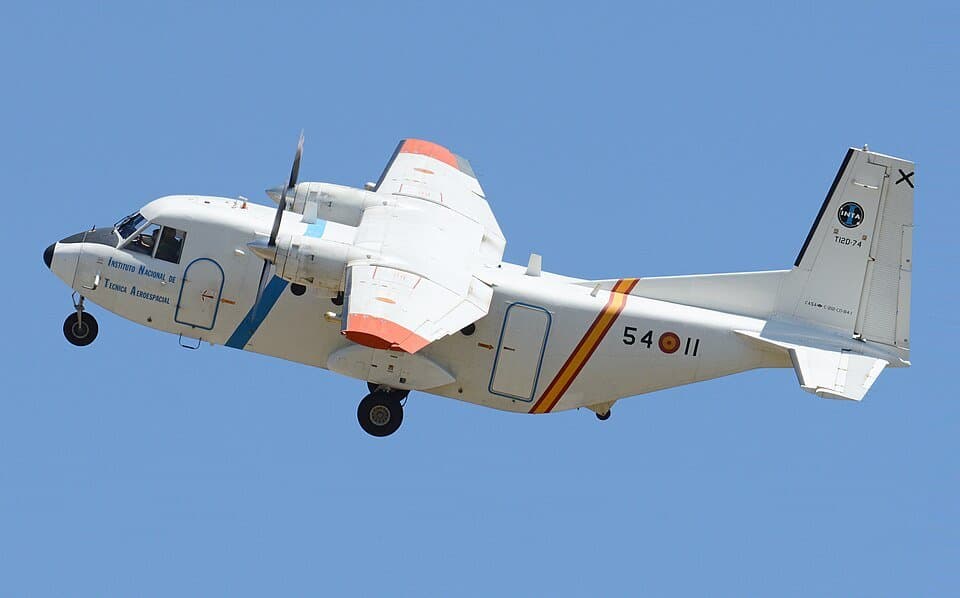

Credit
Alan Wilson from Stilton, Peterborough, Cambs, UK · CC BY-SA 2.0 · Resized · CC BY-SA 2.0 · Source ↗ · Modified


Preparing your view.
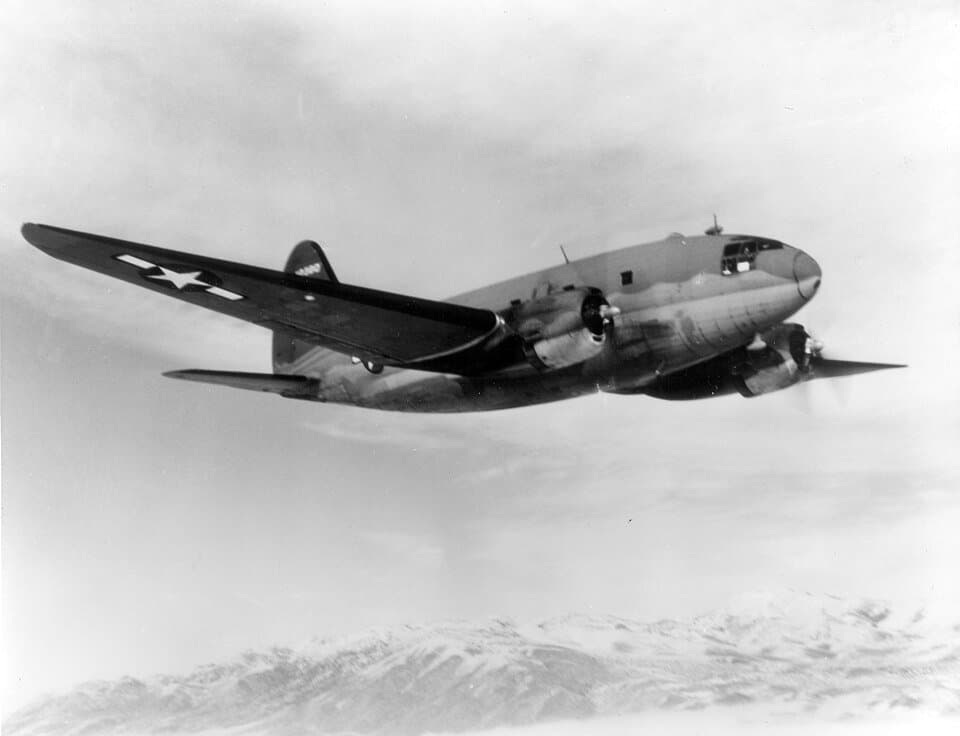

At a glance
True scale
Side by side. From every angle. A human reference for perspective.
3.47 MB · Loads when you open it| Model | Length | Width / span | Height |
|---|---|---|---|
| CASA C-212 Aviocar | ≈ 16.15 m | ≈ 20.28 m (Width) | ≈ 6.6 m |
| Curtiss C-46 Commando | ≈ 23.27 m | ≈ 32.92 m (Width) | ≈ 6.63 m |
Scaled uniformly to the sourced length of 16.15 m. The shape was turned square to the axes; the height was fitted to the sourced 6.6 m; the width was fitted to the sourced 20.28 m. Not an official model or a measured survey.
ForceTally · All rights reserved
Scaled uniformly to the sourced length of 23.27 m. The shape was turned square to the axes; the height was fitted to the sourced 6.63 m; the width was fitted to the sourced 32.92 m. Not an official model or a measured survey.
ForceTally · All rights reserved
The human reference is a generic 1.75 m figure. Models describe external size, not combat performance.
Measured figures
Series 400 · Length
Single source16.15 m (53 ft 0 in)[source]
Configuration
| Specification | CASA C-212 Aviocar | Curtiss C-46 Commando |
|---|---|---|
| Type | Medium STOL military transport aircraft[source] | Military transport aircraft[source] |
| Manufacturer | Construcciones Aeronáuticas SA EADS CASA Indonesian Aerospace[source] | Curtiss-Wright Higgins Aircraft[source] |
| Status | Production in Indonesia[source] | Active in limited civilian use[source] |
| Primary users | Indonesia (70) United States (37) Spain (26)[source] |
C-46A · Length
76 ft 4 in (23.27 m)[source]
Empty; Series 400 · Empty weight
Single sourceMaximum take-off; Series 400 · military
Single sourceMaximum take-off; Series 400 · standard
Single source3,780 kg (8,333 lb)[source]
8,000 kg (17,637 lb) military 7,700 kg (16,976 lb) standard[source]
Empty; C-46A · Empty weight
Single sourceGross; C-46A · Gross weight
Single sourceCruise; Series 400 · (max cruise) at 3,050 m (10,000 ft)
Single sourceMaximum; Series 400 · V MO (maximum operating speed) at MTOW
Single source370 km/h (230 mph, 200 kn) V MO (maximum operating speed) at MTOW[source]
354 km/h (220 mph, 191 kn) (max cruise) at 3,050 m (10,000 ft)[source]
Cruise; C-46A · Cruise speed
Single sourceMaximum; C-46A · at 15,000 ft (4,600 m)
Single sourceFerry; Series 400 · with maximum fuel and 1,192 kg (2,628 lb) payload
Single sourceSeries 400 · with full military payload
Single source835 km (519 mi, 451 nmi) with full military payload[source]
2,680 km (1,670 mi, 1,450 nmi) with maximum fuel and 1,192 kg (2,628 lb) payload[source]
C-46A · at 173 mph (150 kn; 278 km/h)
Single sourceC-46A · at 237 mph (206 kn; 381 km/h)
Single sourceSeries 400 · 2 × Garrett AiResearch TPE331-10R-513C turboprop engines each
Single source2 × Garrett AiResearch TPE331-10R-513C turboprop engines, 671 kW (900 hp) each[source]
C-46A · 2 × Pratt & Whitney R-2800-51 Double Wasp 18-cylinder air-cooled radial piston engines each
Single source2 × Pratt & Whitney R-2800-51 Double Wasp 18-cylinder air-cooled radial piston engines, 2,000 hp (1,500 kW) each[source]
Series 400 · 1,630 ft/min
Single source8.3 m/s (1,630 ft/min)[source]
Series 400 · Up to of weapons on two hardpoints. Typically, machine gun pods or rocket launchers
Single sourceUp to 500 kg (1,102 lb) of weapons on two hardpoints. Typically, machine gun pods or rocket launchers.[source]
Bars compare reported quantities only. A larger figure does not make a system better; configurations and test conditions differ.
Buffalo Airways United States Air Force United States Marine Corps United States Navy[source] |
| Number built | 485 + >124 (IPTN/IAe)[source] | 3,181[source] |
|---|
| Manufactured | 1971–2009 (Spain), 1976-present (Indonesia)[source] | 1940–1945[source] |
|---|
| Introduction date | May 1974[source] | 1941[source] |
|---|
| First flight | 26 March 1971[source] | 26 March 1940[source] |
|---|
| Developed into | Indonesian Aerospace N-219[source] | — |
|---|
| Capacity | 26 passengers / 25 paratroops / 2,820 kg (6,217 lb) military payload / 2,700 kg (5,952 lb) cargo payload[source] | 40 troops or 30 stretcher patients or 15,000 lb (6,800 kg) cargo[source] |
|---|
| Aspect ratio | 10[source] | — |
|---|
| Airfoil | NACA 65 3 -218[source] | root: NACA 23017 ; tip: NACA 4410.5[source] |
|---|
| Fuel capacity | 2,040 L (540 US gal; 450 imp gal) / 1,600 kg (3,527 lb) internal and 1,000 L (260 US gal; 220 imp gal) auxiliary fuel tanks in the cabin or 2x 750 L (200 US gal; 160 imp gal) auxiliary fuel tanks in the cabin and/or 2x 500 L (130 US gal; 110 imp gal) underwing auxiliary fuel tanks[source] | — |
|---|
| Propellers | 4-bladed Dowty Rotol R-334/4-82-F/13, 2.74 m (9 ft 0 in) diameter constant-speed fully-feathering reversible-pitch propellers[source] | 4-bladed Curtiss Electric constant-speed propellers[source] |
|---|
| Stall speed | 145 km/h (90 mph, 78 kn) in take-off configuration[source] | — |
|---|
| Take-off distance to 15 m (49 ft) | 610 m (2,000 ft) (MIL-7700C)[source] | — |
|---|
| Landing distance from 15 m (49 ft) | 462 m (1,516 ft) (MIL-7700C)[source] | — |
|---|
| Landing run | 285 m (935 ft) (MIL-7700C)[source] | — |
|---|
| Hardpoints | Up to 500 kg (1,102 lb) of weapons on two hardpoints. Typically, machine gun pods or rocket launchers.[source] | — |
|---|
| Role | turboprop -powered STOL medium cargo aircraft[source] | — |
|---|
| Source measurement | In July 2010, Airbus Military CEO Domingo Urena-Raso stated that the company could no longer afford to produce the C-212 in Europe. Production of the type at Airbus' Seville facility progressively slowed to only four aircraft in two years. In December 2012, the final Spanish-assembled C-212 was delivered to its customer, the Vietnam Coast Guard . By the time the line shut down, it had produced 477 aircraft for 92 operators.[source]CASA C-212 Aviocar · Development; only the objects and conditions stated in this passage In July 2011, Airbus announced a strategic agreement to collaborate with Indonesian Aerospace /IAe (IPTN's successor) on the C-212. Under the agreement, Airbus undertook an 18-month first phase of support to IAe, after which it was to provide IAe increasing high-value industrial activity, including C-212 upgrades and production transference. In February 2013, their arrangement was formally extended to transfer production of the C-212 to Indonesia. For a time, IAe produced both the NC212-200 and -400 upgrade, which were equipped with new digital avionics , autopilot , and a redesigned cabin that could accommodate up to 28 passengers. In 2014, IAe stopped producing the -400 series to focus on the improved NC212i model.[source]CASA C-212 Aviocar · Development / Indonesian production; only the objects and conditions stated in this passage The C-212 cabin has a maximum occupancy of 21 to 28 passengers. In a paratroop configuration, up to 24 paratroopers along with one jumpmaster can be accommodated on foldable sidewall seats, while in a mixed configuration, it can transport up to ten soldiers and a single vehicle. Since the C-212 does not have a pressurized fuselage , it is limited to relatively low-flight-level airline use (below 10,000 ft (3,000 m) MSL), and is thus suited for short legs and regional airline services.[source]CASA C-212 Aviocar · Design; only the objects and conditions stated in this passage Original military production version. Also known as C-212-5 , C-212-5 series 100M , and by the Spanish Air Force as the T-12B and D-3A (for medevac aircraft), 129 built.[source]CASA C-212 Aviocar · Variants / 100 Series; only the objects and conditions stated in this passage Stretched version with updated engines ( Honeywell TPE331-10R-511C or −512C, rated at 670 kW (900 shp) each, introduced in 1979. The CASA C-212-200 is also a popular skydiving aircraft, known for its large capacity, fast climbing, and large tailgate exit ramp.[source]CASA C-212 Aviocar · Variants / 200 Series; only the objects and conditions stated in this passage C-212 series 200M[source]CASA C-212 Aviocar · Variants / 200 Series; only the objects and conditions stated in this passage Standard production version from 1987 on. Engines were Honeywell TPE331-10R-513C, also rated at 670 kW (900 shp) continuous, 690 kW (925 shp) maximum. The propellers were changed from four-bladed Hartzell composite blade propellers to four-bladed Dowty-Rotol all-metal propellers. Winglets and a larger vertical stabilizer area provided improved performance, and the addition of a nose baggage compartment gave the nose a more streamlined look than the 200 series. Various systems were incrementally upgraded, including the addition of an integrated autopilot system.[source]CASA C-212 Aviocar · Variants / 300 Series; only the objects and conditions stated in this passage C-212-M series 300 (300M series)[source]CASA C-212 Aviocar · Variants / 300 Series; only the objects and conditions stated in this passage Upgraded version with 690 kW (925 shp) TPE331-12JR-701C engines, increased payload, and upgraded avionics moved from under the floor to the nose. First flew 4 April 1997, replacing 300 series in production from 1998. The C-212-400 received Spanish certification in 1998. Between 2004 and 2008, production jigs and fixtures for the NC212-400 were relocated to Bandung from San Pablo, Spain, and IAe became the sole manufacturer of the NC212 family. In 2014, NC212-200 and NC212-400 production ended and production was shifted to the improved NC212i version.[source]CASA C-212 Aviocar · Variants / 400 Series; only the objects and conditions stated in this passage Improved version of -400 series, using two Honeywell TPE331 -12JR-701C turboprop engines, with a maximum output of 723 kW (970 hp). The rotor is the four-bladed Dowty Rotol R334/4-82-F/13 constant speed propeller with a 2.75 m (110-inch) diameter.[source]CASA C-212 Aviocar · Variants / NC212i; only the objects and conditions stated in this passage A Royal Jordanian Air Force CASA 212-A3 Aviocar 100 crashed near Al Qatrana, Jordan due to mechanical problems. All 13 people on board the plane were killed.[source]CASA C-212 Aviocar · Incidents and accidents; only the objects and conditions stated in this passage Northwest Airlink Flight 2268 crashed while landing at Detroit Metropolitan Wayne County Airport in Romulus, Michigan . Nine of the 19 passengers and crew on board were killed.[source]CASA C-212 Aviocar · Incidents and accidents; only the objects and conditions stated in this passage Operated by Geoterrex of Ottawa , Canada, the aircraft crashed on approach to Reykjavík , Iceland, with the loss of all 3 people on board. The cause was that "the crew lost control of the aircraft, most probably because of large fluctuations in the power output of the right engine caused by the shift of an incorrectly installed speeder spring in the right propeller governor."[source]CASA C-212 Aviocar · Incidents and accidents; only the objects and conditions stated in this passage A U.S. Army C-212-200 crashed into the Patuxent River while trying to land at the Naval Air Test Center, Patuxent River, Maryland, killing all five people on board.[source]CASA C-212 Aviocar · Incidents and accidents; only the objects and conditions stated in this passage SANSA Flight 32 crashed into the Cerro Cedral Mountain in Costa Rica shortly after takeoff from Juan Santamaria International Airport in San Jose . All 20 passengers and three crew on board died in the crash.[source]CASA C-212 Aviocar · Incidents and accidents; only the objects and conditions stated in this passage A Venezuelan Navy C-212 crashed into a mountain due to poor weather, killing all 24 people on board.[source]CASA C-212 Aviocar · Incidents and accidents; only the objects and conditions stated in this passage An Angolan government C-212 was shot down by UNITA rebels near Cuito , killing all 25 people on board.[source]CASA C-212 Aviocar · Incidents and accidents; only the objects and conditions stated in this passage American Eagle Flight 5456 , a CASA C-212 flying from Fernando Luis Ribas Dominicci Airport in San Juan, Puerto Rico crashed short of the runway in Mayagüez , killing both crew members and all three passengers. The investigation led to the discontinuation of use of the C-212 by American Eagle.[source]CASA C-212 Aviocar · Incidents and accidents; only the objects and conditions stated in this passage A Spanish Air Force C-212, part of the Ala 37 deployed in Vicenza , Italy , was hit in the tail by an SA-7 missile, allegedly fired by Serb rebels. This occurred east of Rijeka while ferrying UNPROFOR personnel from Zagreb to Split . The tail control surfaces were damaged, the left engine failed and four passengers were injured by splinters. The crew managed to land the aircraft at Rijeka Airport . Spanish technicians were able to repair the damage and had the aircraft back in service within 48 hours.[source]CASA C-212 Aviocar · Incidents and accidents; only the objects and conditions stated in this passage An Angolan Air Force C-212 carrying members of a local football club crashed while on approach to Catumbela Airport , killing 48 of the 53 people aboard.[source]CASA C-212 Aviocar · Incidents and accidents; only the objects and conditions stated in this passage Dirgantara Air Service Flight 5940 crashed into a gas plant shortly after takeoff. 17 people, including one on the ground, died at the scene, a 12-year-old child died on the way to the hospital, and a worker at the gas plant died at the hospital. Only one passenger survived.[source]CASA C-212 Aviocar · Incidents and accidents; only the objects and conditions stated in this passage " Blackwater 61 " Presidential Airways CASA C-212-200 (registration N960BW / serial number 231) was contracted by the U.S. Department of Defense to supply American forces deployed in remote areas of Afghanistan. The aircraft entered a box canyon and struck the 14,650-foot (4,470 m) level of Baba Mountain, which has a peak elevation of 16,739 feet (5,102 m). The flight was about 25 nmi (46 km) north of the typical route between Bagram and Farah.[source]CASA C-212 Aviocar · Incidents and accidents; only the objects and conditions stated in this passage Indonesian Military CASA C-212 was flying from the Jakarta to Bogor, carrying 12 military personnel and six civilians, and was due to test a digital mapping camera, but it disappeared in the Salak Mountain region, about 90 km (56 mi) south of the capital. An air force spokesman said the aircraft was assumed to have crashed.[source]CASA C-212 Aviocar · Incidents and accidents; only the objects and conditions stated in this passage A Cameroon Aéro-Service CASA C-212 chartered by Sundance Resources crashed in dense jungle after departing Cameroon for the Congo, killing all 11 people on board, including Australian mining magnate Ken Talbot and Sundance personnel: Chairman Geoff Wedlock, Chief Executive Officer Don Lewis, company secretary John Carr-Gregg and non-executive directors John Jones and Craig Oliver. At the time of the accident, Talbot was a director of Sundance and its largest shareholder.[source]CASA C-212 Aviocar · Incidents and accidents; only the objects and conditions stated in this passage A Chilean Air Force CASA C-212, carrying 21 people, crashed 500 miles (800 km) from Chile's Pacific coastline in the Juan Fernández Islands , with no survivors. Felipe Camiroaga , a highly popular Chilean TV presenter, was one of the passengers, along with businessman Felipe Cubillos, who had been working on post-earthquake reconstruction efforts. An official inquiry concluded that the cause of the accident was loss of control while approaching the runaway at low alttitude, due to a combination of wind shear, strong turbulence , two counter-rotating vortexes and strong crosswinds.[source]CASA C-212 Aviocar · Incidents and accidents; only the objects and conditions stated in this passage An Indonesian Aerospace CASA C-212 (registration PK-TLF, built in 1989) was carrying 18 people from Medan , North Sumatra to Kutacane , Aceh . Operated by Nusantara Buana Air , the aircraft crashed into Gunung Kapur, a 1,600-metre-high (5,200 ft) mountain in the Bukit Barisan range, near the village of Bukit Lawang , Bohorok District. There were no survivors among the 14 passengers, three crew and pilot. The accident occurred between 07:28 and 08:05 local time, approximately 58 km (36 miles) northwest of Medan , North Sumatra.[source]CASA C-212 Aviocar · Incidents and accidents; only the objects and conditions stated in this passage A Vietnam Coast Guard CASA C-212-400 from Gia Lam Airport en route to the Gulf of Tonkin crashed during a search for a Su-30MK2 and its pilots downed a few days before. All nine C-212 crew members were lost. The crash site was initially reported to be located 44 nautical miles (81 km) south-southwest of Bach Long Vi Island. By 18 June 2016, some debris had been found, but there was no sign of the crew. The Vietnamese Coast Guard and Navy announced that the airframe and black box had been found 15 nautical miles (28 km) southwest of Bach Long Vi , only 5 nm from the Vietnamese-Chinese border on the gulf.[source]CASA C-212 Aviocar · Incidents and accidents; only the objects and conditions stated in this passage A Botswana Defence Force CASA C-212 crashed in the vicinity of Thebephatshwa village in the evening, minutes after leaving Thebephatshwa Air Base. All three people aboard died in the crash. The aircraft was on its way to the capital, Gaborone , 90 kilometres (56 mi) away.[source]CASA C-212 Aviocar · Incidents and accidents; only the objects and conditions stated in this passage En route to the alternate field with the PIC now flying, the PIC reported that the visibly upset SIC apologized for the hard landing, opened his own cockpit window and the rear cargo ramp, and got up from his seat stating that he needed to "get some air." He then proceeded to the rear of the aircraft and departed the aircraft via the open cargo ramp at 3,500 feet (1,100 m) without a parachute.[source]CASA C-212 Aviocar · Incidents and accidents; only the objects and conditions stated in this passage Capacity: 26 passengers / 25 paratroops / 2,820 kg (6,217 lb) military payload / 2,700 kg (5,952 lb) cargo payload[source]CASA C-212 Aviocar · Specifications (Series 400); only the objects and conditions stated in this passage Length: 16.15 m (53 ft 0 in)[source]CASA C-212 Aviocar · Specifications (Series 400); only the objects and conditions stated in this passage Wingspan: 20.28 m (66 ft 6 in)[source]CASA C-212 Aviocar · Specifications (Series 400); only the objects and conditions stated in this passage Height: 6.6 m (21 ft 8 in)[source]CASA C-212 Aviocar · Specifications (Series 400); only the objects and conditions stated in this passage Wing area: 41 m 2 (440 sq ft)[source]CASA C-212 Aviocar · Specifications (Series 400); only the objects and conditions stated in this passage Empty weight: 3,780 kg (8,333 lb)[source]CASA C-212 Aviocar · Specifications (Series 400); only the objects and conditions stated in this passage Max takeoff weight: 8,000 kg (17,637 lb) military 7,700 kg (16,976 lb) standard[source]CASA C-212 Aviocar · Specifications (Series 400); only the objects and conditions stated in this passage Fuel capacity: 2,040 L (540 US gal; 450 imp gal) / 1,600 kg (3,527 lb) internal and 1,000 L (260 US gal; 220 imp gal) auxiliary fuel tanks in the cabin or 2x 750 L (200 US gal; 160 imp gal) auxiliary fuel tanks in the cabin and/or 2x 500 L (130 US gal; 110 imp gal) underwing auxiliary fuel tanks[source]CASA C-212 Aviocar · Specifications (Series 400); only the objects and conditions stated in this passage Powerplant: 2 × Garrett AiResearch TPE331-10R-513C turboprop engines, 671 kW (900 hp) each[source]CASA C-212 Aviocar · Specifications (Series 400); only the objects and conditions stated in this passage Propellers: 4-bladed Dowty Rotol R-334/4-82-F/13, 2.74 m (9 ft 0 in) diameter constant-speed fully-feathering reversible-pitch propellers[source]CASA C-212 Aviocar · Specifications (Series 400); only the objects and conditions stated in this passage Maximum speed: 370 km/h (230 mph, 200 kn) V MO (maximum operating speed) at MTOW[source]CASA C-212 Aviocar · Specifications (Series 400); only the objects and conditions stated in this passage Cruise speed: 354 km/h (220 mph, 191 kn) (max cruise) at 3,050 m (10,000 ft)[source]CASA C-212 Aviocar · Specifications (Series 400); only the objects and conditions stated in this passage Stall speed: 145 km/h (90 mph, 78 kn) in take-off configuration[source]CASA C-212 Aviocar · Specifications (Series 400); only the objects and conditions stated in this passage Range: 835 km (519 mi, 451 nmi) with full military payload[source]CASA C-212 Aviocar · Specifications (Series 400); only the objects and conditions stated in this passage Ferry range: 2,680 km (1,670 mi, 1,450 nmi) with maximum fuel and 1,192 kg (2,628 lb) payload[source]CASA C-212 Aviocar · Specifications (Series 400); only the objects and conditions stated in this passage Service ceiling: 7,925 m (26,000 ft) 3,380 m (11,100 ft) on one engine[source]CASA C-212 Aviocar · Specifications (Series 400); only the objects and conditions stated in this passage Rate of climb: 8.3 m/s (1,630 ft/min)[source]CASA C-212 Aviocar · Specifications (Series 400); only the objects and conditions stated in this passage Take-off distance to 15 m (49 ft): 610 m (2,000 ft) (MIL-7700C)[source]CASA C-212 Aviocar · Specifications (Series 400); only the objects and conditions stated in this passage Landing distance from 15 m (49 ft): 462 m (1,516 ft) (MIL-7700C)[source]CASA C-212 Aviocar · Specifications (Series 400); only the objects and conditions stated in this passage Landing run: 285 m (935 ft) (MIL-7700C)[source]CASA C-212 Aviocar · Specifications (Series 400); only the objects and conditions stated in this passage | The Curtiss C-46 Commando is a low-wing , twin-engine aircraft derived from the Curtiss CW-20 pressurized high-altitude airliner design. Early press reports used the name "Condor III" but the Commando name was in use by early 1942 in company publicity. It was used primarily as a cargo aircraft during World War II , with fold-down seating for military transport and some use in delivering paratroops. Mainly deployed by the United States Army Air Forces , it also served the U.S. Navy / Marine Corps , which called it R5C . The C-46 filled similar roles as its Douglas-built counterpart, the C-47 Skytrain , with some 3,200 C-46s produced to approximately 10,200 C-47s.[source]Curtiss C-46 Commando · Lead; only the objects and conditions stated in this passage The company approached many airlines to obtain their requirements for an advanced airliner. No firm orders resulted, although 25 letters of intent were received, sufficient to begin production. The design of a 24–34 passenger airliner proceeded to the prototype stage as the CW-20 at the St. Louis, Missouri facility with the initial configuration featuring twin vertical tail surfaces. Powered by two 1,700 hp (1,300 kW ) R-2600-C14-BA2 Wright Twin Cyclones , the prototype, registered NX-19436 flew for the first time on 26 March 1940 with test pilot Edmund T. "Eddie" Allen at the controls. After testing, modifications, including the fitting of a large single tail to improve stability at low speeds were made.[source]Curtiss C-46 Commando · Design and development; only the objects and conditions stated in this passage A total of 200 C-46As in two batches were ordered in 1940, although only two were actually delivered by 7 December 1941. An important change was made: more powerful 2,000 hp (1,500 kW)c Pratt & Whitney R-2800 Double Wasp engines replaced the Twin Cyclones. By November 1943, 721 modifications had been made to production models, although many were minor, such as fuel system changes and a reduction in cabin windows. Subsequent military contracts for the C-46A extended the production run to 1,454 examples, 40 of which were destined for the U.S. Marine Corps, to be called R5C-1 . The military model was fitted with double cargo doors, a strengthened floor and a hydraulically operated cargo handling winch; 40 folding seats were the sole passenger accommodation for what was essentially a cargo hauler. Two C-46 were delivered from Higgins Industries Michoud Factory Field in 1942. |
|---|
| Country of origin | Spain[source] | — |
|---|
| National origin | — | United States[source] |
|---|
| Time to altitude | — | 10,000 ft (3,000 m) in 17 minutes 24 seconds[source] |
|---|
Maximum take-off; C-46A Commando · maximum takeoff weight · C-46A Commando · maximum takeoff weight
Single source30,669 lb (13,911 kg)[source]
45,000 lb (20,412 kg)[source]
45,000 lb.[source]C-46A Commando · maximum takeoff weight
3,150 mi (5,070 km, 2,740 nmi) at 173 mph (150 kn; 278 km/h); 1,000 mi (870 nmi; 1,600 km) at 237 mph (206 kn; 381 km/h)[source]
The final large production-run C-46D arrived in 1944–45 and featured single doors to facilitate paratroop drops. Production totaled 1,430 aircraft. Although a one-off XC-46B experimented with a stepped windscreen and more powerful engines, a small run of 17 C-46E s had many of the same features as the XC-46B, along with three-bladed Hamilton-Standard propellers replacing the standard Curtiss-Electric four-bladed units. A last contract for 234 C-46F s reverted to the earlier cockpit shape but introduced square wing tips. A sole C-46G had the stepped windscreen and square wing tips but the end of the war resulted in the cancellation of any additional orders for the type.[source]Curtiss C-46 Commando · Design and development; only the objects and conditions stated in this passage
Its powerful engines enabled it to climb satisfactorily with heavy loads, staying aloft on one engine if not overloaded, though "war emergency" load limits of up to 40,000 lb (18,000 kg) often erased any safety margins.[source]Curtiss C-46 Commando · Operational history / Pacific Theater; only the objects and conditions stated in this passage
The operation's paratroop drop phase was flown in daylight at low speeds at very low altitudes by an unarmed cargo aircraft without self-sealing fuel tanks , over heavy concentrations of German 20 mm, 37 mm and larger caliber anti-aircraft (AA) cannon firing explosive, incendiary and armor-piercing incendiary ammunition.[source]Curtiss C-46 Commando · Operational history / Europe; only the objects and conditions stated in this passage
Indeed, Eastern Air Lines lost only one C-46 in more than two years of operation.[source]Curtiss C-46 Commando · Operational history / Design shortcomings; only the objects and conditions stated in this passage
The type served in the Central Intelligence Agency (CIA). The C-46 played a supporting role in many clandestine operations during the late 1940s and early 1950s, including supply efforts to Chiang Kai-Shek 's troops battling Mao 's Communists in China as well as flying cargoes of military and medical supplies to French forces via Gialam Airfield in Hanoi and other bases in French Indochina. The CIA operated its own "airline" for these operations, Civil Air Transport, which was eventually renamed Air America in 1959. An Air America C-46 was the last fixed-wing aircraft flown out of Vietnam [Saigon] at the close of hostilities there. On 29 April 1975, Capt. E. G. Adams flew a 52-seat version, with 152 people on board, to Bangkok, Thailand .[source]Curtiss C-46 Commando · Operational history / Postwar / Operators; only the objects and conditions stated in this passage
Prices for a used C-46 in 1960 ranged from £20,000 for a C-46F conversion, to £60,000 for a C-46R.[source]Curtiss C-46 Commando · Operational history / Postwar / Operators; only the objects and conditions stated in this passage
Company designation for the C-46G .[source]Curtiss C-46 Commando · Variants; only the objects and conditions stated in this passage
CW-20G[source]Curtiss C-46 Commando · Variants; only the objects and conditions stated in this passage
CW-20H[source]Curtiss C-46 Commando · Variants; only the objects and conditions stated in this passage
1. The original passenger airliner prototype, fitted with a dihedralled tailplane and endplate fins, powered by two 1,700 hp (1,300 kW) Wright R-2600 Twin Cyclone radial piston engines .[source]Curtiss C-46 Commando · Variants; only the objects and conditions stated in this passage
Twin-engined military transport aircraft, powered by two 2,000 hp (1,500 kW) Pratt & Whitney R-2800-43 radial piston engines.[source]Curtiss C-46 Commando · Variants; only the objects and conditions stated in this passage
Twin-engined military transport aircraft, powered by two 2,000 hp Pratt & Whitney R-2800-51 radial piston engines, fitted with a large cargo door on the port side of the fuselage, equipped with strengthened cargo floor, a hydraulic winch and folding seats for up to 40 troops.[source]Curtiss C-46 Commando · Variants; only the objects and conditions stated in this passage
One C-46A was converted into a test aircraft to evaluate a stepped windscreen design, it was powered by two 2,100 hp (1,600 kW) R-2800-34W radial piston engines with water injection.[source]Curtiss C-46 Commando · Variants; only the objects and conditions stated in this passage
Redesignated from C-46G, later redesignated XC-113.[source]Curtiss C-46 Commando · Variants; only the objects and conditions stated in this passage
17 C-46Ds modified with a large single cargo door on the port side of the fuselage, fitted with a stepped windscreen and 2,000 hp R-2800-75 engines with 3-bladed Hamilton Standard propellers.[source]Curtiss C-46 Commando · Variants; only the objects and conditions stated in this passage
C-46G Commando[source]Curtiss C-46 Commando · Variants; only the objects and conditions stated in this passage
C-46H[source]Curtiss C-46 Commando · Variants; only the objects and conditions stated in this passage
More powerful version of C-46F, equipped with twin tail wheels, 300 ordered but later cancelled. One C-46A was modified to C-46H standard after WWII.[source]Curtiss C-46 Commando · Variants; only the objects and conditions stated in this passage
Unbuilt version, intended to be powered by two 2,500 hp (1,900 kW) Wright R-3350-BD radial piston engines.[source]Curtiss C-46 Commando · Variants; only the objects and conditions stated in this passage
Conversion project for C-46F with two 2,500 hp Wright R-3350-BD engines.[source]Curtiss C-46 Commando · Variants; only the objects and conditions stated in this passage
Mid 1950s modification in response to CAB certification mandate (see text) offered by Riddle Airlines , which added 40 mph (64 km/h) to cruising speed and 2,200 lb (1,000 kg) to the payload.[source]Curtiss C-46 Commando · Variants; only the objects and conditions stated in this passage
Engine change: One C-46G, s/n 44-78945, was converted into an engine testbed, the aircraft was fitted with a General Electric T31 turboprop in place of right-hand side R-2800. The aircraft handled so poorly on the ground that it was never flown.[source]Curtiss C-46 Commando · Variants; only the objects and conditions stated in this passage
Capacity: 40 troops or 30 stretcher patients or 15,000 lb (6,800 kg) cargo[source]Curtiss C-46 Commando · Specifications (C-46A); only the objects and conditions stated in this passage
Length: 76 ft 4 in (23.27 m)[source]Curtiss C-46 Commando · Specifications (C-46A); only the objects and conditions stated in this passage
Wingspan: 108 ft 0 in (32.92 m)[source]Curtiss C-46 Commando · Specifications (C-46A); only the objects and conditions stated in this passage
Height: 21 ft 9 in (6.63 m)[source]Curtiss C-46 Commando · Specifications (C-46A); only the objects and conditions stated in this passage
Wing area: 1,360 sq ft (126 m 2 )[source]Curtiss C-46 Commando · Specifications (C-46A); only the objects and conditions stated in this passage
Empty weight: 30,669 lb (13,911 kg)[source]Curtiss C-46 Commando · Specifications (C-46A); only the objects and conditions stated in this passage
Gross weight: 45,000 lb (20,412 kg)[source]Curtiss C-46 Commando · Specifications (C-46A); only the objects and conditions stated in this passage
Powerplant: 2 × Pratt & Whitney R-2800-51 Double Wasp 18-cylinder air-cooled radial piston engines, 2,000 hp (1,500 kW) each[source]Curtiss C-46 Commando · Specifications (C-46A); only the objects and conditions stated in this passage
Maximum speed: 270 mph (430 km/h, 230 kn) at 15,000 ft (4,600 m)[source]Curtiss C-46 Commando · Specifications (C-46A); only the objects and conditions stated in this passage
Cruise speed: 173 mph (278 km/h, 150 kn)[source]Curtiss C-46 Commando · Specifications (C-46A); only the objects and conditions stated in this passage
Range: 3,150 mi (5,070 km, 2,740 nmi) at 173 mph (150 kn; 278 km/h); 1,000 mi (870 nmi; 1,600 km) at 237 mph (206 kn; 381 km/h)[source]Curtiss C-46 Commando · Specifications (C-46A); only the objects and conditions stated in this passage
Service ceiling: 24,500 ft (7,500 m)[source]Curtiss C-46 Commando · Specifications (C-46A); only the objects and conditions stated in this passage
Time to altitude: 10,000 ft (3,000 m) in 17 minutes 24 seconds[source]Curtiss C-46 Commando · Specifications (C-46A); only the objects and conditions stated in this passage