


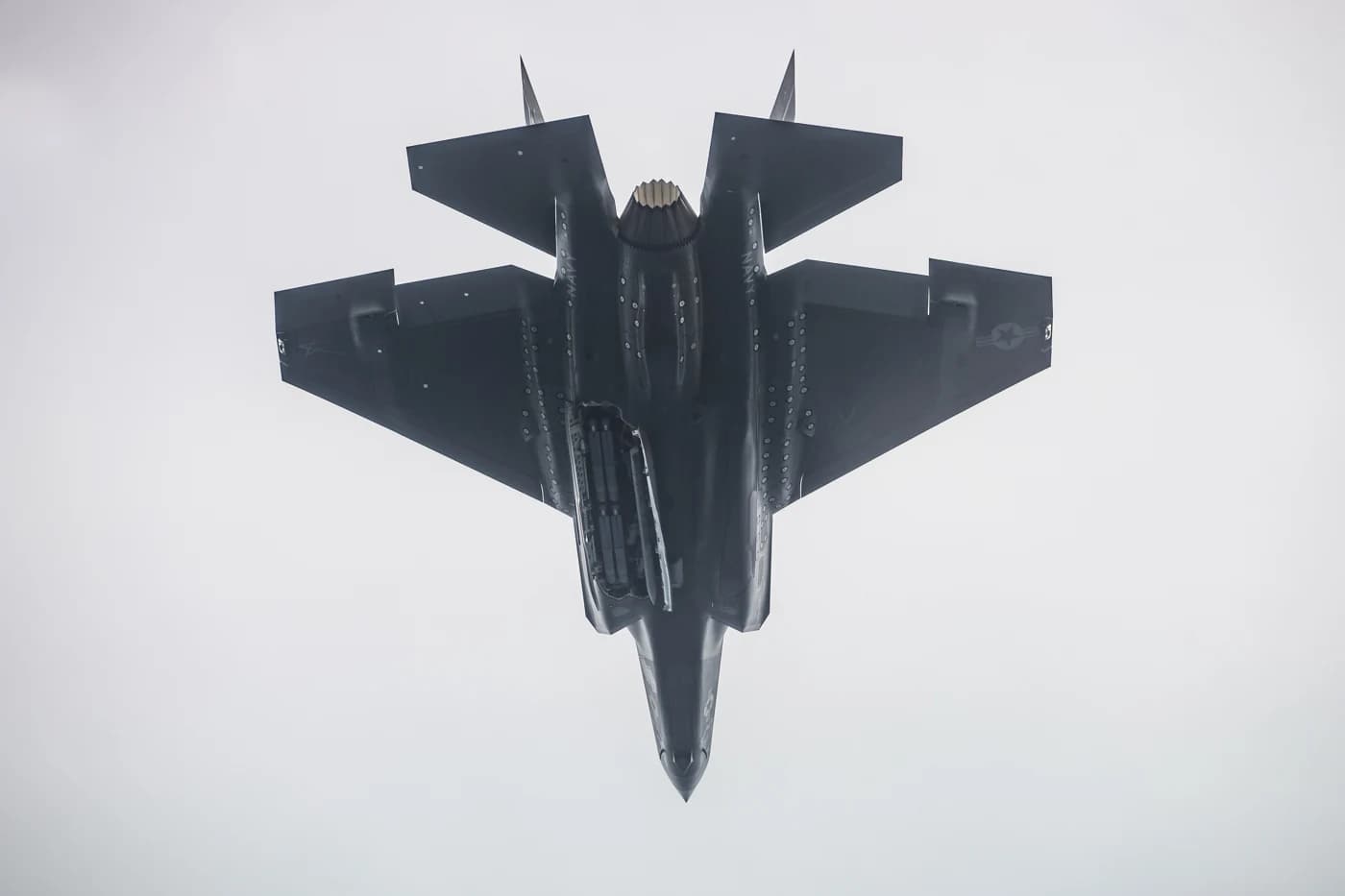
Reference photo · Configuration may differ
Credit
TunaFish Spotting · CC BY-SA 4.0 · Resized · CC BY-SA 4.0 · Source ↗ · Modified


Preparing your view.

At a glance
Measured figures
JF-17 Block 3 · Length
Single source14.33 m (47 ft 0 in)[source]
/15.7 m
Single sourceConfiguration
| Specification | CAC/PAC JF-17 Thunder | F-35C |
|---|---|---|
| Type | Multirole Combat Aircraft[source] Multirole Combat Aircraft[source] | — |
| National origin | Pakistan / China[source] Pakistan / China[source] | — |
| Manufacturer | Pakistan Aeronautical Complex / Chengdu Aircraft Industry Group[source] Pakistan Aeronautical Complex / Chengdu Aircraft Industry Group[source] | Lockheed Martin[source] |
F-35C column in table headed F-35A / F-35B / F-35C; May 2020 manufacturer specification
Single sourceF-35C · Length
Single sourceF-35C Lightning II Fighter Jet / Defense Systems Full Specifications · Length
Single source51.5 ft (15.7 m)[source]F-35C; explicitly labelled CV CATOBAR column; Length
51.5 ft / 15.7 m[source]F-35C column; Length; manufacturer specification dated 4 May 2020
51.5 ft/15.7 m[source]
51.5 ft/15.7 m[source]
51.5 ft (15.7 m)[source]F-35C Lightning II Fighter Jet / Defense Systems Full Specifications
JF-17 Block 3 · Wingspan
Single source9.44 m (31 ft 0 in)[source]
/13.1 m
Single sourceF-35C column in table headed F-35A / F-35B / F-35C; May 2020 manufacturer specification
Single sourceF-35C Lightning II Fighter Jet / Defense Systems Full Specifications · Wingspan
Single sourceF-35C · Wingspan
Single source43 ft (13.1 m)[source]F-35C; explicitly labelled CV CATOBAR column; Wingspan
43 ft / 13.1 m[source]F-35C column; Wingspan; manufacturer specification dated 4 May 2020
43 ft/13.1 m[source]
43 ft/13.1 m[source]
43 ft (13.1 m)[source]F-35C Lightning II Fighter Jet / Defense Systems Full Specifications
JF-17 Block 3 · Height
Single source4.57 m (15 ft 0 in)[source]
F-35C column in table headed F-35A / F-35B / F-35C; May 2020 manufacturer specification
Single sourceF-35C · Height
Single sourceF-35C Lightning II Fighter Jet / Defense Systems Full Specifications · Height
Single source14.7 ft (4.48 m)[source]F-35C; explicitly labelled CV CATOBAR column; Height
14.7 ft / 4.48 m[source]F-35C column; Height; manufacturer specification dated 4 May 2020
14.7 ft (4.48 m)[source]F-35C Lightning II Fighter Jet / Defense Systems Full Specifications
Empty; JF-17 Block 3 · Empty weight
Single sourceMaximum take-off; JF-17 Block 3 · Max takeoff weight
Single source7,965 kg (17,560 lb)[source]
13,500 kg (29,762 lb)[source]
Empty; F-35C column; Weight empty; manufacturer specification dated 4 May 2020 · Empty weight
Single sourceEmpty; F-35C · Empty weight
Single sourceMaximum; JF-17 Block 3 · Maximum speed
Single source1,910 km/h (1,190 mph, 1,030 kn)[source]
Maximum; F-35C Lightning II Fighter Jet / Defense Systems Full Specifications · Mach 1.6 (
Single sourceMach 1.6 (~1,200 mph)[source]F-35C column; Speed (full internal weapons load); manufacturer specification dated 4 May 2020
Mach 1.6[source]
Mach 1.6[source]
Mach 1.6 (1,200 mph / 1,930 km/h)[source]F-35C Lightning II Fighter Jet / Defense Systems Full Specifications
Ferry; JF-17 Block 3 · on internal fuel
Single sourceFerry; JF-17 Block 3 · with drop tanks
Single source1,800 km (1,100 mi, 970 nmi) on internal fuel, 3,482 km (2,163 mi, 1,880 nmi) with drop tanks[source]
F-35C · >
Single sourceF-35C Lightning II Fighter Jet / Defense Systems Full Specifications · Range
Single sourceJF-17 Block 3 · on internal fuel
Single sourceJF-17 Block 3 · with drop tanks
Single source900 km (560 mi, 490 nmi) on internal fuel, 1,741 km (1,082 mi, 940 nmi) with drop tanks[source]
F-35C · Combat radius on internal fuel
Single sourceF-35C Lightning II Fighter Jet / Defense Systems Full Specifications · Combat radius
Single sourceJF-17 Block 3 · 1 × Klimov RD-93MA afterburning turbofan ( thrust with afterburner) with Full Authority Digital Engine Control (FADEC) (previous engine: 1 x Klimov RD-93 afterburning turbofan (
Single sourceJF-17 Block 3 · thrust with afterburner
Single source1 × Klimov RD-93MA afterburning turbofan (91.2 kN (20,500 lbf) thrust with afterburner) with Full Authority Digital Engine Control (FADEC) (previous engine: 1 x Klimov RD-93 afterburning turbofan (84.4 kN (18,974 lbf) thrust with afterburner)[source]
JF-17 Block 3 · 59,000 ft/min
Single source300 m/s (59,000 ft/min)[source]
JF-17 Block 3 · Payload
Single source3,400 kg (7,500 lb)[source]
F-35C column; Weapons payload; manufacturer specification dated 4 May 2020 · Payload
Manufacturer claimF-35C · Weapons payload
Single source18,000 lb (8,160 kg)[source]F-35C; explicitly labelled CV CATOBAR column; Weapons payload
18,000 lb / 8,160 kg[source]F-35C column; Weapons payload; manufacturer specification dated 4 May 2020
F-35C · Internal fuel
Single source19,750 lb (8,958 kg)[source]F-35C; explicitly labelled CV CATOBAR column; Internal fuel
Bars compare reported quantities only. A larger figure does not make a system better; configurations and test conditions differ.
Lockheed Martin[source]F-35C Lightning II Fighter Jet / Defense Systems Full Specifications / General Information
| Status | In service[source] In service[source] | — |
|---|
| Primary users | Pakistan Air Force Myanmar Air Force Nigerian Air Force Azerbaijani Air Forces[source] Pakistan Air Force Myanmar Air Force Nigerian Air Force Azerbaijani Air Forces[source] | — |
|---|
| Number built | >200[source] >200[source] | — |
|---|
| Manufactured | In China: June 2007 – present In Pakistan: January 2008 – present[source] In China: June 2007 – present In Pakistan: January 2008 – present[source] | — |
|---|
| Introduction date | 12 March 2007[source] 12 March 2007[source] | F-35C: 28 February 2019 (USN)[source]F-35C; explicitly named introduction date clause |
|---|
| First flight | 25 August 2003[source] 25 August 2003[source] | June 6, 2010[source]F-35C Lightning II Fighter Jet / Defense Systems Full Specifications / General Information |
|---|
| Fuel capacity | Internal: 3,000 L (2,449 kg); External (3 drop tanks): 1 × 800 L (180 imp gal) under-belly drop tank; 2 × 800 L (180 imp gal) or 1,100 L (240 imp gal) under-wing drop tanks[source] | 19,750 lb / 8,960kg[source]F-35C column; Internal fuel capacity; manufacturer specification dated 4 May 2020 |
|---|
| Guns | 1 × 23 mm GSh-23 twin-barrel cannon[source] | — |
|---|
| Hardpoints | 8 (2 × wingtip, 4 × under-wing, 1 × under-fuselage, 1 × chin) with capacity for dual ejector racks on each under-wing hardpoint[source] | — |
|---|
| Stall speed | 150 km/h (93 mph, 81 kn)[source] | — |
|---|
| g limits | + 8/ - 3 (limited by flight control system)[source] | — |
|---|
| Thrust/weight | 1.07 with RD-93[source] 1.07 with RD-93[source] | — |
|---|
| Missiles | Air-to-air missiles : PL-5EII — (Infrared Homing, Short Range Missile) PL-10E — (Infrared Homing, short range missile) PL-12AE (SD-10A) — (Radar Guided, Beyond Visual Range Missile) PL-15/PL-15E — (Radar Guided, Beyond Visual Range Missile) R-Darter — (Radar Homing, Beyond Visual Range Missile) Faaz-1 (Active Radar Homing and Imaging Infrared) Faaz-2 (Active Radar Homing and Imaging Infrared) Air-to-surface missiles : CM-102 — ( Anti-radiation missile ) LD-10 — (Anti-radiation missile) MAR-1 — (Anti-radiation missile) Ra'ad-II — (Subsonic land attack/anti-ship cruise missile ) CM-400AKG — (Supersonic long-range air-to-surface missile) LD-8A Anti-radiation missile[source] | — |
|---|
| Air-to-air missiles | PL-5EII — (Infrared Homing, Short Range Missile) PL-10E — (Infrared Homing, short range missile) PL-12AE (SD-10A) — (Radar Guided, Beyond Visual Range Missile) PL-15/PL-15E — (Radar Guided, Beyond Visual Range Missile) R-Darter — (Radar Homing, Beyond Visual Range Missile) Faaz-1 (Active Radar Homing and Imaging Infrared) Faaz-2 (Active Radar Homing and Imaging Infrared)[source] | — |
|---|
| Air-to-surface missiles | CM-102 — ( Anti-radiation missile ) LD-10 — (Anti-radiation missile) MAR-1 — (Anti-radiation missile) Ra'ad-II — (Subsonic land attack/anti-ship cruise missile ) CM-400AKG — (Supersonic long-range air-to-surface missile) LD-8A Anti-radiation missile[source] | — |
|---|
| Anti-ship missiles | C-601 — (Anti-ship missile) C-705KD — (Anti-ship missile) C-802AK — (Anti-ship missile) Ra'ad (air-launched cruise missile) Ra'ad-II — (Nuclear-capable subsonic long-range cruise missile) CM-400AKG — (Supersonic long-range anti-ship missile) Taimoor — (Subsonic sea-skimming long-range anti-ship cruise missile)[source] | — |
|---|
| Bombs | Unguided bombs : 250 kg — Pre-fragmented Bomb Pk-82 — (General-Purpose Bomb) Pk-83 — (General-Purpose Bomb) PK-84 — (General-Purpose Bomb) HAFR-1 — (Anti-runway Bomb) HAFR-2 — (Anti-runway Bomb) RPB-1 — (Anti-runway Bomb) BLU-107 — (Anti-runway Bomb) Mk 20 Rockeye II — (Cluster Bomb) Guided bombs : H-2 SOW — (Glide Bomb) H-4 SOW — (Glide Bomb) GBU-10 — (Laser-Guided Bomb) GBU-12 — (Laser-Guided Bomb) GBU-16 — (Laser-Guided Bomb) LT PGB LT-2 — (Laser-Guided Bomb) TG/GB PGB GB-500/GB1 — (Laser-Guided Bomb) TG/GB PGB GB250A/GB3A — (Laser-Guided Bomb) TG/GB PGB GB-6 — (Laser-Guided Bomb) LS PGB LS-6/500 — (Glide Bomb) YL PGB CS/BBF1 (YL-3) — (250 kg (550 lb) Thermobaric Bomb) SCP-5 — (Bunker Buster Bomb) AZB-81 LR — (Small Diameter Bomb) Takbir — (Weapons Guidance & Range Extension Kit) GIDS IREK — (Range Extension Kit) AZB-Series REK — (Range Extension Kit) Al Battaar — (Laser-Guidance Kit)[source] | — |
|---|
| Unguided bombs | 250 kg — Pre-fragmented Bomb Pk-82 — (General-Purpose Bomb) Pk-83 — (General-Purpose Bomb) PK-84 — (General-Purpose Bomb) HAFR-1 — (Anti-runway Bomb) HAFR-2 — (Anti-runway Bomb) RPB-1 — (Anti-runway Bomb) BLU-107 — (Anti-runway Bomb) Mk 20 Rockeye II — (Cluster Bomb)[source] | — |
|---|
| Guided bombs | H-2 SOW — (Glide Bomb) H-4 SOW — (Glide Bomb) GBU-10 — (Laser-Guided Bomb) GBU-12 — (Laser-Guided Bomb) GBU-16 — (Laser-Guided Bomb) LT PGB LT-2 — (Laser-Guided Bomb) TG/GB PGB GB-500/GB1 — (Laser-Guided Bomb) TG/GB PGB GB250A/GB3A — (Laser-Guided Bomb) TG/GB PGB GB-6 — (Laser-Guided Bomb) LS PGB LS-6/500 — (Glide Bomb) YL PGB CS/BBF1 (YL-3) — (250 kg (550 lb) Thermobaric Bomb) SCP-5 — (Bunker Buster Bomb) AZB-81 LR — (Small Diameter Bomb) Takbir — (Weapons Guidance & Range Extension Kit) GIDS IREK — (Range Extension Kit) AZB-Series REK — (Range Extension Kit) Al Battaar — (Laser-Guidance Kit)[source] | — |
|---|
| Others | External Pods: Aselsan ASELPOD — Advanced Targeting Pod (Electro-Optical Reconnaissance, Surveillance, and Targeting System) WMD-7 — FLIR Day/Night Targeting Pod Panjnad EW Pod — Indigenous DRFM airborne self-protection and escort jamming pod developed by NASTP to replace foreign electronic attack suites. Countermeasures: Chaff/Flare dispensers[source] | — |
|---|
| Role | Sino-Pakistani single-engine lightweight supersonic multirole combat aircraft[source] | carrier-based variant[source]F-35C; own variant section |
|---|
| Source measurement | The JF-17 can deploy diverse ordnance , including air-to-air , air-to-surface , and anti-ship missiles ; guided and unguided bombs; and a 23-mm GSh-23-2 twin-barrel autocannon . Powered by the Russian Klimov RD-93 (JF-17 Blocks 1 and 2) or Klimov RD-93MA (JF-17 Block 3) afterburning turbofan engine, it has a top speed of Mach 1.6. The JF-17 is the backbone and workhorse of the PAF, complementing the F-16 Fighting Falcon at approximately half the cost, with the Block II variant costing $25 million. The JF-17 was inducted in the PAF in 2007.[source]CAC/PAC JF-17 Thunder · Lead; only the objects and conditions stated in this passage By 2016, PAF JF-17s had accumulated over 19,000 hours of operational flight.[source]CAC/PAC JF-17 Thunder · Lead; only the objects and conditions stated in this passage The PAF JF-17s have seen military action, both air-to-air and air-to-ground, including bombing terrorist positions in North Waziristan near the Pakistan- Afghanistan border during anti-terror operations in 2014 and 2017, using both guided and unguided munitions, shooting down an intruding Iranian military drone near the Pakistan- Iran border in Balochistan in 2017, in Operation Swift Retort during the 2019 Jammu and Kashmir airstrikes and aerial skirmish between India and Pakistan, and during Operation Marg Bar Sarmachar in 2024 in which Pakistan launched a series of air and artillery strikes inside Iran's Sistan and Baluchestan province targeting Baloch separatist groups.[source]CAC/PAC JF-17 Thunder · Lead; only the objects and conditions stated in this passage Final assembly of the JF-17 in Pakistan began on 30 June 2009; PAC expected to complete production of four to six aircraft that year.[source]CAC/PAC JF-17 Thunder · Development / Production; only the objects and conditions stated in this passage Russia signed an agreement in August 2007 for re-export of 150 RD-93 engines from China to Pakistan for the JF-17. In 2008, the PAF reported it was not fully satisfied with the RD-93 engine and that it would only power the first 50 aircraft; it was alleged that arrangements for a new engine, reportedly the Snecma M53-P2 , may have been made. Mikhail Pogosyan , head of the MiG and Sukhoi design bureaus, recommended the Russian defence export agency Rosoboronexport block RD-93 engine sales to China to prevent export competition from the JF-17 against the MiG-29. At the 2010 Farnborough Airshow , the JF-17 was displayed internationally for the first time; aerial displays at the show were intended but were cancelled due to a late attendance decision as well as licence and insurance costs. According to a Rosoboronexport official at the Airshow China 2010, held on 16–21 November 2005 in Zhuhai , China, Russia and China had signed a contract worth $238 million for 100 RD-93 engines with options for another 400 engines developed for the FC-1.[source]CAC/PAC JF-17 Thunder · Development / Production; only the objects and conditions stated in this passage Up to 3,400 lb (1,500 kg) of ordnance, equipment, and fuel can be mounted under the hardpoints , two of which are on the wing-tips, four are under the wings and one is under the fuselage.[source]CAC/PAC JF-17 Thunder · Design / Airframe; only the objects and conditions stated in this passage The aircraft has three large Multifunction Colour Displays (MFD) and smart Heads-Up Display (HUD) with built-in symbol generation capability. A center stick is used for pitch and roll control while rudder pedals control yaw. A throttle is located to the left of the pilot. The cockpit incorporates hands-on-throttle-and-stick (HOTAS) controls. The pilot sits on a Martin-Baker Mk-16LE zero-zero ejection seat . The cockpit incorporates an electronic flight instrument system (EFIS) and a wide-angle, holographic head-up display (HUD), which has a minimum total field of view of 25 degrees. The EFIS comprises three color multi-function displays, providing basic flight information, tactical information, and information on the engine, fuel, electrical, hydraulics, flight control, and environment control systems. The HUD and MFD can be configured to show any available information. Each MFD is 20.3 cm (8.0 in) wide and 30.5 cm (12.0 in) tall and is arranged side by side in portrait orientation . The central MFD is placed lowest to accommodate a control panel between it and the HUD.[source]CAC/PAC JF-17 Thunder · Design / Cockpit; only the objects and conditions stated in this passage Multiple modes can manage the surveillance and engagement of up to forty air, ground, and sea targets; the track-while-scan mode can track up to ten targets at BVR and can engage two simultaneously with radar-homing AAMs .[source]CAC/PAC JF-17 Thunder · Design / Avionics; only the objects and conditions stated in this passage The operation range for targets with a radar cross-section (RCS) of 5 m 2 (54 sq ft) is stated to be ≥ 105 km (65 miles) in look-up mode and ≥ 85 km (53 miles) in look-down mode.[source]CAC/PAC JF-17 Thunder · Design / Avionics; only the objects and conditions stated in this passage A helmet-mounted sight (HMS) developed by Luoyang Electro-Optics Technology Development Centre of AVIC was developed in parallel with the JF-17; it was first tested on Prototype 04 in 2006.[source]CAC/PAC JF-17 Thunder · Design / Avionics; only the objects and conditions stated in this passage The RD-93 is known to produce smoke trails. The Guizhou Aero Engine Group has been developing a new turbofan engine, the WS-13 Taishan , since 2000 to replace the RD-93. It is based on the RD-33 and incorporates new technologies to boost performance and reliability. A thrust output of 80 to 86.36 kN (17,980 to 19,410 lb f ), a lifespan of 2,200 hours, and a thrust-to-weight ratio of 8.7 are expected. An improved version of the WS-13, developing a thrust of around 100 kN (22,000 lb f ) (22,450 lb), is also reportedly under development. During the 2015 Paris Air Show , it was announced that flight testing of a JF-17 equipped with the WS-13 engine had begun. In 2015, a representative of PAC said that Pakistan would continue to use the RD-93 engine on their fighters. Local media reports in January 2016 said that Russia was planning to sell engines for JF-17 directly to Pakistan. According to a PAC representative, Pakistan is looking to collaborate with Russia in developing and repairing engines.[source]CAC/PAC JF-17 Thunder · Design / Engine; only the objects and conditions stated in this passage The fuel system comprises internal fuel tanks located in the wings and fuselage with a capacity of 2,330 kg (5,140 lb); they are refuelled through a single point pressure refuelling system (see turbine fuel systems ). Internal fuel storage can be supplemented by external fuel tanks. One 800-litre (180 imp gal) drop tank can be mounted on the aircraft's centerline hard point under the fuselage and two 800-litre or 1,110-litre (240 imp gal) drop tanks can be mounted on the two inboard under-wing hardpoints. The fuel system is compatible with in-flight refuelling (IFR) , allowing tanker aircraft to refuel inflight, and increasing its range and loitering time significantly. All production aircraft for the PAF are to be fitted with IFR probes. In June 2013, PAF Air Chief Marshal Tahir Rafique Butt said ground tests on the JF-17's refuelling probes had been successfully completed and the first mid-air refuelling operations would commence that summer.[source]CAC/PAC JF-17 Thunder · Design / Fuel system; only the objects and conditions stated in this passage The JF-17 can be armed with up to 3,400 lb (1,500 kg) of air-to-air and air-to-ground weaponry , and other equipment mounted externally on the aircraft's seven hardpoints. One hardpoint is located under the fuselage between the main landing gear, two are underneath each wing, and one is at each wing-tip. All seven hardpoints communicate via a MIL-STD-1760 data-bus architecture with the Stores Management System, which is stated to be capable of integration with weaponry of any origin. Internal armament comprises one 23 mm (0.91 in) GSh-23-2 twin-barrel cannon mounted under the port side air intake, which can be replaced with a 30 mm (1.2 in) GSh-30-2 twin-barrel cannon.[source]CAC/PAC JF-17 Thunder · Design / Armaments; only the objects and conditions stated in this passage The wing-tip hard-points are typically occupied by short range infra-red homing AAMs. Many combinations of ordnance and equipment such as targeting pods can be carried on the under-wing and under-fuselage hard-points. Underwing hard-points can be fitted with multiple ejector racks , allowing each hard-point to carry two 500 lb (230 kg) unguided bombs or LGBs— Mk.82 or GBU-12 . Active radar homing BVR AAMs can be integrated with the radar and data-link for mid-course updates. The aircraft can carry the PL-12/SD-10 along with the PL-5 E and PL-9 C Short range, infra-red homing missiles. The more advanced PL-10 E High-Off Bore Sight missiles were integrated into the aircraft in April 2021, operated Within Visual Range using the HMD/S. With the Block 3 variant of the JF-17, the ability to fit and operate the PL-15 E, the most advanced BVR missile developed by China for export with a claimed operating range of 145 km, is also integrated.[source]CAC/PAC JF-17 Thunder · Design / Armaments; only the objects and conditions stated in this passage Pakistan claimed that its JF-17 successfully targeted and destroyed an Indian S-400 missile defence system at Adampur Air Force Station in Punjab on 10 May 2025 using two CM-400AKG long-range supersonic air-to-surface missiles .[source]CAC/PAC JF-17 Thunder · Operational history / Pakistan; only the objects and conditions stated in this passage In December 2014, during the International Defence Exhibition and Seminar in Karachi, Nigeria was reportedly buying between 25 and 40 JF-17s from Pakistan . Nigerian Air Force (NAF) chief Air Marshal Adesola Nunayon Amosu had visited Pakistan earlier in October 2014. Nigeria became the second customer in 2016 by placing an order for three planes. However, as the news reports value the deal at US$25 million, it is not clear if the item is misreported. A June 2016 article in Jane's re-affirmed NAF budget for 3 JF-17, 10 Super Mushshak , and 2 Mi-35M aircraft in 2016. With a confirmation from the Nigerian Air Force shortly after.[source]CAC/PAC JF-17 Thunder · Operational history / Nigeria; only the objects and conditions stated in this passage However, in October 2023, the United States approved the transfer of 24 second-hand F-16 Block-15 MLU fighters previously owned by the Royal Danish Air Force to Argentina, countering the Chinese offer; reportedly, the deal did not necessitate an approval from the United Kingdom. Following the inauguration of the Javier Milei administration in Argentina in 2023, the decision to select the F-16 had reportedly materialised, leaving the JF-17 out of the contest.[source]CAC/PAC JF-17 Thunder · Operational history / Former interests / Argentina; only the objects and conditions stated in this passage In June 2021, the RMAF formally released a tender for the supply of 18 light combat-aircraft — dubbed as the "Fighter Lead In Trainer-Light Combat Aircraft" (FLIT/LCA), in an effort to supplant its ageing BAE Hawk 108/208 light-combat aircraft and its MB-339CM trainer-aircraft. The RMAF later issued a Request for Proposal (RFP) to nine different aircraft-manufacturing conglomerates in July, with a submission-deadline of September 2021 (this would later be extended to October 2021). The JF-17 was widely regarded to be a leading contender in the FLIT/LCA procurement initiative, along with the HAL Tejas and the KAI FA-50 .[source]CAC/PAC JF-17 Thunder · Operational history / Former interests / Malaysia; only the objects and conditions stated in this passage Each wing houses 550 Ib while the vertical tail houses 210 lb, which, together with the internal fuel load, totals 4,910 Ib of fuel.[source]CAC/PAC JF-17 Thunder · Variants / Production variants; only the objects and conditions stated in this passage Two prototypes underwent flight tests as of December 2020, one in China and the other in Pakistan.[source]CAC/PAC JF-17 Thunder · Variants / Production variants; only the objects and conditions stated in this passage The KLJ-7A can simultaneously track 15 targets and engage 4 targets.[source]CAC/PAC JF-17 Thunder · Variants / Production variants; only the objects and conditions stated in this passage At the RIAT 2025 air show, Pakistan showcased a C-130H Hercules with a custom paint job featuring artwork of various PAF aircraft; notably, the PFX was depicted highest on the tail, symbolising the Air Force's strong commitment to the program.[source]CAC/PAC JF-17 Thunder · Variants / Production variants; only the objects and conditions stated in this passage 14 November 2011 : A PAF JF-17 Block 1 aircraft crashed during a routine training flight in the mountainous Mullan Mansoor region of Attock District in the Punjab Province while flying from PAF Base Minhas . According to the official PAF report, the crash was caused by a technical malfunction. Pakistani news reported that the pilot, Squadron Leader Muhammad Hussain, ejected but was killed after his parachute failed to open, and that there were no civilian casualties reported on the ground. The pilot's body was discovered two kilometres from the crash site. This was the first known crash of a JF-17.[source]CAC/PAC JF-17 Thunder · Accidents and incidents; only the objects and conditions stated in this passage Length: 14.33 m (47 ft 0 in)[source]CAC/PAC JF-17 Thunder · Specifications (JF-17 Block 3); only the objects and conditions stated in this passage Wingspan: 9.44 m (31 ft 0 in)[source]CAC/PAC JF-17 Thunder · Specifications (JF-17 Block 3); only the objects and conditions stated in this passage Height: 4.57 m (15 ft 0 in)[source]CAC/PAC JF-17 Thunder · Specifications (JF-17 Block 3); only the objects and conditions stated in this passage Wing area: 24.43 m 2 (263.0 sq ft)[source]CAC/PAC JF-17 Thunder · Specifications (JF-17 Block 3); only the objects and conditions stated in this passage Empty weight: 7,965 kg (17,560 lb)[source]CAC/PAC JF-17 Thunder · Specifications (JF-17 Block 3); only the objects and conditions stated in this passage Max takeoff weight: 13,500 kg (29,762 lb)[source]CAC/PAC JF-17 Thunder · Specifications (JF-17 Block 3); only the objects and conditions stated in this passage Fuel capacity: Internal: 3,000 L (2,449 kg); External (3 drop tanks): 1 × 800 L (180 imp gal) under-belly drop tank; 2 × 800 L (180 imp gal) or 1,100 L (240 imp gal) under-wing drop tanks[source]CAC/PAC JF-17 Thunder · Specifications (JF-17 Block 3); only the objects and conditions stated in this passage Powerplant: 1 × Klimov RD-93MA afterburning turbofan (91.2 kN (20,500 lbf) thrust with afterburner) with Full Authority Digital Engine Control (FADEC) (previous engine: 1 x Klimov RD-93 afterburning turbofan (84.4 kN (18,974 lbf) thrust with afterburner)[source]CAC/PAC JF-17 Thunder · Specifications (JF-17 Block 3); only the objects and conditions stated in this passage Maximum speed: 1,910 km/h (1,190 mph, 1,030 kn)[source]CAC/PAC JF-17 Thunder · Specifications (JF-17 Block 3); only the objects and conditions stated in this passage Stall speed: 150 km/h (93 mph, 81 kn)[source]CAC/PAC JF-17 Thunder · Specifications (JF-17 Block 3); only the objects and conditions stated in this passage Combat range: 900 km (560 mi, 490 nmi) on internal fuel, 1,741 km (1,082 mi, 940 nmi) with drop tanks[source]CAC/PAC JF-17 Thunder · Specifications (JF-17 Block 3); only the objects and conditions stated in this passage Ferry range: 1,800 km (1,100 mi, 970 nmi) on internal fuel, 3,482 km (2,163 mi, 1,880 nmi) with drop tanks[source]CAC/PAC JF-17 Thunder · Specifications (JF-17 Block 3); only the objects and conditions stated in this passage Service ceiling: 16,916 m (55,500 ft)[source]CAC/PAC JF-17 Thunder · Specifications (JF-17 Block 3); only the objects and conditions stated in this passage Rate of climb: 300 m/s (59,000 ft/min)[source]CAC/PAC JF-17 Thunder · Specifications (JF-17 Block 3); only the objects and conditions stated in this passage Guns: 1 × 23 mm GSh-23 twin-barrel cannon[source]CAC/PAC JF-17 Thunder · Specifications (JF-17 Block 3); only the objects and conditions stated in this passage Payload: 3,400 kg (7,500 lb)[source]CAC/PAC JF-17 Thunder · Specifications (JF-17 Block 3); only the objects and conditions stated in this passage Bombs: Unguided bombs : 250 kg — Pre-fragmented Bomb Pk-82 — (General-Purpose Bomb) Pk-83 — (General-Purpose Bomb) PK-84 — (General-Purpose Bomb) HAFR-1 — (Anti-runway Bomb) HAFR-2 — (Anti-runway Bomb) RPB-1 — (Anti-runway Bomb) BLU-107 — (Anti-runway Bomb) Mk 20 Rockeye II — (Cluster Bomb) Guided bombs : H-2 SOW — (Glide Bomb) H-4 SOW — (Glide Bomb) GBU-10 — (Laser-Guided Bomb) GBU-12 — (Laser-Guided Bomb) GBU-16 — (Laser-Guided Bomb) LT PGB LT-2 — (Laser-Guided Bomb) TG/GB PGB GB-500/GB1 — (Laser-Guided Bomb) TG/GB PGB GB250A/GB3A — (Laser-Guided Bomb) TG/GB PGB GB-6 — (Laser-Guided Bomb) LS PGB LS-6/500 — (Glide Bomb) YL PGB CS/BBF1 (YL-3) — (250 kg (550 lb) Thermobaric Bomb) SCP-5 — (Bunker Buster Bomb) AZB-81 LR — (Small Diameter Bomb) Takbir — (Weapons Guidance & Range Extension Kit) GIDS IREK — (Range Extension Kit) AZB-Series REK — (Range Extension Kit) Al Battaar — (Laser-Guidance Kit)[source]CAC/PAC JF-17 Thunder · Specifications (JF-17 Block 3); only the objects and conditions stated in this passage | — |
|---|
| Combat radius on internal fuel | — | 670 nmi (1,241 km)[source]F-35C; explicitly labelled CV CATOBAR column; Combat radius on internal fuel |
|---|
| Thrust/weight • full fuel: • 50% fuel: | — | 0.75 0.91[source]F-35C; explicitly labelled CV CATOBAR column; Thrust/weight • full fuel: • 50% fuel: |
|---|
| g limit | — | + 7.5[source]F-35C; explicitly labelled CV CATOBAR column; g limit |
|---|
| Horizontal tail span | — | 26.3 ft / 8.02 m[source]F-35C column; Horizontal tail span; manufacturer specification dated 4 May 2020 |
|---|
| Powerplant | — | F135-PW-100 40,000 lb Max. 25,000 lb Mil. Vertical N/A[source]F-35C column; Propulsion* (uninstalled thrust ratings); manufacturer specification dated 4 May 2020 |
|---|
| Maximum g-rating | — | 7.5[source]F-35C column; Max g-rating; manufacturer specification dated 4 May 2020 |
|---|
| Country of origin | — | United States[source]F-35C Lightning II Fighter Jet / Defense Systems Full Specifications / General Information |
|---|
| Engine type | — | Pratt & Whitney F135-PW-100[source]F-35C Lightning II Fighter Jet / Defense Systems Full Specifications |
|---|
| Reported operators | — |
|
|---|
Empty; F-35C Lightning II Fighter Jet / Defense Systems Full Specifications · Empty weight
Single sourceMaximum take-off; F-35C Lightning II Fighter Jet / Defense Systems Full Specifications · Max takeoff weight
Single source34,581 lb (15,686 kg)[source]F-35C; explicitly labelled CV CATOBAR column; Empty weight
70,000 lb (31,800 kg) class[source]F-35C; explicitly labelled CV CATOBAR column; Max takeoff weight
34,800 lb[source]F-35C column; Weight empty; manufacturer specification dated 4 May 2020
70,000 lb class[source]F-35C column; Maximum weight; manufacturer specification dated 4 May 2020
34,800 lb (15,785 kg[source]F-35C Lightning II Fighter Jet / Defense Systems Full Specifications
70,000 lb (31,800 kg)[source]F-35C Lightning II Fighter Jet / Defense Systems Full Specifications