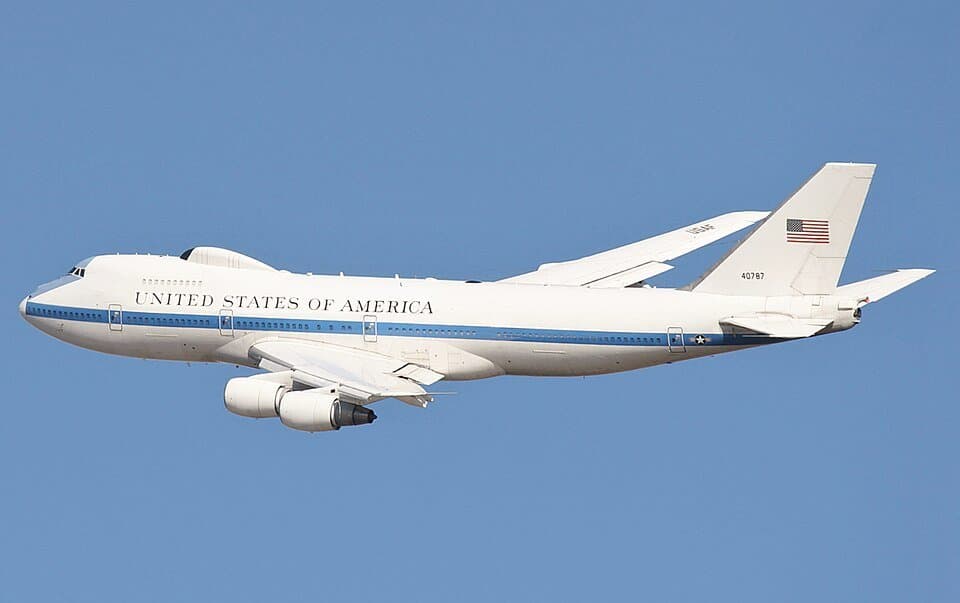

Credit
Masteruploader · Public domain · Resized · Public domain · Source ↗ · Modified


Preparing your view.
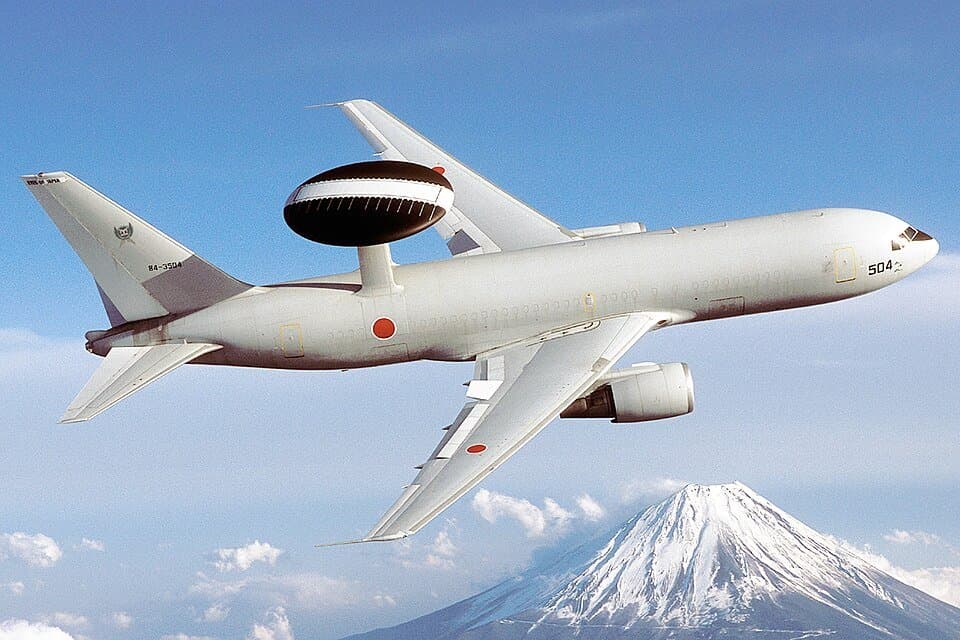
At a glance
True scale
Side by side. From every angle. A human reference for perspective.
3.18 MB · Loads when you open it| Model | Length | Width / span | Height |
|---|---|---|---|
| Boeing E-4 | ≈ 70.51 m | ≈ 59.65 m (Width) | ≈ 19.33 m |
| Boeing E-767 | ≈ 48.5 m | ≈ 47.6 m (Width) | ≈ 15.8 m |
Scaled uniformly to the sourced length of 70.51 m. The shape was turned square to the axes; the height was fitted to the sourced 19.33 m; the width was fitted to the sourced 59.64 m. Not an official model or a measured survey.
ForceTally · All rights reserved
Scaled uniformly to the sourced length of 48.5 m. The shape was turned square to the axes; the height was fitted to the sourced 15.8 m; the width was fitted to the sourced 47.6 m. Not an official model or a measured survey.
ForceTally · All rights reserved
The human reference is a generic 1.75 m figure. Models describe external size, not combat performance.
Measured figures
E-4B · Length
Single source231 ft 4 in (70.51 m)[source]
E-767 · Length
Configuration
| Specification | Boeing E-4 | Boeing E-767 |
|---|---|---|
| Role | Airborne strategic command and control post[source] | — |
| National origin | United States[source] | United States[source] |
| Manufacturer | Boeing[source] | Boeing Integrated Defense Systems[source] |
| Status | In service[source] | In service[source] |
| Primary user |
159 ft 2 in (48.5 m)[source]
Empty; E-4B · Empty weight
Single sourceGross; E-4B · Gross weight
Single sourceMaximum take-off; E-4B · Max takeoff weight
Single source410,000 lb (185,973 kg)[source]
800,000 lb (362,874 kg)[source]
833,000 lb (377,842 kg)[source]
Empty; E-767 · Empty weight
Single sourceGross; E-767 · Gross weight
Single sourceE-4B · 4 × General Electric F103 turbofan engines thrust each
Single source4 × General Electric F103 turbofan engines, 52,500 lbf (234 kN) thrust each[source]
E-767 · 2 × General Electric CF6-80C2 turbofan thrust each
Single source2 × General Electric CF6-80C2 turbofan , 61,500 lbf (274 kN) thrust each[source]
E-4B · Wing area
Single source5,500 sq ft (510 m 2 )[source]
150+ hours (with refueling)[source]
E-767 · at 300-nautical mile radius (no aerial refueling capability)
Single sourceE-767 · on station at 1,000 nautical-mile radius
Single source9.25 hours on station at 1,000 nautical-mile radius; 13 hours at 300-nautical mile radius (no aerial refueling capability).[source]
Bars compare reported quantities only. A larger figure does not make a system better; configurations and test conditions differ.
United States Air Force[source] |
Japan Air Self-Defense Force[source] |
| Number built |
|---|
| Introduction date | 1974[source] | 10 May 2000[source] |
|---|
| First flight | 13 June 1973[source] | 4 October 1994 (without rotodome) 9 August 1996 (with rotodome )[source] |
|---|
| Developed from | Boeing 747-200[source] | Boeing 767[source] |
|---|
| Successors | SNC E-4C Survivable Airborne Operations Center[source] | — |
|---|
| Capacity | up to 108 mission crew[source] | — |
|---|
| Airfoil | root: BAC 463 to BAC 468; tip: BAC 469 to BAC 474[source] | — |
|---|
| Wing loading | 150 lb/sq ft (730 kg/m 2 )[source] | — |
|---|
| Thrust/weight | 0.26[source] | — |
|---|
| Type | — | Airborne Warning and Control System (AWACS)[source] |
|---|
Maximum take-off; E-767 · Max takeoff weight
Single source