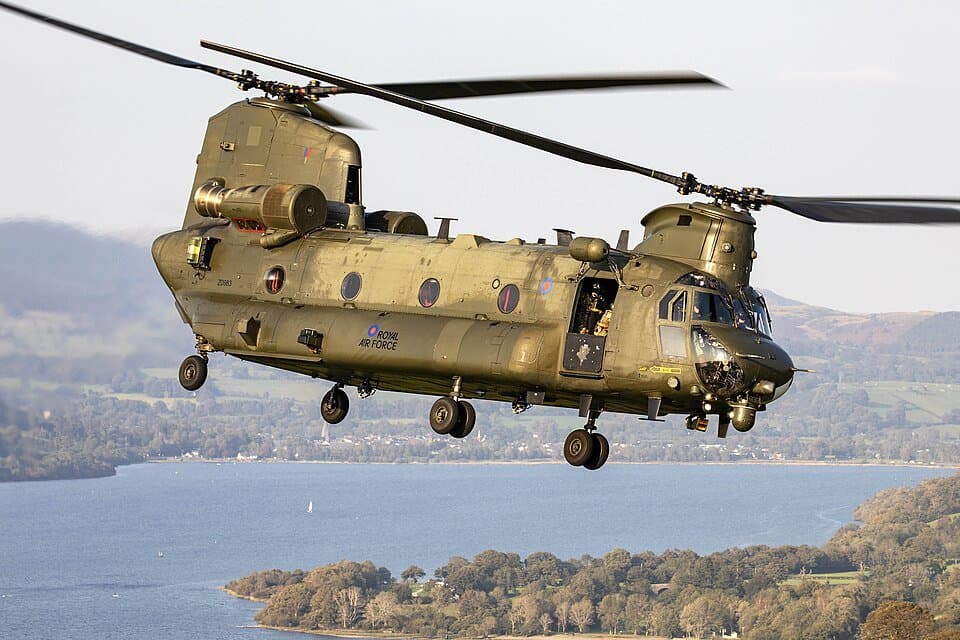



Preparing your view.
Measured figures
Chinook HC6A · Length
Single sourceChinook / RAF specification (variant not stated) · Length · Length
Single sourceConfiguration
| Specification | Boeing Chinook (UK variants) | Fenestron |
|---|---|---|
| Type | Transport helicopter[source] | — |
| Manufacturer | Boeing Defense, Space & Security[source] | — |
| Designer | Boeing-Vertol[source] | — |
| Status | In service[source] | — |
| Primary user | Royal Air Force[source] | — |
| Number built | 72 (all RAF models) |
Chinook HC6A · pilot, copilot, two weapon system operators/loadmasters
Single source4 (pilot, copilot, two weapon system operators/loadmasters)[source]
2 Pilots, 2 Weapon System Operators[source]Chinook / RAF specification (variant not stated) · AircrewSource text · numeric interpretation needs review
Chinook HC6A · with auxiliary fuel tanks
Single source1,200 nmi (1,400 mi, 2,200 km) with auxiliary fuel tanks[source]
Chinook HC6A · 2 × Honeywell T55-GA-714A turboshaft free-turbine engines, 3,750 shp ( ) each
Single source2 × Honeywell T55-GA-714A turboshaft free-turbine engines, 3,750 shp (2,800 kW) each[source]
Chinook HC6A · Service ceiling
Single source15,000 ft (4,600 m)[source]
Chinook HC6A · 1,980 ft/min ( )Thrust 2x 4,168shp each engine
Single source1,980 ft/min (10.1 m/s)Thrust 2x 4,168shp each engine[source]
Bars compare reported quantities only. A larger figure does not make a system better; configurations and test conditions differ.
| — |
| Introduction date | 22 November 1980 (with RAF)[source] | — |
|---|
| First flight | 23 March 1980 (HC1)[source] | — |
|---|
| Developed from | Boeing CH-47 Chinook[source] | — |
|---|
| Variants | HC1, HC1B, HC2, HC3, HC4, HC5, HC6, HC6A, HC7[source] | — |
|---|
| Capacity | 55 soldiers and up to 10 tonnes of freight or equipment[source] | — |
|---|
| Guns | 2× M134 Miniguns and 1× M60 machine gun[source] 2 x M134 Miniguns, 1 x M60 Machine Gun[source]Chinook / RAF specification (variant not stated) · Guns | — |
|---|
| Main rotor area | 5,655.2 sq ft (525.39 m 2 )[source] | — |
|---|
| Blade section | - root: Boeing VR-7; tip: Boeing VR-8[source] | — |
|---|
| Cockpit Avionics | Glass cockpit with a BAE Systems Digital Advanced Flight Control System (DAFCS), includes automatic modes such as auto-hover and auto-descend to ease pilot workload.[source] | — |
|---|
| Sensors | Electro-Optical Sensor Turret (EOST) with two infrared cameras and a low-light TV function .[source] EOST turret including two infrared cameras and a low-light TV function[source]Chinook / RAF specification (variant not stated) · Electro optics | — |
|---|
| Defensive Aids | Missile Warning Receiver, Infrared Warning Receiver, Radar Warning Receiver, Counter-measure dispensing system (flares).[source] | — |
|---|
| Country of origin | United States[source]Boeing Chinook (UK variants) · origin explicitly stated in the linked current national-inventory row; no inference from operator or shipyard | — |
|---|
| Powerplant | Two Honeywell 55-L-714A Free-Turbine engines[source]Chinook / RAF specification (variant not stated) · Powerplant | — |
|---|
| Reported engine rating | 4,168shp each[source]Chinook / RAF specification (variant not stated) · ThrustSource text · numeric interpretation needs review | — |
|---|
| Flight altitude | 15,000ft[source]Chinook / RAF specification (variant not stated) · Maximum altitude | — |
|---|
| Role | — | enclosed helicopter tail rotor[source] |
|---|
| Source measurement | — | During the 1990s, a third generation Fenestron was produced by Eurocopter (Aérospatiale's multinational successor), equipped with unevenly-spaced blades in order to optimize its noise levels; this unit was first fitted onto the company's EC135 helicopter, and was later incorporated into the designs of the EC130 and the EC145 , the latter of which had been produced for over a decade with a conventional tail rotor. During the 2010s, multinational helicopter manufacturer Airbus Helicopters (a rebranded version of the Eurocopter entity) developed the Fenestron further for their new H160 helicopter, a medium-twin sized rotorcraft; in this revision, the fan duct was intentionally sloped by 12 degrees to achieve improved performance and greater stability when being operated with higher payloads and flown at lower speeds.[source]Fenestron · History; only the objects and conditions stated in this passage |
|---|