Credit
One half 3544 · Public domain · Resized · Public domain · Source ↗ · Modified


Preparing your view.
At a glance
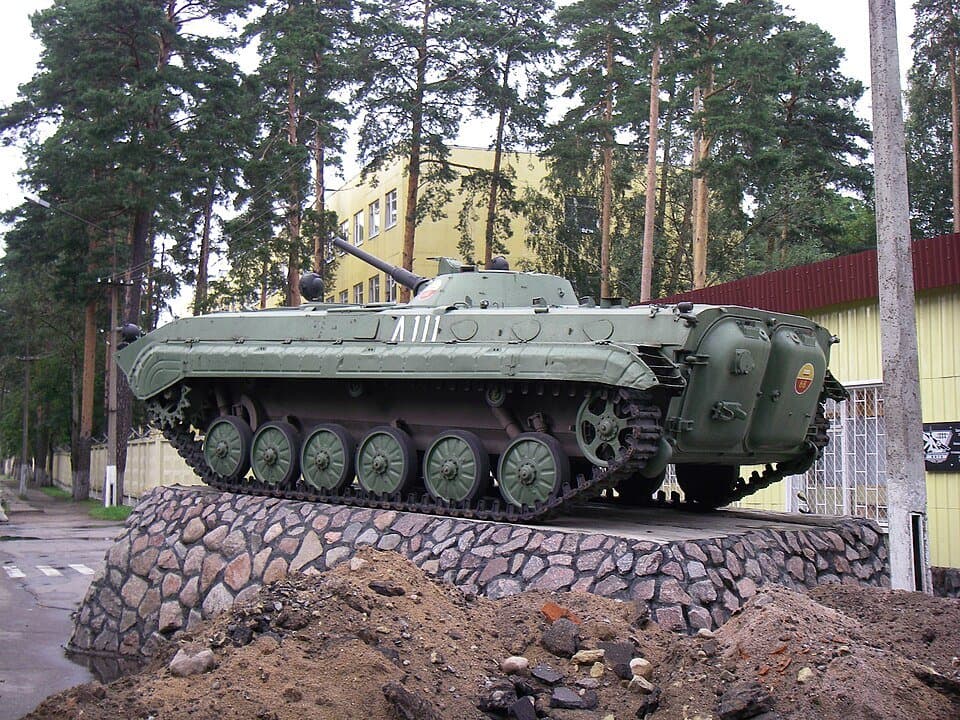
BMP-1larger figure on 0 of 3
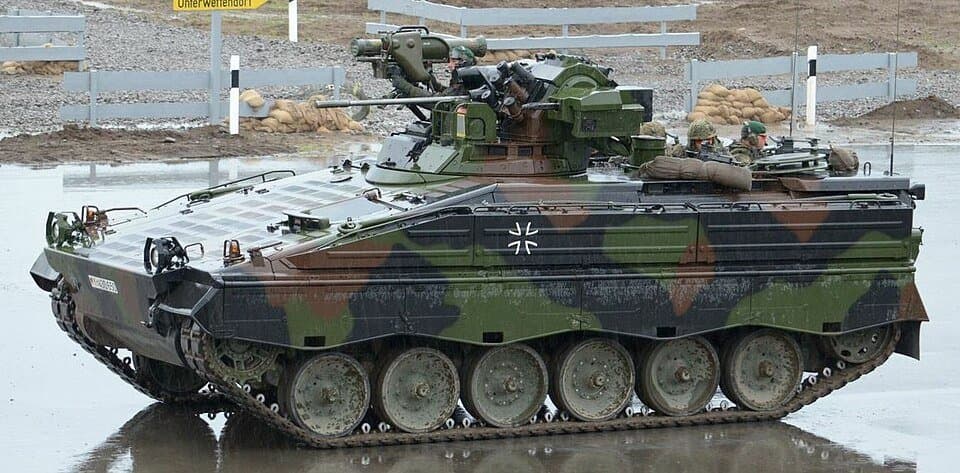
Marder (infantry fighting vehicle)larger figure on 3 of 3
Counts only measures both sources give with the same scope. A larger figure is not a better system.
Measured figures
Length
Single source6.735 m (22 ft 1.2 in)[source]
Length
Single sourceConfiguration
| Specification | BMP-1 | Marder (infantry fighting vehicle) |
|---|---|---|
| Type | Infantry fighting vehicle Armoured personnel carrier[source] | Infantry fighting vehicle[source] |
| Place of origin | Soviet Union[source] | West Germany[source] |
| In service | 1966–present[source] | 1971–present[source] |
| Used by | See Service history[source] |
Schützenpanzer Marder 1 · Length · Länge
Single sourceHeight
Single sourceto turret top
Single source2.068 m (6 ft 9.4 in) 1.881 m (6 ft 2.1 in) to turret top[source]
Height
Single sourceSchützenpanzer Marder 1 · Height · Höhe
Single sourceMass
Single source13.2 tonnes (13.0 long tons; 14.6 short tons)[source]
A2 Marder 1A3
Single sourceA2 Marder 1A5
Single sourceMarder 1A1/
Single source28.5 t (31.4 short tons) Marder 1A1/A2 33.5 t (36.9 short tons) Marder 1A3 37.4 t (41.2 short tons) Marder 1A5[source]
Maximum; Off-road
Single sourceMaximum; road
Single sourceMaximum; water
Single source65 km/h (40 mph) road 45 km/h (28 mph) off-road 7–8 km/h (4.3–5.0 mph) water[source]
Maximum; Marder 1A2
Single sourceMaximum; Marder 1A3
Single sourceOperational; Off-road
Single sourceOperational; road
Single source600 km (370 mi) road 500 km (310 mi) off-road[source]
Operational; Operational range
Single sourcerange of around
Single sourceUTD-20 V6 diesel engine at 2,600 rpm
Single sourceUTD-20 V6 diesel engine 300 hp (220 kW) at 2,600 rpm[source]
Bars compare reported quantities only. A larger figure does not make a system better; configurations and test conditions differ.
Bundeswehr Armed Forces of Ukraine[source] |
| Wars | See Service history[source] | Kosovo War Prizren incident War in Afghanistan Russo-Ukrainian War Russian invasion of Ukraine[source] |
|---|
| Designer | Pavel Isakov (Design Bureau of the ChTZ )[source] | Rheinmetall Landsysteme[source] |
|---|
| Designed | 1961–1965[source] | 1959–1969[source] |
|---|
| Manufacturer | Kurganmashzavod (Soviet Union) ZTS Detva (Czechoslovakia) See also Production history section for details.[source] | Rheinmetall Landsysteme Maschinenbau Kiel[source] |
|---|
| Produced | 1966–(production in the Soviet Union ended in 1982 or 1983) 2026–(production to restart in Slovakia between 2026 and 2027)[source] | 1969–1975[source] |
|---|
| No. built | More than 20,000 of all variants (Soviet Union) More than 3,000 of all variants (PRC) 18,000 (Czechoslovakia) ≈800 (India)[source] | 2,137 (incl. Marder 2 prototype)[source] |
|---|
| Variants | BMP-1, BMP-2 , MLI-84 , Boragh ; see also BMP-1 variants .[source] | — |
|---|
| Armor | 6–33 mm (0.24–1.30 in) welded rolled steel[source] | Welded steel, protection up to 20 mm APDS DM43 from 0 m and 25 mm APDS from 200 m (220 yd)[source] |
|---|
| Main armament | 73 mm 2A28 Grom smoothbore gun (40 rounds) 9M14 Malyutka ATGM (4 rounds)[source] | 20 mm Rheinmetall MK 20 Rh 202 automatic cannon 1,250 rounds MILAN ATGM launcher[source] |
|---|
| Secondary armament | 7.62 mm PKT coaxial machine gun (2,000 rounds)[source] | 7.62 mm MG3 machine gun 5,000 rounds[source] |
|---|
| Power/weight | 22.7 hp/tonne (17.0 kW/tonne)[source] | 15.7 kW/t (21.1 hp/t)[source] |
|---|
| Suspension | torsion bar[source] | Torsion bar[source] |
|---|
| Ground clearance | 370 mm (15 in)[source] | 0.45 m (18 in)[source] |
|---|
| Fuel capacity | 462 L (102 imp gal; 122 US gal)[source] | 652 L (143 imp gal; 172 US gal)[source] |
|---|
| Unit cost | — | $390,000 2.33 million[source] |
|---|
| Transmission | — | RENK HSWL 194[source] |
|---|
| Former operator · Brazil | — | Brazil[source] |
|---|
| Role | — | tracked German infantry fighting vehicle[source] |
|---|
| Source measurement | — | A more reliable 20 mm cannon.[source]Marder (infantry fighting vehicle) · Development; only the objects and conditions stated in this passage Initially, development contracts were awarded to two groups of companies: the Rheinstahl group (Rheinstahl- Hanomag , Ruhrstahl, Witten-Annen, Büro Warnecke) and the second group comprising Henschel Werke and the Swiss MOWAG company. This resulted in the production of seven prototype vehicles. A second set of eight prototype vehicles were built between 1961 and 1963. Development priority was then switched for a while to the development of the Jagdpanzer 90 mm Kanone .[source]Marder (infantry fighting vehicle) · Development; only the objects and conditions stated in this passage A number of upgrade programs were carried out, that included fitting night vision equipment and a thermal imager , as well as an upgraded ammunition feed to the 20 mm cannon.[source]Marder (infantry fighting vehicle) · Development; only the objects and conditions stated in this passage Improved armour, weighing 1,600 kg, intended to protect against the 30 mm 2A42 cannon on the Russian BMP-2 . The armour provided additional protection against cluster bomblets .[source]Marder (infantry fighting vehicle) · Development; only the objects and conditions stated in this passage The new total weight was 35,000 kg.[source]Marder (infantry fighting vehicle) · Development; only the objects and conditions stated in this passage The hull of the Marder 1 is all welded steel, giving protection from small-arms fire and shell fragments . The front of the hull provided protection from up to 20 mm armour-piercing discarding sabot (APDS) rounds. Later variants increased protection up to 30mm APDS, in response to the 30 mm autocannon armed BMP-2 and the development of top-attack cluster bomblets.[source]Marder (infantry fighting vehicle) · Description; only the objects and conditions stated in this passage The Marder is a relatively conventional design, with the driver sitting at the front left side of the hull with the engine to the driver's right. The driver has three day periscopes mounted in a hatch that opens to the right. The center periscope can be replaced by a passive night vision device. Behind the driver is a seat for a single infantryman. In early versions of the Marder, this infantryman had a hatch that opened to the right and a periscope that could be rotated through 360 degrees. This hatch was removed in the 1A3 variant onwards.[source]Marder (infantry fighting vehicle) · Description; only the objects and conditions stated in this passage The Marder is capable of fording in up to 1.5 meters of water unprepared. It can be fitted with a kit allowing it to ford water up to 2.5 meters deep.[source]Marder (infantry fighting vehicle) · Description; only the objects and conditions stated in this passage The vehicle is powered by an MTU MB 833 Ea-500 six-cylinder liquid-cooled sequentially turbocharged diesel engine which delivers approximately 441 kW (600 PS; 591 hp) at 2,200 rpm. The cooling radiators are mounted at the rear of the hull, either side of the exit ramp. The engine is coupled to a Renk four speed HSWL 194 planetary gear box , with four forward and four reverse gears. The transmission also provides steering and braking via a stepless hydrostatic unit, which transmits power to two drive units mounted at the front of the hull. The vehicle carries 652 liters of fuel, giving it a road range of around 500 kilometres. Early Marders could achieve a road speed of 75 km/h in 4th gear, but the extra armour of later vehicles reduced this to 65 km/h.[source]Marder (infantry fighting vehicle) · Description; only the objects and conditions stated in this passage The primary armament is the 20 mm Rheinmetall MK 20 Rh202 autocannon . It is mounted in the small two-man turret and can fire either armour-piercing or HE rounds. Mounted coaxially to the left of the cannon is a 7.62 mm MG 3 machine gun . The turret has 360 degree traverse, and can elevate from −17 degrees to +65 degrees, at a rate of 40 degrees per second while traversing at a rate of 60 degrees a second.[source]Marder (infantry fighting vehicle) · Description / Armament; only the objects and conditions stated in this passage Early production Marders, up to and including version 1A1 had a second, rear-facing MG 3 mounted on the rear deck in a remote controlled pod and operated by one of the mounted infantry using a co-axial PERI-Z12 periscope sight (with a 180° horizontal traverse arc and a vertical arc of -15° to +55°). Typically, 1,250 rounds are carried for the 20 mm cannon, along with a further 5,000 rounds for the MG3.[source]Marder (infantry fighting vehicle) · Description / Armament; only the objects and conditions stated in this passage Six 76-millimeter-diameter smoke grenade dischargers can create a visual and infrared blocking smoke screen .[source]Marder (infantry fighting vehicle) · Description / Armament; only the objects and conditions stated in this passage Two Marders were damaged by the use of an improvised explosive device in the course of a German-led offensive on Taliban fighters in Quatliam, on 31 October 2010. Later in the battle, code-named by the Coalition " Operation Halmazag ", a single Marder beat off a Taliban attempt to outflank positions held by German paratroopers. On 2 June 2011, a German Marder was destroyed near Kunduz by a 200 kg (440.91 lbs.) IED, killing one soldier and injuring five others.[source]Marder (infantry fighting vehicle) · Combat service; only the objects and conditions stated in this passage Marder 1 A1(+) (1979–1982): Dual feed for the 20 mm cannon enabling choice of ammunition, night vision equipment including image intensifiers and a thermal pointer.[source]Marder (infantry fighting vehicle) · Variants / Main-IFV models; only the objects and conditions stated in this passage A Marder 1A3 of Panzergrenadier Battalion 391 in 2006.[source]Marder (infantry fighting vehicle) · Variants / Main-IFV models; only the objects and conditions stated in this passage The Marder is used as a carrier for the Roland air defence system. The Kanonenjagdpanzer and Raketenjagdpanzer 2 started development as part of the Marder family but were realised based on the second batch of prototypes using different engines etc. The Kanonenjagdpanzer built for Belgium are a hybrid between the original Bundeswehr version and Marder parts. Some 4–6 test models of a 120 mm mortar on a Marder chassis were built, and at least one is in use as a firefighting vehicle at the WTS Meppen. Tests with an AAA tank were performed but the high weight of the system resulted in a switch to the heavier Standardpanzer chassis, resulting in the Gepard AAA system. At least one first or second generation prototype was equipped with the 110 mm artillery rocket system that later became the truck-mounted LARS system.[source]Marder (infantry fighting vehicle) · Variants / Derivative models; only the objects and conditions stated in this passage During the Eurosatory Show 2012 , Rheinmetall Landsysteme GmbH offered two further upgrades as part of the Marder Evolution family . The first upgrade was the Marder APC which features a new M151 Protector remotely controlled weapon, replacing the original Rheinmetall MK 20 Rh 202 automatic cannon, ballistic protection comparable to STANAG Level 4+, and mine protection comparable to Level 3a/3b+. The top deck has been lifted to enable improved ergonomics and uses a 440 kW (600 PS) MTU MB883 diesel. The other upgrade was the Marder Medium Tank which features a rifled, stabilized 105 mm OTO-Melara gun in a new turret.[source]Marder (infantry fighting vehicle) · Variants / Derivative models; only the objects and conditions stated in this passage At Indo Defence 2016 , Rheinmetall exhibited the Marder Medium Tank RI ("RI" stands for "Republic of Indonesia"), which was offered to the Indonesian Army, at the time already operating the Marder 1A3. The tank used the Marder 1A3 hull, with the three-crew Leonardo HITFACT turret armed with an OTO-Melara 105 mm gun and two 7.62 mm machine guns used in coaxial and roof-mounted positions. The HITFACT turret was equipped with an advanced fire control system, linked with the commander and gunner sights, a laser rangefinder, and day/thermal sights for both the commander and gunner. Improvements included upgraded suspension, a new MTU diesel engine with 690 hp (510 kW), and the availability to mount a modular armour package.[source]Marder (infantry fighting vehicle) · Variants / Derivative models; only the objects and conditions stated in this passage |
|---|
| Reported engine rating | — | 441 kW / 600 PS[source]Schützenpanzer Marder 1 · Motorleistung |
|---|
| Reported occupants | — | 3+6[source]Schützenpanzer Marder 1 · BesatzungSource text · numeric interpretation needs review |
|---|