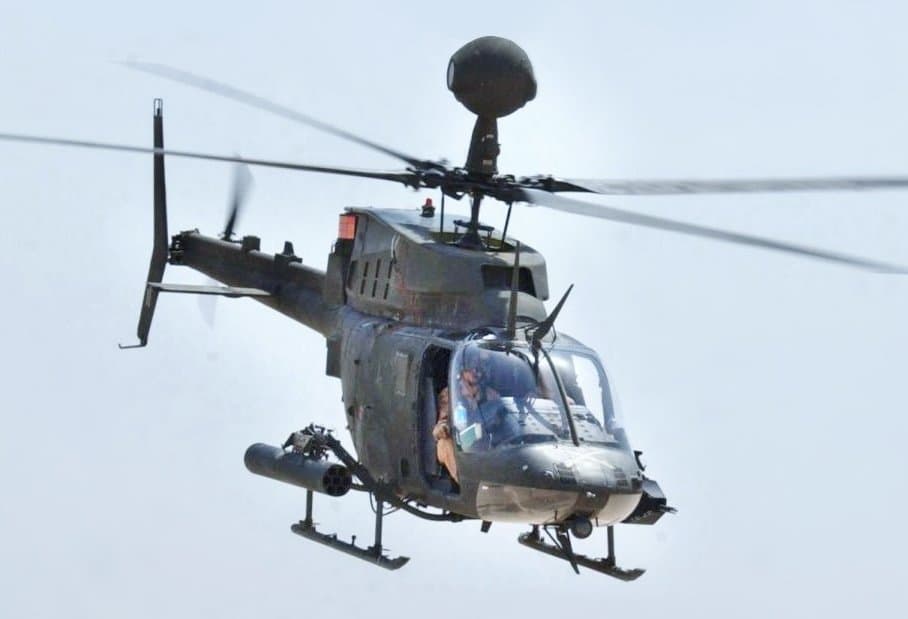

Credit
U.S. Army · Public domain · Resized · Public domain · Source ↗ · Modified


Preparing your view.
At a glance
Measured figures
OH-58D · Length
Single source42 ft 2 in (12.85 m)[source]
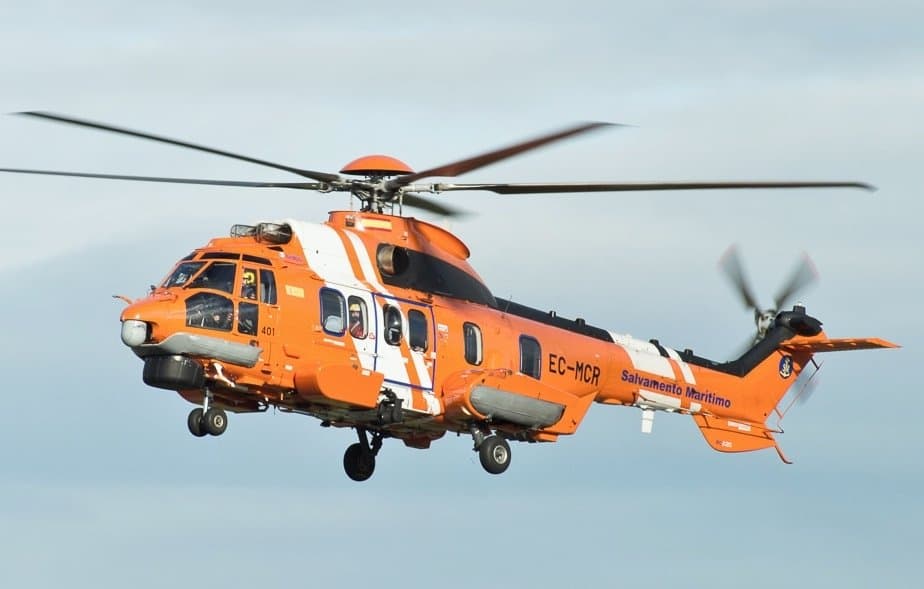
H225 · Length
Single sourceConfiguration
| Specification | Bell OH-58 Kiowa | Eurocopter EC225 Super Puma |
|---|---|---|
| Type | Observation and reconnaissance helicopter[source] | Passenger transport helicopter[source] |
| National origin | United States[source] | Multinational[source] |
| Manufacturer | Bell Helicopter[source] | Eurocopter Airbus Helicopters[source] |
| Status | In service[source] |
19.5 m (64 ft 0 in)[source]
H225 · 1,710 ft/min
Single source8.7 m/s (1,710 ft/min)[source]
Bars compare reported quantities only. A larger figure does not make a system better; configurations and test conditions differ.
| — |
| Primary users | United States Army (historical) Republic of China Army Royal Saudi Land Forces Hellenic Army[source] | — |
|---|
| Number built | 2,325 plus 58 206B-1[source] | 170+ (as of 2016 )[source] |
|---|
| Manufactured | 1966–1989[source] | 1999–present[source] |
|---|
| Introduction date | May 1969[source] | December 2004[source] |
|---|
| First flight | Bell 206A: 10 January 1966 OH-58D: 6 October 1983 OH-58F: 26 April 2013[source] | 27 November 2000[source] |
|---|
| Retired | 2020 (U.S. Army)[source] | — |
|---|
| Developed from | Bell 206[source] | Eurocopter AS332 Super Puma[source] |
|---|
| Main rotor area | 962.11 sq ft (89.42 m 2 )[source] | 206.15 m 2 (2,219.0 sq ft)[source] |
|---|
| Endurance | Two hours[source] | — |
|---|
| Hardpoints | Two pylons , with provisions to carry combinations of:[source] | — |
|---|
| Rockets | 1x LAU-68 rocket launcher with seven 70 mm (2.75 in) Hydra 70 or APKWS rockets[source] | — |
|---|
| Missiles | 2x AGM-114 Hellfire missiles[source] | — |
|---|
| Other | 1x .50 cal (12.7 mm) M3P (or M296) heavy machine gun[source] | — |
|---|
| Role | family of single-engine single- rotor military helicopters[source] | long-range passenger transport helicopter[source] |
|---|
| Source measurement | When the YOH-4A was rejected by the Army, Bell went about solving the problem of marketing the aircraft. In addition to the image problem, the helicopter lacked cargo space and only provided cramped quarters for the planned three passengers in the back. The solution was a fuselage redesigned to be more sleek and aesthetic, adding 16 cubic feet (0.45 cubic metres) of cargo space in the process. The redesigned aircraft was designated as the Model 206A . Bell President Edwin J. Ducayet named it the JetRanger , denoting an evolution from the popular Model 47J Ranger .[source]Bell OH-58 Kiowa · Development / Light Observation Helicopter (LOH); only the objects and conditions stated in this passage The Army's decision to acquire the NTSH resulted in the "Army Helicopter Improvement Program (AHIP)". Both Bell Helicopter and Hughes Helicopters redesigned their scout aircraft to compete for the contract. Bell offered a more robust version of the OH-58 in their Model 406 . Hughes offered an upgraded version of the OH-6. In September 1981, Bell Helicopter Textron was awarded a development contract. On 6 October 1983, the first prototype performed its maiden flight, In 1985, the aircraft entered service as the OH-58D.[source]Bell OH-58 Kiowa · Development / Army Helicopter Improvement Program (AHIP); only the objects and conditions stated in this passage The Bell OH-58 Kiowa is a family of single-engine single- rotor military helicopters principally used for observation, utility, and direct fire support. The primary role of the original OH-58A was to identify targets for other platforms, such as the Bell AH-1 Cobra attack helicopter and ground artillery . It lacked any armaments and weighed 1,451 kg (3,200 lb) when fully loaded, being able to carry a small amount of cargo or up to two passengers. While initial examples were reliant on the crew to conduct observations, later models were furnished with sophisticated sensors to precisely determine a target's location. Payload capacity was increased considerably on later-build rotorcraft. The OH-58D Kiowa was designed to carry a maximum load of 2,495 kg, 72% more capacity than the original version.[source]Bell OH-58 Kiowa · Design; only the objects and conditions stated in this passage Early Kiowas were fitted with a flexible twin-bladed main rotor. Starting with the OH-58D, a four-bladed rigid main rotor was used. Entirely composed of composite materials , the OH-58D was the first US Army rotorcraft to incorporate an all-composite main rotor hub. Later models were outfitted as light gunships , equipped with armaments such as Stinger air-to-air missiles , a .50-caliber machine gun , podded 70mm Hydra rockets and AGM-114 Hellfire air to ground missiles .[source]Bell OH-58 Kiowa · Design; only the objects and conditions stated in this passage On 27 March 1970, an OH-58A Kiowa (s/n 68-16785) was shot down over South Vietnam, one of the first OH-58A losses of the war. The pilot, Warrant Officer Ralph Quick Jr., was flying Lieutenant Colonel Joseph Benoski Jr. as an artillery spotter. After completing a battle damage assessment for a previous fire mission, the aircraft was damaged by .51 inch (13 mm) machine gun fire and crashed, killing both crew members. Approximately 45 OH-58A helicopters were destroyed during the Vietnam War due to combat losses and accidents.[source]Bell OH-58 Kiowa · Operational history / Vietnam War; only the objects and conditions stated in this passage During Operation Desert Storm, 130 deployed OH-58D helicopters worked alongside the other Army attack helicopters, 145 AH-1 Cobras and 277 AH-64 Apaches , and participated in a wide variety of critical combat ground forces mission. During Operation Desert Shield and Operation Desert Storm , the Kiowas collectively flew nearly 9,000 hours with a 92 percent fully mission capable rate. The Kiowa Warrior had the lowest ratio of maintenance hours to flight hours of any combat helicopter in the war.[source]Bell OH-58 Kiowa · Operational history / Gulf War; only the objects and conditions stated in this passage Army attack helicopters also worked jointly with close air support and support aircraft such as the USAF A-10As , F-16A/Cs , EF-111As , EC-130H Compass Call , F-4G Phantom II " Wild Weasel ", and E-8 Joint STARS .[source]Bell OH-58 Kiowa · Operational history / Gulf War; only the objects and conditions stated in this passage The RAID program's mission has now been expanded to include the war against terrorism and supporting U.S. Border Patrol activities in support of homeland defense. The National Guard RAID units' Area of Operation (AO) is the only one in the Department of Defense that is wholly contained within the borders of the United States .[source]Bell OH-58 Kiowa · Operational history / RAID; only the objects and conditions stated in this passage During Operation Just Cause in 1989, a team consisting of an OH-58 and an AH-1 were part of the Aviation Task Force during the securing of Fort Amador in Panama . The OH-58 was fired upon by Panama Defense Force soldiers and crashed 100 yards (90 m) away, in the Bay of Panama . The pilot was rescued, but the co-pilot was killed in action.[source]Bell OH-58 Kiowa · Operational history / Operation Just Cause and action in the 1990s; only the objects and conditions stated in this passage On 17 December 1994, Army Chief Warrant Officers (CWO) David Hilemon and Bobby Hall left Camp Page, South Korea on a routine training mission along the Demilitarized Zone (DMZ). Their flight was intended to be to a point known as Checkpoint 84, south of the DMZ "no-fly zone", but the OH-58C Kiowa strayed nearly four miles (6 km) into the Kangwon Province, inside North Korean airspace, due to errors in navigating the snow-covered, rugged terrain. The helicopter was shot down by North Korean troops and CWO Hilemon was killed. CWO Hall was held captive and the North Korean government insisted that the crew had been spying. Five days of negotiations resulted in the North Koreans turning over Hilemon's body to U.S. authorities. The negotiations failed to secure Hall's immediate release. After 13 days in captivity, Hall was freed on 30 December, uninjured.[source]Bell OH-58 Kiowa · Operational history / Operation Just Cause and action in the 1990s; only the objects and conditions stated in this passage In Iraq, OH-58Ds flew 72 hours per month. In Afghanistan, the type flew 80 hours per month. In April 2013, Bell stated that the OH-58 collectively accumulated 820,000 combat hours, and had achieved a 90% mission capable rate.[source]Bell OH-58 Kiowa · Operational history / Afghanistan and Iraq; only the objects and conditions stated in this passage In December 2013, the U.S. Army had 338 Kiowas in its active-duty force and 30 in the Army National Guard . The Army considered retiring the Kiowa as part of a wider restructuring to cut costs and reduce the variety of helicopters operated. The Analysis of Alternatives for the AAS program found that operating the Kiowa alongside RQ-7 Shadow UAVs was the most affordable and capable solution, while the AH-64E Apache Guardian was the most capable immediate solution. One proposal was to transfer all Army National Guard and Army Reserve AH-64s to the active Army for use as scouts, to divest the OH-58.[source]Bell OH-58 Kiowa · Operational history / Retirement; only the objects and conditions stated in this passage The OH-58A Kiowa is a four-place observation helicopter. It has two-place pilot seating, although the controls in the left seat are designed to be removed to carry a passenger up front. During its development for Vietnam War, it was fitted with the M134 Minigun , a 7.62 millimetres (0.300 in) electrically operated machine gun.[source]Bell OH-58 Kiowa · Variants / OH-58A; only the objects and conditions stated in this passage The Australian Army leased eight OH-58As in 1971 in South Vietnam for eight months. The Australian government procured the OH-58A for the Australian Army and Royal Australian Navy as the CAC CA-32 . Licensed produced in Australia by Commonwealth Aircraft Corporation , the CA-32 was the equivalent of the 206B-1 (uprated engine and longer rotor blades). The first twelve of 56 were built in the U.S. then partially disassembled and shipped to Australia, where they were reassembled.[source]Bell OH-58 Kiowa · Variants / OH-58A; only the objects and conditions stated in this passage The Kiowa Warrior , sometimes referred to by its acronym KW , is the armed version of the OH-58D. A key difference between the Kiowa Warrior and original AHIP aircraft is a universal weapons pylon found mounted on both sides of the fuselage, capable of carrying combinations of AGM-114 Hellfire missiles, air-to-air Stinger (ATAS) missiles, 7-shot 2.75 inches (70 mm) Hydra-70 rocket pods, and an M296 0.50 in (12.7 mm) caliber machine gun. The performance standard of aerial gunnery from an OH-58D is to achieve at least one hit out of 70 shots fired at a wheeled vehicle 800 to 1,200 m (2,600 to 3,900 ft) away. The Kiowa Warrior includes improvements in available power, navigation, communication, survivability, and deployability.[source]Bell OH-58 Kiowa · Variants / OH-58D; only the objects and conditions stated in this passage The OH-58F is powered by a Rolls-Royce 250-C30R3 engine rated at 650 shp (480 kW). It has a dual-channel, full-authority digital engine-controller that operates at required power levels in all environments. Rolls-Royce proposed engine tweaks to raise output by 12%.[source]Bell OH-58 Kiowa · Variants / OH-58F; only the objects and conditions stated in this passage In October 2012, the first OH-58F was finished. Unlike most military projects, the Army designed and built the new variant itself, which lowered development costs. It weighed 3,590 lb (1,630 kg), 53 lb (24 kg) below the target weight and about 200 lb (91 kg) lighter than the OH-58D. The weight savings are attributed to more efficient wiring and a lighter sensor. The first production aircraft began manufacturing in January 2013 and was handed over to the Army by year end. Low rate production was to start in March 2015, with the first operational squadron being fully equipped by 2016. The Army was to buy 368 OH-58Fs, with older OH-58 variants to be remanufactured. Due to battle damage and combat attrition, total OH-58F numbers were about 321 aircraft. The OH-58F's first flight occurred on 26 April 2013.[source]Bell OH-58 Kiowa · Variants / OH-58F; only the objects and conditions stated in this passage Length: 42 ft 2 in (12.85 m)[source]Bell OH-58 Kiowa · Specifications (OH-58D); only the objects and conditions stated in this passage Height: 12 ft 10 in (3.93 m)[source]Bell OH-58 Kiowa · Specifications (OH-58D); only the objects and conditions stated in this passage Empty weight: 3,829 lb (1,737 kg)[source]Bell OH-58 Kiowa · Specifications (OH-58D); only the objects and conditions stated in this passage Gross weight: 5,500 lb (2,495 kg)[source]Bell OH-58 Kiowa · Specifications (OH-58D); only the objects and conditions stated in this passage Powerplant: 1 × Rolls-Royce T703-AD-700A turboshaft , 650 hp (485 kW)[source]Bell OH-58 Kiowa · Specifications (OH-58D); only the objects and conditions stated in this passage Main rotor diameter: 35 ft 0 in (10.67 m)[source]Bell OH-58 Kiowa · Specifications (OH-58D); only the objects and conditions stated in this passage Main rotor area: 962.11 sq ft (89.42 m 2 )[source]Bell OH-58 Kiowa · Specifications (OH-58D); only the objects and conditions stated in this passage Maximum speed: 149 mph (240 km/h, 129 kn)[source]Bell OH-58 Kiowa · Specifications (OH-58D); only the objects and conditions stated in this passage Cruise speed: 127 mph (204 km/h, 110 kn)[source]Bell OH-58 Kiowa · Specifications (OH-58D); only the objects and conditions stated in this passage Range: 161 mi (260 km, 140 nmi)[source]Bell OH-58 Kiowa · Specifications (OH-58D); only the objects and conditions stated in this passage Endurance: Two hours[source]Bell OH-58 Kiowa · Specifications (OH-58D); only the objects and conditions stated in this passage Service ceiling: 15,000 ft (4,575 m)[source]Bell OH-58 Kiowa · Specifications (OH-58D); only the objects and conditions stated in this passage Hardpoints: Two pylons , with provisions to carry combinations of: Rockets: 1x LAU-68 rocket launcher with seven 70 mm (2.75 in) Hydra 70 or APKWS rockets Missiles: 2x AGM-114 Hellfire missiles Other: 1x .50 cal (12.7 mm) M3P (or M296) heavy machine gun[source]Bell OH-58 Kiowa · Specifications (OH-58D); only the objects and conditions stated in this passage | The Airbus Helicopters H225 (formerly Eurocopter EC225 Super Puma ) is a long-range passenger transport helicopter developed by Eurocopter as the next generation of the civilian Super Puma family. It is a twin-engined aircraft and can carry up to 24 passengers along with two crew and a cabin attendant, dependent on customer configuration. The helicopter is marketed for offshore support and VIP passenger transport duties, as well as public service missions.[source]Eurocopter EC225 Super Puma · Lead; only the objects and conditions stated in this passage In February 2014, Airbus Helicopters announced at Heli-Expo 2014 the development of an improved variant, the EC225e. The EC225e features numerous changes including new avionics systems, such as the TCAS II collision avoidance system, an automatic identification system, and a specialized rig-approach system; it was also intended to feature an improved Turbomeca Makila 2B engine to increase the EC225e's maximum takeoff weight by 550 kg, and an additional fuel tank in the rear baggage compartment to extend its range to 300 nautical miles with up to ten passengers on board. Some, but not all, modifications can be retrofitted onto existing EC225s. In the same announcement, in February 2014, Lease Corporation International said that they had placed a $645 million order for 15 EC225e (along with 6 Airbus Helicopters EC175 ) helicopters as the launch customer. In February 2016, the Makila 2B engine was dropped from the EC225e as a cost reduction measure, development of the other structural and avionics aspects is proceeding.[source]Eurocopter EC225 Super Puma · Development; only the objects and conditions stated in this passage A key safety feature of the aircraft's main gear box (MGB) is an emergency oil spraying sub-system present in the lubrication system; this is designed to exceed the JAR 29 Standard's requirements of a 30-minute running time in the event of the loss of MGB oil pressure, and has demonstrated up to 50-minute running time. The engine also incorporates a "blade shedding" system to ensure engine integrity during an overspeed instance. Energy absorbent self-sealing fuel tanks are contained in the aircraft's sponsons , along with other equipment such as downward-facing illumination and navigation lighting fixtures. The transmission can accommodate more power than the maximum output of the engines; however two aircraft were lost in 2012 due to the cracking of the bevel gear shaft, a gearbox component. In response, the design of the transmission was modified in 2013, and the onboard health and usage monitoring system (HUMS) was upgraded to provide real-time monitoring of the bevel gear shaft against the threat of crack formation. |
|---|
| Engine | single-engine[source]Kiowa Warrior | — |
|---|
| Country of origin | Canada[source]Inventory Origin column; table 2, row 25, cell 2; revision 1376392791; retrieved 2026-10-02 | — |
|---|
| Primary user | — | CHC Helicopter[source] |
|---|
| Variant | — | Eurocopter EC725[source] |
|---|
| Capacity | — | 24 passengers + 1 cabin attendant[source] |
|---|
| Never exceed speed | — | 324 km/h (201 mph, 175 kn)[source] |
|---|
Maximum take-off; H225 · Max takeoff weight
Single sourceIn terms of cockpit equipment and avionics, the H225 is equipped with a full glass cockpit with active-matrix liquid crystal displays ; these include four 6-inch by 8-inch multi-functional displays as the predominant instrumentation for key flight information, two 4-inch by 5-inch monitors for displaying aircraft parameters, and a 3-inch screen for backup. The advanced helicopter cockpit and avionics system is described as serving to reduce pilot and crew workload, being used to display flight management and sub-systems information and is complete with a four-axis digital autopilot. During a typical flight, the pilot programs the route into the aircraft and then monitors it, as opposed to direct continuous control of the flight; the need for paper charts has been eliminated by these systems. Under autopilot, the automatic flight control system acts to prevent pilot actions from exceeding the established flight envelope; the H225 remains flyable with all automatic systems disabled. From initiating the startup sequence to being ready to takeoff only takes three minutes.[source]Eurocopter EC225 Super Puma · Design; only the objects and conditions stated in this passage
There are currently a total of four principal configurations designed by Airbus Helicopters for the H225. The passenger transport version has a crash-worthy seating arrangement for up to 19 passengers with a high-density seating arrangement accommodating up to 28 passengers available to be fitted. The VIP transport version has a large lounge with seating for up to 12 passengers and a cabin attendant. The emergency medical services (EMS) configuration has medical units for six stretchers and four seats for medical workers. The search and rescue (SAR) configuration allows space for search and rescue equipment with an operator seat, hoistman seat and up to eight rescue seats and three stretchers. While a single pilot is capable of controlling the aircraft under visual meteorical conditions, two pilots are used in a typical crew complement and, dependent on role, a cabin attendant or flight engineer may also be present.[source]Eurocopter EC225 Super Puma · Design; only the objects and conditions stated in this passage
Icelandic Coast Guard — received 2 H225s in 2019 and 1 in 2021.[source]Eurocopter EC225 Super Puma · Operators / Military operators; only the objects and conditions stated in this passage
18 February 2009: G-REDU, an EC225 LP operated by Bond Offshore Helicopters . During a night visual approach to the ETAP platform, the helicopter descended and impacted the surface of the sea. The crew's perception of the helicopter's position and orientation relative to the platform during the final approach was erroneous. All 18 people on board survived the controlled flight into terrain (water) .[source]Eurocopter EC225 Super Puma · Accidents and incidents; only the objects and conditions stated in this passage
10 May 2012: G-REDW, an EC225 LP, carried out a controlled ditching following indications of a failure of the main gearbox (MGB) lubrication system and a subsequent failure indication warning on the emergency lubrication system. An investigation by the Air Accidents Investigation Branch (AAIB) identified a 360° circumferential crack in the bevel gear vertical shaft in the main gearbox, in the vicinity of a manufacturing weld, causing disengagement of the drive to both mechanical oil pumps.[source]Eurocopter EC225 Super Puma · Accidents and incidents; only the objects and conditions stated in this passage
22 October 2012: G-CHCN, an EC225 LP of CHC Scotia, ditched in the North Sea 32 miles south west of Shetland whilst en route from Aberdeen to the West Phoenix drilling rig. All 19 on board were rescued. A special bulletin issued by the Air Accidents Investigation Branch (AAIB) said the main and standby oil pumps were not working; a 360-degree crack found on the bevel gear vertical shaft of the gearbox had prevented the oil pump gears from being driven. A worldwide grounding of the type was initiated in response. In both of the 2012 incidents, although the main gearbox lubrication system had failed, the backup system was working correctly but displaying an erroneous warning light, due to an incorrect specification of a pressure switch, which led to the helicopters being ditched.[source]Eurocopter EC225 Super Puma · Accidents and incidents; only the objects and conditions stated in this passage
29 April 2016: LN-OJF , an EC225 LP of CHC Helikopter Service , crashed at an islet near Turøy in the Bergen archipelago, en route to Bergen Airport, Flesland , from the Gullfaks B platform in the North Sea. The helicopter was carrying 11 passengers and 2 crew members; everyone on board died. Eyewitnesses reported that the main rotor separated from the hull immediately before the crash. Due to the crash, all commercial flights by EC225 helicopters, excluding search and rescue flights, were grounded by both Norwegian and British civil aviation authorities. The subsequent investigation concluded that a gear in the main rotor gearbox had failed due to a fatigue crack that had propagated under-surface, escaping detection. As a result of the incident the German Defence Ministry had also decided to ground 3 AS532 Helicopter in government use which were manufactured by the same company.[source]Eurocopter EC225 Super Puma · Accidents and incidents; only the objects and conditions stated in this passage
18 January 2023: an EC225 carrying the Minister of Internal Affairs of Ukraine , Denys Monastyrsky , his deputy Yevhen Yenin and state secretary Yurii Lubkovych , crashed at a kindergarten in Brovary , a suburb of Kyiv , Ukraine . The crash killed 14 people, including Monastyrsky, Yenin and Lubkovych; a child was also among the fatalities, while 25 others were injured.[source]Eurocopter EC225 Super Puma · Accidents and incidents; only the objects and conditions stated in this passage
Capacity: 24 passengers + 1 cabin attendant[source]Eurocopter EC225 Super Puma · Specifications (H225); only the objects and conditions stated in this passage
Length: 19.5 m (64 ft 0 in)[source]Eurocopter EC225 Super Puma · Specifications (H225); only the objects and conditions stated in this passage
Height: 4.97 m (16 ft 4 in)[source]Eurocopter EC225 Super Puma · Specifications (H225); only the objects and conditions stated in this passage
Empty weight: 5,256 kg (11,587 lb)[source]Eurocopter EC225 Super Puma · Specifications (H225); only the objects and conditions stated in this passage
Gross weight: 11,000 kg (24,251 lb)[source]Eurocopter EC225 Super Puma · Specifications (H225); only the objects and conditions stated in this passage
Max takeoff weight: 11,200 kg (24,692 lb)[source]Eurocopter EC225 Super Puma · Specifications (H225); only the objects and conditions stated in this passage
Powerplant: 2 × Turbomeca Makila 2A1 turboshaft engines, 1,776 kW (2,382 hp) each[source]Eurocopter EC225 Super Puma · Specifications (H225); only the objects and conditions stated in this passage
Main rotor diameter: 16.2 m (53 ft 2 in)[source]Eurocopter EC225 Super Puma · Specifications (H225); only the objects and conditions stated in this passage
Main rotor area: 206.15 m 2 (2,219.0 sq ft)[source]Eurocopter EC225 Super Puma · Specifications (H225); only the objects and conditions stated in this passage
Maximum speed: 275.5 km/h (171.2 mph, 148.8 kn)[source]Eurocopter EC225 Super Puma · Specifications (H225); only the objects and conditions stated in this passage
Cruise speed: 260.5 km/h (161.9 mph, 140.7 kn)[source]Eurocopter EC225 Super Puma · Specifications (H225); only the objects and conditions stated in this passage
Never exceed speed : 324 km/h (201 mph, 175 kn)[source]Eurocopter EC225 Super Puma · Specifications (H225); only the objects and conditions stated in this passage
Range: 857 km (533 mi, 463 nmi)[source]Eurocopter EC225 Super Puma · Specifications (H225); only the objects and conditions stated in this passage
Ferry range: 985 km (612 mi, 532 nmi)[source]Eurocopter EC225 Super Puma · Specifications (H225); only the objects and conditions stated in this passage
Service ceiling: 5,900 m (19,400 ft)[source]Eurocopter EC225 Super Puma · Specifications (H225); only the objects and conditions stated in this passage
Rate of climb: 8.7 m/s (1,710 ft/min)[source]Eurocopter EC225 Super Puma · Specifications (H225); only the objects and conditions stated in this passage