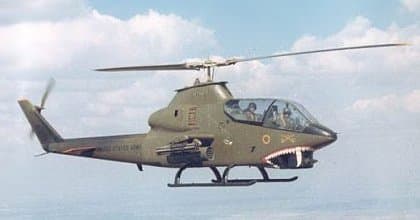

Credit
US Army · Public domain · Resized · Public domain · Source ↗ · Modified


Preparing your view.

At a glance
True scale
Side by side. From every angle. A human reference for perspective.
3.22 MB · Loads when you open it| Model | Length | Width / span | Height |
|---|---|---|---|
| Bell AH-1 Cobra | ≈ 16 m | ≈ 6.78 m (Width) | ≈ 4.11 m |
| Kamov Ka-50 | ≈ 16 m | ≈ 13.8 m (Width) | ≈ 5.61 m |
Scaled uniformly to the sourced length of 16 m. The height was fitted to the sourced 4.11 m. Not an official model or a measured survey.
ForceTally · All rights reserved
Scaled uniformly to the sourced length of 16 m. Not an official model or a measured survey.
ForceTally · All rights reserved
The human reference is a generic 1.75 m figure. Models describe external size, not combat performance.
Measured figures
AH-1G HueyCobra · including rotors
Single source53 ft (16 m) including rotors[source]
Configuration
| Specification | Bell AH-1 Cobra | Kamov Ka-50 |
|---|---|---|
| Type | Attack helicopter[source] | Attack helicopter , scout helicopter[source] |
| National origin | United States[source] | Soviet Union / Russia[source] |
| Manufacturer | Bell Helicopter[source] | Kamov[source] |
| Status | In service[source] |
Ka-50 · Length
16 m (52 ft 6 in)[source]
AH-1G HueyCobra · stub wings
Single source10 ft 4 in (3.15 m) stub wings[source]
Ka-50 · Combat range
Single source470 km (290 mi, 250 nmi)[source]
Bars compare reported quantities only. A larger figure does not make a system better; configurations and test conditions differ.
In service[source] |
| Primary users | United States Army (historical) Japan Ground Self-Defense Force Republic of Korea Army Royal Jordanian Air Force[source] | Russian Aerospace Forces Russian Naval Aviation Egyptian Air Force[source] |
|---|
| Number built | 1,116[source] | Ka-50: 18–19 Ka-52: >196[source] |
|---|
| Manufactured | 1967–2019[source] | 1990–present[source] |
|---|
| Introduction date | 1967[source] | 28 August 1995[source] |
|---|
| First flight | 7 September 1965[source] | Ka-50: 17 June 1982 Ka-52: 25 June 1997 Ka-52M: 9 January 2023[source] |
|---|
| Retired | 2001 (US Army)[source] | — |
|---|
| Developed from | Bell UH-1 Iroquois[source] | Kamov V-80[source] |
|---|
| Variants | Bell AH-1 SeaCobra/SuperCobra Bell 309 KingCobra[source] | — |
|---|
| Fuselage length | 44 ft 5 in (13.5 m)[source] | — |
|---|
| Main rotor area | 1,520 sq ft (141 m 2 )[source] | 330.3 m 2 (3,555 sq ft) contra-rotating 3-bladed main rotors[source] |
|---|
| Blade section | NACA 0009.3 mod[source] | — |
|---|
| Never exceed speed | 190 kn (220 mph, 350 km/h)[source] | 350 km/h (220 mph, 190 kn)[source] |
|---|
| Role | single-engined attack helicopter[source] | Soviet/Russian single-seat attack helicopter[source] |
|---|
| Source measurement | While some officials within the Pentagon, particularly those within the US Army, had recognized the potential value of purpose-built armed rotary aircraft as early as 1962 and were keen to see such a vehicle developed promptly, the issue was complicated in part due to inter-service politics. The United States Air Force (USAF) largely held the opinion that most forms of US military aircraft should be operated only by their service, and that the US Army would be intruding into their domain by developing a complex armed aerial combatant, and ought to be largely restricted to transport aircraft. Meanwhile, some Army officials were concerned that the USAF did not take the close air support (CAS) mission as seriously as it ought to, and that response times of 30 minutes or more for fixed-wing aircraft would be unacceptable.[source]Bell AH-1 Cobra · Development / Background; only the objects and conditions stated in this passage Bell had been investigating helicopter gunships since the late 1950s, paying particular attention to the Algerian War , in which French forces mounted weapons on helicopters to fight the growing insurgency. The company created a mockup of its D-255 helicopter gunship concept, named "Iroquois Warrior". The Iroquois Warrior was planned to be a purpose-built attack aircraft based on UH-1B components with a new, slender airframe and a two-seat, tandem cockpit. It featured a grenade launcher in a ball turret on the nose, a 20 mm belly-mounted gun pod, and stub wings for mounting rockets or SS.10 anti-tank missiles.[source]Bell AH-1 Cobra · Development / Iroquois Warrior, Sioux Scout and AAFSS; only the objects and conditions stated in this passage The Army's solution to the shortcomings of the Sioux Scout was to launch the Advanced Aerial Fire Support System (AAFSS) competition. This called for a heavily armed helicopter capable of at least 200 miles per hour (320 km/h). A total of seven companies, including Bell, opted to respond to the requirement. It was out of the AAFSS program that the Lockheed AH-56 Cheyenne emerged, a heavy attack helicopter with high speed capability. During testing, it proved to be too sophisticated and costly, and was ultimately canceled in 1972 after ten years of development. In its place, the Advanced Attack Helicopter program was launched. Under this initiative, the Army sought a conventional attack helicopter with a greater level of survivability.[source]Bell AH-1 Cobra · Development / Iroquois Warrior, Sioux Scout and AAFSS; only the objects and conditions stated in this passage As the Vietnam War proceeded, pressure accumulated in favor of the Model 209. Attacks on US forces were increasing and, by the end of June 1965, there were already 50,000 US ground troops in Vietnam. 1965 was also the deadline for AAFSS selection, but the program would become stuck in technical difficulties and political bickering. The US Army needed an interim gunship for Vietnam and it approached five separate companies with its request to provide a quick solution. Submissions came in for armed variants of the Boeing-Vertol ACH-47A , Kaman HH-2C Tomahawk , Piasecki 16H Pathfinder , Sikorsky S-61 , and the Bell 209.[source]Bell AH-1 Cobra · Development / Model 209; only the objects and conditions stated in this passage During April 1966, Bell's submission emerged victorious in an evaluation against the other rival helicopters. The US Army promptly signed the first production contract, ordering an initial batch of 110 aircraft. By the end of the year, rapid follow-on orders had increased this to 500 Cobras. Bell added "Cobra" to the UH-1's Huey nickname to produce its HueyCobra name for the 209. The Army applied the Cobra name to its AH-1G designation for the helicopter. The Bell 209 demonstrator was used for the next six years to test weapons and fit of equipment. An additional use for the demonstrator was participating in marketing initiatives. It was also modified to match the AH-1 production standard by the early 1970s. The demonstrator was retired to the Patton Museum at Fort Knox , Kentucky and converted to approximately its original appearance.[source]Bell AH-1 Cobra · Development / Model 209; only the objects and conditions stated in this passage Typically, the Cobra would avoid hovering at any point in an active engagement; instead, emphasis was placed on maintaining speed and mobility. The gunner often fired the chin-mounted cannon with the intention of suppressing hostile targets in between barrages of 2.75-inch rockets, held in pods upon the stub wings, which were fired by the back-seater. It was unusual for Cobras to operate alone; instead, two or more would be dispatched and teamwork encouraged, leading to hunter-killer tactics being used to flush out and eliminate ground targets. Pairings with other helicopters, such as the Bell OH-58 Kiowa scout helicopter, were also common occurrences. Radio communications were handled by the gunner. Regardless of mission profile, low altitude flying was commonplace.[source]Bell AH-1 Cobra · Design; only the objects and conditions stated in this passage By June 1967, the first AH-1G HueyCobras had been delivered. Originally designated as UH-1H, the "A" for attack designation was soon adopted and when the improved UH-1D became the UH-1H, the HueyCobra became the AH-1G. The AH-1 was initially considered a variant of the H-1 line, resulting in the G series letter.[source]Bell AH-1 Cobra · Operational history / United States; only the objects and conditions stated in this passage On 12 September 1968, Capt. Ronald Fogleman was flying an F-100 Super Sabre when the aircraft was shot down and he ejected 200 miles (320 km) north of Bien Hoa. Fogleman became the only pilot to be rescued by holding on to an Army AH-1G's deployed gun-panel door. Bell built 1,116 AH-1Gs for the U.S. Army between 1967 and 1973, and the Cobras chalked up over a million operational hours in Vietnam; the number of Cobras in service peaked at 1,081. In 1971 during Operation Lam Son 719 in Southeastern Laos , 26 U.S. Army AH-1Gs were destroyed and 158 sustained some level of damage. Out of nearly 1,110 AH-1s that were delivered between 1967 and 1973, approximately 300 were lost to a combination of combat and accidents during the conflict. Approximately one third of this number were operational or non-combat losses.[source]Bell AH-1 Cobra · Operational history / United States; only the objects and conditions stated in this passage The U.S. Marine Corps also operated the AH-1G Cobra in Vietnam for a short time before acquiring the twin-engine AH-1J Cobras . The AH-1Gs had been adopted by the Marines as an interim measure, a total of 38 helicopters having been transferred from the U.S. Army to the Marines in 1969.[source]Bell AH-1 Cobra · Operational history / United States; only the objects and conditions stated in this passage By 2013, Pakistan reportedly operated a fleet of 35 AH-1F helicopters. Maintaining these aircraft has been difficult, but possible through commercial channels. Additionally, the US government provided $750,000 (~$993,036 in 2024) through 2013 to update the existing AH-1F/S Cobra fleet. However, controversy over how much of this funding has actually been spent on Pakistan's Cobras has also been present throughout the 2010s. Türkiye has also become a key supplier of spare parts for the Cobra, often free of cost, to Pakistan. During the 2010s, Pakistan lost a total of three aircraft in separate incidents.[source]Bell AH-1 Cobra · Operational history / Pakistan; only the objects and conditions stated in this passage Pakistan repeatedly sought the Bell AH-1W SuperCobra from the US to supplement and replace its current AH-1 Cobras. Attempts to acquire the AH-1Z Viper or AH-64E Apache from the US were rejected, so Pakistan turned to buying other foreign attack helicopters. Possible candidates have included the Turkish T129 , the Chinese CAIC Z-10 , and the Russian Mi-35 Hind . In November 2014, Russia approved the sale of Mi-35M helicopters to Pakistan. In April 2015, China delivered three Z-10s to Pakistan. During the same month, the US Department of State approved the sale of 15 AH-1Zs and associated equipment to Pakistan. During October 2017, the T129 was also reported to be a contender for further orders.[source]Bell AH-1 Cobra · Operational history / Pakistan; only the objects and conditions stated in this passage The Florida Division of Forestry also acquired three AH-1Ps from the US Army. These are called Bell 209 "Firesnakes" and are equipped to carry a water/fire retardant system.[source]Bell AH-1 Cobra · Operational history / Civilian operators; only the objects and conditions stated in this passage Original AH-1G prototype with retractable skid landing gear. This model number is also used by the FAA for the civilian registration of former U.S. Army AH-1s used in firefighting service.[source]Bell AH-1 Cobra · Variants / Single-engine; only the objects and conditions stated in this passage AH-1G HueyCobra[source]Bell AH-1 Cobra · Variants / Single-engine; only the objects and conditions stated in this passage Initial 1966 production model gunship for the U.S. Army, with one 1,400 shp (1,000 kW ) Avco Lycoming T53-13 turboshaft.[source]Bell AH-1 Cobra · Variants / Single-engine; only the objects and conditions stated in this passage JAH-1G HueyCobra[source]Bell AH-1 Cobra · Variants / Single-engine; only the objects and conditions stated in this passage TH-1G HueyCobra[source]Bell AH-1 Cobra · Variants / Single-engine; only the objects and conditions stated in this passage The Spanish Navy purchased eight new-build AH-1Gs, designating the type the "Z-14". These were equipped with the M35 20 mm cannon system, and were used to support coastal patrol boats. Four of these were lost in accidents. The remaining helicopters were retired in 1985 with three sent back to the US, and one kept in storage in Spain.[source]Bell AH-1 Cobra · Variants / Single-engine; only the objects and conditions stated in this passage AH-1G powered by a T53-L-703 engine without TOW system.[source]Bell AH-1 Cobra · Variants / Single-engine; only the objects and conditions stated in this passage The baseline AH-1S is an AH-1Q upgraded with a 1,800 shp (1,300 kW) T53-L-703 turboshaft engine. The AH-1S is also referred to as the "Improved AH-1S", "AH-1S Modified", or "AH-1S(MOD)" prior to 1988. (Prior to 1988, all upgraded aircraft were referred to as variants of the AH-1S.)[source]Bell AH-1 Cobra · Variants / Single-engine; only the objects and conditions stated in this passage 98 production aircraft with the Enhanced Cobra Armament System (ECAS) featuring the M97A1 armament subsystem with a three-barreled M197 20 mm cannon. The AH-1E is also referred to as the "Upgunned AH-1S", or "AH-1S(ECAS)" prior to 1988. These improvements are considered Step 2 of the AH-1S upgrade program. AH-1E aircraft included the M147 Rocket Management Subsystem (RMS) to fire 2.75-inch (70 mm) rockets.[source]Bell AH-1 Cobra · Variants / Single-engine; only the objects and conditions stated in this passage 143 production aircraft and 387 converted AH-1G Cobras. The AH-1F incorporates all Step 1 and 2 upgrades to the AH-1S. It also featured Step 3 upgrades: a head-up display, a laser rangefinder, an infrared jammer mounted above the engine exhaust, and an infrared suppressing engine exhaust system, and the M143 Air Data Subsystem (ADS). The AH-1F is also referred to as the "Modernized AH-1S", "AH-1S Modernized Cobra", or "AH-1S(MC)" prior to 1988.[source]Bell AH-1 Cobra · Variants / Single-engine; only the objects and conditions stated in this passage Experimental all-weather version based on the AH-1G single-engine and AH-1J twin-engine designs. Two Bell 309s were produced; the first was powered by a PWC T400-CP-400 Twin-Pac engine set and the second was powered by a Lycoming T55-L-7C engine.[source]Bell AH-1 Cobra · Variants / Single-engine; only the objects and conditions stated in this passage Length: 53 ft (16 m) including rotors[source]Bell AH-1 Cobra · Specifications (AH-1G HueyCobra); only the objects and conditions stated in this passage Fuselage length: 44 ft 5 in (13.5 m)[source]Bell AH-1 Cobra · Specifications (AH-1G HueyCobra); only the objects and conditions stated in this passage Width: 10 ft 4 in (3.15 m) stub wings[source]Bell AH-1 Cobra · Specifications (AH-1G HueyCobra); only the objects and conditions stated in this passage Height: 13 ft 6 in (4.11 m)[source]Bell AH-1 Cobra · Specifications (AH-1G HueyCobra); only the objects and conditions stated in this passage Empty weight: 5,810 lb (2,635 kg)[source]Bell AH-1 Cobra · Specifications (AH-1G HueyCobra); only the objects and conditions stated in this passage Max takeoff weight: 9,500 lb (4,309 kg)[source]Bell AH-1 Cobra · Specifications (AH-1G HueyCobra); only the objects and conditions stated in this passage Powerplant: 1 × Lycoming T53-L-13 turboshaft , 1,100 hp (820 kW)[source]Bell AH-1 Cobra · Specifications (AH-1G HueyCobra); only the objects and conditions stated in this passage Main rotor diameter: 44 ft 0 in (13.4 m)[source]Bell AH-1 Cobra · Specifications (AH-1G HueyCobra); only the objects and conditions stated in this passage Main rotor area: 1,520 sq ft (141 m 2 )[source]Bell AH-1 Cobra · Specifications (AH-1G HueyCobra); only the objects and conditions stated in this passage Maximum speed: 149 kn (171 mph, 276 km/h)[source]Bell AH-1 Cobra · Specifications (AH-1G HueyCobra); only the objects and conditions stated in this passage Never exceed speed : 190 kn (220 mph, 350 km/h)[source]Bell AH-1 Cobra · Specifications (AH-1G HueyCobra); only the objects and conditions stated in this passage Range: 310 nmi (360 mi, 570 km)[source]Bell AH-1 Cobra · Specifications (AH-1G HueyCobra); only the objects and conditions stated in this passage Service ceiling: 11,400 ft (3,500 m)[source]Bell AH-1 Cobra · Specifications (AH-1G HueyCobra); only the objects and conditions stated in this passage Rate of climb: 1,230 ft/min (6.2 m/s)[source]Bell AH-1 Cobra · Specifications (AH-1G HueyCobra); only the objects and conditions stated in this passage 2 × 7.62 mm (0.308 in) multi-barrel Miniguns , or 2 × M129 40 mm grenade launchers , or one of each, in the M28 turret . (When one of each was mounted, the minigun was mounted on the right side of the turret, due to feed requirements.)[source]Bell AH-1 Cobra · Specifications (AH-1G HueyCobra); only the objects and conditions stated in this passage 2.75 in (70 mm) rockets – 7 rockets mounted in the M158 launcher or 19 rockets in the M200 launcher[source]Bell AH-1 Cobra · Specifications (AH-1G HueyCobra); only the objects and conditions stated in this passage M18 7.62 mm Minigun pod or XM35 armament subsystem with XM195 20 mm cannon[source]Bell AH-1 Cobra · Specifications (AH-1G HueyCobra); only the objects and conditions stated in this passage | Trials led to two "final" versions: Ka-50N "Night Shark" (Russian: Ночная акула , " velvet belly lanternshark ") and Ka-50Sh (Russian: Ш ар , romanized: Sh ar , "ball"; because of the spherical FLIR turret). The first Ka-50Sh, which was the eighth pre-production aircraft, Bort 018, first flew on 4 March 1997. The Kamov company and Black Shark logos were displayed on the endplate fins and the vertical tail. It featured the Samshit-50 system installed within a 640 mm (25 in) diameter sphere under the nose. Shkval system was moved to the nose cone area. Neither of the Ka-50 night-attack versions has entered full production.[source]Kamov Ka-50 · Development / Ka-50N "Night Shark" and Ka-50Sh; only the objects and conditions stated in this passage The Ka-50-2 is a tandem cockpit variant of the Ka-50. It featured a modern, Israeli-made " glass cockpit " avionics and a turret-mounted folding (for landing clearance) 30 mm cannon instead of the fixed cannon on the Ka-50. It features combat-proven avionics and advanced anti-tank guided missiles for a high level of combat effectiveness. It is equipped with IAI's flexible modular avionics suite, which can be readily tailored to meet the TLF's operational requirements and provides growth potential.[source]Kamov Ka-50 · Development / Ka-50-2 "Erdogan"; only the objects and conditions stated in this passage In comparison to the original Ka-50, the Ka-52 has a new radome with a nose-mounted radar system for targeting, giving the Ka-52 a rounder nose profile. A day-and-night TV/thermal sighting system is fitted in a spherical turret under the nose (some examples have an additional mast radar for aerial targets and a second sighting system above the cockpit). The Ka-52 has the side-mounted cannon of the original Ka-50. It features six wing-mounted hardpoints compared to four on the Ka-50. To keep the weight and performance on par with that of the Ka-50, the armor and the capacity of the cannon magazine/feed were reduced. Also, some flight parameters deteriorated: rate of climb dropped from 10 to 8 m/s and maximum positive load factor became 3.0 g. Most of the problems were solved by installing the new VK-2500 engine. The Ka-52 is approved for day, night and adverse weather conditions.[source] |
|---|
| Disk loading | — | 30 kg/m 2 (6.1 lb/sq ft)[source] |
|---|
| Power/mass | — | 0.33 kW/kg (0.20 hp/lb)[source] |
|---|
| Guns | — | 1 × mobile semi-rigid 30 mm Shipunov 2A42 cannon (460 rounds total, dual feeding AP or HE-Frag )[source] |
|---|
| Hardpoints | — | 6 × under-wing hardpoints, plus 2 on wingtips for countermeasures or air-to-air missiles with a capacity of 2,000 kg, with provisions to carry combinations of:[source] |
|---|
| Rockets | — | 80 × 80 mm S-8 rockets and 20 × 122 mm S-13 rocket , 4 × Igla air-to-air missiles[source] |
|---|
| Missiles | — | 2 × APU-6 Missile racks, able to accommodate a total of 12 × 9K121 Vikhr anti-tank missiles, 2 × LMUR[source] |
|---|
| Bombs | — | 4 × 250 kg (550 lb) bombs or 2 × 500 kg (1,100 lb) bombs,[source] |
|---|
| Other | — | 23 mm UPK-23-250 gun pods (240 rounds each), 500 L (130 US gal) external fuel tanks.[source] |
|---|
| Rate of fire | — | rate of fire between 200 and 800 rounds per minute[source]Kamov Ka-50 · Design / Armament · The aircraft has one Shipunov 2A42 autocannon with selective fire , and a dual-feed, giving it a cyclic rate of fire between 200 and 800 rounds per minute. |
|---|
Maximum take-off; Ka-50 · Max takeoff weight
Single sourceThe helicopter features the Arbalet-52 dual-band coherent pulse radar, which has an Earth mapping range of 32 km and a detection range of 25 km for ground targets and 15 km for aerial targets.[source]Kamov Ka-50 · Development / Ka-52 "Nile Crocodile"; only the objects and conditions stated in this passage
The new version announced by the Russian Ministry of Defence in 2018 eventually crystallized into the Ka-52M; 114 helicopters of this new version are to be acquired. Additionally, older Ka-52s are to be upgraded to Ka-52M standard. The contract for the first 30 Ka-52Ms was signed in August 2021. A new contract was signed in August 2022. Upgrades embodied in the Ka-52M include a modernized GOES-451M electro-optical targeting turret with an increased range, stronger undercarriage wheels, and improved cockpit ergonomics, with better adaptation to the use of night-vision goggles . The LMUR missile is added to the helicopter's armament options. Several new radar types are being considered for the Ka-52M. A new self-protection system will also be fitted to the Ka-52M, replacing the current L370-5 Vitebsk. Lastly, the Ka-52M is adapted to work within a new battlefield command and control system. The Russian military received its first 10 modified Ka-52M helicopters on 9 January 2023. The state defense order for the helicopters was doubled in 2023.[source]Kamov Ka-50 · Development / Ka-52M; only the objects and conditions stated in this passage
The hovering ceiling is 4,000 m and vertical rate of climb 10 m/s at an altitude of 2,500 m. Having a coaxial rotor with blades of polymer results in low inertia both relative to vertical and lateral axes, at 50%–75% as compared to a single rotor helicopter with tail rotor. No tail rotor also means it can perform flat turns at all speeds. A maximum vertical load of 3.5 g combined with low inertia makes the Ka-50 highly agile.[source]Kamov Ka-50 · Design / Maneuvering; only the objects and conditions stated in this passage
For its own protection, Ka-50 is fitted with a radar warning receiver, electronic warfare system, and chaff and flare dispensers. Aerodynamic cases at wings' ends each contain two dispensers, which in turn have 32 x 26 mm countermeasures each. The whole system works on the principle of evaluated response based on infrared or electronic impulse irradiation. Extensive all-round armour in the cockpit protects the pilot against 12.7 mm armour-piercing bullets and 23 mm projectile fragments. The rotor blades are rated to withstand several hits from ground-based automatic weapons.[source]Kamov Ka-50 · Design / Protection and survivability; only the objects and conditions stated in this passage
The aircraft has one Shipunov 2A42 autocannon with selective fire , and a dual-feed, giving it a cyclic rate of fire between 200 and 800 rounds per minute. It is mounted near centre of gravity for accuracy, and carries 460 high-fragmentation, explosive incendiary, or armour-piercing rounds. The type of ammunition is selected by the pilot during flight. The integrated 30 mm cannon is semi-rigidly fixed on the helicopter's side, movable only slightly in elevation and azimuth . Semi-rigid mounting improves the cannon's accuracy, giving the 30 mm a longer practical range and better hit ratio at medium ranges than with a free-turning turret mount.[source]Kamov Ka-50 · Design / Armament; only the objects and conditions stated in this passage
Weapons can be carried on four external hardpoints under the stub wings, plus two on the wingtips, a total of more than 2,000 kg (depending on the mix). The pylons can be tilted 10 degrees downward. Fuel tanks may be mounted on a suspension point whenever necessary.[source]Kamov Ka-50 · Design / Armament; only the objects and conditions stated in this passage
Anti-tank armament comprises twelve Vikhr laser-guided anti-tank missiles (transl. Vortex or whirlwind), with a maximum range of some 8 km. The laser guidance is reported to be virtually jam-proof, and the system features automatic guidance to target, enabling evasive action immediately after missile launch; alternatively, it can also use Ataka laser-guided anti-tank missiles. Before firing laser-guided missiles, it often must hover a few hundred feet off the ground to direct a laser at a target, leaving itself briefly exposed.[source]Kamov Ka-50 · Design / Armament; only the objects and conditions stated in this passage
On 6 February, in the forest-covered mountain area to the south of the village of Tsentoroj, a strike group composed of two Ka-50s and the sole Ka-29 discovered and, from a range of 3 km, destroyed a fortified camp of insurgents using two " 9K121 Vikhr " guided missiles.[source]Kamov Ka-50 · Operational history / Second Chechen War; only the objects and conditions stated in this passage
In difficult conditions, pilots found and destroyed eight targets.[source]Kamov Ka-50 · Operational history / Second Chechen War; only the objects and conditions stated in this passage
On 4 June, Ukrainian forces of the 128th Mountain Brigade reported the downing of a Russian Ka-52 in the north.[source]Kamov Ka-50 · Operational history / Russo-Ukrainian War; only the objects and conditions stated in this passage
Reportedly, a few Ka-52s have suffered from wing vibration under heavy-load attack missions. This was observed months after the invasion. It has been suggested that this may be due to causes such as fatigue, inadequate design, lack of maintenance, and poor management. Ukrainian military intelligence claimed that the Ka-52 can be "disabled with a 7.62mm machine gun" despite a claimed ability to withstand 12.7mm rounds.[source]Kamov Ka-50 · Operational history / Russo-Ukrainian War; only the objects and conditions stated in this passage
As of late July 2023, the UK MoD claimed that Russia has lost 40 Ka-52s since the start of the Russian invasion. At the same time the UK MoD said on 27 July 2023: "One of the single most influential Russian weapon systems in the sector is the Ka-52 HOKUM attack helicopter". With the LMUR missile, the Ka-52 has an attack range of 15 km, putting it beyond the range of Ukrainian air defences.[source]Kamov Ka-50 · Operational history / Russo-Ukrainian War; only the objects and conditions stated in this passage
On 7 August 2024 during the Ukrainian incursion into Kursk , a Ka-52 was destroyed along with the two-man crew. The Ukrainians are concerned about the ability of the aircraft to carry 9K121 Vikhr air-to-surface missiles, as they are able to penetrate tank armour. The Ka-52 "can carry up to 12 units, allowing it to attack targets from 5 to 11 kilometres."[source]Kamov Ka-50 · Operational history / Russo-Ukrainian War; only the objects and conditions stated in this passage
Russia has deployed the Ka-52 against Ukrainian kamikaze drones; downing a number with the Ka-52's 30mm cannon.[source]Kamov Ka-50 · Operational history / Russo-Ukrainian War; only the objects and conditions stated in this passage
In June 2015, Sergei Kornev, the head of Rosoboronexport's 's delegation, said that Russia has signed its first contracts on the export of Ka-52 Alligator attack helicopters. "We have the Ka-52 in its export model, and we have contracts for it, and it's already being spun because it has a good, firm future" he said at the airshow outside Paris. Kornev did not specify the volume of contracts or with whom they were signed.[source]Kamov Ka-50 · Operational history / Other; only the objects and conditions stated in this passage
Kamov Ka-52M[source]Kamov Ka-50 · Variants; only the objects and conditions stated in this passage
Length: 16 m (52 ft 6 in)[source]Kamov Ka-50 · Specifications (Ka-50); only the objects and conditions stated in this passage
Height: 4.93 m (16 ft 2 in)[source]Kamov Ka-50 · Specifications (Ka-50); only the objects and conditions stated in this passage
Empty weight: 7,700 kg (16,976 lb)[source]Kamov Ka-50 · Specifications (Ka-50); only the objects and conditions stated in this passage
Gross weight: 9,800 kg (21,605 lb)[source]Kamov Ka-50 · Specifications (Ka-50); only the objects and conditions stated in this passage
Max takeoff weight: 10,800 kg (23,810 lb)[source]Kamov Ka-50 · Specifications (Ka-50); only the objects and conditions stated in this passage
Powerplant: 2 × Klimov VK-2500 turboshaft engines, 1,800 kW (2,400 shp) each[source]Kamov Ka-50 · Specifications (Ka-50); only the objects and conditions stated in this passage
Main rotor diameter: 2 × 14.5 m (47 ft 7 in)[source]Kamov Ka-50 · Specifications (Ka-50); only the objects and conditions stated in this passage
Main rotor area: 330.3 m 2 (3,555 sq ft) contra-rotating 3-bladed main rotors[source]Kamov Ka-50 · Specifications (Ka-50); only the objects and conditions stated in this passage
Maximum speed: 315 km/h (196 mph, 170 kn)[source]Kamov Ka-50 · Specifications (Ka-50); only the objects and conditions stated in this passage
Cruise speed: 270 km/h (170 mph, 150 kn)[source]Kamov Ka-50 · Specifications (Ka-50); only the objects and conditions stated in this passage
Never exceed speed : 350 km/h (220 mph, 190 kn)[source]Kamov Ka-50 · Specifications (Ka-50); only the objects and conditions stated in this passage
Range: 545 km (339 mi, 294 nmi)[source]Kamov Ka-50 · Specifications (Ka-50); only the objects and conditions stated in this passage
Combat range: 470 km (290 mi, 250 nmi)[source]Kamov Ka-50 · Specifications (Ka-50); only the objects and conditions stated in this passage
Ferry range: 1,160 km (720 mi, 630 nmi)[source]Kamov Ka-50 · Specifications (Ka-50); only the objects and conditions stated in this passage
Service ceiling: 5,500 m (18,000 ft)[source]Kamov Ka-50 · Specifications (Ka-50); only the objects and conditions stated in this passage
Rate of climb: 12 m/s (2,400 ft/min)[source]Kamov Ka-50 · Specifications (Ka-50); only the objects and conditions stated in this passage
Guns: 1 × mobile semi-rigid 30 mm Shipunov 2A42 cannon (460 rounds total, dual feeding AP or HE-Frag )[source]Kamov Ka-50 · Specifications (Ka-50); only the objects and conditions stated in this passage
Hardpoints: 6 × under-wing hardpoints, plus 2 on wingtips for countermeasures or air-to-air missiles with a capacity of 2,000 kg, with provisions to carry combinations of: Rockets: 80 × 80 mm S-8 rockets and 20 × 122 mm S-13 rocket , 4 × Igla air-to-air missiles Missiles: 2 × APU-6 Missile racks, able to accommodate a total of 12 × 9K121 Vikhr anti-tank missiles, 2 × LMUR Bombs: 4 × 250 kg (550 lb) bombs or 2 × 500 kg (1,100 lb) bombs, Other: 23 mm UPK-23-250 gun pods (240 rounds each), 500 L (130 US gal) external fuel tanks.[source]Kamov Ka-50 · Specifications (Ka-50); only the objects and conditions stated in this passage