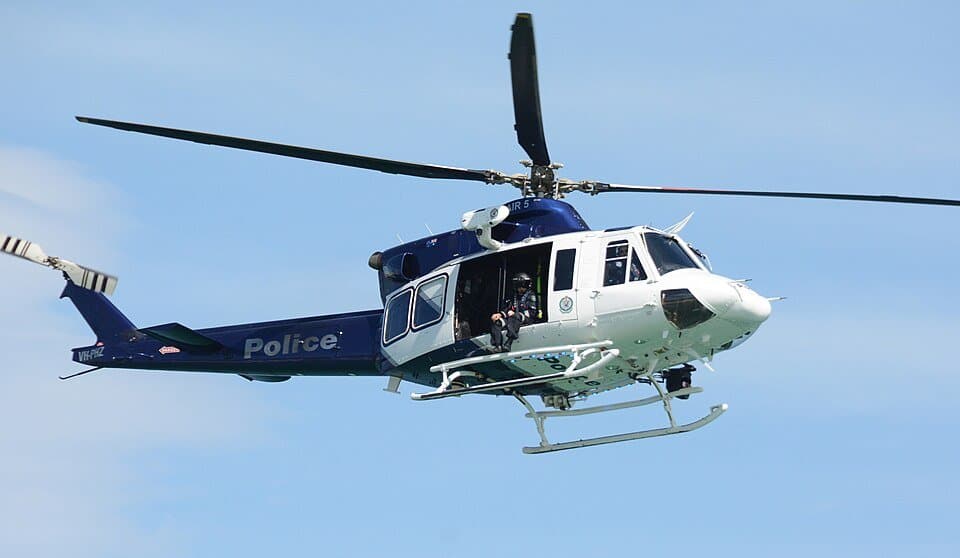

Credit
Sardaka · CC BY-SA 4.0 · Resized · CC BY-SA 4.0 · Source ↗ · Modified


Preparing your view.
At a glance
Measured figures
AH-1G HueyCobra · stub wings
Single source10 ft 4 in (3.15 m) stub wings[source]
Empty; Bell 412EP · Empty weight
Single sourceMaximum take-off; Bell 412EP · Max takeoff weight
Single source6,789 lb (3,079 kg)[source]
11,900 lb (5,398 kg)[source]
Empty; AH-1G HueyCobra · Empty weight
Single sourceMaximum take-off; AH-1G HueyCobra · Max takeoff weight
Single sourceBell 412EP · 1 × Pratt & Whitney Canada PT6T-3D Twin-Pac or PT6T-3DF Twin-Pac coupled turboshaft engine - each, 1,250 shp (
Single source1 × Pratt & Whitney Canada PT6T-3D Twin-Pac or PT6T-3DF Twin-Pac coupled turboshaft engine - each, 1,250 shp (930 kW)[source]
AH-1G HueyCobra · 1 × Lycoming T53-L-13 turboshaft
Single source1 × Lycoming T53-L-13 turboshaft , 1,100 hp (820 kW)[source]
Bars compare reported quantities only. A larger figure does not make a system better; configurations and test conditions differ.
Configuration
| Specification | Bell 412 | Bell AH-1 Cobra |
|---|---|---|
| Crew | one-two pilots[source] | 2; one pilot, one co-pilot/gunner (CPG)[source] |
| Type | Multipurpose utility helicopter[source] | Attack helicopter[source] |
| National origin | United States / Canada[source] | United States[source] |
| Manufacturer | Bell Helicopter[source] | Bell Helicopter[source] |
| Primary users | Japan Ground Self Defence Force See Operators for others[source] | United States Army (historical) Japan Ground Self-Defense Force Republic of Korea Army Royal Jordanian Air Force[source] |
| Number built | 1,300+[source] | 1,116[source] |
| Manufactured | 1979–present[source] | 1967–2019[source] |
| Introduction date | 1981 ( 1981 )[source] | 1967[source] |
| First flight | August 1979 ( 1979-08 )[source] | 7 September 1965[source] |
| Developed from | Bell 212[source] | Bell UH-1 Iroquois[source] |
| Variant | Bell CH-146 Griffon[source] | — |
| Capacity | up to 13 passengers, maximum external load of almost 6,614 lb (3,000 kg)[source] | — |
| Fuselage length | 43 ft (13 m)[source] | 44 ft 5 in (13.5 m)[source] |
| Blade sections | root: Boeing VR-7; tip: Wortmann FX 71-H-080[source] | — |
| Main rotor area | 1,662 sq ft (154.4 m 2 )[source] | 1,520 sq ft (141 m 2 )[source] |
| Power/mass | 0.2663 hp/lb (0.4378 kW/kg)[source] | — |
| Status | — | In service[source] |
| Retired | — | 2001 (US Army)[source] |
| Variants | — | Bell AH-1 SeaCobra/SuperCobra Bell 309 KingCobra[source] |
| Blade section | — | NACA 0009.3 mod[source] |
| Never exceed speed | — | 190 kn (220 mph, 350 km/h)[source] |
| Role | — | single-engined attack helicopter[source] |
| Source measurement | — | While some officials within the Pentagon, particularly those within the US Army, had recognized the potential value of purpose-built armed rotary aircraft as early as 1962 and were keen to see such a vehicle developed promptly, the issue was complicated in part due to inter-service politics. The United States Air Force (USAF) largely held the opinion that most forms of US military aircraft should be operated only by their service, and that the US Army would be intruding into their domain by developing a complex armed aerial combatant, and ought to be largely restricted to transport aircraft. Meanwhile, some Army officials were concerned that the USAF did not take the close air support (CAS) mission as seriously as it ought to, and that response times of 30 minutes or more for fixed-wing aircraft would be unacceptable.[source]Bell AH-1 Cobra · Development / Background; only the objects and conditions stated in this passage Bell had been investigating helicopter gunships since the late 1950s, paying particular attention to the Algerian War , in which French forces mounted weapons on helicopters to fight the growing insurgency. The company created a mockup of its D-255 helicopter gunship concept, named "Iroquois Warrior". The Iroquois Warrior was planned to be a purpose-built attack aircraft based on UH-1B components with a new, slender airframe and a two-seat, tandem cockpit. It featured a grenade launcher in a ball turret on the nose, a 20 mm belly-mounted gun pod, and stub wings for mounting rockets or SS.10 anti-tank missiles.[source]Bell AH-1 Cobra · Development / Iroquois Warrior, Sioux Scout and AAFSS; only the objects and conditions stated in this passage The Army's solution to the shortcomings of the Sioux Scout was to launch the Advanced Aerial Fire Support System (AAFSS) competition. This called for a heavily armed helicopter capable of at least 200 miles per hour (320 km/h). A total of seven companies, including Bell, opted to respond to the requirement. It was out of the AAFSS program that the Lockheed AH-56 Cheyenne emerged, a heavy attack helicopter with high speed capability. During testing, it proved to be too sophisticated and costly, and was ultimately canceled in 1972 after ten years of development. In its place, the Advanced Attack Helicopter program was launched. Under this initiative, the Army sought a conventional attack helicopter with a greater level of survivability.[source]Bell AH-1 Cobra · Development / Iroquois Warrior, Sioux Scout and AAFSS; only the objects and conditions stated in this passage As the Vietnam War proceeded, pressure accumulated in favor of the Model 209. Attacks on US forces were increasing and, by the end of June 1965, there were already 50,000 US ground troops in Vietnam. 1965 was also the deadline for AAFSS selection, but the program would become stuck in technical difficulties and political bickering. The US Army needed an interim gunship for Vietnam and it approached five separate companies with its request to provide a quick solution. Submissions came in for armed variants of the Boeing-Vertol ACH-47A , Kaman HH-2C Tomahawk , Piasecki 16H Pathfinder , Sikorsky S-61 , and the Bell 209.[source]Bell AH-1 Cobra · Development / Model 209; only the objects and conditions stated in this passage During April 1966, Bell's submission emerged victorious in an evaluation against the other rival helicopters. The US Army promptly signed the first production contract, ordering an initial batch of 110 aircraft. By the end of the year, rapid follow-on orders had increased this to 500 Cobras. Bell added "Cobra" to the UH-1's Huey nickname to produce its HueyCobra name for the 209. The Army applied the Cobra name to its AH-1G designation for the helicopter. The Bell 209 demonstrator was used for the next six years to test weapons and fit of equipment. An additional use for the demonstrator was participating in marketing initiatives. It was also modified to match the AH-1 production standard by the early 1970s. The demonstrator was retired to the Patton Museum at Fort Knox , Kentucky and converted to approximately its original appearance.[source]Bell AH-1 Cobra · Development / Model 209; only the objects and conditions stated in this passage Typically, the Cobra would avoid hovering at any point in an active engagement; instead, emphasis was placed on maintaining speed and mobility. The gunner often fired the chin-mounted cannon with the intention of suppressing hostile targets in between barrages of 2.75-inch rockets, held in pods upon the stub wings, which were fired by the back-seater. It was unusual for Cobras to operate alone; instead, two or more would be dispatched and teamwork encouraged, leading to hunter-killer tactics being used to flush out and eliminate ground targets. Pairings with other helicopters, such as the Bell OH-58 Kiowa scout helicopter, were also common occurrences. Radio communications were handled by the gunner. Regardless of mission profile, low altitude flying was commonplace.[source]Bell AH-1 Cobra · Design; only the objects and conditions stated in this passage By June 1967, the first AH-1G HueyCobras had been delivered. Originally designated as UH-1H, the "A" for attack designation was soon adopted and when the improved UH-1D became the UH-1H, the HueyCobra became the AH-1G. The AH-1 was initially considered a variant of the H-1 line, resulting in the G series letter.[source]Bell AH-1 Cobra · Operational history / United States; only the objects and conditions stated in this passage On 12 September 1968, Capt. Ronald Fogleman was flying an F-100 Super Sabre when the aircraft was shot down and he ejected 200 miles (320 km) north of Bien Hoa. Fogleman became the only pilot to be rescued by holding on to an Army AH-1G's deployed gun-panel door. Bell built 1,116 AH-1Gs for the U.S. Army between 1967 and 1973, and the Cobras chalked up over a million operational hours in Vietnam; the number of Cobras in service peaked at 1,081. In 1971 during Operation Lam Son 719 in Southeastern Laos , 26 U.S. Army AH-1Gs were destroyed and 158 sustained some level of damage. Out of nearly 1,110 AH-1s that were delivered between 1967 and 1973, approximately 300 were lost to a combination of combat and accidents during the conflict. Approximately one third of this number were operational or non-combat losses.[source]Bell AH-1 Cobra · Operational history / United States; only the objects and conditions stated in this passage The U.S. Marine Corps also operated the AH-1G Cobra in Vietnam for a short time before acquiring the twin-engine AH-1J Cobras . The AH-1Gs had been adopted by the Marines as an interim measure, a total of 38 helicopters having been transferred from the U.S. Army to the Marines in 1969.[source]Bell AH-1 Cobra · Operational history / United States; only the objects and conditions stated in this passage By 2013, Pakistan reportedly operated a fleet of 35 AH-1F helicopters. Maintaining these aircraft has been difficult, but possible through commercial channels. Additionally, the US government provided $750,000 (~$993,036 in 2024) through 2013 to update the existing AH-1F/S Cobra fleet. However, controversy over how much of this funding has actually been spent on Pakistan's Cobras has also been present throughout the 2010s. Turkey has also become a key supplier of spare parts for the Cobra, often free of cost, to Pakistan. During the 2010s, Pakistan lost a total of three aircraft in separate incidents.[source]Bell AH-1 Cobra · Operational history / Pakistan; only the objects and conditions stated in this passage Pakistan repeatedly sought the Bell AH-1W SuperCobra from the US to supplement and replace its current AH-1 Cobras. Attempts to acquire the AH-1Z Viper or AH-64E Apache from the US were rejected, so Pakistan turned to buying other foreign attack helicopters. Possible candidates have included the Turkish T129 , the Chinese CAIC Z-10 , and the Russian Mi-35 Hind . In November 2014, Russia approved the sale of Mi-35M helicopters to Pakistan. In April 2015, China delivered three Z-10s to Pakistan. During the same month, the US Department of State approved the sale of 15 AH-1Zs and associated equipment to Pakistan. During October 2017, the T129 was also reported to be a contender for further orders.[source]Bell AH-1 Cobra · Operational history / Pakistan; only the objects and conditions stated in this passage The Florida Division of Forestry also acquired three AH-1Ps from the US Army. These are called Bell 209 "Firesnakes" and are equipped to carry a water/fire retardant system.[source]Bell AH-1 Cobra · Operational history / Civilian operators; only the objects and conditions stated in this passage Original AH-1G prototype with retractable skid landing gear. This model number is also used by the FAA for the civilian registration of former U.S. Army AH-1s used in firefighting service.[source]Bell AH-1 Cobra · Variants / Single-engine; only the objects and conditions stated in this passage AH-1G HueyCobra[source]Bell AH-1 Cobra · Variants / Single-engine; only the objects and conditions stated in this passage Initial 1966 production model gunship for the U.S. Army, with one 1,400 shp (1,000 kW ) Avco Lycoming T53-13 turboshaft.[source]Bell AH-1 Cobra · Variants / Single-engine; only the objects and conditions stated in this passage JAH-1G HueyCobra[source]Bell AH-1 Cobra · Variants / Single-engine; only the objects and conditions stated in this passage TH-1G HueyCobra[source]Bell AH-1 Cobra · Variants / Single-engine; only the objects and conditions stated in this passage The Spanish Navy purchased eight new-build AH-1Gs, designating the type the "Z-14". These were equipped with the M35 20 mm cannon system, and were used to support coastal patrol boats. Four of these were lost in accidents. The remaining helicopters were retired in 1985 with three sent back to the US, and one kept in storage in Spain.[source]Bell AH-1 Cobra · Variants / Single-engine; only the objects and conditions stated in this passage AH-1G powered by a T53-L-703 engine without TOW system.[source]Bell AH-1 Cobra · Variants / Single-engine; only the objects and conditions stated in this passage The baseline AH-1S is an AH-1Q upgraded with a 1,800 shp (1,300 kW) T53-L-703 turboshaft engine. The AH-1S is also referred to as the "Improved AH-1S", "AH-1S Modified", or "AH-1S(MOD)" prior to 1988. (Prior to 1988, all upgraded aircraft were referred to as variants of the AH-1S.)[source]Bell AH-1 Cobra · Variants / Single-engine; only the objects and conditions stated in this passage 98 production aircraft with the Enhanced Cobra Armament System (ECAS) featuring the M97A1 armament subsystem with a three-barreled M197 20 mm cannon. The AH-1E is also referred to as the "Upgunned AH-1S", or "AH-1S(ECAS)" prior to 1988. These improvements are considered Step 2 of the AH-1S upgrade program. AH-1E aircraft included the M147 Rocket Management Subsystem (RMS) to fire 2.75-inch (70 mm) rockets.[source]Bell AH-1 Cobra · Variants / Single-engine; only the objects and conditions stated in this passage 143 production aircraft and 387 converted AH-1G Cobras. The AH-1F incorporates all Step 1 and 2 upgrades to the AH-1S. It also featured Step 3 upgrades: a head-up display, a laser rangefinder, an infrared jammer mounted above the engine exhaust, and an infrared suppressing engine exhaust system, and the M143 Air Data Subsystem (ADS). The AH-1F is also referred to as the "Modernized AH-1S", "AH-1S Modernized Cobra", or "AH-1S(MC)" prior to 1988.[source]Bell AH-1 Cobra · Variants / Single-engine; only the objects and conditions stated in this passage Experimental all-weather version based on the AH-1G single-engine and AH-1J twin-engine designs. Two Bell 309s were produced; the first was powered by a PWC T400-CP-400 Twin-Pac engine set and the second was powered by a Lycoming T55-L-7C engine.[source]Bell AH-1 Cobra · Variants / Single-engine; only the objects and conditions stated in this passage Length: 53 ft (16 m) including rotors[source]Bell AH-1 Cobra · Specifications (AH-1G HueyCobra); only the objects and conditions stated in this passage Fuselage length: 44 ft 5 in (13.5 m)[source]Bell AH-1 Cobra · Specifications (AH-1G HueyCobra); only the objects and conditions stated in this passage Width: 10 ft 4 in (3.15 m) stub wings[source]Bell AH-1 Cobra · Specifications (AH-1G HueyCobra); only the objects and conditions stated in this passage Height: 13 ft 6 in (4.11 m)[source]Bell AH-1 Cobra · Specifications (AH-1G HueyCobra); only the objects and conditions stated in this passage Empty weight: 5,810 lb (2,635 kg)[source]Bell AH-1 Cobra · Specifications (AH-1G HueyCobra); only the objects and conditions stated in this passage Max takeoff weight: 9,500 lb (4,309 kg)[source]Bell AH-1 Cobra · Specifications (AH-1G HueyCobra); only the objects and conditions stated in this passage Powerplant: 1 × Lycoming T53-L-13 turboshaft , 1,100 hp (820 kW)[source]Bell AH-1 Cobra · Specifications (AH-1G HueyCobra); only the objects and conditions stated in this passage Main rotor diameter: 44 ft 0 in (13.4 m)[source]Bell AH-1 Cobra · Specifications (AH-1G HueyCobra); only the objects and conditions stated in this passage Main rotor area: 1,520 sq ft (141 m 2 )[source]Bell AH-1 Cobra · Specifications (AH-1G HueyCobra); only the objects and conditions stated in this passage Maximum speed: 149 kn (171 mph, 276 km/h)[source]Bell AH-1 Cobra · Specifications (AH-1G HueyCobra); only the objects and conditions stated in this passage Never exceed speed : 190 kn (220 mph, 350 km/h)[source]Bell AH-1 Cobra · Specifications (AH-1G HueyCobra); only the objects and conditions stated in this passage Range: 310 nmi (360 mi, 570 km)[source]Bell AH-1 Cobra · Specifications (AH-1G HueyCobra); only the objects and conditions stated in this passage Service ceiling: 11,400 ft (3,500 m)[source]Bell AH-1 Cobra · Specifications (AH-1G HueyCobra); only the objects and conditions stated in this passage Rate of climb: 1,230 ft/min (6.2 m/s)[source]Bell AH-1 Cobra · Specifications (AH-1G HueyCobra); only the objects and conditions stated in this passage 2 × 7.62 mm (0.308 in) multi-barrel Miniguns , or 2 × M129 40 mm grenade launchers , or one of each, in the M28 turret . (When one of each was mounted, the minigun was mounted on the right side of the turret, due to feed requirements.)[source]Bell AH-1 Cobra · Specifications (AH-1G HueyCobra); only the objects and conditions stated in this passage 2.75 in (70 mm) rockets – 7 rockets mounted in the M158 launcher or 19 rockets in the M200 launcher[source]Bell AH-1 Cobra · Specifications (AH-1G HueyCobra); only the objects and conditions stated in this passage M18 7.62 mm Minigun pod or XM35 armament subsystem with XM195 20 mm cannon[source]Bell AH-1 Cobra · Specifications (AH-1G HueyCobra); only the objects and conditions stated in this passage |