
FORCETALLY
Loading the evidence…
Preparing your view.


Preparing your view.
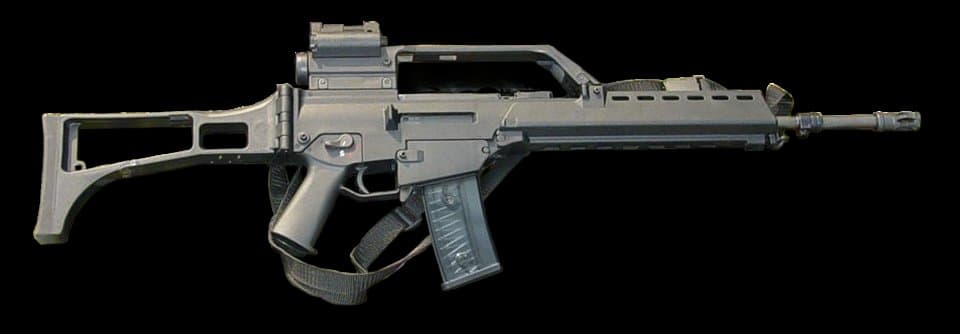

At a glance
Measured figures
collapsed
Single source34.5 in (876.3 mm) collapsed[source]
stock extended /
Single sourceConfiguration
| Specification | Barrett REC10 | Heckler & Koch G36 |
|---|---|---|
| Type | Designated Marksman Rifle[source] | Assault rifle[source] |
| Place of origin | United States[source] | Germany[source] |
| Manufacturer | Barrett Firearms Manufacturing[source] | Heckler & Koch Santa Bárbara Sistemas Military Industries Corporation[source] |
| Calibre | .308 Winchester / 7.62×51mm NATO[source] |
stock folded
Single source999 mm (39.3 in) stock extended / 758 mm (29.8 in) stock folded[source]
1.000 auf 750 Millimeter[source]G36 · Schulterstütze ausgeklappt / abgeklappt · two source configurationsSource text · numeric interpretation needs review
Barrel length · source measurement 1
Single sourceBarrel length · source measurement 2
Single sourceBarrel length · source measurement 3
Single sourceG36 · Barrel length · Rohrlänge
Single source480 mm (18.9 in) 318 mm (12.5 in) 228 mm (9.0 in)[source]
480 mm[source]G36 · Rohrlänge
Muzzle velocity
Single source920 m/s (3,018 ft/s)[source]
Bars compare reported quantities only. A larger figure does not make a system better; configurations and test conditions differ.
| — |
| Action | semi-automatic[source] Direct impingement; semi-automatic[source] | Short-stroke piston , closed rotating bolt[source] automatischer Gasdrucklader mit Drehkopfverschluss[source]G36 · Action |
|---|
| In service | — | 1997–present[source] |
|---|
| Used by | — | 40+ countries (see Users )[source] |
|---|
| Wars | — | See Conflicts[source] |
|---|
| Designer | — | Heckler & Koch[source] |
|---|
| Designed | — | 1991–1995[source] |
|---|
| Produced | — | 1996–present[source] |
|---|
| No. built | — | 260,000+[source] |
|---|
| Variants | — | See Variants[source] |
|---|
| Cartridge | — | 5.56×45mm NATO[source] 5,56 mm x 45[source]G36 · Kaliber |
|---|
| Feed system | — | 30-round proprietary detachable box magazine 100-round C-Mag drum magazine STANAG magazines (with optional adaptor)[source] |
|---|
| Sights | — | Reflex sight with 1× magnification, telescopic sight with 3× magnification (export version has a 1.5× magnified sight) and back-up fixed notch sight Picatinny rails for various optics (later models)[source] |
|---|
| Role | — | assault rifle[source] |
|---|
| Source measurement | — | The Heckler & Koch G36 ( German : Gewehr 36 ) is an assault rifle designed in the early 1990s by German weapons manufacturer Heckler & Koch . It is chambered in 5.56×45mm NATO , and replaced the heavier G3 battle rifle chambered in 7.62×51mm . The G36 was accepted into service with the Bundeswehr in 1997. Since then, it has been a popular export and has seen active service in military and police units in several countries, including Germany, Spain, and the United Kingdom. The G36 is gas-operated and feeds from a 30-round detachable box magazine or 100-round C-Mag drum magazine .[source]Heckler & Koch G36 · Lead; only the objects and conditions stated in this passage In the 1970s, arms manufacturers in Germany began work on a successor for the G3 rifle, resulting in the creation of the 4.73 mm G11 assault rifle (developed jointly by a group of companies led by Heckler & Koch) that used caseless ammunition (designed by Dynamit Nobel ). This weapon was intended to replace the G3, therefore further development of Heckler & Koch's series of firearms chambered for the 5.56×45mm NATO cartridge was halted. Heckler & Koch, having no incentive to pursue a new 5.56 mm weapon system, was content with the export-oriented HK33 and G41 rifles. However, the G11 program came to an abrupt end when the Bundeswehr cancelled its procurement due to defence budget cuts resulting from the unification of East and West Germany , and Heckler & Koch's 1991 acquisition by British Aerospace's Royal Ordnance division (known today as BAE Systems ).[source]Heckler & Koch G36 · History / Development; only the objects and conditions stated in this passage Increasing demand for a modern service rifle , chambered in the NATO -standard 5.56 mm cartridge, led Heckler & Koch to offer the German armed forces the G41 rifle, which, too, was rejected. Design work was initiated on a completely novel, modern 5.56 mm assault rifle; it would later be designated Project 50 or HK50 . During testing, prototypes were rated higher than the Austrian competition (the Steyr AUG system). The final version of the G36 was completed in 1995, and production began in 1996.[source]Heckler & Koch G36 · History / Development; only the objects and conditions stated in this passage In April 2012, reports surfaced that G36 rifles used in Afghanistan would overheat during prolonged firefights after several hundred rounds were fired. Overheating affected the accuracy of the G36, making it difficult to hit targets past 100 metres, ineffective past 200 metres, and incapable of effective fire past 300 metres. The G36 has been called unsuitable for long battles. Operational commanders advised allowing the weapon to cool between periods of rapid shooting.[source]Heckler & Koch G36 · History / Replacement; only the objects and conditions stated in this passage On 22 June 2014, it was reported that Germany's defense ministry had temporarily halted new orders worth €34 million ($45 million) over accuracy concerns for the rifle. The Bundeswehr consulted the Fraunhofer Institute for High-Speed Dynamics (Ernst Mach Institut) and the Federal Criminal Police Office . On 30 March 2015, Minister of Defence Ursula von der Leyen told Associated Press that the weight-saving design was the root of the issues. This was based on a letter from Inspector General Volker Wieker advising the Stewards of the Defence and Budget Committees of the Bundestag and the troops in advance of publication of the report. The report was released by the Fraunhofer Ernst Mach Institut and Wehrtechnische Dienststelle 91 on 19 April 2015. According to their 372-page report, the observed hit rate of the predominantly plastic weapon with the unsupported free-floating barrel drops down to a mere 7% at 100 metres when the temperature increases by 30 °C (86 °F) or more, whereas the Bundeswehr required a hit rate of 90% at that distance.[source]Heckler & Koch G36 · History / Replacement; only the objects and conditions stated in this passage The Bundeswehr began the System Sturmgewehr Bundeswehr (Bundeswehr Assault Rifle System) effort to replace the G36 in 2017. Initially, C.G. Haenel won the competition in September 2020 offering their Haenel MK 556 . However, German authorities cancelled the contract the next month, amid allegations that the MK 556 infringed on Heckler and Koch patents, and the G95A1 (known as the HK416 A8 during field testing) was selected in early 2021. Haenel sued to attempt to reverse the decision, but a German court dismissed the lawsuit in June 2022. In December 2022, the Bundestag approved initial funding to begin procuring the rifles. The Bundeswehr expected to purchase 118,718 rifles, designated G95A1 (with a 16.5 in (420 mm) barrel) and G95KA1 (with a shorter 14 in (360 mm) barrel). Fielding is planned to start in 2026.[source]Heckler & Koch G36 · History / Replacement; only the objects and conditions stated in this passage The G36 is chambered in 5.56×45mm NATO and fires from a closed rotary bolt . The rifle body has a conventional layout and a modular component design. While modifications can vary, all G36 variants share an identical receiver , buttstock assembly, bolt carrier group , return mechanism, and guide rod. The receiver contains the barrel , carry handle with integrated sights , trigger group with pistol grip , handguard, and magazine socket.[source]Heckler & Koch G36 · Design details; only the objects and conditions stated in this passage The G36 employs a free-floating barrel, meaning the barrel does not make contact with the handguard. The barrel is fastened to the receiver with a special nut, which can be removed with a wrench. The barrel is forged using a cold hammer process. It features a chrome-lined bore with 6 right-hand grooves and a 1 in 178 mm (1:7 in) rifling twist rate. The barrel features a collar and lug permitting attachment of a bayonet ; it can also be used to attach rifle grenades and a flash suppressor .[source]Heckler & Koch G36 · Design details; only the objects and conditions stated in this passage The fire and safety selector is ambidextrous and has controls on both sides of the receiver; this feature is inherited from the design of the original G3 . Selector settings are described with letters: "S"—safe ("Sicher"), "E"— semi-automatic fire ("Einzelfeuer") and "F"— automatic fire ("Feuerstoß"). The three-position fire selector has a 0°/45°/90° rotation pattern between the settings. HK offers several other trigger options, including the "Navy" trigger group with illustrated pictograms for each setting. An exclusively semi-automatic trigger is also available.[source]Heckler & Koch G36 · Design details / Features / Fire selector; only the objects and conditions stated in this passage An empty G36 magazine weighs 127 g (4.5 oz), while a fully loaded magazine weighs 483 g (17.0 oz).[source]Heckler & Koch G36 · Design details / Features / Magazine; only the objects and conditions stated in this passage The standard German Army versions of the G36 are equipped with a ZF 3×4° dual optical sight, which includes a 3× magnified telescopic sight and an unmagnified reflex sight mounted slightly higher. The reflex sight is illuminated by ambient light during the day and uses battery-powered illumination for use at night. Electric illumination is activated automatically by a built-in photoresistor and can be manually activated to boost the brightness of the reticle in low contrast situations. The main reticle is sighted in at 200 m (219 yd) and includes crosshairs and a range-finding scale. It also features bullet drop compensation markings for 200, 400, 600, and 800 m (219, 437, 656, and 875 yd).[source]Heckler & Koch G36 · Design details / Sights; only the objects and conditions stated in this passage Export versions have a single telescopic sight with 1.5× magnification and a fixed 300 m (328 yd) reticle. All rifles are adapted to use the Hensoldt NSA 80 third-generation night sight , which clamps into the G36 carry handle adaptor in front of the optical sight housing and mates with the rifle's standard optical sight. The sighting bridge also functions as a carrying handle and features auxiliary open sights moulded on top of the handle that consist of a forward blade and rear notch, but these can only be used with the reflex sight removed, as in the G36V. The optical sight system is produced by Hensoldt AG (a subsidiary of Carl Zeiss AG ).[source]Heckler & Koch G36 · Design details / Sights; only the objects and conditions stated in this passage The rifle can be fitted with a 40 mm AG36 ( German : Anbau-Granatwerfer ) under-barrel grenade launcher , which loads via a side-tilting break action .[source]Heckler & Koch G36 · Design details / Accessories; only the objects and conditions stated in this passage Introduced in 1996, the G36 is chambered in 5.56×45mm NATO . It features a 18.9 in (480 mm) barrel.[source]Heckler & Koch G36 · Variants / G36; only the objects and conditions stated in this passage In July 1998, it was announced that the G36 had been selected as the service rifle for the Spanish Armed Forces , replacing the Spanish-designed 5.56 mm CETME Model L and LC rifles. Deliveries started at the end of 1999.[source]Heckler & Koch G36 · Variants / Licensed productions / Spain; only the objects and conditions stated in this passage Heckler & Koch created the semi-automatic SL8 rifle and the straight-pull, bolt-action R8 , which are offered to the civilian sport shooting markets, both loosely based on the G36. The SL8 is substantially different from the G36, it has a modified receiver and a thumbhole stock with a cheek rest, which is integral with the trigger group. The SL8 has a heavy profile, extended, 510 mm (20.1 in) barrel that does not have a flash hider or bayonet lug. The rifle uses a 10-round single-stack magazine and an extended top rail used to mount a wide variety of Picatinny-standard optics. Mounted to the rail are a set of iron sights with a hooded foresight and adjustable flip rear aperture. The SL8 can also mount the G36 carry handle and integrated sight assembly, after removing the mechanical iron sights. The SL8 has an unloaded weight of 4.3 kg (9.5 lb), overall length of 980–1,030 mm (39–41 in) and a trigger rated at 20 N (4.5 lb f ).[source]Heckler & Koch G36 · Variants / Sporting and civilian variants; only the objects and conditions stated in this passage In November 2013, Heckler & Koch applied for permission from the German Government to sell a new civilian-legal version of the G36. Known as the HK243 in Europe and the HK293 in America, it is more similar to the G36 assault rifle than previous civilian models. The main difference is the bolt, redesigned not to allow a conversion to fully automatic fire. It has quad picatinny rails and accepts STANAG magazines. Four different barrel lengths from 230 mm (9.1 in) to 480 mm (19 in) and four stock models (short fixed, long fixed and two adjustable) will be offered.[source]Heckler & Koch G36 · Variants / Sporting and civilian variants; only the objects and conditions stated in this passage |
|---|
| Magazine capacity | — | 100 Patronen[source]G36 · Drum magazine (Trommelmagazin) 30-Patronen- Magazin[source]G36 · Standard magazine (Magazin) |
|---|
| Reported operators |
| — |
|---|