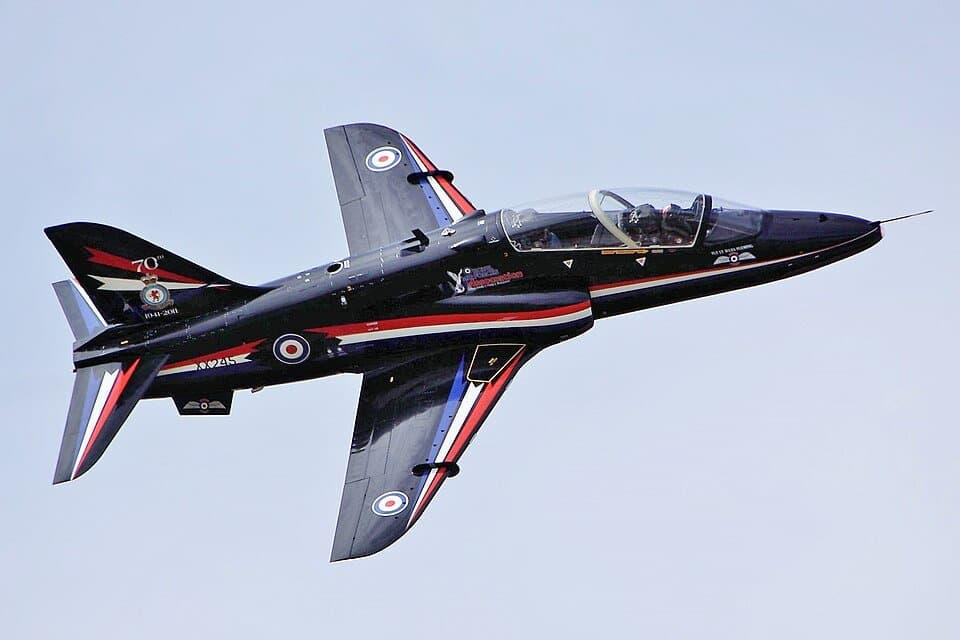
Credit
Tim Felce (Airwolfhound) · CC BY-SA 2.0 · Resized · CC BY-SA 2.0 · Source ↗ · Modified


Preparing your view.
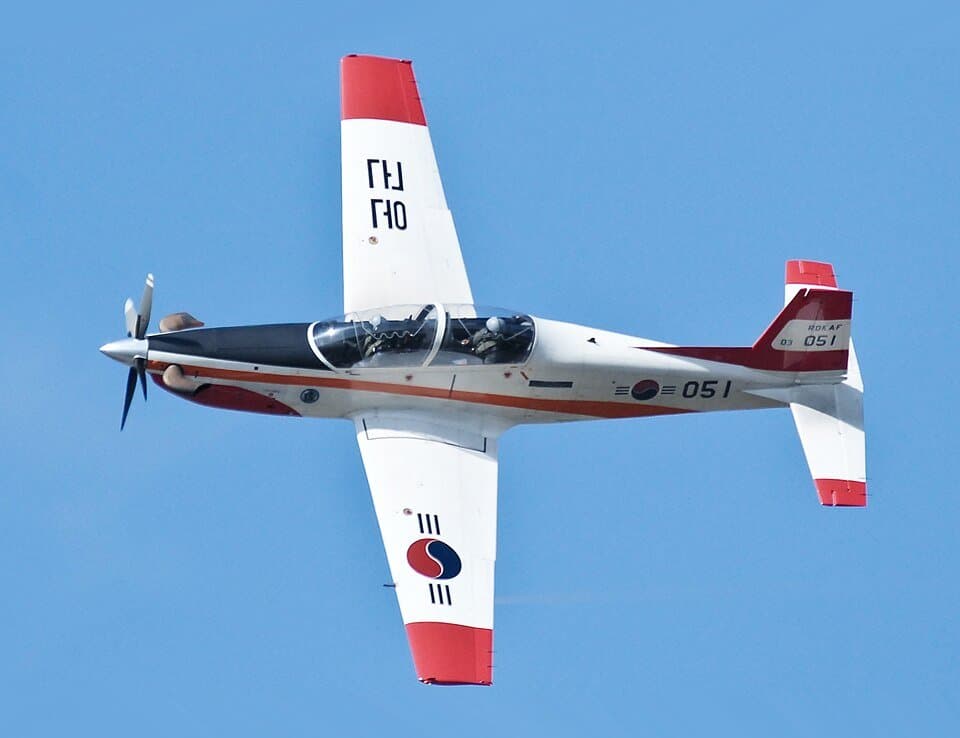

At a glance
Measured figures
Hawk 128 · Length
Single source12.43 m (40 ft 9 in)[source]
KT-1 · Length
Single sourceConfiguration
| Specification | BAE Systems Hawk | KAI KT-1 Woongbi |
|---|---|---|
| Type | Advanced trainer aircraft[source] | Basic trainer and light attack aircraft[source] |
| National origin | United Kingdom[source] | South Korea[source] |
| Manufacturer | Hawker Siddeley (1974–1977) British Aerospace (1977–1999) BAE Systems MAI division (1999–2022) Hindustan Aeronautics Limited (2008–present)[source] | Korea Aerospace Industries[source] |
| Status | In service[source] |
10.3 m (33 ft 10 in)[source]
Maximum; Hawk 128 · ) at altitude
Single sourceMaximum; Hawk 128 · Mach 0.84 (
Single sourceMaximum; Hawk 128 · Maximum speed
Single sourceMach 0.84 (1,028 km/h, 639 mph, 555 kn) at altitude[source]
Maximum; KT-1 · at 4,570 m (14,993 ft)
Single source644 km/h (400 mph, 348 kn) at 4,570 m (14,993 ft)[source]
Hawk 128 · Range
Single source2,520 km (1,360 nmi , 1,565 mi)[source]
Ferry; KT-1 · at 6,100 m (20,013 ft) with max internal and external fuel (30 minutes reserve)
Single sourceKT-1 · at 7,620 m (25,000 ft) with max internal fuel (30 minutes reserve)
Single source1,333 km (828 mi, 720 nmi) at 7,620 m (25,000 ft) with max internal fuel (30 minutes reserve)[source]
2,070 km (1,290 mi, 1,120 nmi) at 6,100 m (20,013 ft) with max internal and external fuel (30 minutes reserve)[source]
KT-1 · 1 × Pratt & Whitney Canada PT6A-62 turboprop engine
Single source1 × Pratt & Whitney Canada PT6A-62 turboprop engine, 708.4 kW (950.0 hp)[source]
Hawk 128 · 1× Rolls-Royce Turbomeca Adour Mk. 951 turbofan with FADEC
Single sourceHawk 128 · Powerplant
Single source1× Rolls-Royce Turbomeca Adour Mk. 951 turbofan with FADEC , 29 kN (6,500 lbf ) 29 kN[source]
Hawk 128 · Up to of weapons on five hardpoints, including
Single sourceUp to 6,800 lb (3,085 kg) of weapons on five hardpoints, including:[source]
KT-1 · < at 6,100 m (20,013 ft) with max internal fuel (
Single sourceKT-1 · reserve
Single source<4 hours at 6,100 m (20,013 ft) with max internal fuel (30 minutes reserve)[source]
Bars compare reported quantities only. A larger figure does not make a system better; configurations and test conditions differ.
In service[source] |
| Primary users | Royal Air Force Indian Air Force Royal Saudi Air Force Royal Australian Air Force South African Air Force[source] | Republic of Korea Air Force Indonesian Air Force Turkish Air Force Peruvian Air Force Senegalese Air Force[source] |
|---|
| Number built | 1,000+[source] | 186[source] |
|---|
| Manufactured | 1974–present[source] | 1999–present[source] |
|---|
| Introduction date | 1976[source] | 2000[source] |
|---|
| First flight | 21 August 1974[source] | November 1991[source] |
|---|
| Developed into | British Aerospace Hawk 200 McDonnell Douglas T-45 Goshawk[source] | — |
|---|
| Useful load | 3,000 kg (6,600 lb)[source] | — |
|---|
| Never exceed speed | Mach 1.2 (in dive)[source] | 648 km/h (403 mph, 350 kn)[source] |
|---|
| Thrust/weight | 0.65[source] | — |
|---|
| Hardpoints | Up to 6,800 lb (3,085 kg) of weapons on five hardpoints, including:[source] | — |
|---|
| Role | British single-engine, subsonic, jet-powered advanced trainer aircraft[source] | — |
|---|
| Source measurement | Operators of the Hawk include the Royal Air Force (notably the Red Arrows display team) and several foreign military operators. The Hawk was produced at BAE Brough until 2020 in the UK, and continues to be produced under licence in India by Hindustan Aeronautics Limited (HAL), with over 1000 Hawks sold to 18 operators around the world.[source]BAE Systems Hawk · Lead; only the objects and conditions stated in this passage The prototype aircraft XX154 first flew on 21 August 1974 from Dunsfold piloted by Duncan Simpson , Chief Test Pilot of HSA (Kingston), reaching 20,000 ft in a flight lasting 53 minutes. All development aircraft were built on production jigs; the program remained on time and to budget throughout. The Hawk T1 entered RAF service in late 1976. The first export Hawk 50 flew on 17 May 1976. This variant had been specifically designed for the dual role of lightweight fighter and advanced trainer; it had a greater weapons capacity than the T.1.[source]BAE Systems Hawk · Development / Origins; only the objects and conditions stated in this passage The Hawk was designed to be manoeuvrable and can reach Mach 0.88 in level flight and Mach 1.15 in a dive, thus allowing trainees to experience transonic flight before advancing to a supersonic trainer. The airframe is very durable and strong, stressed for +9 g ; the normal limit in RAF service is +7.5/-4 g. A dual hydraulic system supplies power to operate systems such as the aircraft's flaps, airbrakes and landing gear, together with the flight controls. A ram air turbine is fitted in front of the single tail fin to provide backup hydraulic power for the flight controls in the event of an engine failure; additionally, a gas turbine auxiliary power unit is housed directly above the engine.[source]BAE Systems Hawk · Design; only the objects and conditions stated in this passage The Hawk is designed to carry a centreline gun pod, such as the 30 mm ADEN cannon , two under-wing pylons, and up to four hardpoints for fitting armaments and equipment. In RAF service, Hawks have been equipped to operate the Sidewinder air-to-air missiles . In the early 1990s, British Aerospace investigated the possibility of arming the Hawk with the Sea Eagle anti-ship missile for export customers. In 2016, BAE Systems was developing the so-called 'Advanced Hawk' with a new wing using leading-edge slats , and potentially additional sensors and weapons, a head-mounted display , and a single large-screen display in the forward cockpit.[source]BAE Systems Hawk · Design; only the objects and conditions stated in this passage From 1983 to 1986, some Hawks were equipped as short-range interceptor aircraft . 88 T1s were modified to carry two AIM-9L Sidewinder air-to-air missiles in addition to a 30 mm ADEN cannon gun pod ; these aircraft were redesignated as Hawk T1A . In a wartime scenario, they would have worked in collaboration with the RAF's Tornado F3 interceptors, which would use their Foxhunter search radars and more sophisticated navigation systems to vector the Hawks against enemy targets.[source]BAE Systems Hawk · Operational history / United Kingdom; only the objects and conditions stated in this passage Seven additional Mk. 51As were delivered in 1993–94 to make up for losses. In June 2007, Finland arranged to purchase 18 used Hawk Mk. 66s from the Swiss Air Force for 41 million euros; they were delivered in 2009–2010. Finnish Hawks have reportedly been armed with Soviet Molniya R-60 /AA-8 as well as with AIM-9J and AIM-9M air-to-air missiles, Matra Type 155 SNEB rocket pods, unspecified British general-purpose bombs of multiple types, VKT 12.7 mm machine gun pods and Royal Small Arms Factory 30 mm ADEN autocannon pods. The Finnish Air Force aerobatics team, the Midnight Hawks , also uses the aircraft.[source]BAE Systems Hawk · Operational history / Finland; only the objects and conditions stated in this passage Due to rising levels of metal fatigue, a major structural reinforcement program was carried out to extend the operational life of Finland's Hawks during the 1990s. Due to lifespan limitations, 41 out of 67 in Finland's total Hawk fleet were taken out of service between 2012 and 2016; the remaining aircraft are younger and thus are expected to be flying into the 2030s. In 2011, Finnish Mk. 51s and Mk. 66s underwent a series of upgrades performed by Patria , these included the adoption of a new Cockpit 4000 glass cockpit , new software, and other life-extending modifications. This upgrade program was completed in 2013.[source]BAE Systems Hawk · Operational history / Finland; only the objects and conditions stated in this passage The Hawk fleet is based at IAF's Bidar Air Force Station in north Karnataka, about 700 km from Bangalore. As of 2015, a total of 123 aircraft were on order by the Indian Air Force and 17 by the Indian Navy, with an additional order of 20 aircraft were under negotiation.[source]BAE Systems Hawk · Operational history / India; only the objects and conditions stated in this passage Hawk 53 – Export version for the Indonesian Air Force . Eight ordered 4 April 1978, with five more ordered in May 1981, a further three in October 1981 and four in November 1982, giving a total of 20 delivered between 1980 and 1984. Five repurchased by BAE Systems in 1999.[source]BAE Systems Hawk · Variants / Hawk 50; only the objects and conditions stated in this passage Another export version, replacing the Hawk 50, intended for conversion and weapons training. Weapons carriage is increased. It is a two-seater, has uprated Rolls-Royce Adour 861 engines, and is capable of a level speed at altitude of 555 knots (1028 km/h) or Mach 0.84. The T-45 Goshawk was derived from this version.[source]BAE Systems Hawk · Variants / Hawk 60; only the objects and conditions stated in this passage The Royal Australian Air Force ordered 33 Hawk 127 Lead-in Fighter Trainers (LIFTs) in June 1997, 12 of which were produced in the UK and 21 in Australia. This variant is also powered by the Adour 871. The Hawk 127 is operated by the RAAF's No. 76 Squadron and No. 79 Squadron , which are based at RAAF Base Williamtown and RAAF Base Pearce respectively. Work to upgrade the RAAF's Hawks to a standard similar to the Hawk 128 standard began in 2014, and it is planned that the two squadrons will begin operations with these aircraft in 2017. The RAAF's Hawk fleet has been upgraded to Hawk 128 standard under the Lead-In Fighter Capability Assurance Program (LIFCAP).[source]BAE Systems Hawk · Variants / Hawk 127; only the objects and conditions stated in this passage The Advanced Hawk is a joint venture by BAE Systems and Hindustan Aeronautics Limited (HAL) to upgrade the IAF's existing Hawk 132 AJT into an Advanced Transonic Fighter Trainer, which can be used for combat operations. A single prototype of the aircraft was unveiled at Aero India 2017 in Bangalore , from 14-18 February 2017. It made its first flight with the IAF in June 2017.[source]BAE Systems Hawk · Variants / Advanced Hawk (Hawk-i); only the objects and conditions stated in this passage On 1 April 2018, a BAE Hawk Mk 166 crashed on landing at RAFO Masirah , Oman, killing the student pilot and one person on the ground; only the flight instructor survived with serious injuries.[source]BAE Systems Hawk · Accidents and incidents; only the objects and conditions stated in this passage Length: 12.43 m (40 ft 9 in)[source]BAE Systems Hawk · Specifications (Hawk 128); only the objects and conditions stated in this passage Wingspan : 9.94 m (32 ft 7 in)[source]BAE Systems Hawk · Specifications (Hawk 128); only the objects and conditions stated in this passage Height: 3.98 m (13 ft 1 in)[source]BAE Systems Hawk · Specifications (Hawk 128); only the objects and conditions stated in this passage Wing area: 16.70 m 2 (179.64 ft 2 )[source]BAE Systems Hawk · Specifications (Hawk 128); only the objects and conditions stated in this passage Empty weight: 4,480 kg (9,880 lb)[source]BAE Systems Hawk · Specifications (Hawk 128); only the objects and conditions stated in this passage Useful load: 3,000 kg (6,600 lb)[source]BAE Systems Hawk · Specifications (Hawk 128); only the objects and conditions stated in this passage Max takeoff weight : 9,100 kg (20,000 lb)[source]BAE Systems Hawk · Specifications (Hawk 128); only the objects and conditions stated in this passage Powerplant: 1× Rolls-Royce Turbomeca Adour Mk. 951 turbofan with FADEC , 29 kN (6,500 lbf ) 29 kN[source]BAE Systems Hawk · Specifications (Hawk 128); only the objects and conditions stated in this passage Maximum speed : Mach 0.84 (1,028 km/h, 639 mph, 555 kn) at altitude[source]BAE Systems Hawk · Specifications (Hawk 128); only the objects and conditions stated in this passage Range : 2,520 km (1,360 nmi , 1,565 mi)[source]BAE Systems Hawk · Specifications (Hawk 128); only the objects and conditions stated in this passage Service ceiling : 13,565 m (44,500 ft)[source]BAE Systems Hawk · Specifications (Hawk 128); only the objects and conditions stated in this passage Rate of climb : 47 m/s (9,300 ft/min)[source]BAE Systems Hawk · Specifications (Hawk 128); only the objects and conditions stated in this passage 1× 30 mm ADEN cannon , in centreline pod[source]BAE Systems Hawk · Specifications (Hawk 128); only the objects and conditions stated in this passage Up to 6,800 lb (3,085 kg) of weapons on five hardpoints, including: 4× AIM-9 Sidewinder or ASRAAM or A-Darter on wing pylons and wingtip rails 2x Umbani or Al Tariq Smart Anti-Airfield Weapon[source]BAE Systems Hawk · Specifications (Hawk 128); only the objects and conditions stated in this passage 1,500 lb (680 kg), limited to one centreline and two wing pylons (Hawk T1)[source]BAE Systems Hawk · Specifications (Hawk 128); only the objects and conditions stated in this passage | — |
|---|
| Designer | — | Agency for Defence Development Korea Aerospace Industries[source] |
|---|
| Fuel capacity | — | 551 L (146 US gal; 121 imp gal) in two wing tanks with provision for two 189 L (50 US gal; 42 imp gal) drop-tanks on the inboard pylons[source] |
|---|
| Aspect ratio | — |
|---|
| Airfoil | — | root: NACA 63-218 ; tip: NACA 63-212[source] |
|---|
| Maximum fuel weight | — | 408 kg (899 lb)[source] |
|---|
| Propellers | — | 4-bladed Hartzell HC-E4N-2/E9512CB-1, 2.44 m (8 ft 0 in) diameter constant-speed fully feathering reversible propeller[source] |
|---|
| Stall speed | — | 132 km/h (82 mph, 71 kn) flaps down[source] |
|---|
| g limits | — | + 7 - 3.5 (aerobatic, clean)[source] |
|---|
| Wing loading | — | 206.8 kg/m 2 (42.4 lb/sq ft) with external stores[source] |
|---|
| Power/mass | — | 0.2137 kW/kg (0.1300 hp/lb)with external stores[source] |
|---|
Maximum take-off; KT-1 · (and Maximum Landing Weight)with external stores
Single source