
FORCETALLY
Loading the evidence…
Preparing your view.


Preparing your view.

At a glance
Babur (cruise missile)larger figure on 2 of 2
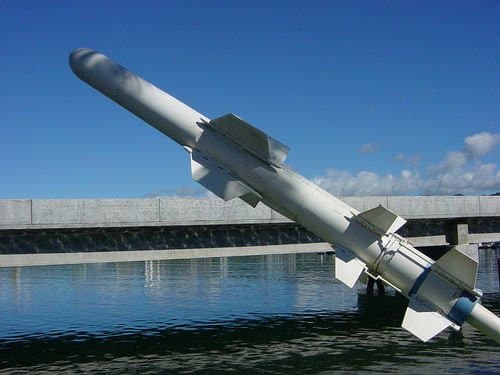
Harpoon (missile)larger figure on 0 of 2
Counts only measures both sources give with the same scope. A larger figure is not a better system.
Measured figures
Length
Single source6.2 m (20 ft)[source]
air-launched
Single sourceConfiguration
| Specification | Babur (cruise missile) | Harpoon (missile) |
|---|---|---|
| Type | GLCM / SLCM / AshM[source] | Anti-ship missile[source] |
| In service | 2010 –Present[source] | 1977–present[source] |
| Used by | Pakistan Army ( Army Strategic Forces ) Pakistan Navy ( Navy Strategic Forces )[source] | See operators[source] |
| Designer | National Defence Complex[source] |
surface- and submarine-launched
Single source12.6 ft (3.8 m), air-launched; 15 ft (4.6 m), surface- and submarine-launched[source]
Maximum; 0.7 Mach. (subsonic)
Single source0.7 Mach. (subsonic) 990 km/h (620 mph)[source]
Maximum; Mach 0.71), ship-launched Harpoon Block I & air-launched Harpoon Block IC; Greater than
Single sourceMaximum; Mach 0.71), ship-launched Harpoon Block IC & Block II
Single sourceMaximum; Maximum speed · source measurement 1
Single sourceMaximum; Maximum speed · source measurement 2
Single sourceMaximum; Maximum speed · source measurement 4
Single sourceMaximum; Maximum speed · source measurement 5
Single source537 mph (864 km/h ; 240 m/s ; Mach 0.71), ship-launched Harpoon Block I & air-launched Harpoon Block IC; Greater than 537 mph (864 km/h ; 240 m/s ; Mach 0.71), ship-launched Harpoon Block IC & Block II[source]
Maximum; Maximum firing range
Single sourceOperational; Babur-I
Single sourceOperational; Babur-IA
Single sourceOperational; Babur-IB
Single sourceOperational; Babur-II
Single sourceOperational; Babur-III
Single sourceOperational; Harbah
Single sourceOperational; Harbah export variant
Single source900 km (560 mi)[source]
Babur-I: 700 km (430 mi) Babur-IA: 450 km Babur-II: 750 km (470 mi) Babur-III: 450 km (280 mi; 240 nmi) Harbah: 700 km (430 mi; 380 nmi) Babur-IB: 900 km (560 mi) Harbah export variant: 290 km (180 mi; 160 nmi)[source]
Operational; air-launched Block IC
Single sourceOperational; Greater than ship-launched Harpoon Block I & Block IC; Greater than
Single sourceWarhead weight
Single source450 kg (990 lb) – 500 kg (1,100 lb)[source]
Bars compare reported quantities only. A larger figure does not make a system better; configurations and test conditions differ.
| — |
| Designed | 1998–2008 (GLCM) 2001–2018 (SLCM)[source] | — |
|---|
| Manufacturer | National Defence Complex[source] | McDonnell Douglas Boeing Defense, Space & Security[source] |
|---|
| Developed from | BGM-109 Tomahawk[source] | — |
|---|
| Variants | See variants[source] | — |
|---|
| Warhead | HE / NE[source] | 488 pounds (221 kg)[source] |
|---|
| Blast yield | 5 kilotons of TNT (21 TJ) – 12 kilotons of TNT (50 TJ)[source] | — |
|---|
| Engine | Turbojet[source] | Teledyne CAE J402 turbojet/solid propellant booster for surface and submarine launch; greater than 600 lb f (2,700 N) of thrust[source] |
|---|
| Transmission | Automatic[source] | — |
|---|
| Suspension | WS2500 10WD[source] | — |
|---|
| Propellant | Liquid-propellant (jet engine) Solid-propellant (booster)[source] | — |
|---|
| Flight altitude | Terrain-following[source] | Sea-skimming[source] |
|---|
| Guidance system | INS , TERCOM / DSMAC , GPS , GLONASS , Terminal ,[source] | Sea-skimming cruise monitored by radar altimeter , active radar terminal homing[source] |
|---|
| Accuracy | 20 m (66 ft) CEP[source] | — |
|---|
| Launch platform | Transporter erector launcher Cruise-missile submarine[source] | RGM-84A surface ship/TEL-launched AGM-84A air-launched UGM-84A submarine-launched[source] |
|---|
| Transport | TEL , Horizontal launch tube (HLT)[source] | — |
|---|
| Country of origin | Pakistan[source] | — |
|---|
| Place of origin | — | United States[source] |
|---|
| Wars | — | Iran–Iraq War Russo-Ukrainian War[source] |
|---|
| Unit cost | — | US$ 1,406,812 for Harpoon Block II (2020)[source] |
|---|
| No. built | — | 7,500[source] |
|---|
| Detonation mechanism | — | Impact fuze[source] |
|---|
| Role | — | all-weather, over-the-horizon , anti-ship missile[source] |
|---|
| Source measurement | — | In 1965, the United States Navy began studies for a missile in the 24-nautical-mile (45 km) range class for use against surfaced submarines . The name Harpoon was assigned to the project. The sinking of the Israeli destroyer Eilat in 1967 by a Soviet-built Styx anti-ship missile shocked senior United States Navy officers, who until then had not appreciated the threat posed by anti-ship missiles. In 1970 Chief of Naval Operations Admiral Elmo Zumwalt accelerated the development of Harpoon as part of his "Project Sixty" initiative, hoping to add much-needed striking power to U.S. surface warships such as the Ticonderoga -class cruiser .[source]Harpoon (missile) · Development; only the objects and conditions stated in this passage The Harpoon has also been adapted for carriage on several aircraft, including the P-3 Orion , the P-8 Poseidon , the AV-8B Harrier II , the F/A-18 Hornet and the U.S. Air Force B-52H bombers . The Harpoon was purchased by many nations, including India, Japan, Singapore , South Korea, Taiwan , the United Arab Emirates and most NATO countries.[source]Harpoon (missile) · Development; only the objects and conditions stated in this passage The Block 1 missiles were designated A/R/UGM-84A in US service and UGM-84B in the UK. Block 1B standard missiles were designated A/R/UGM-84C, Block 1C missiles were designated A/R/UGM-84D. Block 1 used a terminal attack mode that included a pop-up to approximately 5,900 feet (1,800 m) before diving on the target; Block 1B omitted the terminal pop-up; and Block 1C provided a selectable terminal attack mode.[source]Harpoon (missile) · Development; only the objects and conditions stated in this passage This version featured a larger fuel tank and re-attack capability, allowing it to search for a target again if the initial radar acquisition failed by searching in a clover-leaf pattern, but was not produced in large numbers because its intended mission (warfare with the Warsaw Pact countries of Eastern Europe) was considered to be unlikely following the Dissolution of the Soviet Union . The range is 150 miles (240 km). Block 1D missiles were designated A/RGM-84F.[source]Harpoon (missile) · Development / Harpoon Block 1D; only the objects and conditions stated in this passage This version entered service in 1999, gives the SLAM a re-attack capability, as well as an image comparison capability similar to the Tomahawk cruise missile ; that is, the weapon can compare the target scene in front of it with an image stored in its onboard computer during terminal phase target acquisition and lock on (this is known as DSMAC ). Block 1G missiles A/R/UGM-84G; the original SLAM-ER missiles were designated AGM-84H (2000-2002) and later ones the AGM-84K (2002 onwards).[source]Harpoon (missile) · Development / SLAM-ER (Block 1H); only the objects and conditions stated in this passage It increases the ship-launched Harpoon missile's range from the Block II's 70 nmi (81 mi; 130 km) to 167.5 nmi (192.8 mi; 310.2 km), along with a new lighter 300 lb (140 kg) warhead and a more fuel-efficient engine with electronic fuel controls.[source]Harpoon (missile) · Development / Harpoon Block II+ ER; only the objects and conditions stated in this passage In December 1988, a Harpoon launched by an F/A-18 Hornet fighter from the aircraft carrier USS Constellation killed one sailor when it struck the merchant ship Jagvivek , a 250 ft (76 m) long Indian-owned ship, during an exercise at the Pacific Missile Range near Kauai , Hawaii . A Notice to Mariners had been issued warning of the danger, but Jagvivek left port before receiving the communication and subsequently strayed into the test range area, and the Harpoon missile, loaded just with an inert dummy warhead, locked onto it instead of its intended target.[source]Harpoon (missile) · Operational history; only the objects and conditions stated in this passage |
|---|
| Reported operators | — |
|
|---|
Operational; ship-launched Harpoon Block II
Single sourceGreater than 77 nmi (143 km), ship-launched Harpoon Block I & Block IC; Greater than 67 nmi (124 km), ship-launched Harpoon Block II; 120 nmi (220 km), air-launched Block IC[source]