



Preparing your view.
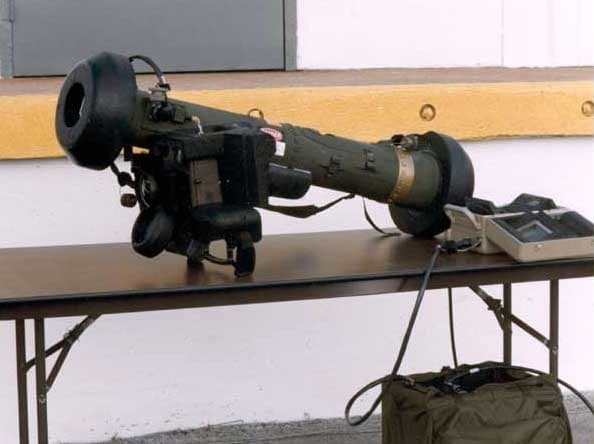
At a glance
Measured figures
Length
Single source102 cm (40 in)[source]
missile
Single sourceConfiguration
| Specification | AT4 | FGM-148 Javelin |
|---|---|---|
| Crew | — | 1 or 2[source] |
| Type | Disposable anti-tank launcher[source] | Anti-tank missile Surface-to-surface missile Surface-to-air missile[source] |
| Place of origin | Sweden United States[source] | United States[source] |
| In service | 1987–present[source] | 1996–present[source] |
| Used by |
1.1 m (43 in) (missile)[source]
detachable CLU
Single sourceJavelin · missile and command launch unit together · Mass
Single sourceCS
Single sourceMuzzle velocity
Single source290 m/s (950 ft/s; 1,000 km/h), 220 m/s (720 ft/s; 790 km/h) (CS)[source]
Barrel length
Single source1.2 m (47 in)[source]
Bars compare reported quantities only. A larger figure does not make a system better; configurations and test conditions differ.
See Operators[source]
See Operators[source] |
| Wars | See Wars[source] | War in Afghanistan Iraq War Syrian Civil War Second Libyan Civil War Russo-Ukrainian War[source] |
|---|
| Designer | Förenade Fabriksverken[source] | Texas Instruments & Martin Marietta , now Raytheon Technologies & Lockheed Martin[source] |
|---|
| Manufacturer | Saab Bofors Dynamics (Swedish version) Alliant Techsystems (U.S. version)[source] | Raytheon & Lockheed Martin[source] |
|---|
| Unit cost | US$1,480 (In 1999) US$2,857 (2025)[source] | US$216,717 (G-model missile only, FY2021) US$240,000 (missile only, export cost, FY2019) US$249,700 (Lightweight CLU only, FY2021)[source] |
|---|
| No. built | 600,000+[source] | 50,000 missiles (12,000 CLUs)[source] |
|---|
| Variants | See Variants[source] | See: § Variants[source] |
|---|
| Sights | Iron sights , optional AN/PVS-4 night vision unit[source] | Optical sight & thermal imaging[source] |
|---|
| Filling | Octol[source] | — |
|---|
| Operating temperature | −40–60 °C (−40–140 °F)[source] | — |
|---|
| Role | Swedish 84 mm (3.31 in) unguided, man-portable, disposable, shoulder-fired recoilless anti-tank weapon[source] | — |
|---|
| Source measurement | The AT4 is a Swedish 84 mm (3.31 in) unguided, man-portable, disposable, shoulder-fired recoilless anti-tank weapon manufactured by Saab Bofors Dynamics . The AT4 is not a rocket launcher strictly speaking, because the explosive warhead is not propelled by a rocket motor . Rather, it is a smooth-bore recoilless gun (as opposed to a recoilless rifle , which has a rifled barrel). Saab has had considerable sales success with the AT4, making it one of the most common light anti-tank weapons in the world. The M136 AT4 and M136A1 AT4CS-RS are the variants used by the United States Army .[source]AT4 · Lead; only the objects and conditions stated in this passage The name AT4 is a double entendre on the 84 mm caliber of the weapon, (84) 'eighty four' being a homophone of 'A-T-4'. The name also doubles as an alpha-phonetic word play on the weapon's role, due to "AT" being a common military abbreviation for "anti-tank". The name was created for export purposes as the nickname "eighty-four" was already a common English nickname for the Carl Gustaf 8.4 cm recoilless rifle after its caliber.[source]AT4 · Etymology; only the objects and conditions stated in this passage The AT4 is a development of the 74-mm Pansarskott m/68 (Miniman) adopted by the Swedish Army in the late 1960s.[source]AT4 · Development; only the objects and conditions stated in this passage FFV began research on a replacement for the m/68 in 1976, deliberately designing an individual anti-armour weapon that would not be able to defeat the heavy armour protection of MBTs (main battle tanks) in frontal engagements, believing that to be counterproductive.[source]AT4 · Development; only the objects and conditions stated in this passage The AT4 may be considered a disposable, lower-cost alternative to a Carl Gustaf 8.4 cm recoilless rifle .[source]AT4 · Operation; only the objects and conditions stated in this passage The disadvantage of the recoilless design is that it creates a large back blast area behind the weapon, which can cause severe burns and overpressure injuries to friendly personnel in the vicinity of the user and sometimes even to the users themselves, especially in confined spaces. The back blast may also reveal the user's position to the enemy. The problem of back blast was solved with the AT4-CS (Confined Space) version, specially designed for urban warfare . This version uses a saltwater countermass in the rear of the launcher to absorb the back blast; the resulting spray captures and dramatically slows down the pressure wave, allowing troops to fire from enclosed areas. The AT4-CS version also reduced its muzzle velocity from the original 290 m/s to 220 m/s as part of its effort to be user-safe in a confined space, making the AT4-CS version more difficult to use as the drop is more pronounced. The effectiveness of the HEAT warhead is not dependent on speed.[source]AT4 · Operation; only the objects and conditions stated in this passage The AT4 requires little training and is quite simple to use, making it suitable for general issue. However, as the cost of each launcher makes regular live-fire training very expensive, practice versions exist that are identical in operation but fire reloadable 9×19mm or 20mm tracer ammunition . Both practice cartridges are unique to their respective weapons, with their trajectory matched to that of the live round. The 20mm version also has a recoilless weapon effect with the same high noise and back blast as the AT4 firing and is favoured by the Swedish army because of the added realism of the back blast as compared to the "plonk" sound of the 9mm round (similar to the sound of a finger tapping on an empty can).[source]AT4 · Operation; only the objects and conditions stated in this passage Time of flight (to 250 metres (820 ft)): less than 1 second[source]AT4 · Specifications; only the objects and conditions stated in this passage High-explosive anti-tank (HEAT) – Can penetrate up to 45 centimetres (18 in) of rolled homogeneous armour (RHA) with beyond-armour effect .[source]AT4 · Projectiles; only the objects and conditions stated in this passage High-explosive dual purpose (HEDP) 502 – For use against bunkers , buildings, enemy personnel in the open, and light armour. It can be set to detonate on impact or with a brief detonation delay. The heavier nose cap allows either to penetrate light walls or windows before exploding, or to be "skipped" off the ground for an air burst. For use against light armour, there is a smaller-cone HEAT warhead with 15 centimetres (5.9 in) penetration of RHA.[source]AT4 · Projectiles; only the objects and conditions stated in this passage High penetration (HP) – Extra high penetration ability, up to 42–60 centimetres (17–24 in) of RHA.[source]AT4 · Projectiles; only the objects and conditions stated in this passage Extended range (ER) – Anti-armor version with HEAT warhead. Range is extended from 300 to 600 metres (980 to 1,970 ft), with increased penetration up to 46 centimetres (18 in) of RHA. These major improvements add only about 2 kilograms of mass, despite being CS models.[source]AT4 · Projectiles; only the objects and conditions stated in this passage High explosive (HE) – High explosive anti-personnel weapon that can be set for impact or air-burst detonation, with an effective range up to 1,000 metres (3,300 ft).[source]AT4 · Projectiles; only the objects and conditions stated in this passage American variant with a unique bi-metal warhead design, specially developed to maximize behind-armor effects for higher kill probability. The weapon is capable of firing from confined spaces (CS) and features a reduced sensitivity (RS) explosive, with penetration capabilities of up to 500mm of armor. Its effective range is 20–300 m.[source]AT4 · Variants / M136A1 AT4CS-RS; only the objects and conditions stated in this passage In the early 1990s, there were tests of a tandem charge 120mm version (Bofors AT 12-T). The 14kg weapon had a claimed penetration of 90 centimetres (35 in) RHA, and in 1994 was demonstrated to defeat two NATO Single Heavy targets inclined at 68 degrees from vertical with ERA, for a line-of-sight penetration of 600mm. However, the project was cancelled due to the dissolution of the Soviet Union and the subsequent cuts in Western defence budgets.[source]AT4 · Variants / AT12-T; only the objects and conditions stated in this passage | — |
|---|
| Designed | — | June 1989[source] |
|---|
| Produced | — | 1996–present[source] |
|---|
| Warhead | — | Tandem-charge HEAT[source] |
|---|
| Detonation mechanism | — | Contact fuze[source] |
|---|
| Blast yield | — | Penetration: Stated as being in excess of 30 in (760 mm) RHA[source] |
|---|
| Propellant | — | Solid-fuel[source] |
|---|
| Flight ceiling | — | 150 m (490 ft) (top attack mode) 60 m (200 ft) (direct attack mode)[source] |
|---|
| Guidance system | — | Infrared homing[source] |
|---|
| Launch platform | — | Man-portable launcher[source] |
|---|
| Launch platforms | — | shoulder-fired[source]Javelin |
|---|
| Reported operators |
|
|
|---|
missile in launch tube
Single sourceready to fire
Single source22.3 kg (49 lb), ready to fire 6.4 kg (14 lb), detachable CLU 15.9 kg (35 lb), missile in launch tube[source]
49.5 pounds[source]Javelin · missile and command launch unit together
Effective; Original CLU
Single sourceOriginal CLU: 2,500 m (1.6 mi) Lightweight CLU: 4,000 m (2.5 mi) From vehicle: 4,750 m (2.95 mi)[source]