

Credit
Dmitry A. Mottl · Public domain · Resized · Public domain · Source ↗ · Modified


Preparing your view.

At a glance
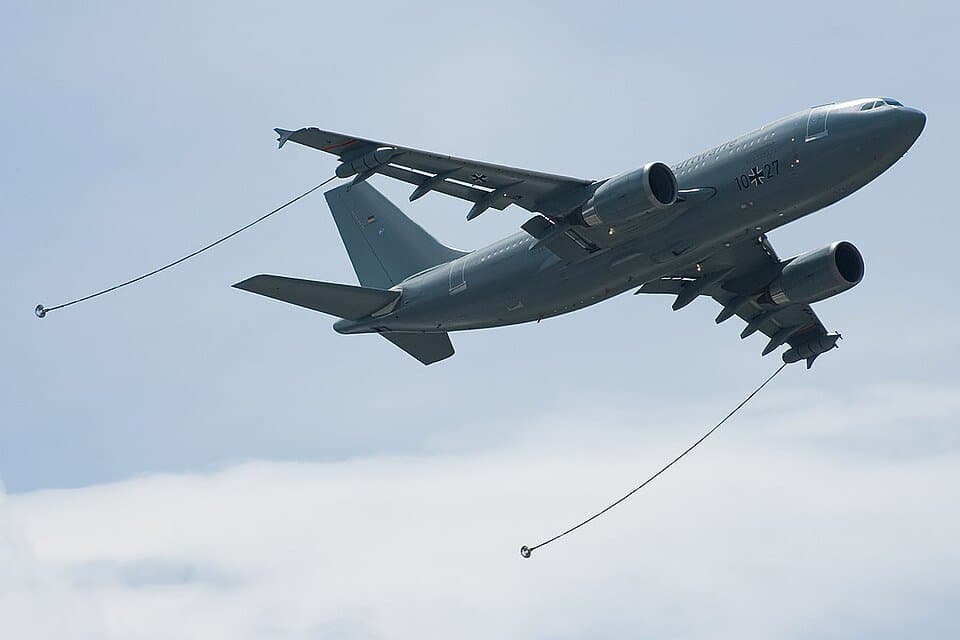
Airbus A310 MRTTlarger figure on 1 of 6
Measured figures
Length
Single sourceA310 MRTT · Length
Single sourceConfiguration
| Specification | Airbus A310 MRTT | Boeing KC-46 Pegasus |
|---|---|---|
| Type | Multi-role tanker / transport[source] | Tanker / transport[source] |
| Manufacturer | Airbus Military SAS , Airbus Deutschland, Lufthansa Technik[source] Airbus Industrie (Airframe)/ Daimler-Chrysler Aerospace GmbH and Lufthansa Technik (MRT/MRTT conversion)[source]Airbus A310 Multi Role Transport (MRT) Airbus A310 Multi Role Tanker Transport (MRTT) | Boeing Defense, Space & Security[source] |
| Designer | Airbus Military SAS[source] | — |
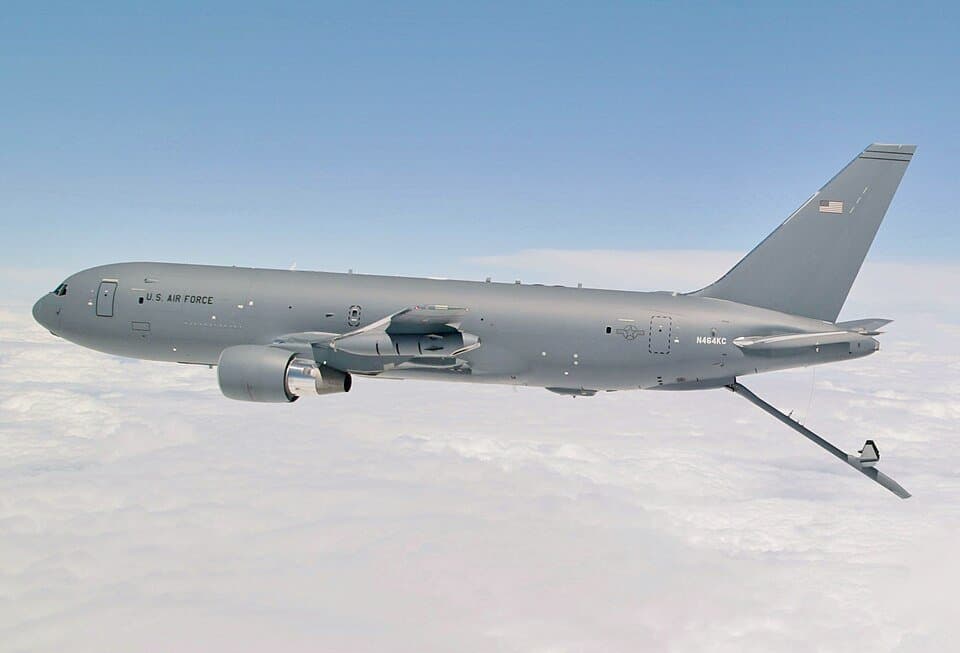
Boeing KC-46 Pegasuslarger figure on 5 of 6
Counts only measures both sources give with the same scope. A larger figure is not a better system.
Airbus A310 · Length
Single sourceAirbus A310 Multi Role Transport (MRT) Airbus A310 Multi Role Tanker Transport (MRTT) · Length
Single source47.4 m (155 ft 6 in)[source]
46,7 m[source]Airbus A310
46,7 m[source]
153 feet (46.66 meters)[source]Airbus A310 Multi Role Transport (MRT) Airbus A310 Multi Role Tanker Transport (MRTT)
46,7 m[source]
47,4 м ()[source]
46,66 m[source]
47.4m[source]
47,4 м ()[source]
46,66 m[source]
46.88 m[source]
46,66 m[source]
46,66 m[source]
Wingspan
Single sourceA310 MRTT · Wingspan
Single sourceAirbus A310 Multi Role Transport (MRT) Airbus A310 Multi Role Tanker Transport (MRTT) · Wingspan
Single sourceAirbus A310 · Wingspan
Single source43.9 m (144 ft 0 in)[source]
43,9 m[source]Airbus A310
43,9 m[source]
144 feet (43.90 meters)[source]Airbus A310 Multi Role Transport (MRT) Airbus A310 Multi Role Tanker Transport (MRTT)
43,9 m[source]
43,9 м ()[source]
43,9 m[source]
43.9m[source]
43,9 м ()[source]
43,9 m
Height
Single sourceA310 MRTT · Height
Single sourceAirbus A310 · Height
Single sourceAirbus A310 Multi Role Transport (MRT) Airbus A310 Multi Role Tanker Transport (MRTT) · Height
Single source15.81 m (51 ft 10 in)[source]
15,8 m[source]Airbus A310
15,8 m[source]
51 feet (15.80 meters)[source]Airbus A310 Multi Role Transport (MRT) Airbus A310 Multi Role Tanker Transport (MRTT)
15,8 m[source]
15,8 м ()[source]
15,8 m[source]
15,8 м ()[source]
15,8 m[source]
15.88 m[source]
Empty; Empty weight
DisputedMaximum take-off; Max takeoff weight
Single sourceEmpty; A310 MRTT · Empty weight
Single sourceEmpty; Airbus A310 · Empty weight
Single source113,999 kg (251,325 lb)[source]
164,000 kg (361,558 lb)[source]
79 t[source]Airbus A310
79 t[source]
79 t[source]
114 тонн ()[source]
164 тонны ()[source]
114 тонн ()[source]
164 тонны ()[source]
80,000 kg[source]
Empty; Empty weight
Single sourceMaximum take-off; Max takeoff weight
Single sourceAirbus A310 / Daten des Airbus A310 MRTT – Version Tanker · Luftbetankungsoffizierin/-offizier ( ARO )
Single sourceAirbus A310 / Daten des Airbus A310 MRTT – Version Tanker · Pilotinnen/Piloten Cockpit
Single sourceDaten des Airbus A310 MRTT – Version Tanker · Luftbetankungsoffizierin/-offizier ( ARO )
Single sourceDaten des Airbus A310 MRTT – Version Tanker · Pilotinnen/Piloten Cockpit
Single sourceThree (hose and drogue) or four (flying boom) flight crew (two pilots and other flight crew)[source]
2 Pilotinnen/Piloten Cockpit, 1 Luftbetankungsoffizierin/-offizier ( ARO )[source]Airbus A310 / Daten des Airbus A310 MRTT – Version Tanker
2 Pilotinnen/Piloten Cockpit, 1 Luftbetankungsoffizierin/-offizier ( ARO )[source]Daten des Airbus A310 MRTT – Version Tanker
2 Pilotinnen/Piloten Cockpit, 1 Luftbetankungsoffizierin/-offizier ( ARO )[source]Daten des Airbus A310 MRTT – Version Tanker
3 или 4 (2 пилота, бортинженер, оператор дозаправки)[source]
3~4명[source]
3 или 4 (2 пилота, бортинженер, оператор дозаправки)[source]
3名( パイロット 2名、給油担当1名)[source]
(2 pilots, 1 boom operator ) basic crew; 15 permanent seats for additional crew members, including aeromedical evacuation crew members
Single source3 (2 pilots, 1 boom operator ) basic crew; 15 permanent seats for additional crew members, including aeromedical evacuation crew members[source]
Maximum; Maximum speed
Single sourceMaximum; A310 MRTT · Maximum speed
Single sourceMaximum; Airbus A310 · Maximum speed
Single sourceMaximum; Mach 0,86
Single source978 km/h (608 mph, 528 kn)[source]
900 km/h[source]Airbus A310
900 km/h[source]
900 km/h[source]
978 км/ч[source]
915 km/h ( Mach 0,86 )[source]Mach 0,86
978 км/ч[source]
915 km/h ( Mach 0,86 )[source]Mach 0,86
885 km/h[source]
0.79-0.84馬赫[source]
Maximum; Maximum speed
Single sourceCruise; Cruise speed
Single sourceA310 MRTT · Range
Single sourceAirbus A310 · mit 16 t Nutzlast
Single sourceFerry; A310 MRTT · Ferry range
Single sourcemit 16 t Nutzlast
Single sourceRange
Disputed8,889 km (5,523 mi, 4,800 nmi)[source]
13,000 km (8,100 mi, 7,000 nmi)[source]
10.560 km mit 16 t Nutzlast[source]Airbus A310
10.560 km mit 16 t Nutzlast[source]
10.560 km mit 16 t Nutzlast[source]
8,889km[source]
9,600 km[source]
4 000 nm[source]
global with in flight refueling
Single source7,350 mi (11,830 km, 6,385 nmi) – global with in flight refueling[source]
A310 MRTT · 2 × General Electric CF6-80C2 or Pratt & Whitney PW4152 turbofan jet engines thrust each
Single source2 × General Electric CF6-80C2 or Pratt & Whitney PW4152 turbofan jet engines , 262 kN (59,000 lbf) thrust each[source]
2 × Pratt & Whitney PW4062 turbofan thrust each
Single source2 × Pratt & Whitney PW4062 turbofan , 62,000 lbf (280 kN) thrust each[source]
Bars compare reported quantities only. A larger figure does not make a system better; configurations and test conditions differ.
| Status |
|---|
Active service[source] |
In service[source] |
| Primary users | German Air Force Royal Canadian Air Force[source] | U.S. Air Force (USAF) Japan Air Self-Defense Force Israeli Air Force[source] |
|---|
| Number built | 6, (from existing A310-300C airframes)[source] | 113 as of Aug 2026[source] |
|---|
| Introduction date | October 2004[source] | 2019[source] |
|---|
| First flight | December 2003[source] | 25 September 2015[source] |
|---|
| Developed from | Airbus A310-300C[source] | Boeing KC-767[source] |
|---|
| Variant | Airbus CC-150 Polaris[source] | — |
|---|
| Successors | Airbus A330 MRTT[source] | — |
|---|
| Capacity | 214 passengers / 40,000 kg (88,000 lb) deliverable fuel / 36,000 kg (79,000 lb) cargo[source] 36 000 kg o 214 passeggeri[source] | 65,000 lb (29,500 kg) payload, configurable as: seating for up to 54 passengers (up to 114 in contingencies), up to 18 463L pallets , or up to 58 patients (24 litters, 34 ambulatory)[source] |
|---|
| Role | military air-to-air refuelling , or in-flight refuelling tanker transport aircraft, capable of operating multi-role missions[source] | American military aerial refueling and strategic military transport aircraft[source] |
|---|
| Source measurement | Five additional centre fuel tanks or Additional Centre Tanks (ACT), providing an extra 28,000 kilograms (62,000 pounds ); giving a total capacity of 77,500 kilograms (170,900 pounds), or 96,920 litres (21,320 imperial gallons ; 25,600 US gallons );[source]Airbus A310 MRTT · Airbus A310 MRTT / Design and development; only the objects and conditions stated in this passage When not used as an in-flight refueller, i.e., in an air cargo role, the A310 MRTT is capable of carrying a non-fuel payload of up to 37 tonnes (36 long tons ; 41 short tons ), or 81,600 lb. When used in a troop transport role, the A310 MRTT can accommodate up to 214 seats . And for a mixed-use combined troop transport and cargo, it can carry 54 troops and 12 pallets. The A310 MRTT contains four separate cargo systems within the fuselage , including the main deck cargo compartment, which is loaded and unloaded via the vertically opening main deck cargo door, located on the front left ( port ) side. This means that main deck cargo can be loaded by overhead crane, in addition to conventional cargo loading platforms. Below deck are three more cargo compartments, and can accommodate container and palletised loads up to 96 inches (2,400 millimetres) in height.[source]Airbus A310 MRTT · Airbus A310 MRTT / Design and development; only the objects and conditions stated in this passage Operated by a crew of three: two pilots and the air-to-air refuelling (AAR) operator, the pilots are able to directly operate all functions of in-flight refuelling, even if the AAR post is deactivated. Depending on mission, the A310 MRTT can deliver up to 33 tonnes (32 long tons ; 36 short tons ) of fuel to receiver aircraft on an operation of 3,000 nautical miles (5,600 kilometres ; 3,500 miles ), or up to 40 tonnes (39 long tons; 44 short tons) of fuel during a 1,000 nautical miles (1,900 kilometres; 1,200 miles) mission. All fuel to receiver aircraft is supplied directly from the centre tank, if necessary, drawing fuel from conventional fuel tanks; this is controlled automatically by the fuel management system together with the centre of gravity computer, to ensure correct fuel feed to the engines , and maintaining the correct centre of gravity in flight.[source]Airbus A310 MRTT · Airbus A310 MRTT / Design and development; only the objects and conditions stated in this passage The dual hose and drogue system was supplied by Flight Refuelling Ltd (FRL) of England, and uses the Mk32B pods under each wing on pylons, close to the wingtips . Two receiver aircraft can be refuelled simultaneously, and is capable of delivering 15,000 litres (3,300 imperial gallons; 4,000 US gallons) per minute.[source]Airbus A310 MRTT · Airbus A310 MRTT / Design and development; only the objects and conditions stated in this passage While the original and current A310 MRTTs rely on probe and drogue for air-to-air refuelling, EADS has invested $ 90m in research and development of a flying boom refuelling system such as that used by the United States Air Force (USAF). They are now able to offer air tankers from the A310 with air-to-air refuelling pods to the larger A330 MRTT equipped with refuelling booms. When installed, the flying boom system can deliver fuel to receiver aircraft at a rate of 1,200 US gallons (4,500 litres ; 1,000 imperial gallons ) per minute, and is supplied by two hose drum units (HDU) centrally mounted side by side in the rear fuselage.[source]Airbus A310 MRTT · Airbus A310 MRTT / Design and development; only the objects and conditions stated in this passage Despite not yet receiving final approval of in-flight refuelling operations by the German authorities, this air-to-air refuelling mission was sanctioned as part of the A310 MRTTs 'operational testing phase' for in-flight refuelling, and consisted of a flight route of nearly 8,200 kilometres (4,400 nautical miles; 5,100 miles), including a stopover at the Al Dahfra airbase ( Arabic : قاعدة الظفرة الجوية ) in the United Arab Emirates .[source]Airbus A310 MRTT · Operators / Germany; only the objects and conditions stated in this passage Capacity: 214 passengers / 40,000 kg (88,000 lb) deliverable fuel / 36,000 kg (79,000 lb) cargo[source]Airbus A310 MRTT · Specifications (A310 MRTT); only the objects and conditions stated in this passage Length: 47.4 m (155 ft 6 in)[source]Airbus A310 MRTT · Specifications (A310 MRTT); only the objects and conditions stated in this passage Wingspan: 43.9 m (144 ft 0 in)[source]Airbus A310 MRTT · Specifications (A310 MRTT); only the objects and conditions stated in this passage Height: 15.81 m (51 ft 10 in)[source]Airbus A310 MRTT · Specifications (A310 MRTT); only the objects and conditions stated in this passage Empty weight: 113,999 kg (251,325 lb)[source]Airbus A310 MRTT · Specifications (A310 MRTT); only the objects and conditions stated in this passage Max takeoff weight: 164,000 kg (361,558 lb)[source]Airbus A310 MRTT · Specifications (A310 MRTT); only the objects and conditions stated in this passage Powerplant: 2 × General Electric CF6-80C2 or Pratt & Whitney PW4152 turbofan jet engines , 262 kN (59,000 lbf) thrust each[source]Airbus A310 MRTT · Specifications (A310 MRTT); only the objects and conditions stated in this passage Maximum speed: 978 km/h (608 mph, 528 kn)[source]Airbus A310 MRTT · Specifications (A310 MRTT); only the objects and conditions stated in this passage Range: 8,889 km (5,523 mi, 4,800 nmi)[source]Airbus A310 MRTT · Specifications (A310 MRTT); only the objects and conditions stated in this passage Ferry range: 13,000 km (8,100 mi, 7,000 nmi)[source]Airbus A310 MRTT · Specifications (A310 MRTT); only the objects and conditions stated in this passage | The United States Air Force has taken delivery of 105 KC-46A aircraft and intends to procure 263 in total, a number which has grown with the cancellation of the KC-Y program and may grow further if the Next Generation Air-refueling System (NGAS) program does not develop as planned. Other nations which operate or have purchased the KC-46A include Japan and Israel.[source]Boeing KC-46 Pegasus · Lead; only the objects and conditions stated in this passage In September 2009, the USAF began a new round of bids with clearer criteria, including reducing the number of requirements from 800 to 373 in an attempt to simplify the process and allow more objective decision making. In March 2010, Boeing announced it would bid the KC-767 for the new KC-X round. EADS stated in April 2010 it would submit a bid without Northrop Grumman as a U.S. partner. Boeing submitted its KC-767 "NewGen Tanker" bid, based on the 767-200 with an improved version of the KC-10 's refueling boom , and cockpit displays from the 787, in July 2010. Boeing submitted a revised bid in February 2011.[source]Boeing KC-46 Pegasus · Development / USAF KC-X program; only the objects and conditions stated in this passage In December 2013, Boeing joined the wings and fuselage for the first 767-2C to be adapted into a KC-46A. The first of four 767-2C provision freighters were to complete assembly by the end of January 2014. Once assembled, it would go through ground vibration and instrumentation testing and have body fuel tanks added. The first test flight would occur during summer 2014 and include measuring its rate of climb and descent. The Engineering Manufacturing and Design (EMD) model was to be integrated with the needed systems and technologies to become a military-standard KC-46A by January 2015. Seven low-rate production KC-46s were to be delivered in 2015, 12 in 2016, and 15 delivered annually from 2017 to 2027. The last of four test aircraft began assembly in January 2014.[source]Boeing KC-46 Pegasus · Development / Selection and early development; only the objects and conditions stated in this passage The 767-2C's first flight took place on 28 December 2014. It flew from Paine Field and landed at Boeing Field . In March 2015, a refueling test with a C-17 transport was stopped because of a higher-than-expected boom axial load while delivering fuel. The problem was caused by the turbulent "bow wave effect" generated by two large aircraft flying in line. In January 2016, the KC-46 successfully refueled an F-16 for the first time during a five hour 36 minute sortie. Test refueling of several other military aircraft followed, including a C-17, F/A-18 , A-10 , and AV-8B . In February 2016, a KC-46 refueled an F/A-18, using its probe-and-drogue system for the first time. |
|---|
| Country of origin | France/Germany[source]Airbus A310 Multi Role Transport (MRT) Airbus A310 Multi Role Tanker Transport (MRTT) | — |
|---|
| Powerplant | 2x GE-CF6-80C2A2[source]Airbus A310 Multi Role Transport (MRT) Airbus A310 Multi Role Tanker Transport (MRTT) | — |
|---|
| Engine | 2 General Electric CF6-80C2[source] 제네럴 일렉트릭 CF6-80C2(추력 59,000파운드) 2기[source] 2 General Electric CF6-80C2[source] 2 turbofan General Electric CF6-80C2 oppure 2 turbofan Pratt & Whitney PW4152/6[source] | — |
|---|
| National origin | — | United States[source] |
|---|
| Manufactured | — | 2013–present[source] |
|---|
| Fuel Capacity | — | 212,299 lb (96,297 kg) / 31,220 US gal (118,200 L; 26,000 imp gal)[source] |
|---|
| Maximum Fuel Available for Transfer | — | 207,672 lb (94,198 kg)[source] |
|---|
43.9 m[source]
43,9 m[source]
43,9 m[source]
15,81 m[source]
15,81 m[source]
Maximum take-off; A310 MRTT · Max takeoff weight
Single source157,000 kg[source]
114 000 kg[source]
2 Piloti 1 Addetto al rifornimento[source]
On 5 July 2016, USAF spokesman Daryl Mayer stated that, despite the testing delays, Milestone C approval was expected in the following month, and that Boeing would add a fifth EMD aircraft to accelerate testing. EMD-1 and EMD-3 primarily conducted flight tests towards FAA airworthiness certificates, while EMD-2 and EMD-4 focused on USAF aerial refueling and mission system testing. An F-16 was successfully refueled on 8 July, and a C-17 on 12 July 2016. Once the hardware fix was verified, a KC-46 with the updated boom underwent regression testing on the F-16, followed by refueling demonstrations with the C-17 and A-10 for the final test for Milestone C approval. On 15 July 2016, the KC-46 successfully refueled an A-10, offloading 1,500 pounds of fuel at 15,000 feet. At the time, more than 900 flight test hours have been completed by the five EMD aircraft. On 12 August 2016, the program received Milestone C approval, indicating production readiness. The issuing of contracts for two lots covering 19 aircraft was expected within 30 days.[source]Boeing KC-46 Pegasus · Development / Flight tests and delays; only the objects and conditions stated in this passage
Ongoing development efforts associated with the KC-46 aim to provide new capabilities and fix problems. In the FY27 budget request, the USAF proposed reallocating funds ($13M as requested) from the Next Generation air-refueling System (NGAS) to a new effort called the Advanced Tanker System (ATS). ATS will develop upgrades for connectivity, electronic warfare , and self-defense capabilities—many of the features associated with NGAS—for the existing tanker fleet. The USAF has clarified that they are not abandoning plans for the future NGAS.[source]Boeing KC-46 Pegasus · Development / Continuing development; only the objects and conditions stated in this passage
The aircraft is FAA-certified to transport up to 58 passengers in the rear fuselage using palletized seating similar to that of the C-17, along with a galley/lavatory pallet and passenger baggage loaded onto a cargo pallet.[source]Boeing KC-46 Pegasus · Design; only the objects and conditions stated in this passage
Boeing states that in contingency operations, the aircraft could accommodate up to 114 passengers.[source]Boeing KC-46 Pegasus · Design; only the objects and conditions stated in this passage
In an all-cargo configuration, the KC-46A can carry up to 65,000 pounds (29,000 kg) of cargo across 18 pallets.[source]Boeing KC-46 Pegasus · Design; only the objects and conditions stated in this passage
The KC-46A can carry 212,299 pounds (96,297 kg) of fuel, 10 percent more than the KC-135.[source]Boeing KC-46 Pegasus · Design; only the objects and conditions stated in this passage
In June 2024 the USAF completed a 45 hour non-stop flight around the globe as part of Project Magellan. The flight, which took off and landed at McConnell Air Force Base, was refueled several times while it refueled other operational aircraft at various places around the world.[source]Boeing KC-46 Pegasus · Operational history / United States; only the objects and conditions stated in this passage
The three tankers were to be fielded around 2020 at a cost of more than ¥20.8 billion, about US$173 million (~$206 million in 2024) per aircraft. An order for a third and fourth KC-46 was placed in October 2020. Japan ordered two additional KC-46s in December 2022, bringing Japan's order total to six. In February 2021, the JASDF conducted its first KC-46 flight. Training of Japanese KC-46 pilots began in June 2021 and Japan received its first KC-46 in November 2021.[source]Boeing KC-46 Pegasus · Operational history / Japan; only the objects and conditions stated in this passage
Capacity: 65,000 lb (29,500 kg) payload, configurable as: seating for up to 54 passengers (up to 114 in contingencies), up to 18 463L pallets , or up to 58 patients (24 litters, 34 ambulatory)[source]Boeing KC-46 Pegasus · Specifications; only the objects and conditions stated in this passage
Length: 165 ft 6 in (50.5 m)[source]Boeing KC-46 Pegasus · Specifications; only the objects and conditions stated in this passage
Wingspan: 157 ft 8 in (48.1 m)[source]Boeing KC-46 Pegasus · Specifications; only the objects and conditions stated in this passage
Height: 52 ft 1 in (15.9 m)[source]Boeing KC-46 Pegasus · Specifications; only the objects and conditions stated in this passage
Empty weight: 181,610 lb (82,377 kg)[source]Boeing KC-46 Pegasus · Specifications; only the objects and conditions stated in this passage
Max takeoff weight: 415,000 lb (188,240 kg)[source]Boeing KC-46 Pegasus · Specifications; only the objects and conditions stated in this passage
Fuel Capacity: 212,299 lb (96,297 kg) / 31,220 US gal (118,200 L; 26,000 imp gal)[source]Boeing KC-46 Pegasus · Specifications; only the objects and conditions stated in this passage
Maximum Fuel Available for Transfer: 207,672 lb (94,198 kg)[source]Boeing KC-46 Pegasus · Specifications; only the objects and conditions stated in this passage
Powerplant: 2 × Pratt & Whitney PW4062 turbofan , 62,000 lbf (280 kN) thrust each[source]Boeing KC-46 Pegasus · Specifications; only the objects and conditions stated in this passage
Maximum speed: 570 mph (914 km/h, 500 kn)[source]Boeing KC-46 Pegasus · Specifications; only the objects and conditions stated in this passage
Cruise speed: 530 mph (851 km/h, 460 kn)[source]Boeing KC-46 Pegasus · Specifications; only the objects and conditions stated in this passage
Range: 7,350 mi (11,830 km, 6,385 nmi) – global with in flight refueling[source]Boeing KC-46 Pegasus · Specifications; only the objects and conditions stated in this passage
Service ceiling: 40,100 ft (12,200 m)[source]Boeing KC-46 Pegasus · Specifications; only the objects and conditions stated in this passage