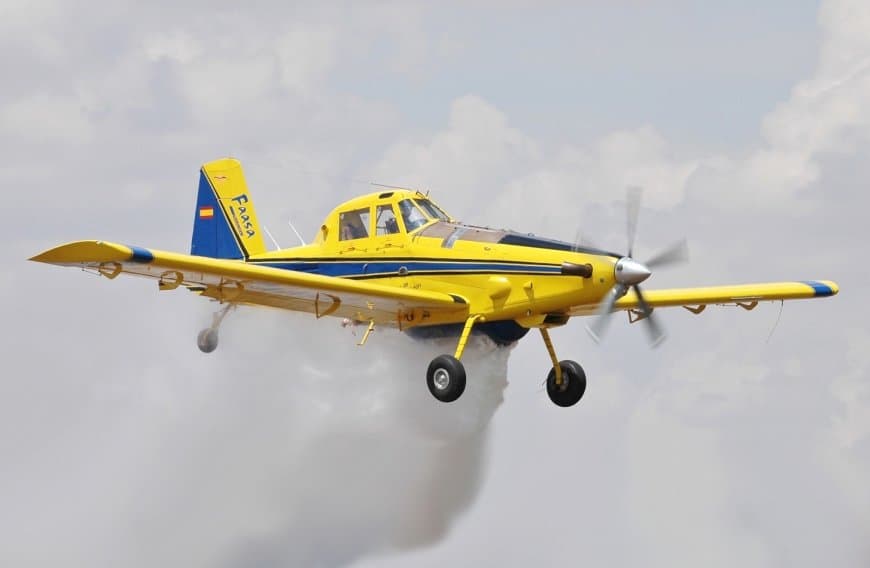

Credit
Daniel VA · CC BY-SA 4.0 · Resized · CC BY-SA 4.0 · Source ↗ · Modified


Preparing your view.
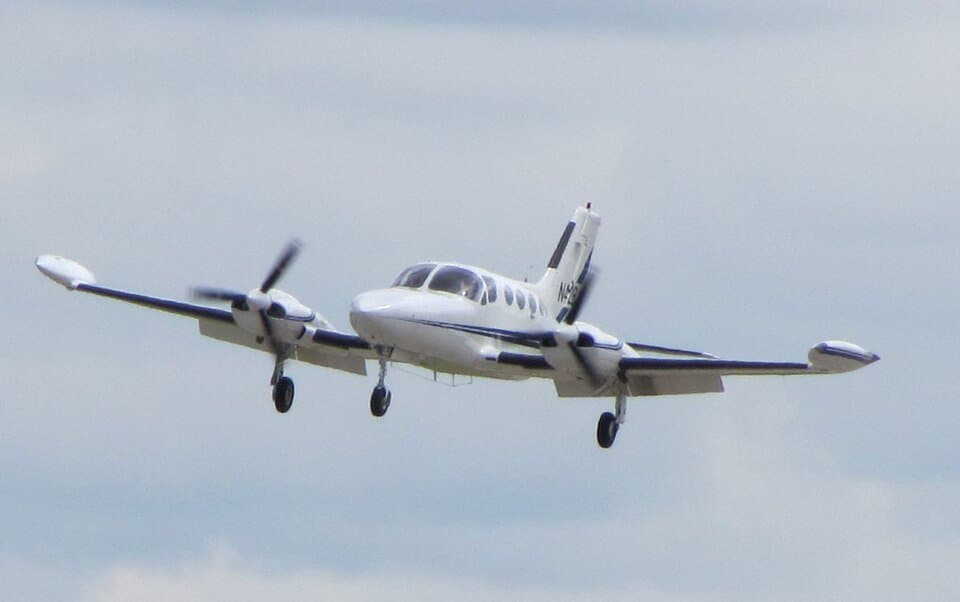
BSupport aircraft
American six or seven seat twin-engined light transport aircraft,
At a glance
Measured figures
AT-802 · Length
Single source35 ft 11 in (10.95 m)[source]
421C · Length
Single sourceConfiguration
| Specification | Air Tractor AT-802 | Cessna 421 Golden Eagle |
|---|---|---|
| Crew | One or Two (AT-802A – single-seat)[source] | One or two[source] |
| Type | Agricultural / Fire-fighting aircraft[source] | Light transport[source] |
| National origin | United States[source] | United States[source] |
| Manufacturer | Air Tractor[source] |
36 ft 4 + 5 ⁄ 8 in (11.09 m)[source]
Cruise; AT-802 · at 8,000 ft (2,440 m)
Single source221 mph (356 km/h, 192 kn) at 8,000 ft (2,440 m)[source]
AT-802 · 1 × Pratt & Whitney PT6A -67AG turboprop , 1,350 shp (
Single source1 × Pratt & Whitney PT6A -67AG turboprop , 1,350 shp (1,010 kW)[source]
421C · 2 × Continental GTSIO-520-L turbocharged, fuel injected and geared flat-six engines each
Single source2 × Continental GTSIO-520-L turbocharged, fuel injected and geared flat-six engines, 375 hp (280 kW) each[source]
Bars compare reported quantities only. A larger figure does not make a system better; configurations and test conditions differ.
Cessna[source]
| Status | Active[source] | — |
|---|
| Manufactured | 1990–present[source] | 1967–1985[source] |
|---|
| First flight | 1990[source] | October 14, 1965[source] |
|---|
| Variant | L3Harris OA-1K Skyraider II[source] | — |
|---|
| Capacity | 820 US gal (683 imp gal; 3,104 L)[source] | Six passengers[source] |
|---|
| Aspect ratio | 8.8:1[source] | — |
|---|
| Airfoil | NACA 4415[source] | — |
|---|
| Stall speed | 91 mph (146 km/h, 79 kn) (power off, flaps down)[source] | — |
|---|
| Number built | — | 1,916[source] |
|---|
| Introduction date | — | 1968[source] |
|---|
| Developed from | — | Cessna 411[source] |
|---|
| Developed into | — | Cessna 425[source] |
|---|
| Fuel capacity | — | 206 US gal (172 imp gal; 780 L) normal (usable capacity), 262 US gal (218 imp gal; 990 L) with optional wing tanks[source] |
|---|
| Propellers | — | 3-bladed McCauley constant-speed propellers[source] |
|---|
| Takeoff distance to 50 ft (15m) | — | 2,323 ft (708 m)[source] |
|---|
| Landing distance from 50 ft (15 m) | — | 2,293 ft (699 m)[source] |
|---|
| Role | — | American six or seven seat twin-engined light transport aircraft,[source] |
|---|
| Source measurement | — | The next year, 1969, the design was refined, with a three-inch stretch of the fuselage, five more gallons of fuel capacity, and a 40-pound increase in gross weight. The plane was redesignated the Cessna 421A.[source]Cessna 421 Golden Eagle · Development; only the objects and conditions stated in this passage In 1971, the design was again improved. Both empty and gross weight increased, the wingspan was increased by two feet, raising the service ceiling by 5,000 feet. The nose was stretched two feet to accommodate a larger nose baggage section. This new plane is designated the Cessna 421B.[source]Cessna 421 Golden Eagle · Development; only the objects and conditions stated in this passage Type approved 1 May 1967, powered by two Continental GTSIO-520-Ds of 375 hp (280 kW) each, maximum takeoff weight 6,800 lb (3,084 kg). 200 built.[source]Cessna 421 Golden Eagle · Variants; only the objects and conditions stated in this passage Type approved 19 November 1968, powered by two Continental GTSIO-520-Ds of 375 hp (280 kW) each, maximum takeoff weight 6,840 lb (3,103 kg). 158 built.[source]Cessna 421 Golden Eagle · Variants; only the objects and conditions stated in this passage Eight-seat light passenger transport aircraft. Type approved 28 April 1970, powered by two Continental GTSIO-520-Hs of 375 hp (280 kW) each, maximum takeoff weight 7,250 lb (3,289 kg), later models 7,450 lb (3,379 kg). 699 built.[source]Cessna 421 Golden Eagle · Variants; only the objects and conditions stated in this passage Model with new wing and landing gear. Type approved 28 October 1975, powered by two Continental GTSIO-520-Ls or Continental GTSIO-520-Ns of 375 hp (280 kW) each, maximum takeoff weight 7,450 lb (3,379 kg). 859 built.[source]Cessna 421 Golden Eagle · Variants; only the objects and conditions stated in this passage Conversion of Cessna 421C aircraft by fitting two 750hp Pratt & Whitney Canada PT6A -135 turboprop engines. Formal designation R421CP .[source]Cessna 421 Golden Eagle · Variants; only the objects and conditions stated in this passage Pakistan Army at least one 421 in use.[source]Cessna 421 Golden Eagle · Military operators; only the objects and conditions stated in this passage On December 16, 1972, a private Cessna 421 crashed into the homes at 116 and 121 Diane Drive in Cheektowaga near Buffalo Niagara International Airport . The crash killed three on board and three on the ground, and at least four people on the ground were injured.[source]Cessna 421 Golden Eagle · Accidents and incidents; only the objects and conditions stated in this passage On 4 December 1980, a Cessna 421 carrying Prime Minister of Portugal Francisco de Sá Carneiro and other government officials, crashed into buildings in Camarate seconds after takeoff, killing all 7 persons on board.[source]Cessna 421 Golden Eagle · Accidents and incidents; only the objects and conditions stated in this passage On 5 March 1984, the pilot and five passengers in a Cessna 421B, registration number N3291Q , were killed when the aircraft impacted trees 1 mile (1.6 km) northeast of Folsom Field, Alabama during an incorrectly executed nighttime instrument approach in IMC conditions. The NTSB attributed the accident to the pilot's failure to initiate a missed approach , his failure to maintain altitude, his lack of recent instrument flying experience, and his history of heart problems; contributing factors were poor visibility and adverse weather.[source]Cessna 421 Golden Eagle · Accidents and incidents; only the objects and conditions stated in this passage On June 24, 1992, a Cessna 421 VGAB (tail number N628RJ), the 40-year-old pilot and two passengers took off from Monterey. About three minutes after takeoff the Cessna collided with a hill about three miles east of the airport. The investigation revealed that ground fog and overconfidence in the pilot caused the accident. All three were killed. The pilot had about 75 hours of flight experience.[source]Cessna 421 Golden Eagle · Accidents and incidents; only the objects and conditions stated in this passage On January 30, 2006, an eight-seat twin engine Cessna 421B with four passengers crashed about 1 mile (1,600 m) south of the airport. The aircraft was heading from Kansas to Palwaukee. There were no survivors.[source]Cessna 421 Golden Eagle · Accidents and incidents; only the objects and conditions stated in this passage On April 17, 2009, a Cessna 421 crashed shortly after take-off from Fort Lauderdale Executive Airport around 11:20 a.m. Local authorities stated the aircraft crashed into a vacant home located about two miles (3.2 km) from the airport. The aircraft was en route to Fernandina Beach, Florida near Jacksonville and was due to arrive at 13:00. The Federal Aviation Administration indicated that one person was on board the aircraft, and was killed in the accident. Sebring Air Charter of Tamarac, Florida was listed on FAA records as the owner of the aircraft. The probable cause of the accident was determined to be pilot error, with an inflight fire of the right engine as a contributing factor.[source]Cessna 421 Golden Eagle · Accidents and incidents; only the objects and conditions stated in this passage On December 9, 2011, a Cessna 421C aircraft crashed shortly after takeoff less than a mile from the airport into an open field. All 4 passengers on board were killed when the aircraft burst into flames upon crashing.[source]Cessna 421 Golden Eagle · Accidents and incidents; only the objects and conditions stated in this passage On August 27, 2013, a Cessna 421C crashed just after takeoff. The aircraft had engine issues on takeoff and impacted a tree a mile after takeoff. Witnesses reported that the aircraft's takeoff run appeared slower than normal, and the aircraft was found to have used the entire runway and traveled through two different 300-foot fields.[source]Cessna 421 Golden Eagle · Accidents and incidents; only the objects and conditions stated in this passage On November 22, 2017, the left-hand engine of a Cessna 421, registration N421RX , caught fire soon after takeoff from Presque Isle; the pilot attempted to return to the airport but was unable to maintain altitude and performed a forced landing in an adjacent field. Two persons aboard the aircraft suffered minor injuries and two others were uninjured; the aircraft was badly damaged. The NTSB attributed the accident to a fuel leak onto the hot turbocharger .[source]Cessna 421 Golden Eagle · Accidents and incidents; only the objects and conditions stated in this passage On July 13, 2021, at around 10:42 am, a Cessna 421C (tail number N678SW), piloted by Mary Ellen Carlin crashed into a suburban residential area killing the pilot, passenger and a pet. Investigators found that the Cessna 421C diverged from its flight plan, resulting in a crash less than five minutes after departure.[source]Cessna 421 Golden Eagle · Accidents and incidents; only the objects and conditions stated in this passage On April 30, 2026, around 11:25pm in Wimberly Texas, a Cessna 421C crashed while carrying 5 passengers to a Pickleball tournament near Austin Texas. Officials claimed the plane went down near Round Rock Road in Hays County. The 5 passengers on board were Brooke Skypala, Glen Appling, Seren Wilson, Hayden Dillard, and Stacy Hedrick. Unfortunately, none survived and were announced deceased on arrival. The second aircraft that was coming with them made it safely to its destination.[source]Cessna 421 Golden Eagle · Accidents and incidents; only the objects and conditions stated in this passage Capacity: Six passengers[source]Cessna 421 Golden Eagle · Specifications (421C); only the objects and conditions stated in this passage Length: 36 ft 4 + 5 ⁄ 8 in (11.09 m)[source]Cessna 421 Golden Eagle · Specifications (421C); only the objects and conditions stated in this passage Wingspan: 41 ft 1 + 1 ⁄ 2 in (12.53 m)[source]Cessna 421 Golden Eagle · Specifications (421C); only the objects and conditions stated in this passage Height: 11 ft 5 + 3 ⁄ 8 in (3.49 m)[source]Cessna 421 Golden Eagle · Specifications (421C); only the objects and conditions stated in this passage Wing area: 215 sq ft (20.0 m 2 )[source]Cessna 421 Golden Eagle · Specifications (421C); only the objects and conditions stated in this passage Empty weight: 4,501 lb (2,042 kg)[source]Cessna 421 Golden Eagle · Specifications (421C); only the objects and conditions stated in this passage Max takeoff weight: 7,450 lb (3,379 kg)[source]Cessna 421 Golden Eagle · Specifications (421C); only the objects and conditions stated in this passage Powerplant: 2 × Continental GTSIO-520-L turbocharged, fuel injected and geared flat-six engines, 375 hp (280 kW) each[source]Cessna 421 Golden Eagle · Specifications (421C); only the objects and conditions stated in this passage Maximum speed: 256 kn (295 mph, 474 km/h) at 20,000 ft (6,100 m)[source]Cessna 421 Golden Eagle · Specifications (421C); only the objects and conditions stated in this passage Cruise speed: 240 kn (280 mph, 440 km/h) at 25,000 ft (7,600 m) (75% power)[source]Cessna 421 Golden Eagle · Specifications (421C); only the objects and conditions stated in this passage Range: 1,487 nmi (1,711 mi, 2,754 km) at 25,000 ft (7,600 m), econ cruise speed[source]Cessna 421 Golden Eagle · Specifications (421C); only the objects and conditions stated in this passage Service ceiling: 30,200 ft (9,200 m)[source]Cessna 421 Golden Eagle · Specifications (421C); only the objects and conditions stated in this passage Rate of climb: 1,940 ft/min (9.9 m/s)[source]Cessna 421 Golden Eagle · Specifications (421C); only the objects and conditions stated in this passage Takeoff distance to 50 ft (15m): 2,323 ft (708 m)[source]Cessna 421 Golden Eagle · Specifications (421C); only the objects and conditions stated in this passage Landing distance from 50 ft (15 m): 2,293 ft (699 m)[source]Cessna 421 Golden Eagle · Specifications (421C); only the objects and conditions stated in this passage |
|---|