
FORCETALLY
Loading the evidence…
Preparing your view.


Preparing your view.

At a glance
Measured figures
Length
Single source14.5 m (47.6 ft)[source]
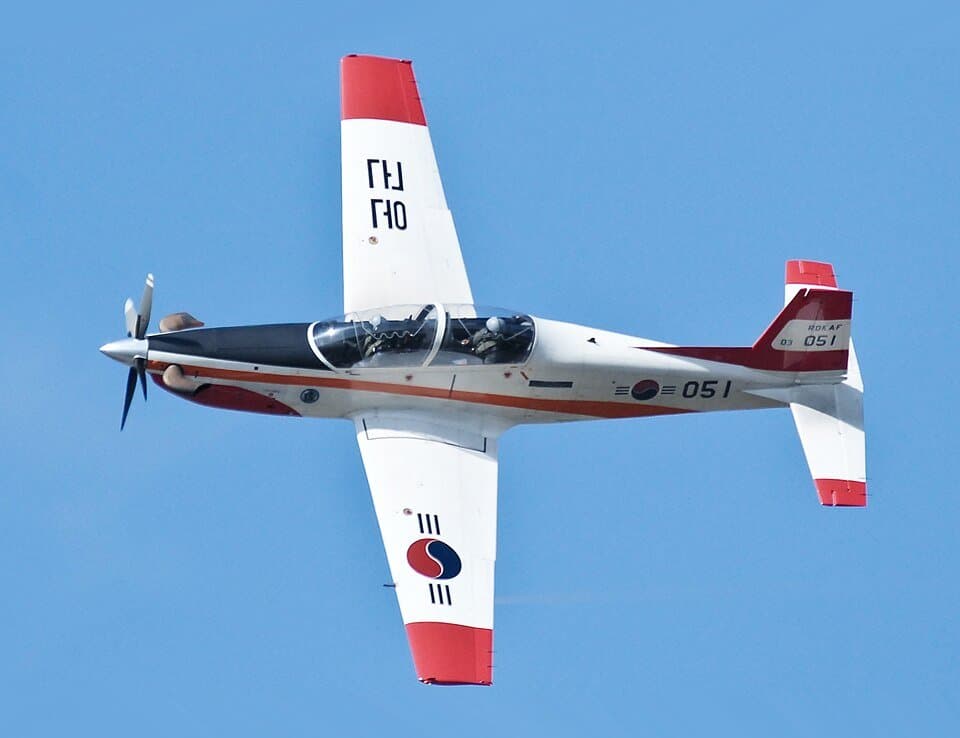
KT-1 · Length
Single sourceConfiguration
| Specification | AIDC T-5 Brave Eagle | KAI KT-1 Woongbi |
|---|---|---|
| Type | Advanced jet trainer[source] | Basic trainer and light attack aircraft[source] |
| National origin | Taiwan[source] | South Korea[source] |
| Manufacturer | Aerospace Industrial Development Corporation[source] | Korea Aerospace Industries[source] |
| Designer | Aerospace Industrial Development Corporation and National Chung-Shan Institute of Science and Technology[source] |
10.3 m (33 ft 10 in)[source]
Ferry; Ferry range
Single sourceRange
Single source1,350 km (839 mi, 729 nmi)[source]
1,350 km (839 mi, 729 nmi)[source]
Ferry; KT-1 · at 6,100 m (20,013 ft) with max internal and external fuel (30 minutes reserve)
Single sourceKT-1 · at 7,620 m (25,000 ft) with max internal fuel (30 minutes reserve)
Single sourceKT-1 · 1 × Pratt & Whitney Canada PT6A-62 turboprop engine
Single source1 × Pratt & Whitney Canada PT6A-62 turboprop engine, 708.4 kW (950.0 hp)[source]
2 × Honeywell/ITEC F124 -200TW turbofan thrust each
Single source2 × Honeywell/ITEC F124 -200TW turbofan , 27.8 kN (6,250 lbf) thrust each[source]
KT-1 · Wing area
Single source16.01 m 2 (172.3 sq ft)[source]
KT-1 · < at 6,100 m (20,013 ft) with max internal fuel (
Single sourceKT-1 · reserve
Single source<4 hours at 6,100 m (20,013 ft) with max internal fuel (30 minutes reserve)[source]
Bars compare reported quantities only. A larger figure does not make a system better; configurations and test conditions differ.
Agency for Defence Development Korea Aerospace Industries[source] |
| Status | In service[source] | In service[source] |
|---|
| Primary user | Republic of China Air Force[source] | — |
|---|
| Number built | 4 prototypes and 56 serials (May 2026)[source] | 186[source] |
|---|
| Manufactured | 2020–2026[source] | 1999–present[source] |
|---|
| Introduction date | 2021[source] | 2000[source] |
|---|
| First flight | June 10, 2020[source] | November 1991[source] |
|---|
| Developed from | AIDC F-CK-1 Ching-kuo[source] | — |
|---|
| Hardpoints | 2 (fitted for but not with ) , with provisions to carry combinations of:[source] | — |
|---|
| Missiles | Sky Sword I , AIM-9 and AGM-65 (fitted for but not with )[source] | — |
|---|
| Role | Taiwanese transonic advanced jet trainer aircraft[source] | — |
|---|
| Source measurement | The Advanced Jet Trainer Program (AJT) began in the early 2000s as the Republic of China Air Force sought a replacement for its fleet of AIDC AT-3 and Northrop F-5 advanced trainers with 66 newly built aircraft. Three designs were proposed, a modernized, upgraded version of AT-3 branded as the AT-3 MAX, an evolution of the AIDC F-CK-1 Ching-Kuo combat aircraft to be called the XAT-5, or the Italian Alenia Aermacchi M-346 Master . In 2014 AIDC signed a memorandum of understanding with Alenia Aermacchi to assemble the M-346 in Taiwan. The engines of all M-346 are assembled in Taiwan by International Turbine Engine Company (ITEC), a joint partnership of Honeywell and AIDC. The MOD also evaluated the South Korean KAI T-50 Golden Eagle aircraft.[source]AIDC T-5 Brave Eagle · Development / Advanced Jet Trainer Program; only the objects and conditions stated in this passage The design is based on the AIDC F-CK-1 Ching-kuo and shares the same engines, but has 80% new components including a composite body. Compared to the F-CK-1, it will have more advanced avionics, increased fuel capacity, and will be a little larger. The aerofoil is slightly revised, with the wings being thicker than on the F-CK-1 in order to increase stability at low speed and low altitude, as well as to provide increased fuel storage. The ram air scoop of the F-CK-1 has been redesigned in partnership with the Eaton Corporation with two aluminium laser powder bed fusion printed parts replacing 22 original parts. Meggitt will supply the main wheels, carbon brakes and brake control systems as they do on the AT-3 and F-CK-1. Martin-Baker will provide the ejection seat systems. More than 55% of its components are made in Taiwan. It has been reported that the aircraft was designed from the beginning to serve dual peacetime training and wartime combat roles.[source]AIDC T-5 Brave Eagle · Design; only the objects and conditions stated in this passage Length: 14.5 m (47.6 ft)[source]AIDC T-5 Brave Eagle · Specifications; only the objects and conditions stated in this passage Wingspan: 9.2 m (30.3 ft)[source]AIDC T-5 Brave Eagle · Specifications; only the objects and conditions stated in this passage Height: 4.39 m (14 ft 5 in)[source]AIDC T-5 Brave Eagle · Specifications; only the objects and conditions stated in this passage Empty weight: 4,500 kg (9,921 lb)[source]AIDC T-5 Brave Eagle · Specifications; only the objects and conditions stated in this passage Max takeoff weight: 7,500 kg (16,535 lb)[source]AIDC T-5 Brave Eagle · Specifications; only the objects and conditions stated in this passage Powerplant: 2 × Honeywell/ITEC F124 -200TW turbofan , 27.8 kN (6,250 lbf) thrust each[source]AIDC T-5 Brave Eagle · Specifications; only the objects and conditions stated in this passage Maximum speed: 1,030 km/h (640 mph, 556 kn)[source]AIDC T-5 Brave Eagle · Specifications; only the objects and conditions stated in this passage Cruise speed: 1,013 km/h (629 mph, 547 kn)[source]AIDC T-5 Brave Eagle · Specifications; only the objects and conditions stated in this passage Range: 1,350 km (839 mi, 729 nmi)[source]AIDC T-5 Brave Eagle · Specifications; only the objects and conditions stated in this passage Ferry range: 1,350 km (839 mi, 729 nmi)[source]AIDC T-5 Brave Eagle · Specifications; only the objects and conditions stated in this passage Service ceiling: 13,000 m (42,651 ft)[source]AIDC T-5 Brave Eagle · Specifications; only the objects and conditions stated in this passage Rate of climb: 48 m/s (9,500 ft/min)[source]AIDC T-5 Brave Eagle · Specifications; only the objects and conditions stated in this passage ROCAF T-5 in 2020[source]AIDC T-5 Brave Eagle · Gallery; only the objects and conditions stated in this passage | — |
|---|
| Primary users | — | Republic of Korea Air Force Indonesian Air Force Turkish Air Force Peruvian Air Force Senegalese Air Force[source] |
|---|
| Fuel capacity | — | 551 L (146 US gal; 121 imp gal) in two wing tanks with provision for two 189 L (50 US gal; 42 imp gal) drop-tanks on the inboard pylons[source] |
|---|
| Aspect ratio | — |
|---|
| Airfoil | — | root: NACA 63-218 ; tip: NACA 63-212[source] |
|---|
| Maximum fuel weight | — | 408 kg (899 lb)[source] |
|---|
| Propellers | — | 4-bladed Hartzell HC-E4N-2/E9512CB-1, 2.44 m (8 ft 0 in) diameter constant-speed fully feathering reversible propeller[source] |
|---|
| Stall speed | — | 132 km/h (82 mph, 71 kn) flaps down[source] |
|---|
| Never exceed speed | — | 648 km/h (403 mph, 350 kn)[source] |
|---|
| g limits | — | + 7 - 3.5 (aerobatic, clean)[source] |
|---|
| Wing loading | — | 206.8 kg/m 2 (42.4 lb/sq ft) with external stores[source] |
|---|
| Power/mass | — | 0.2137 kW/kg (0.1300 hp/lb)with external stores[source] |
|---|
Maximum take-off; KT-1 · (and Maximum Landing Weight)with external stores
Single source