Credit
US Navy · Public domain · Resized · Public domain · Source ↗ · Modified


Preparing your view.

At a glance
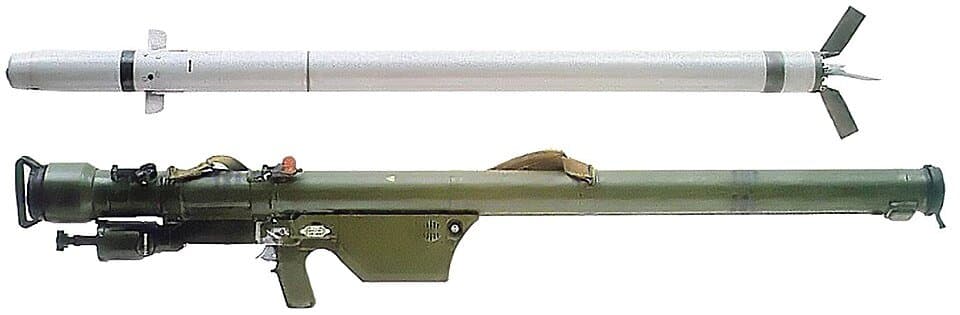
9K32 Strela-2larger figure on 3 of 3
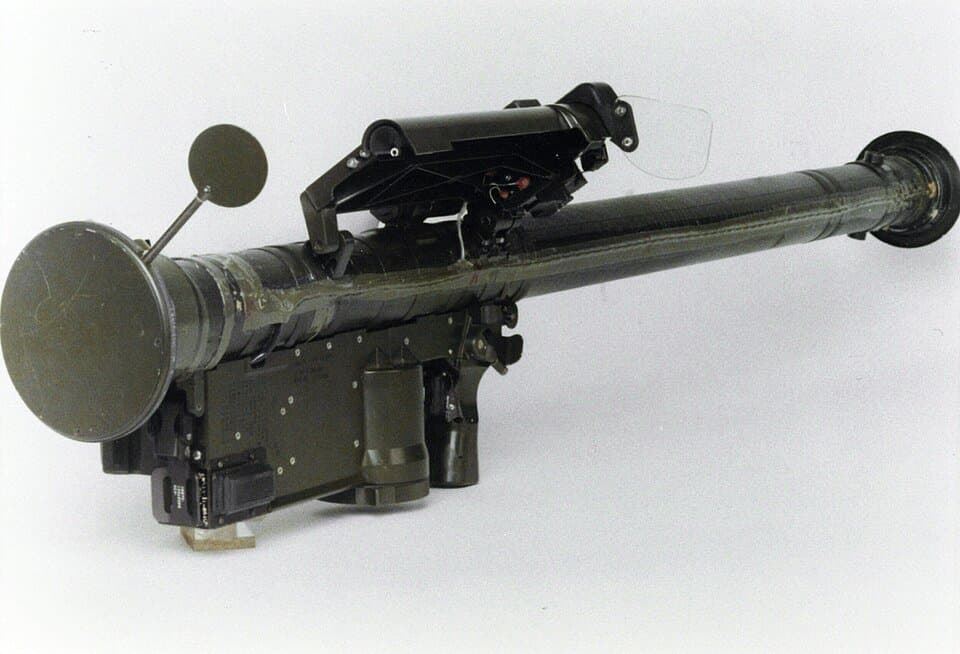
FIM-92 Stingerlarger figure on 0 of 3
Counts only measures both sources give with the same scope. A larger figure is not a better system.
Measured figures
Length
Single source1.44 m (4 ft 9 in)[source]
Length
Single sourceConfiguration
| Specification | 9K32 Strela-2 | FIM-92 Stinger |
|---|---|---|
| Type | Man portable surface-to-air missile launcher[source] | Man-portable surface-to-air missile[source] |
| Place of origin | Soviet Union[source] | United States[source] |
| In service | 1970–present[source] | 1981–present[source] |
| Used by | See operators[source] |
At launch In flight
Single sourceAt launch – 5 ft (1.53 m) In flight – 4 ft 6 in (1.37 m)[source]
Strela-2M missile
Single sourcesystem, ready to fire
Single source9.8 kg (21.6 lb) (Strela-2M missile) 15 kg (33.1 lb) (system, ready to fire)[source]
Mass
Single sourceMissile System
Single sourceMissile – 22 lb (10.1 kg) System – 35 lb (15.7 kg)
Maximum; Strela-2
Single sourceMaximum; Strela-2M
Single source430 m/s (1,400 ft/s) (Strela-2) 500 m/s (1,600 ft/s)(Strela-2M)[source]
Maximum; Mach 2.2 (
Single sourceMaximum; Maximum speed
Single sourceEffective; (Strela-2M) (minimal range)
Single sourceMaximum; Strela-2
Single sourceMaximum; Strela-2M
Single source800 m (2,600 ft) (Strela-2M) (minimal range)[source]
3,700 m (12,100 ft) (Strela-2) 4,200 m (13,800 ft) (Strela-2M)[source]
Effective; Effective firing range
Single source0.1–5 mi (0.16–8.05 km)[source]
Bars compare reported quantities only. A larger figure does not make a system better; configurations and test conditions differ.
See Operators[source] |
| Wars | War of Attrition Yom Kippur War Portuguese Colonial War Vietnam War Cambodian Civil War The Troubles Basque conflict Western Sahara War Communist insurgency in Thailand Rhodesian Bush War Nicaraguan Revolution Uganda–Tanzania War Salvadoran Civil War 1982 Lebanon War Lebanese Civil War Iran–Iraq War Gulf War Falklands War Second Sudanese Civil War South African Border War Soviet–Afghan War War in Afghanistan Syrian occupation of Lebanon Yugoslav Wars Iraq War Libyan Civil War Insurgency in Egypt Sinai insurgency Syrian Civil War War in Donbas Yemeni Civil War Libyan Civil War Russo-Ukrainian war Gaza war Iran war[source] | Falklands War Soviet–Afghan War Iran–Iraq War Gulf War Angolan Civil War Sri Lankan Civil War Chadian–Libyan conflict Tajikistani Civil War Kargil War Yugoslav Wars Invasion of Grenada Second Chechen War War in Afghanistan Iraq War Syrian Civil War War in Iraq (2013–2017) Russo-Ukrainian War[source] |
|---|
| Designer | KBM ( Kolomna )[source] | General Dynamics[source] |
|---|
| Designed | c. 1964[source] | 1967[source] |
|---|
| Unit cost | US$ 75,000 (launcher with 5 missiles, export price to Libya , 1972–1973)[source] | FIM-92A: U.S.$ 38,000 (missile only, 1980 FY) ($119,320 2020 FY )[source] |
|---|
| Variants | See versions[source] | FIM-92A, FIM-92B, FIM-92C, FIM-92D, FIM-92G[source] |
|---|
| Detonation mechanism | Non-delay impact and grazing fuzes, 14–17 second delay self-destruct.[source] | Impact[source] |
|---|
| Flight altitude | 50–1500 m (Strela-2) 50–2300 m (Strela-2M)[source] | — |
|---|
| Guidance system | Infra-red passive homing (AM-modulated reticle seeker head with uncooled PbS detector element), proportional navigation logic[source] | Infrared homing[source] |
|---|
| Source measurement | Both Strela-1 and Strela-2 were initially intended to be man-portable systems. As the Strela-2 proved to be a considerably smaller and lighter package, however, the role of the Strela-1 was changed, becoming a heavier, vehicle-mounted system with increased range and performance to better support the ZSU-23-4 in the regimental air defense role.[source]9K32 Strela-2 · Development; only the objects and conditions stated in this passage In order to address the shortcomings, two improved versions were ordered in 1968; as an intermediate stop-gap the slightly improved 9K32M "Strela-2M" (NATO reporting name SA-7b) to replace the original, as well as the more ambitious Strela-3 .[source]9K32 Strela-2 · Development / Improvements; only the objects and conditions stated in this passage As the modifications introduced with the Strela-2M were relatively minor, the process was fast and it was accepted in service in 1970. The Strela-2M replaced the Strela-2 in production lines immediately. Improvements were made particularly to increase the engagement envelope of the new system:[source]9K32 Strela-2 · Development / Improvements; only the objects and conditions stated in this passage Higher thrust propellant increased slant range from 3.4 to 4.2 km (2.1 to 2.6 mi) and ceiling from 1.5 to 2.3 km (0.93 to 1.43 mi)[source]9K32 Strela-2 · Development / Improvements; only the objects and conditions stated in this passage Improved guidance and control logic allowed the engagement of helicopters and propeller-driven aircraft (but not jets) approaching at a maximum speed of 150 m/s (490 ft/s; 340 mph)[source]9K32 Strela-2 · Development / Improvements; only the objects and conditions stated in this passage Maximum speed of receding targets was increased from 220 to 260 m/s (720 to 850 ft/s; 490 to 580 mph)[source]9K32 Strela-2 · Development / Improvements; only the objects and conditions stated in this passage Contrary to what was initially reported in some Western publications, more recent information indicates that, while lethality on impact had proven to be a problem, the warhead remained the same 1.17 kg (2.6 lb) unit (including 370-gram (13 oz) TNT charge) as in the original. This remained the warhead of all Soviet MANPADS up to and including most 9K38 Igla variants; to address the problem of poor lethality, a more powerful HE filling than TNT, improved fuzing, a terminal maneuver, and finally a separate charge to set off any remaining rocket fuel were gradually introduced in later MANPADS systems, but the original Strela-2/2M warhead design of a 370-gram (13 oz) directed-energy HE charge in a pre-fragmented casing remained.[source]9K32 Strela-2 · Development / Improvements; only the objects and conditions stated in this passage The Strela-2M was also procured for use on-board Warsaw Pact warships; installed on four-round pedestal mounts aboard Soviet amphibious warfare vessels and various smaller combatants, the weapon remained unchanged, but was assigned the NATO reporting name SA-N-5 "Grail".[source]9K32 Strela-2 · Development / Improvements; only the objects and conditions stated in this passage The manufacturer lists reaction time measured from the carrying position (missile carried on a soldier's back with protective covers) to missile launch to be 13 seconds, a figure that is achievable but requires considerable training and skill in missile handling. With the launcher on the shoulder, covers removed and sights extended, reaction time from fire command to launch reduces to 6–10 seconds, depending greatly on the target difficulty and the shooter's skill.[source]9K32 Strela-2 · Description; only the objects and conditions stated in this passage After activating the power supply to the missile electronics, the gunner waits for electricity supply and gyros to stabilize, puts the sights on target and tracks it smoothly with the launch tube's iron sights, and pulls the trigger on the grip stock. This activates the seeker electronics and the missile attempts to lock onto the target. If the target is producing a strong enough signal and the angular tracking rate is within acceptable launch parameters, the missile alerts the gunner that the target is locked on by illuminating a light in the sight mechanism, and producing a constant buzzing noise. The operator then has 0.8 seconds to provide lead to the target while the missile's on-board power supply is activated and the throw-out motor ignited.[source]9K32 Strela-2 · Description; only the objects and conditions stated in this passage On launch, the booster burns out before the missile leaves the launch tube at 32 m/s (100 ft/s) and rotating at around 20 revolutions per second. As the missile leaves the tube, the two forward steering fins unfold, as do the four rear stabilizing tail fins. The self-destruct mechanism is then armed, which is set to destroy the missile after between 14 and 17 seconds to prevent it hitting the ground if it should miss the target.[source]9K32 Strela-2 · Description; only the objects and conditions stated in this passage Once the missile is five and a half meters away from the gunner, about 0.3 seconds after leaving the launch tube, it activates the rocket sustainer motor. The sustainer motor takes it to a velocity of 430 metres per second (1,400 ft/s; 960 mph), and sustains it at this speed. Once it reaches peak speed, at a distance of around 120 metres (390 ft) from the gunner, the final safety mechanism is disabled and the missile is fully armed. All told, the booster burns for 0.5 seconds and the driving engine for another 2.0 seconds.[source]9K32 Strela-2 · Description; only the objects and conditions stated in this passage It has a 1.9 degree field of view and can track at 9 degrees per second.[source]9K32 Strela-2 · Description; only the objects and conditions stated in this passage The first combat use of the missile is credited as being in 1969 during the War of Attrition by Egyptian soldiers. The first "kill" was claimed on 19 August 1969. An Israeli 102 Squadron A-4H Skyhawk was hit with a shoulder-fired missile 19 km (12 mi) west of the Suez Canal and pilot SqL Nassim Ezer Ashkenazi captured. Between this first firing and June 1970 the Egyptian army fired 99 missiles resulting in 36 hits. The missile proved to have poor kinematic reach against combat jets, and also poor lethality as many aircraft that were hit managed to return safely to base.[source]9K32 Strela-2 · Combat use / Middle East / Egypt; only the objects and conditions stated in this passage The Americans responded with a large strike package of 12 A-7 Corsairs and 16 A-6 Intruders (supported by a single E-2C Hawkeye , two EA-6B Prowlers and two F-14As) launched from the carriers USS John F. Kennedy (CV-67) and USS Independence (CV-62) sailing in the Mediterranean. The aircraft were to bomb Syrian installations, AAA sites and weapons depots near Falouga and Hammana , some 16 km (10 mi) north of Beirut - Damascus highway, when they were received by a volley of (possibly up to 40) Syrian SAMs, one of which hit a Corsair (AE305 of the VA-15 ), forcing the pilot to eject over the sea before being rescued by a USN search and rescue mission.[source]9K32 Strela-2 · Combat use / Middle East / Syria; only the objects and conditions stated in this passage In the early dawn of 31 January 1991 during the Battle of Khafji in Operation Desert Storm , an Iraqi soldier shot down an American AC-130H gunship with a Strela 2, killing all 14 crewmembers.[source]9K32 Strela-2 · Combat use / Middle East / Iraq; only the objects and conditions stated in this passage Strela-2 missiles have been used against Turkish Army helicopters by the PKK in northern Iraq . During Operation Hammer ; on 18 May 1997, a Strela-2 missile was used to shoot down an AH-1W Super Cobra attack helicopter. On 4 June 1997, another Strela was used to bring down a Turkish Army AS-532UL Cougar transport helicopter in the Zakho area, killing the 11 soldiers on board. The video of the first attack was used extensively for PKK propaganda and eventually released to the Internet. Greece and Serbia 's intelligence services, as well as Iran, Syria, Armenia, and Cyprus were traced as possible sources of the missiles.[source]9K32 Strela-2 · Combat use / Middle East / Iraq; only the objects and conditions stated in this passage The spate of helicopter shoot-downs during 2006 and 2007 in Iraq has been partly attributed to the prevalence of the Strela amongst Sunni insurgent groups of that time; while al Qaeda is said to have produced an hour-long training video on how to use SA-7s.[source]9K32 Strela-2 · Combat use / Middle East / Iraq; only the objects and conditions stated in this passage The Strela-2 system was also given to North Vietnam , where along with the more advanced Strela-2M it achieved 204 hits out of 589 firings against US and South Vietnamese aircraft between 1972 and 1975 according to Russian sources. (Some sources, such as Fiszer (2004), claim that it was used from 1968 onwards).[source]9K32 Strela-2 · Combat use / Southeast Asia; only the objects and conditions stated in this passage Roughly 95–120 kills and several dozen damaged are attributed to Strela-2/2M hits between April 1972 and the Fall of Saigon in April 1975, almost all against helicopters and propeller-driven aircraft. As in the War of Attrition, the missile's speed and range proved insufficient against fast jets and results were poor: only one U.S. A-4 Skyhawk , one U.S. F-4 Phantom and three South Vietnamese F-5 Freedom Fighter are known to have been shot down with Strela-2s during the conflict.[source]9K32 Strela-2 · Combat use / Southeast Asia; only the objects and conditions stated in this passage The table shows heavy losses particularly in the beginning of May, with especially lethal results on the 1st and 2nd, where the shootdown of the O-2 FAC led to further losses when a rescue operation was attempted. After these initial losses, changes in tactics and widespread introduction of decoy flares helped to counter the threat, but a steady flow of attrition and necessity of minimizing time spent in the Strela's engagement envelope nonetheless continued to limit the effectiveness of US battlefield air operations until the end of US involvement in South-East Asia. The United States lost at least 10 AH-1 Cobras and several UH-1 Hueys to Strela-2/2M hits in South East Asia.[source]9K32 Strela-2 · Combat use / Southeast Asia; only the objects and conditions stated in this passage In 1977, the Republic of Afghanistan received the Strela-2M for use by the Afghan Army . The Strela-2M was used also in Afghanistan during the Soviet–Afghan War by the Mujahiddeen. The missiles were obtained from various sources, some from Egypt and China (locally manufactured Sakr Eye and HN-5 versions of the SAM), and the CIA also assisted the guerrillas in finding missiles from other sources.[source]9K32 Strela-2 · Combat use / Western Asia / Afghanistan; only the objects and conditions stated in this passage Results from combat use were not dissimilar from experiences with the Strela-2/2M from Vietnam: while 42 helicopters were shot down by various Strela-2 variants (including a few Mi-24s until exhaust shrouds made them next to invisible to the short-wavelength Strela-2 seeker) only five fixed-wing aircraft were destroyed with the weapon. Due to its poor kinematic performance and vulnerability to even the most primitive infra-red countermeasures, the guerrillas considered the Strela-2 suitable for use against helicopters and prop-driven transports, but not combat jets.[source]9K32 Strela-2 · Combat use / Western Asia / Afghanistan; only the objects and conditions stated in this passage Chechen forces had access to old Soviet stockpiles of Strela-2M and Igla missiles, as well former Soviet Army personnel trained to operate them. In the First Chechen War , Russian forces lost about 38 aircraft of which 15 were caused by MANPADS with another 10 probably caused by MANPADS, while the rest were caused by other anti-aircraft weapons. During the Second Chechen War the Russians lost 45 helicopters and 8 fixed-wing aircraft—the majority presumably caused by MANPADS.[source]9K32 Strela-2 · Combat use / Western Asia / Chechnya; only the objects and conditions stated in this passage The SA-7 saw heavy usage by all sides during the Georgian Civil War . The first known loss to an SA-7 happened on 13 June 1993, when a GAF Su-25 was shot down by a Strela over Shubara. On two later occasions, Georgian airliners (a Tu-134A and a Tu-134B) were shot down by SA-7s, killing a total of 110 people.[source]9K32 Strela-2 · Combat use / Western Asia / Georgia; only the objects and conditions stated in this passage FRELIMO fighters in Mozambique were also able to field some SA-7s with Chinese support, although the weapon is not known to have caused any losses to the FAP, even if it forced Portuguese pilots to change their tactics. In one case a Douglas DC-3 carrying foreign military attaches and members of the senior Portuguese military command was hit by an SA-7 in one of the engines. The crippled plane managed to land safely and was later repaired.[source]9K32 Strela-2 · Combat use / Africa / Mozambique; only the objects and conditions stated in this passage Using an SA-7, the Sudan People's Liberation Army shot down a Sudan Airways Fokker F-27 Friendship 400M taking off from Malakal on 16 August 1986, killing all 60 on board. On 21 December 1989, an Aviation Sans Frontières Britten-Norman BN-2A-9 Islander (F-OGSM) was shot down by an SA-7 while taking off from Aweil Sudan, killing the four crew on board.[source]9K32 Strela-2 · Combat use / Africa / Sudan; only the objects and conditions stated in this passage After having taken off from Dakar , Senegal , en route to Arrecife , Canary Islands , flying 5 minutes behind Polar 2 and at a lower altitude of 2,700 m (9,000 ft), Polar 3 was shot down by a SA-7 fired by the Polisario.[source]9K32 Strela-2 · Combat use / Africa / Western Sahara; only the objects and conditions stated in this passage In another incident, on 8 December 1988, two Douglas DC-7 CFs flying at 3,400 m (11,000 ft) from Dakar, Senegal to Agadir , Morocco for a locust control mission there, had SA-7s fired at them by the Polisario.[source]9K32 Strela-2 · Combat use / Africa / Western Sahara; only the objects and conditions stated in this passage Vickers Viscount, Flight RH825 , 3 September 1978 – downed by a Strela missile near Kariba Dam. After initial impact, the pilot was able to make an emergency landing in a nearby field but the aircraft broke up on impact. Eighteen of the fifty-six passengers in the tail section survived the crash. Ten of these survivors were shot dead at the crash-site by insurgents, who later looted the bodies and wreckage.[source]9K32 Strela-2 · Combat use / Africa / Airliner attacks; only the objects and conditions stated in this passage Vickers Viscount, Flight RH827 , 12 February 1979 – shot by down Strela missile near Kariba Dam; all 59 people on board were killed.[source]9K32 Strela-2 · Combat use / Africa / Airliner attacks; only the objects and conditions stated in this passage Strela-2M missiles were available to Argentinian troops in the Falkland Islands during the Falklands War . War Machine Encyclopedia shows no records of any launches, but several missiles were captured.[source]9K32 Strela-2 · Combat use / Latin America / Argentina; only the objects and conditions stated in this passage On 15 June 1987, a Contra-operated Beechcraft Baron 56TC (reg. N666PF, msn. TG-60) was hit by Sandinista anti-aircraft fire over the Nueva Segovia Department. The (formerly civilian) light utility aircraft , which was removed from the US registry two years before, and was reportedly modified to carry rockets for use in an air-to-ground light strike role , was downed after an attack that reportedly included dropping leaflets and, possibly, reconnaissance. The aircraft crashed 6 km (4 mi) inside Honduras , in an area known as Cerro El Tigre and its three occupants, all former military elements of the Somoza dictatorship , were injured and captured after the crash landing and were treated in Honduras. The pilot, Juan Gomez, a former colonel in Somoza's National Guard was also reported to be the head of the Contra air force. A Russian source credits the Baron's downing to a Strela-2 fired from Murra by Sandinista soldier Jose Manuel Rodriguez.[source]9K32 Strela-2 · Combat use / Latin America / Nicaragua; only the objects and conditions stated in this passage In late December 2012, a video showing FARC rebels attempting to shoot down a Colombian Air Force Arpía helicopter with an SA-7 in the Cauca raised the alarm in the Colombian military, though the missile failed. During that same month, a Strela was captured by the Colombian military. It is believed that they might came from Cuba, Nicaragua or Peru; the only Latin American operators of the type.[source]9K32 Strela-2 · Combat use / Latin America / Colombia; only the objects and conditions stated in this passage At the beginning of the Croatian War of Independence , the Croatian forces did not have an air force, and the anti-aircraft weapons they had at their disposal were more symbolic than dangerous for their opponents (about 25-30 light air defense systems Strela-2M). On September 19, 1991, the Croatian Air Defense shot down a J-22 Orao with the Strela-2M over the Đakovo area. The first Yugoslav aircraft shot down over the Adriatic Sea was the G-2 Galeb , which was hit by a Strela-2M by a police officer during the battle of Šibenik on September 20, 1991. A day later shooting down of two enemy aircraft in the same area in a short time, known by the cry "Both have fallen" occurred. On that day members of the Croatian Army during the Battle of the Dalmatian Channels shot down two J-21 Jastreb using M55 anti-aircraft gun and Strela 2M. On November 8, 1991. in Gorski Kotar, the Croatian air defense shot down MiG-21R with the Strela-2M. On April 24, 1992 during the siege of Dubrovnik an enemy aircraft was shot down with the Strela 2M.[source]9K32 Strela-2 · Combat use / Europe / Croatia; only the objects and conditions stated in this passage The Army of Republika Srpska , backed by the Armed Forces of Serbia and Montenegro , used Strela-2M and upgraded Strela-2M/A missiles against Bosnian, Croatian, and NATO forces. On 3 September 1992, an Italian Air Force G.222 transport was presumably shot down by a Strela-2M during a United Nations relief mission near Sarajevo. Serbian forces shot down a Croatian Air Force MiG-21 in September 1993 with a Strela-2M. On 17 December 1994, a French Navy Dassault Étendard IVP was hit by a Strela-2M, but managed to return to its carrier.[source]9K32 Strela-2 · Combat use / Europe / Bosnia; only the objects and conditions stated in this passage The Provisional Irish Republican Army (IRA) acquired some missiles from Libya. One was reported to have been fired at a British Army Air Corps Lynx helicopter in July 1991 in South Armagh ; however, it missed its target. To counter the new threat, the British helicopters flew in pairs below 15 meters (50 feet) or above 150 meters (500 feet).[source]9K32 Strela-2 · Combat use / Europe / Northern Ireland; only the objects and conditions stated in this passage 9K32M Strela-2M : "SA-7b Grail"[source]9K32 Strela-2 · Versions; only the objects and conditions stated in this passage Fasta-4M : East German variant consisting of 4 Strela-2Ms mounted to a fully rotating turret. used by the NVA and Volksmarine[source]9K32 Strela-2 · Versions; only the objects and conditions stated in this passage CA-94 and CA-94M : Romanian license-built versions of the 9K32 and 9K32M, respectively[source]9K32 Strela-2 · Versions; only the objects and conditions stated in this passage Finland : Strela-2M operated under designation 'ItO-78'[source]9K32 Strela-2 · Operators / Former operators; only the objects and conditions stated in this passage Latvia : 5 Strela 2M in 2008[source]9K32 Strela-2 · Operators / Former operators; only the objects and conditions stated in this passage North Macedonia : 54 in 2008[source]9K32 Strela-2 · Operators / Former operators; only the objects and conditions stated in this passage | — |
|---|
| Manufacturer | KBM, Degtyarev plant, Cugir Arms Factory, Kyiv Arsenal[source] | Raytheon Missiles & Defense[source] |
|---|
| Origin reported by inventory | USSR[source]Inventory Origin column; table 1, row 35, cell 2; revision 1373427941; retrieved 2026-10-02 | — |
|---|
| Produced | — | 1978–present[source] |
|---|
| Warhead | — | HE-FRAG[source] |
|---|
| Engine | — | Solid-fuel rocket motor[source] |
|---|
| Launch platform | — | MANPADS , M6 Linebacker , Multi-Mission Launcher , Eurocopter Tiger , AN/TWQ-1 Avenger , MQ-1 Predator , AH-64 Apache , T129 ATAK[source] |
|---|
| References | — | Janes[source] |
|---|
| Reported operators |
|
|
|---|
Mach 2.2 (2,440 ft/s; 745 m/s)[source]