AAir defence
9K31 Strela-1
highly mobile, short-range, low altitude infra-red guided surface-to-air missile system


Preparing your view.
AAir defence
highly mobile, short-range, low altitude infra-red guided surface-to-air missile system
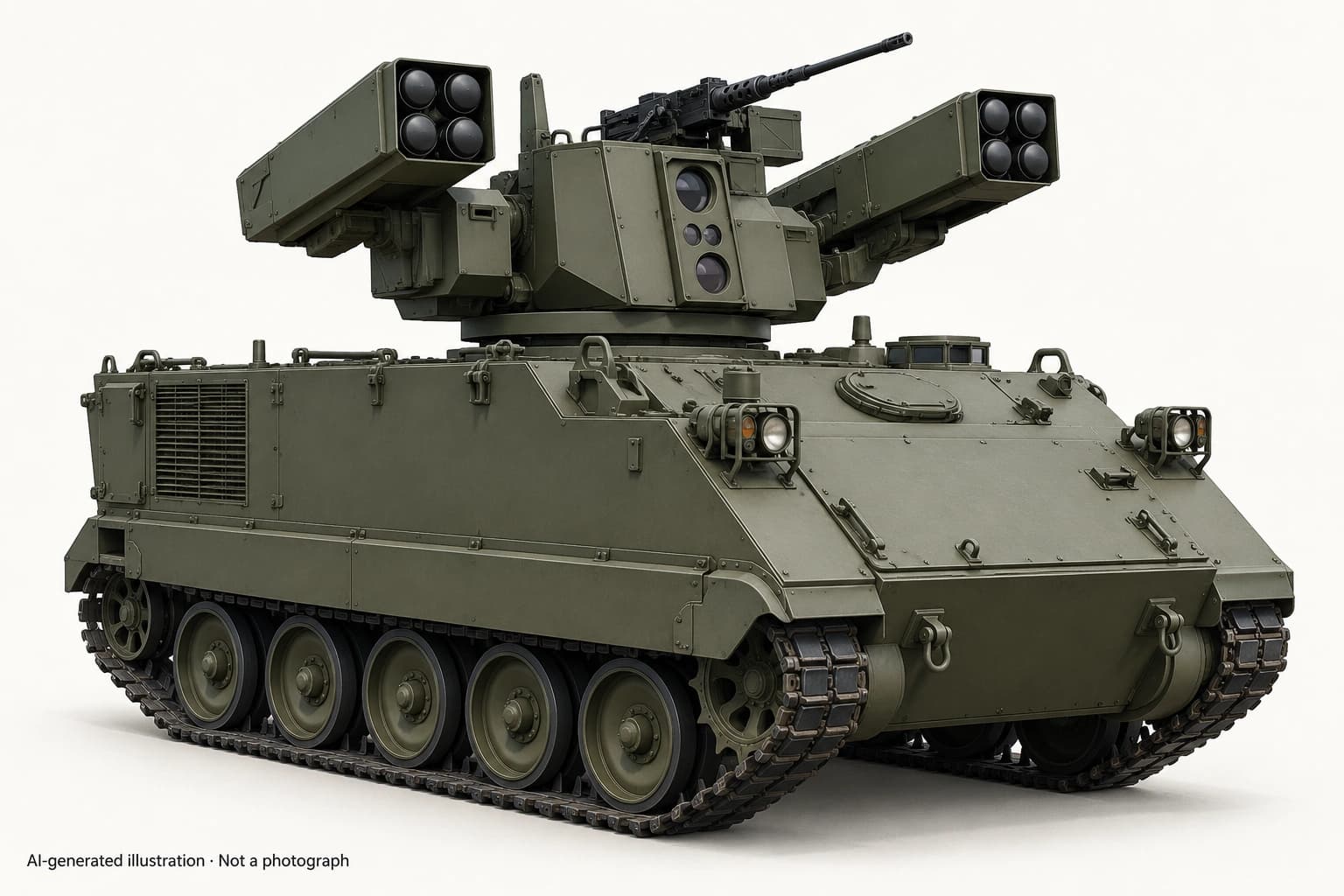

BAir defence
Self-propelled anti-aircraft weapon Mobile air defense missile system Surface to air missile
At a glance
9K31 Strela-1larger figure on 2 of 4
Measured figures
Length
Single source5.8 m (19 ft)[source]
Length
Single sourceConfiguration
| Specification | 9K31 Strela-1 | ATILGAN PMSS |
|---|---|---|
| Type | Vehicle-mounted SAM system[source] | Self-propelled anti-aircraft weapon Mobile air defense missile system Surface to air missile[source] |
| Place of origin | Soviet Union[source] | Turkey[source] |
| In service | 1968–present[source] | 2001–present[source] |
| Used by | See list of operators[source] |
Counts only measures both sources give with the same scope. A larger figure is not a better system.
4.863 m (16.0 ft)[source]
Maximum; road
Single sourceMaximum; water
Single source100 km/h (62 mph) (road) 10 km/h (6.2 mph) (water)[source]
Maximum; on land
Single sourceMaximum; swimming
Single sourceWarhead weight
Single source3 kg (6.6 lb)[source]
Bars compare reported quantities only. A larger figure does not make a system better; configurations and test conditions differ.
Turkish Armed Forces Turkish Naval Forces[source] |
| Wars | Arab–Israeli wars Western Sahara War South African Border War Lebanon wars Iran–Iraq War Gulf War Yugoslav wars 2003 invasion of Iraq Russian invasion of Ukraine Syrian Civil War Yemeni Civil War (2014–present)[source] | — |
|---|
| Designer | OKB-16 design bureau (now the Moscow-based KB Tochmash Design Bureau of Precision Engineering)[source] | — |
|---|
| Manufacturer | Soviet state factories[source] | ROKETSAN and ASELSAN[source] |
|---|
| Produced | 1966[source] | 2001–present[source] |
|---|
| Variants | 9K31, CA-95[source] | — |
|---|
| Armour | 5–14 mm (0.20–0.55 in)[source] | — |
|---|
| Main armament | 4 × 9M31 (or 9M31M)[source] | 4 or 8 FIM-92 Stinger missiles[source] |
|---|
| Power/weight | 20 hp/t (15 kW/t)[source] | — |
|---|
| Ground clearance | 0.43 m (1.4 ft)[source] | — |
|---|
| Fuel capacity | 290 litres (77 US gal)[source] | — |
|---|
| Guidance system | infrared homing[source] | — |
|---|
| Warhead | Frag-HE[source] | — |
|---|
| Detonation mechanism | RF Proximity[source] | — |
|---|
| Propellant | single-stage Solid-fuel rocket motor[source] | — |
|---|
| Flight altitude | 3,500 metres (11,500 ft) (some sources give also higher figures)[source] | — |
|---|
| Former operator · Benin | Benin[source] | — |
|---|
| Former operator · Bulgaria | Bulgaria[source] | — |
|---|
| Former operator · Czechoslovakia | Czechoslovakia[source] | — |
|---|
| Former operator · Czech Republic | Czech Republic[source] | — |
|---|
| Former operator · East Germany | East Germany[source] | — |
|---|
| Former operator · Egypt | Egypt[source] | — |
|---|
| Former operator · Ethiopia | Ethiopia[source] | — |
|---|
| Former operator · Herzeg-Bosnia | Herzeg-Bosnia[source] | — |
|---|
| Former operator · Hungary | Hungary[source] | — |
|---|
| Former operator · Iraq | Iraq[source] | — |
|---|
| Former operator · Israel | Israel[source] | — |
|---|
| Former operator · Libya | Libya[source] | — |
|---|
| Former operator · Mozambique | Mozambique[source] | — |
|---|
| Former operator · Nicaragua | Nicaragua[source] | — |
|---|
| Former operator · Palestine Liberation Organization | Palestine Liberation Organization[source] | — |
|---|
| Former operator · Poland | Poland[source] | — |
|---|
| Former operator · Republika Srpska | Republika Srpska[source] | — |
|---|
| Former operator · Serbia and Montenegro | Serbia and Montenegro[source] | — |
|---|
| Former operator · Slovenia | Slovenia[source] | — |
|---|
| Former operator · Slovakia | Slovakia[source] | — |
|---|
| Former operator · South Africa | South Africa[source] | — |
|---|
| Former operator · Tanzania | Tanzania[source] | — |
|---|
| Former operator · Ukraine | Ukraine[source] | — |
|---|
| Former operator · United States | United States[source] | — |
|---|
| Former operator · Soviet Union | Soviet Union[source] | — |
|---|
| Former operator · Vietnam | Vietnam[source] | — |
|---|
| Former operator · South Yemen | South Yemen[source] | — |
|---|
| Former operator · Yemen | Yemen[source] | — |
|---|
| Former operator · Yugoslavia | Yugoslavia[source] | — |
|---|
| Role | highly mobile, short-range, low altitude infra-red guided surface-to-air missile system[source] | — |
|---|
| Source measurement | Each TEL carries four ready-to fire missiles, but typically no missiles for reloading. Reloading is performed manually and usually takes approximately 5 minutes. The missile boxes are lowered for transport to lower the total height of the vehicle. The driver and commander have periscopes for viewing outside the vehicle when the hatches are closed.[source]9K31 Strela-1 · Vehicle; only the objects and conditions stated in this passage Apart from the new turret, the other major change to the BRDM-2 chassis is the removal of the belly wheels (which are presumably to improve off-road performance). The driver and commander both have infra-red vision systems. The vehicle has standard NBC ( Nuclear, Biological and Chemical ) protection including overpressure. The missiles fold down to the sides of the turret which greatly reduces the height of the vehicle whilst travelling. Each vehicle weighs around 7 tonnes (7.7 short tons) and has a 104 kW (140 hp) engine and a central tire pressure control system.[source]9K31 Strela-1 · Vehicle; only the objects and conditions stated in this passage According to a number of Russian sources, the original 9M31 ( US DoD designation SA-9A "Gaskin-Mod0" ) had a zone of reliable target destruction from 900 to 4200 metres. Several western and also some Russian sources give much higher range estimates of 800 to 6500 m (0.5 to 4 miles); these may refer to maximum firing range against an approaching target and minimum against receding, which are obviously larger envelopes as the target only has to reach the intercept zone by the time the missile would reach it.[source]9K31 Strela-1 · Missiles and guidance / 9M31; only the objects and conditions stated in this passage The missile is effective against targets receding at a maximum speed of 220 m/s, or approaching at 310 m/s.[source]9K31 Strela-1 · Missiles and guidance / 9M31; only the objects and conditions stated in this passage The warhead was primarily intended to impact the target directly, and had contact and magnetic fuzes, but also contained a back-up optical proximity fuze to detonate the warhead in case of a near miss. The missile also had an unusual safety mechanism in case of a miss; rather than a self-destruct fuze, if the optical fuze didn't detect a target within 13–16 seconds, the warhead safety mechanism would be engaged to prevent its detonation upon impact.[source]9K31 Strela-1 · Missiles and guidance / 9M31; only the objects and conditions stated in this passage The new photo-contrast seeker also had serious limits, which came in the form of rather strict meteorological conditions that had to be met to enable the seeker to detect and track the target. It could only engage targets against background conditions of either clear sky or solid overcast, at least 20 degrees away from the sun, and at least 2 degrees above horizon. Nevertheless, following a study of battlefield conditions and aircraft tactics in past conflicts where short-range air defences had been used, it was concluded that conditions allowing the use of such a homing system were common enough to make it a cost-effective design choice and a better trade-off than the only practical alternative available at the time, which was infrared homing restricted to rear-hemisphere engagements.[source]9K31 Strela-1 · Missiles and guidance / 9M31; only the objects and conditions stated in this passage While the 9M31 was accepted to service after state trials in 1968, the trials committee also suggested improvements that should be incorporated into the weapon as soon as possible. As a result of these improvements, the 9M31M "Strela-1M" (US DoD designation SA-9B "Gaskin-Mod1" ) entered service in 1970.[source]9K31 Strela-1 · Missiles and guidance / 9M31M; only the objects and conditions stated in this passage The new version introduced many incremental improvements in the performance characteristics of the missile: it had a slightly heavier warhead (increased from 2.6 kg to 3 kg), a more accurate guidance system to increase the probability of a hit, and extended range. Range is again reported to be as high as 8000 m (0.35 to 5 miles) in a number of western and also a few Russian sources, whereas for example Petukhov & Shestov, Lappi, and a number Russian web sources give much more modest performance figures; considering the performance of similar systems, at least an intercept range of 8,000 m seems unlikely for such a small, high-drag missile design.[source]9K31 Strela-1 · Missiles and guidance / 9M31M; only the objects and conditions stated in this passage | — |
|---|
| No. built | — | 100+[source] |
|---|
| Secondary armament | — | 1x 12.7 mm (0.500 in) automatic machine gun[source] |
|---|
| Payload capacity | — | 8 ready-to-fire Stinger missiles[source] |
|---|
| Suspension | — | torsion bar, 5 road wheels[source] |
|---|
| Reported operators |
| — |
|---|
67.6 km/h (36.5 kn; 42.0 mph) on land 5.8 km/h (3.1 kn; 3.6 mph) swimming[source]