


Preparing your view.
At a glance
2R2M mortarlarger figure on 0 of 1
M69 mortarlarger figure on 1 of 1
Counts only measures both sources give with the same scope. A larger figure is not a better system.
Measured figures
Length
Single source1,324 millimetres (52.1 in)[source]
Configuration
| Specification | 2R2M mortar | M69 mortar |
|---|---|---|
| Type | Heavy Mortar[source] | Mortar[source] |
| Place of origin | France[source] | Yugoslavia[source] |
| Shell | 16–18.7 kg (35–41 lb)[source] | — |
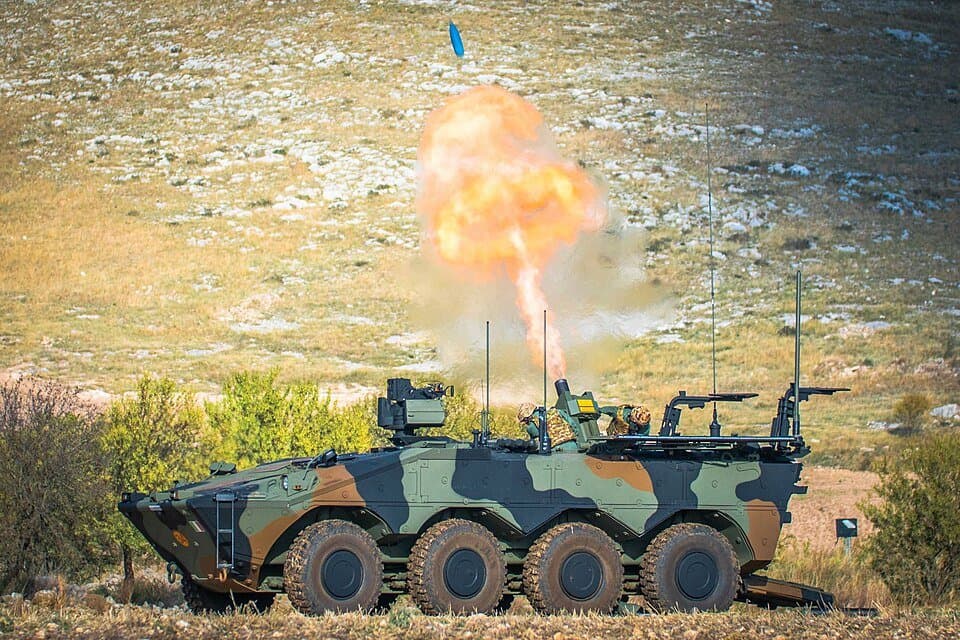
| Role | vehicle-mounted, rifled 120 mm heavy mortar[source] | — |
| Manufacturer | Thales[source] |
Mass
Single source47.1 kilograms (104 lb)[source]
Effective; with rocket-assisted projectile
Single sourceEffective; with standard projectile
Single sourceMaximum; with Precision Extended Range Munition (PERM)
Single source8,140 m (8,900 yd) with standard projectile 12,850 m (14,050 yd) with rocket-assisted projectile[source]
17 km (19,000 yd) with Precision Extended Range Munition (PERM)[source]
Maximum; Maximum firing range
Single source4,943 metres (16,217 ft)[source]
Bars compare reported quantities only. A larger figure does not make a system better; configurations and test conditions differ.
| — |
| Status | The 2R2M is in service with 5 nations.[source]2R2M · source-literal primary status | — |
|---|
| Source measurement | The 2R2M ( Rifled Recoiled Mounted Mortar ) is a vehicle-mounted, rifled 120 mm heavy mortar produced by Thales of France. It is derived from the MO-120-RT towed mortar. The 2R2M is in service with 5 nations.[source]2R2M mortar · Lead; only the objects and conditions stated in this passage The US Marine Corps Warfighting Laboratory (MCWL) started a Concept Demonstrator project in 1997. They wanted a "mortar in a box," that is a weapon that could be remotely emplaced and fired unattended on a future battlefield. In late 1997, MCWL accepted a proposal by the army's Program Manager, Mortars (PM Mortars) and Armament Research, Development, and Engineering Command (ARDEC) at Picatinny Arsenal , New Jersey to design and build a firing system to fulfill the design objectives. An early requirement was that the system had to be a 120 mm system to give sufficient lethality and range. Ultimately, the design team picked parts of the French Thomson-Daimler Armements (TDA) experimental 2R2M mortar because it had a usable power driven traverse and elevation in addition to a loading system. Its 120 mm rifled ammunition promised greater accuracy and range.[source]2R2M mortar · History (Dragon Fire II); only the objects and conditions stated in this passage The project was initiated in 2002, but, not long afterwards, TDA dropped out of the project because of issues concerning sharing of design information and their price, and when Marine Corps Systems Command made it known that it would be looking for an "off the shelf, commercial system" for the EFSS requirement, the system specifications for the Dragon Fire II were de-scoped to Concept Demonstrator and the budget was reduced. ARDEC contracted with General Dynamics to design the new electric actuators for elevation, traverse, loading and firing and despite some difficulties in that contract, the finished Dragon Fire II, now known as the XM-326 120mm Automated Mortar, was rolled out at Rock Island Arsenal in September 2005.[source]2R2M mortar · History (Dragon Fire II); only the objects and conditions stated in this passage The new Dragon Fire II was half the weight of the first Dragon Fire, 1,565 kg (3,450 lb) versus over 3,175 kg (7,000 lb). It was capable of receiving a fire mission over its on-board radio, processing the fire mission, aiming the weapon, loading and firing in any direction within 18 seconds. The Dragon Fire II was incorporated into testing with the Counter Rockets, Artillery, and Mortars (C-RAM) project while it was still undergoing engineering and safety tests at Yuma Proving Ground . It fired in support of C-RAM's demonstrations and was responsive and accurate, with most rounds landing within a circular error probable (CEP) of 15 m (49 ft) at a range of 5,600 m (18,400 ft).[source]2R2M mortar · History (Dragon Fire II); only the objects and conditions stated in this passage The Dragon Fire mortar system can be deployed mounted in an LAV-25 , towed by a HMMWV , or air deployed by CH-53 Sea Stallion helicopter or V-22 Osprey . Fixing the weapon in an LAV does not require a separate mount; its towing carriage can be converted to an LAV mount in five minutes. After deployment, the crew can control the weapon system from a remote station. In operation, it is designed to be fully automatic: loading, computing firing solutions, aiming and firing automatically. From an unloaded condition, the weapon is capable of loading, completing a firing solution, aiming, and firing the first round within 18 seconds of receiving an order. The weapon is also capable of being operated manually in the event of failure of an automatic system. Because the Dragon Fire II contains its own GPS positioning system and pointing system (the Honeywell 5000HG Ring Laser Gyro) and on-board SINCGARS FM radio, it was also capable of controlling other like weapons, with the potential of one designated "Master Gun" controlling multiple other Dragon Fire Mortars in a synchronized manner.[source]2R2M mortar · Operation; only the objects and conditions stated in this passage The Dragon Fire system is designed to be able to use all NATO types of rifled and smoothbore 120 mm mortar ammunition. However, the USMC awarded Raytheon a contract to design, develop and demonstrate a new 120 mm long-range, guided-mortar munition for use with the M327 mortar. The new Precision Extended Range Munition (PERM) is expected to be ready for a live-fire demonstration by the summer of 2015. The 120 mm rifled mortar PERM round will give the EFSS a reach of 17 kilometres (11 mi), with a CEP of 20 m (66 ft). The prototype PERM rounds have a GPS antenna and small fins, canards , that provide lift and extend the range of the weapon. The Marine Corps acquisition program performed a shoot-off of the prototype mortar rounds developed by Raytheon and ATK . In December 2015, the Marine Corps awarded a five-year contract to Raytheon Missile Systems to deliver about 4,300 rounds. Each round, weighing 16 kg (35 lbs) each, costs $18,000 each, about $16,000 more than the non-precision rounds.[source]2R2M mortar · Operation / Types of rounds; only the objects and conditions stated in this passage The Brazilian Army is looking for a 120mm mortar system to be integrated to the Guarani 6×6 . The competitors include: SRAMS by ST Kinetics Patria NEMO RUAG Cobra Elbit Cardom 120[source]2R2M mortar · Operators / Potential future systems; only the objects and conditions stated in this passage | — |
|---|
| Country of origin | Italy[source]Inventory Origin column; table 7, row 8, cell 3; revision 1375013163; retrieved 2026-10-02 | — |
|---|
| Designer | — | Military Technical Institute[source] |
|---|
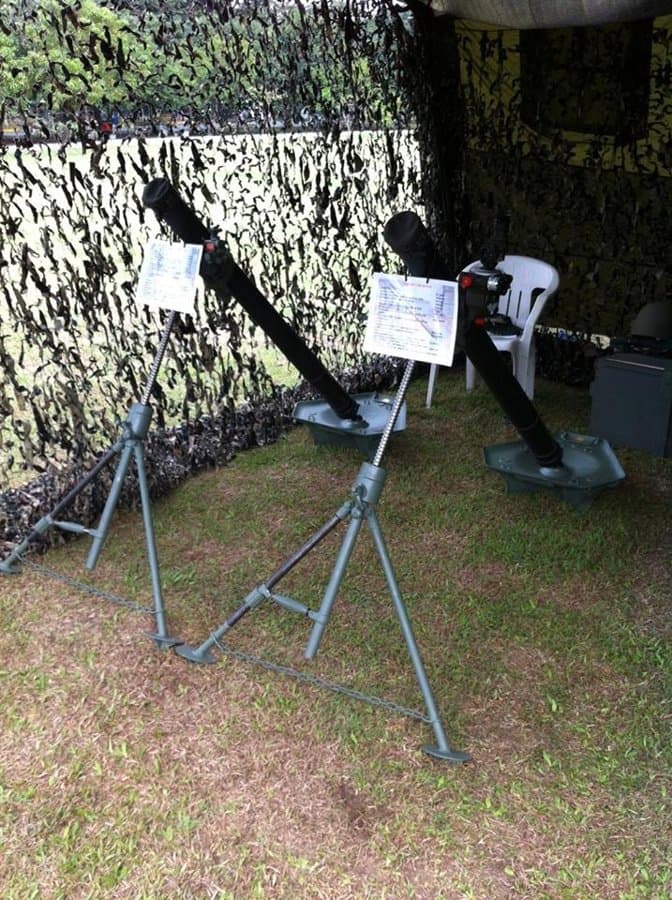
| Elevation | — | 45°–85°[source] |
|---|
| Traverse | — | 5.6°[source] |
|---|
| Feed system | — | muzzle-loaded[source] |
|---|
| Sights | — | NSB-3[source] |
|---|
| Reported operators | — |
|
|---|