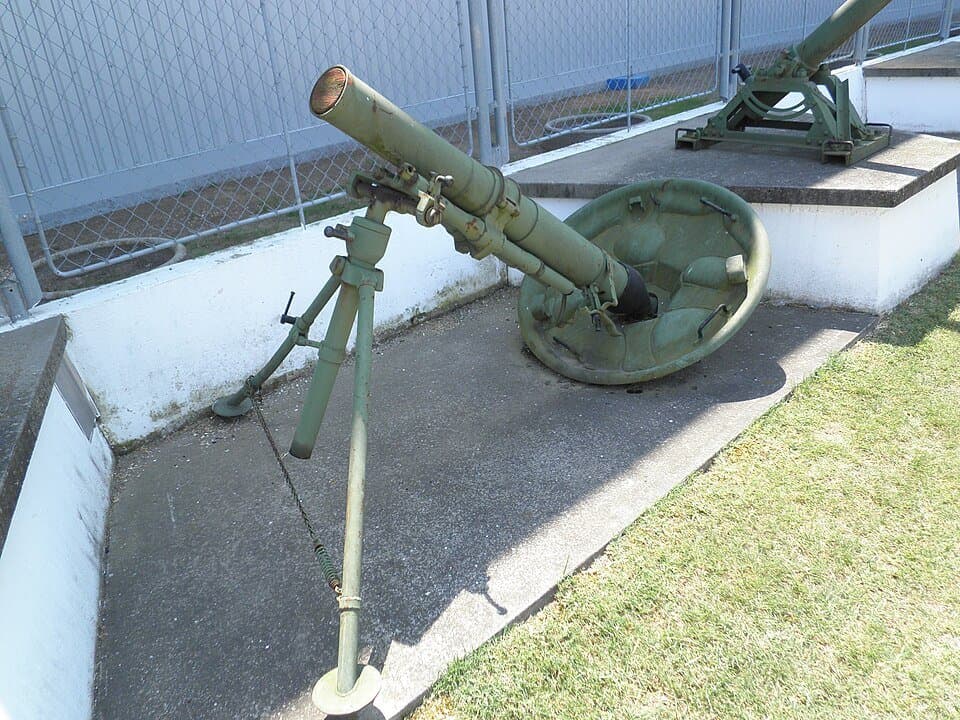
Credit
Cooper6 · CC BY-SA 3.0 · Resized · CC BY-SA 3.0 · Source ↗ · Modified


Preparing your view.
Measured figures
Mass
Single source275 kg (606 lb)[source]
combat
Single sourceConfiguration
| Specification | 120-PM-43 mortar | M1938 mortar |
|---|---|---|
| Type | Mortar[source] | Mortar[source] |
| Place of origin | Soviet Union[source] | Soviet Union[source] |
| In service | 1943-present[source] | — |
| Used by | Soviet Union[source] | — |
| Wars | Eastern Front (World War II) Korean War Vietnam War Cambodian Civil War Rhodesian Bush War Portuguese Colonial War Lebanese Civil War Soviet–Afghan War Gulf War South Sudanese Civil War |
travel
Single sourcetravel: 477 kg (1,052 lb) combat: 280 kg (620 lb)[source]
L/15.5
Single source1.86 m (6 ft 1 in) L/15.5[source]
Bars compare reported quantities only. A larger figure does not make a system better; configurations and test conditions differ.
World War II Chinese Civil War Korean War First Indochina War Vietnam War Suez Crisis Six-Day War Lebanese Civil War Iran–Iraq War[source] |
| Manufacturer | Uralmash[source] | — |
|---|
| Breech | muzzle loaded[source] | muzzle loaded[source] |
|---|
| Elevation | +45° to +80°[source] | +45° to +80°[source] |
|---|
| Designed | — | 1938[source] |
|---|
| Produced | — | 1939[source] |
|---|
| Variants | — | Reșița Model 1942 (Romania)[source] |
|---|
| Shell | — | 16 kg (35 lb)[source] |
|---|
| Traverse | — | 6°[source] |
|---|
| Role | — | 120 mm Soviet mortar[source] |
|---|
| Source measurement | — | The 120-PM-38 or M1938 was a 120 mm Soviet mortar that was used in large numbers by the Red Army during World War II . Although a conventional design its combination of light weight, mobility, heavy firepower and range saw its features widely copied by successive generations of mortars.[source]M1938 mortar · Lead; only the objects and conditions stated in this passage The origins of the M1938 lay in the French Mortier Brandt de 120mm Modele 1935 and the Brandt mle 27/31 which the Soviet Union produced under license as the 82-PM-36 . In 1937 the Soviets produced a modified version of the 82-PM-36 known as the 82-PM-37 and this mortar served as the pattern for the 120-PM-38. The main difference between the 82-PM-37 and the earlier 82-PM-36 was the adoption of a round base-plate, revised traverse/elevation controls, simplified sights and spring-loaded shock absorbers on the bi-pod to reduce the amount of relaying needed between shots. The 120-PM-38 is essentially a scaled up 82-PM-37 which uses the same two-wheeled limber as the 107 mm PBHM-38 . The limber works in much the same way as a hand truck . The limber is wheeled vertically into place, hooks on the base-plate hook onto the limber, the barrel is clamped down and then everything is lowered into towing position. The limber can either be towed directly or attached to a 20-round caisson for towing by a vehicle or horse team.[source]M1938 mortar · Design; only the objects and conditions stated in this passage During the early phases of Operation Barbarossa the Germans captured large quantities of Soviet hardware including the 120-PM-38 which they designated the 12 cm Granatwerfer 378(r) . After being on the receiving end of the 120-PM-38's firepower they adopted it to supplement their own mortars and eventually produced a modified version called the 12 cm Granatwerfer 42 . The Granatwerfer 42 was widely issued to German units and often took the place of infantry guns later in the war. The Finnish and Romanians also made use of captured stocks of Soviet weapons and eventually the Romanians also created their own design, the Reșița Model 1942 , produced at the Reșița Works with a rate of 80 pieces per month as of October 1942.[source]M1938 mortar · Employment; only the objects and conditions stated in this passage |
|---|
| Country of origin | — | Soviet Union[source]Inventory Origin column; table 2, row 19, cell 4; revision 1377599444; retrieved 2026-10-01 Soviet Union[source]Inventory Origin column; table 3, row 20, cell 4; revision 1377847565; retrieved 2026-10-01 |
|---|
| Reported operators |
| — |
|---|