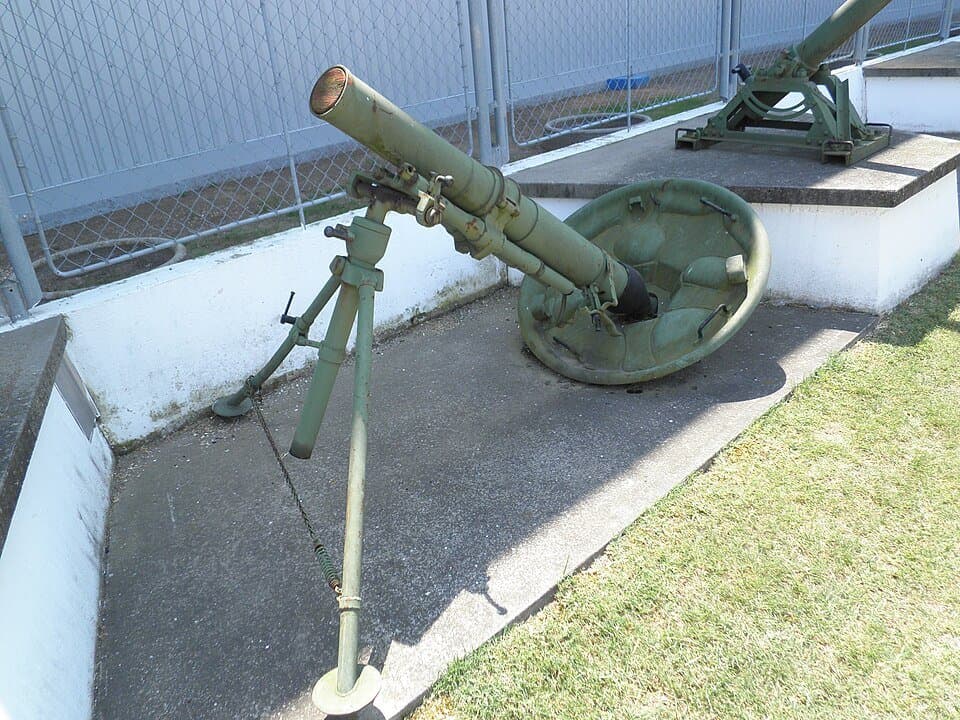
Credit
Cooper6 · CC BY-SA 3.0 · Resized · CC BY-SA 3.0 · Source ↗ · Modified


Preparing your view.

At a glance
120-PM-43 mortarlarger figure on 1 of 1
M19 mortarlarger figure on 0 of 1
Counts only measures both sources give with the same scope. A larger figure is not a better system.
Measured figures
Configuration
| Specification | 120-PM-43 mortar | M19 mortar |
|---|---|---|
| Type | Mortar[source] | Infantry mortar[source] |
| Place of origin | Soviet Union[source] | United States[source] |
| In service | 1943-present[source] | — |
| Used by | Soviet Union[source] | See Users[source] |
| Wars |
Effective; maximum
Single sourceEffective; minimum
Single source5,700 m (6,200 yd) maximum, 500 m (550 yd) minimum[source]
Effective; Effective firing range
Single sourceMaximum; Maximum firing range
Single sourcemaximum, 70 rds/hr sustained
Single source9 rpm maximum, 70 rds/hr sustained[source]
Barrel length
Single source72.6 cm (2 ft 4.6 in)[source]
Bars compare reported quantities only. A larger figure does not make a system better; configurations and test conditions differ.
Eastern Front (World War II) Korean War Vietnam War Cambodian Civil War Rhodesian Bush War Portuguese Colonial War Lebanese Civil War Soviet–Afghan War Gulf War South Sudanese Civil War[source] |
Korean War Vietnam War Laotian Civil War Cambodian Civil War Salvadoran Civil War[source] |
| Manufacturer | Uralmash[source] | Watervliet Arsenal[source] |
|---|
| Breech | muzzle loaded[source] | — |
|---|
| Elevation | +45° to +80°[source] | +40° to +85° on M5 mount free on M1 mount[source] |
|---|
| Shell weight | — | 1.36 kg (3 lb 0 oz)[source] |
|---|
| Traverse | — | 14° on M5 mount free on M1 mount[source] |
|---|
| Feed system | — | manual[source] |
|---|
| Source measurement | — | The M19 mortar is a light, smoothbore , muzzle-loading , high-angle-of-fire weapon for light infantry support developed and produced in the United States. It has been replaced in service by the more modern 60 mm M224 mortar , which has a much longer range and improved ammunition.[source]M19 mortar · Lead; only the objects and conditions stated in this passage The development of the M19 began in 1942 as the T18E6, a light weapon weighing only 19.5 pounds (8.8 kg) and intended to be man-carried troops in rough terrain and quickly brought into action against enemy positions. The primary differences between the M2 and T18E6 was that the M2 was drop-fire only (the bomb being fired by a fixed firing pin at the base of the tube), while the T18E6 could be either drop-fired or a round loaded into the barrel and then fired by a lever-like trigger at the base of the tube. In addition, the original T18E6 only had a simple spade -like M1 baseplate , leaving the elevation and traverse free for the firer like the Japanese Type 89 grenade discharger or British Two-inch mortar .[source]M19 mortar · History and description; only the objects and conditions stated in this passage A 7th Infantry Division operations report from the Battle of Leyte stated that "During this operation, the 60mm Mortar with T18E6 tube and M2 base plate, bipod, and sight, were employed.[source]M19 mortar · History and description; only the objects and conditions stated in this passage This weapon has not proved as efficient as the M2 Mortar, since it is less accurate." Conversely, War Department observers in early 1944 found that after demonstrations of the weapon in the European and Mediterranean Theaters , "The lightness and versatility of the new 60-mm mortar firing mechanism and baseplate were appreciated, and this mortar is preferred to the present standard weapon." Postwar, the T18E6 was standardized as the M19, and saw action during the Korean War and Vietnam War alongside the M2 before being replaced by the M224 mortar in the late 1970s.[source]M19 mortar · History and description; only the objects and conditions stated in this passage |
|---|
| Country of origin | — | United States[source]Inventory Origin column; table 5, row 21, cell 4; revision 1372817704; retrieved 2026-10-01 |
|---|
| Reported operators |
|
|
|---|