
Credit
George Shuklin · CC BY-SA 1.0 · Resized · CC BY-SA 1.0 · Source ↗ · Modified


Preparing your view.
At a glance
100 mm anti-tank gun T-12larger figure on 3 of 3
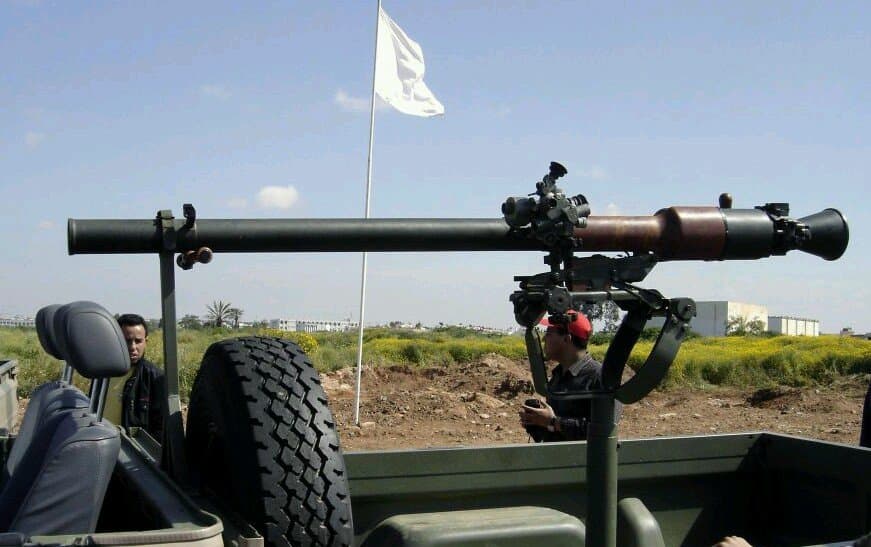
SPG-9larger figure on 0 of 3
Measured figures
Length
Single source9.16 m (30 ft 1 in)[source]
Length
Single sourceConfiguration
| Specification | 100 mm anti-tank gun T-12 | SPG-9 |
|---|---|---|
| Type | Anti-tank gun[source] | Recoilless gun Anti-tank gun[source] |
| Place of origin | Soviet Union[source] | Soviet Union[source] |
| In service | 1961–present[source] | 1962–present[source] |
| Used by | See Operators[source] |
Counts only measures both sources give with the same scope. A larger figure is not a better system.
2.11 m (6 ft 11 in)[source]
Bars compare reported quantities only. A larger figure does not make a system better; configurations and test conditions differ.
| — |
| Wars | See Combat history[source] | Vietnam War Iran–Iraq War Salvadoran Civil War Lord's Resistance Army insurgency Gulf War Lebanese Civil War Iraq War Second Sudanese Civil War Third Sudanese Civil War Libyan Civil Wars Northern Mali conflict Syrian Civil War War in Iraq (2013-2017) War in Donbas Yemeni Civil War (2014–present) Saudi Arabian-led intervention in Yemen 2022 Kyrgyzstan–Tajikistan clashes Russo-Ukraine War Gaza war[source] |
|---|
| Shell | Fixed QF 100 × 910 mmR (R/147mm)[source] | — |
|---|
| Recoil | Hydro-pneumatic[source] | None[source] |
|---|
| Carriage | Transport: Ural-375D (6×6) On road: 60 km/h (37 mph) Off road: 15 km/h (9 mph)[source] | Tripod[source] |
|---|
| Elevation | −10° to +20°[source] | +7°/−3°[source] |
|---|
| Traverse | 27° left or right[source] | 30° total[source] |
|---|
| Former operator · Armenia | Armenia[source] | — |
|---|
| Former operator · Bosnia and Herzegovina | Bosnia and Herzegovina[source] | — |
|---|
| Former operator · Cuba | Cuba[source] | — |
|---|
| Former operator · East Germany | East Germany[source] | — |
|---|
| Former operator · Egypt | Egypt[source] | — |
|---|
| Former operator · Ethiopia | Ethiopia[source] | — |
|---|
| Former operator · Hungary | Hungary[source] | — |
|---|
| Former operator · Iraq | Iraq[source] | — |
|---|
| Former operator · People's Republic of Kampuchea | People's Republic of Kampuchea[source] | — |
|---|
| Former operator · Mongolia | Mongolia[source] | — |
|---|
| Former operator · Somalia | Somalia[source] | — |
|---|
| Former operator · South Yemen | South Yemen[source] | — |
|---|
| Former operator · Soviet Union | Soviet Union[source] | — |
|---|
| Former operator · Yugoslavia | Yugoslavia[source] | — |
|---|
| Role | Soviet -designed 100-mm anti-tank gun[source] | tripod-mounted man-portable, 73mm caliber recoilless gun[source] |
|---|
| Source measurement | 2A19 or T-12 is a Soviet -designed 100-mm anti-tank gun . It was the first anti-tank gun to adopt a smoothbore barrel, and to introduce modern armor piercing shot, like the APFSDS . It uses long projectiles that are more powerful than its caliber suggests. The T-12 served as the primary towed anti-tank artillery in the Soviet and Bulgarian armies from the early 1960s to the late 1980s.[source]100 mm anti-tank gun T-12 · Lead; only the objects and conditions stated in this passage The T-12 was designed by the construction bureau of the Yurga Machine-Building Plant as a replacement for the BS-3 100 mm gun . The first serial examples were produced in 1955, but the T-12 entered service only in 1961. Its special feature was the use of a smoothbore gun. The T-12 was typically deployed in the anti-tank units of armored and motor rifle regiments to protect flanks against counter-attacks during rapid advances.[source]100 mm anti-tank gun T-12 · History; only the objects and conditions stated in this passage By the mid-1990s, modern western tanks' frontal armor protection could no longer be penetrated by a 100 mm gun. The 100 mm caliber ammunition had reached the limits of what could be achieved with it. For a static anti-tank that cannot move to attack the sides of an opponent this is particularly problematic. Today, the T-12 is used mostly in the role of ordinary artillery, using FRAG-HE shells. The T-12 was planned to be superseded by the 2A45 Sprut-B 125 mm smooth bore anti-tank gun.[source]100 mm anti-tank gun T-12 · History; only the objects and conditions stated in this passage Another reason to use a smoothbore barrel for armor piercing shot, is that smoothbore guns allow for higher pressures, and thus higher projectile speeds. The result is that the T-12 fired a conspicuously long APFSDS projectile. This BM2 shot (see picture) had a diameter of 38 mm (1.5 in) and used 8.75 kg (19.3 lb) of propellant instead of less than 6 kg (13 lb) for the existing Soviet tank gun. It was fired at a muzzle velocity of 1,540 m/s (5,100 ft/s) as opposed to only 900 m/s (3,000 ft/s) for the usual armor piercing shot. At 1,000 m (3,300 ft) this improved armor penetration from 185 mm (7.3 in) to 230 mm (9.1 in), enough to penetrate most NATO tanks of the period.[source]100 mm anti-tank gun T-12 · Description / A revolutionary smoothbore gun; only the objects and conditions stated in this passage In 1958 Nikita Khrushchev saw the T-12 and was so enthusiastic about the gun, that he wanted it placed in the T55 . However, the long ammunition would not fit in the existing Soviet medium-tank turrets. Therefore, the 115 mm U-5TS gun of the T-62 was developed with a larger caliber, so it could use more propellant while not requiring the very long T-12 cartridges.[source]100 mm anti-tank gun T-12 · Description / A revolutionary smoothbore gun; only the objects and conditions stated in this passage The T-12 used the carriage of the 85 mm anti-tank gun D-48 . In fact the only difference between the T-12 and the D-48 was the barrel. Both can be told apart by the muzzle brake , which becomes wider towards the end of the D-48's barrel, but has the same width throughout for the T-12 and MT-12. The wheels of both D-48 and T-12 are secured by six bolts. The carriage of the T-12 did not allow it to be towed cross-country by fast tracked vehicles. It was therefore usually towed by trucks. This limited the T-12's cross country movement to only 15 km/h (9.3 mph).[source]100 mm anti-tank gun T-12 · Description / Other charactertistics; only the objects and conditions stated in this passage The standard equipment of the T-12 includes multiple sights . The indirect aiming mechanism consists of the S71-40 mechanism with panoramic PG-1M sight. The OP4M-40U sight is used for direct fire. The APN-5-40 or APN-6-40 are used for direct fire by night.[source]100 mm anti-tank gun T-12 · Description / Other charactertistics; only the objects and conditions stated in this passage Note: penetration numbers for RHA at 90 degrees.[source]100 mm anti-tank gun T-12 · Ammunition; only the objects and conditions stated in this passage Round weight: 19.34 kg (42.6 lb)[source]100 mm anti-tank gun T-12 · Ammunition / APFSDS; only the objects and conditions stated in this passage Projectile weight: 5.65 kg (12.5 lb)[source]100 mm anti-tank gun T-12 · Ammunition / APFSDS; only the objects and conditions stated in this passage Muzzle velocity: 1,575 m/s (5,170 ft/s)[source]100 mm anti-tank gun T-12 · Ammunition / APFSDS; only the objects and conditions stated in this passage Maximum range: 3,000 m (3,300 yd)[source]100 mm anti-tank gun T-12 · Ammunition / APFSDS; only the objects and conditions stated in this passage Penetration: 230 mm at 500 m (9 in at 550 yd) 180 mm at 2,000 m (7 in at 2,200 yd) 140 mm at 3,000 m (5.5 in at 3,300 yd)[source]100 mm anti-tank gun T-12 · Ammunition / APFSDS; only the objects and conditions stated in this passage Round weight: 19.9 kg (44 lb)[source]100 mm anti-tank gun T-12 · Ammunition / APFSDS; only the objects and conditions stated in this passage Projectile weight: 4.55 kg (10.0 lb)[source]100 mm anti-tank gun T-12 · Ammunition / APFSDS; only the objects and conditions stated in this passage Muzzle velocity: 1,548 m/s (5,080 ft/s)[source]100 mm anti-tank gun T-12 · Ammunition / APFSDS; only the objects and conditions stated in this passage Penetration: 225 mm at 1000 m (8.8 in at 1100 yd)[source]100 mm anti-tank gun T-12 · Ammunition / APFSDS; only the objects and conditions stated in this passage Round weight: 23.1 kg (51 lb)[source]100 mm anti-tank gun T-12 · Ammunition / HEAT; only the objects and conditions stated in this passage Projectile weight: 9.5 kg (21 lb)[source]100 mm anti-tank gun T-12 · Ammunition / HEAT; only the objects and conditions stated in this passage Muzzle velocity: 975 m/s (3,200 ft/s)[source]100 mm anti-tank gun T-12 · Ammunition / HEAT; only the objects and conditions stated in this passage Maximum range: 1,000 m (1,100 yd)[source]100 mm anti-tank gun T-12 · Ammunition / HEAT; only the objects and conditions stated in this passage Penetration: 400 mm (16 in)[source]100 mm anti-tank gun T-12 · Ammunition / HEAT; only the objects and conditions stated in this passage Round weight: 28.9 kg (64 lb)[source]100 mm anti-tank gun T-12 · Ammunition / HE-FRAG; only the objects and conditions stated in this passage Projectile weight: 16.7 kg (37 lb)[source]100 mm anti-tank gun T-12 · Ammunition / HE-FRAG; only the objects and conditions stated in this passage Muzzle velocity: 700 m/s (2,300 ft/s)[source]100 mm anti-tank gun T-12 · Ammunition / HE-FRAG; only the objects and conditions stated in this passage Maximum range (indirect): 8,200 m (9,000 yd)[source]100 mm anti-tank gun T-12 · Ammunition / HE-FRAG; only the objects and conditions stated in this passage Round weight: 24.5 kg (54 lb)[source]100 mm anti-tank gun T-12 · Ammunition / Guided projectile; only the objects and conditions stated in this passage Projectile weight: 17.6 kg (39 lb)[source]100 mm anti-tank gun T-12 · Ammunition / Guided projectile; only the objects and conditions stated in this passage Average speed: 300 m/s (980 ft/s)[source]100 mm anti-tank gun T-12 · Ammunition / Guided projectile; only the objects and conditions stated in this passage Range: 100–5,000 m (110–5,470 yd)[source]100 mm anti-tank gun T-12 · Ammunition / Guided projectile; only the objects and conditions stated in this passage Penetration: 550–600 mm (22–24 in)[source]100 mm anti-tank gun T-12 · Ammunition / Guided projectile; only the objects and conditions stated in this passage A407 - This artillery system was designed by Arsenal-Resita and is very similar to the MT-12. It can fire the same range of ammunition as the T-54/55 tank and has a maximum range of 2,200 m (7,200 ft) (HEAT) or 4,000 m (13,000 ft) (APC-T). Subversions are the A407M1 and the A407M2 . In Romanian Army service, the A407 is known as the 100 mm anti-tank gun M1977 ( Romanian : Tun antitanc calibrul 100-mm Model 1977 ) and is normally towed by the DAC 887R truck. It can also be towed with the DAC 665T truck. The Model 2002 is an improved version, fitted with the automatic fire control system TAT-100.[source]100 mm anti-tank gun T-12 · Variants / Romania; only the objects and conditions stated in this passage Type 86 - This is a 100mm smoothbore anti-tank gun that has some similarities with the 85mm Type 56 (D-44) . It fires ammunition of the fixed type, including the Type 73 HE, Type 73 HEAT, Type 73 APFSDS and Type 86 APFSDS to a maximum range of 1,800 m (5,900 ft).[source]100 mm anti-tank gun T-12 · Variants / People's Republic of China; only the objects and conditions stated in this passage | The SPG-9 Kop'yo ( Russian : СПГ-9 Копьё , transliterated: Stankovyi Protivotankovyi Granatomet "Kop'yo" - Easel Anti-tank Grenade Launcher "Spear") is a tripod-mounted man-portable, 73mm caliber recoilless gun developed by the Soviet Union . It fires fin-stabilized, rocket-assisted high explosive (HE) and high-explosive anti-tank (HEAT) shaped charge projectiles similar to those fired by the 73mm 2A28 Grom low pressure gun of the BMP-1 armored vehicle. It was accepted into service in 1962, replacing the B-10 recoilless rifle .[source]SPG-9 · Lead; only the objects and conditions stated in this passage The projectile is launched from the gun by a small charge, which gives it an initial velocity of between 250–400 metres per second (820–1,310 ft/s). The launch charge also imparts spin to the projectile by a series of offset holes. Once the projectile has traveled approximately 20 metres (66 ft) from the launcher, a rocket motor in its base ignites. For the PG-9 projectile, this takes it to a velocity of 700 metres per second (2,300 ft/s) before the motor burns out.[source]SPG-9 · Description; only the objects and conditions stated in this passage The SPG-9 is heavy, ~60 kilograms (130 lb), and normally transported by vehicle, and carried into position by its two person crew. It can be deployed in about a minute. The weapon is in service with a large number of armed forces, and a variety of ammunition is produced; however, they are mostly copies of the original Soviet PG-9 HEAT and OG-9 fragmentation high explosive (Frag-HE) rounds.[source]SPG-9 · Description; only the objects and conditions stated in this passage |
|---|
| Country of origin | Soviet Union[source]Inventory Origin column; table 2, row 23, cell 2; revision 1345547771; retrieved 2026-10-01 Soviet Union[source]Inventory Origin column; table 5, row 5, cell 3; revision 1377349402; retrieved 2026-10-02 Soviet Union[source]Inventory Origin column; table 26, row 4, cell 6; revision 1377394124; retrieved 2026-10-01 | — |
|---|
| Breech | — | Interrupted screw[source] |
|---|
| Feed system | — | Manually breech-loaded[source] |
|---|
| Sights | — | PGO-9 optical 4× sight or PGN-9 IR and passive night sight[source] |
|---|
| Reported operators |
|
|
|---|