


Preparing your view.

At a glance
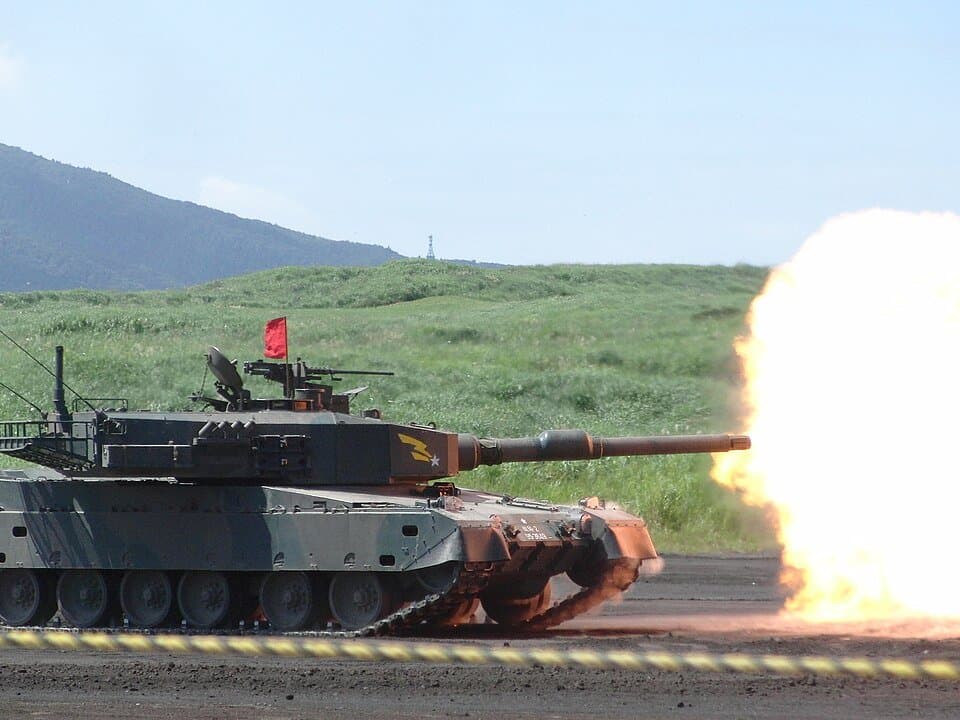
Type 90 tanklarger figure on 2 of 4
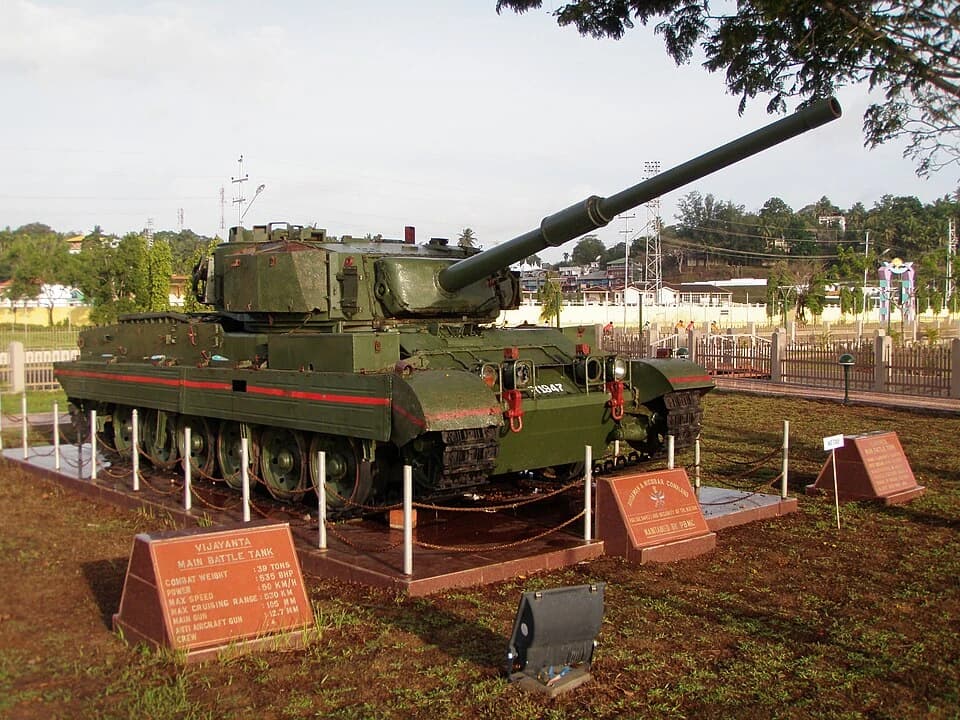
Vickers MBTlarger figure on 2 of 4
True scale
Side by side. From every angle. A human reference for perspective.
3.06 MB · Loads when you open it| Model | Length | Width / span | Height |
|---|---|---|---|
| Type 90 tank | ≈ 9.76 m | ≈ 3.43 m (Width) | ≈ 2.76 m |
| Vickers MBT | ≈ 9.73 m | ≈ 3.17 m (Width) | ≈ 3.05 m |
Scaled uniformly to the sourced length of 9.76 m. The width was fitted to the sourced 3.43 m. Not an official model or a measured survey.
ForceTally · All rights reserved
Scaled uniformly to the sourced length of 9.73 m. The width was fitted to the sourced 3.17 m. Not an official model or a measured survey.
ForceTally · All rights reserved
The human reference is a generic 1.75 m figure. Models describe external size, not combat performance.
Measured figures
Length
Single source9.76 m[source]
overall gun forward
Single sourceConfiguration
| Specification | Type 90 tank | Vickers MBT |
|---|---|---|
| Type | Main battle tank[source] | Main battle tank[source] |
| Place of origin | Japan[source] | United Kingdom[source] |
| Designer | Mitsubishi Heavy Industries / Japan Ministry of Defense Technology Research and Development Institute[source] | Vickers[source] |
| Manufacturer | Mitsubishi Heavy Industries[source] |
Counts only measures both sources give with the same scope. A larger figure is not a better system.
9.73 m (31 ft 11 in) overall gun forward[source]
Mitsubishi 10ZG32WT 10-cylinder, two-stroke cycle /2,400 rpm diesel 21.5 litre
Single sourceMitsubishi 10ZG32WT 10-cylinder, two-stroke cycle, 1,500 hp/2,400 rpm diesel 21.5 litre[source]
Leyland L60 (multi-fuel 2-stroke opposed-piston compression-ignition ) 6 cyl, 19 litres
Single sourceLeyland L60 (multi-fuel 2-stroke opposed-piston compression-ignition ) 535 hp (399 kW) 6 cyl, 19 litres[source]
Bars compare reported quantities only. A larger figure does not make a system better; configurations and test conditions differ.
Vickers Defence Systems[source]
| Unit cost | JPY¥800 Million (2009)[source] | — |
|---|
| Produced | 1990–2009[source] | 1964–1994[source] |
|---|
| No. built | 341[source] | — |
|---|
| Armor | Modular ceramic composite armour[source] | — |
|---|
| Main armament | Rheinmetall 120mm L/44 smoothbore gun with automatic loader[source] | 1 x 105 mm L7A1 gun (44 rounds)[source] |
|---|
| Secondary armament | M2HB 12.7 mm machine gun Type 74 7.62 mm machine gun[source] | 1 x 12.7 mm L6A1 ranging machine gun with 700 rounds 1 x 7.62 mm MG (pintle mount) with 1,300 rounds 1 x 7.62 mm MG (coax) with 1,300 rounds[source] |
|---|
| Power/weight | 30 hp/tonne[source] | 13.79 bhp/t[source] |
|---|
| Transmission | Mitsubishi MT1500 automatic transmission (4 forward gears, 2 reverse gears )[source] | Merrit-Wilson TN-12 (6 fwd / 2 rev) with a triple differential steering system[source] |
|---|
| Suspension | hydropneumatic[source] | Torsion bars[source] |
|---|
| Role | main battle tank (MBT) of the Japan Ground Self-Defense Force (JGSDF)[source] | series of main battle tanks (MBTs)[source] |
|---|
| Source measurement | A first series of two prototypes of the Type 90 were developed, both armed with a Japanese 120 mm smoothbore gun (produced by Japan Steel Works Limited) firing Japanese ammunition (produced by Daikin Industries Limited).[source]Type 90 tank · History; only the objects and conditions stated in this passage A second series of four prototypes was built between 1986 and 1988, incorporating changes resulting from trials with the first two prototypes. These were armed with the Rheinmetall 120 mm smoothbore gun also fitted to the German Leopard 2 and, in a modified version, the US M1A1/M1A2 Abrams main battle tanks. These second prototypes were used for development and then user trials, all of which were completed by December 1989, before Japan formally introduced the Type 90 in August 1990. Mass production began in 1990, and 30 vehicles were produced by the end of the year.[source]Type 90 tank · History; only the objects and conditions stated in this passage With the exception of the 120 mm smoothbore gun, which is made under license from Rheinmetall of Germany , the Type 90 and its subsystems are all designed and built in Japan, leading to higher per unit costs than comparable models from NATO countries such as the M1 Abrams and the Challenger 2 . Development of upgrades to the Type 90 suffered both as a result of limited budget, which caused procurement delays, and funding prioritization in favor of the Type 10 main battle tank . Due to a perception that Type 90s are unsuited to operations in the tight confines of Japan's urban areas, they are preferentially assigned to the JGSDF Fuji School Brigade and the 7th Armored Division based in Hokkaido , where there is sufficient room for maneuver.[source]Type 90 tank · History; only the objects and conditions stated in this passage The Type 90 mounts a Rheinmetall L44 120 mm smoothbore cannon licensed produced by Japan Steel Works Limited. This is the same gun that is mounted on the German Leopard 2 , the American Abrams , and the South Korean K1A1 tank. Before Rheinmetall's gun was selected, Japan had successfully produced a domestic version of the 120 mm smoothbore for testing, but the lower cost of the Rheinmetall gave it an advantage over the domestic version. .[source]Type 90 tank · Design / Armament; only the objects and conditions stated in this passage Since its introduction there have been several upgrades to the fire-control system , including the addition of a Yttrium-Aluminium-Garnet laser rangefinder with a range of 300 to 5,000 meters, a 32-bit ballistics analysis computer, improved thermal imaging and Automated-tracking systems, and improved gun stabilization. The FCS also has an automated tracking system, and is capable of engaging moving or stationary targets while moving in day or night. The automatic target tracking system uses a thermal image display which can be controlled by either the tank gunner or commander. It is capable of tracking soldiers, vehicles and helicopters. The targeting computer can also calculate lead on moving targets.[source]Type 90 tank · Design / Armament; only the objects and conditions stated in this passage The commander's sight consists of a 3× / 10× (day-only sight). The sight can track vertically from −29 to +29 degrees, as well as track horizontally through 180 degrees. The gunners sight has a 10 x magnification.[source]Type 90 tank · Design / Armament; only the objects and conditions stated in this passage The gun is armed and loaded by a mechanical bustle autoloader (conveyor-belt type) developed by Mitsubishi of Japan. As with autoloader-equipped Russian main battle tanks, the French Leclerc , and the Swedish Strv 103 , the Type 90 achieves manpower savings by reducing the crew to three. Its ability to operate without a loader also allows the use of a smaller turret. The practical auto-loading and firing cycle for one target is around 4–6 seconds.[source]Type 90 tank · Design / Armament; only the objects and conditions stated in this passage Mounted in front of the gunner's hatch on the turret is the ubiquitous Browning M2 machine gun , manufactured under license by Sumitomo Heavy Industries , part of the Sumitomo Group . In addition to the .50-caliber machine gun, a Japanese-built 7.62 mm machine gun is mounted coaxially to the left of the main gun.[source]Type 90 tank · Design / Armament; only the objects and conditions stated in this passage The Type 90 is smaller than most main battle tanks with a height of 2.33 metres (7.6 ft), a width of 3.33 metres (10.9 ft), and a weight of 50.2 metric tons (55.3 short tons). It was designed with a distinctive low-slung turret with boxy, vertical sides and a long overhanging bustle . In comparison, the Leopard 2A4's dimensions are 2.48 metres (8.1 ft) high and 3.70 metres (12.1 ft) wide with a weight of 55.2 metric tons (60.8 short tons).[source]Type 90 tank · Design / Armor; only the objects and conditions stated in this passage The powerpack of the Type 90 tank has the Mitsubishi 10ZG32WT 10-cylinder two-stroke cycle diesel engine providing 1500 hp, coupled with Mitsubishi MT1500 automatic transmission with four forward and two reverse gears, manufactured by Mitsubishi Heavy Industries (designated 10ZG32WT, MT1500). The development of the 10ZG32WT prototype was started in 1972 and was finished in 1982. It can attain a top output of 1,120 kW (1,500 horsepower @15min).[source]Type 90 tank · Design / Mobility; only the objects and conditions stated in this passage According to the Japanese Ministry of Defense official data report, the acceleration of the type is 0–200 m in 20 seconds.[source]Type 90 tank · Design / Mobility; only the objects and conditions stated in this passage Being 12 tonnes heavier than its predecessor, the Type 74, the Type 90 was found to be more challenging to operate around Japan, with the exception of Hokkaido. Some politicians therefore criticized the effectiveness of Type 90 due to difficulty in transportation. In fact, more than 65% of major bridges in Japan were still considered passable for the Type 90, while overseas main battle tanks, such as Challenger 2 and Leopard 2, could only use 40% of bridges in Japan.[source]Type 90 tank · Design / Transportation; only the objects and conditions stated in this passage | The Vickers MBT followed on from a 24-tonne 20-pdr gunned tank design intended for export. This would be as well equipped as a Centurion but substantially cheaper and with eight Vickers Vigilant anti-tank missiles it would be as effective. However, with the introduction of the 105 mm L7 gun into the British, US and German tank designs, this light tank would have been less powerful while too large for the reconnaissance role, and so a new design was required. With armour twice that of the light tank design, it would still be 12 tonnes lighter than Centurion and hence more mobile. The design would use the new engine and transmission of the Chieftain tank then being developed. The development coincided with an agreement with India in 1961 to produce a tank design and help set up a factory there to produce it.[source]Vickers MBT · Design and development; only the objects and conditions stated in this passage The Vickers was made of welded rolled homogeneous armour plates. It weighed 38,600 kg, carried a 105 mm gun with 44 rounds and had a top speed of 48 km/h. 70 tanks were sold to Kuwait and many of a modified version were made in India where the tank was called Vijayanta .[source]Vickers MBT · Design and development; only the objects and conditions stated in this passage The 1968 proposal for a vehicle specification that differed from the Mark 1 in the following respects:[source]Vickers MBT · Other developments / Vickers Main Battle Tank Mark 2; only the objects and conditions stated in this passage Improved track, suitable for 56 km/h (35 mph) continuously.[source]Vickers MBT · Other developments / Vickers Main Battle Tank Mark 2; only the objects and conditions stated in this passage Provision for fitting four Swingfire wire-controlled anti-tank missiles (intended as a response to weapons of greater range, such as the 120 mm L11 tank gun. |
|---|
| In service | — | 1965–2008[source] |
|---|
| Used by | — | See Operators[source] |
|---|
| Wars | — | Indo-Pakistani War of 1965 Indo-Pakistani War of 1971 Iraqi invasion of Kuwait 2019 India–Pakistan standoff[source] |
|---|
| Armour | — | Gun mantlet : 80 mm Turret front: 60 mm Turret sides: 40 mm Glacis: 60 mm Lower hull front: 80 mm Hull sides: 30 mm[source] |
|---|
| Former operator · India | — | India[source] |
|---|
| Former operator · Kuwait | — | Kuwait[source] |
|---|
| Former operator · Iraq | — | Iraq[source] |
|---|
| Former operator · Boko Haram | — | Boko Haram[source] |
|---|
| Country of origin | — | United Kingdom[source]Inventory Origin column; table 12, row 5, cell 5; revision 1377602121 |
|---|
| Reported operators | — |
|---|
The Mk. 3 was introduced in 1975 for the export market. It was the last of the Vickers tanks to see sales in numbers abroad. In 1974, Vickers pressed on with development of a Mark 3 version. This stems from Design No. 51400 T and differs from the Mark 1 mainly in having a turret with a well-shaped cast front welded to a fabricated armour plate body. It also has a cast gun mantlet which is better shaped from the point of view of its resistance to armour-piercing projectiles than the flat mantlet of the Mark. 1. The Mark 3 embodies various other improvements, such as an increase in the depression of its main gun from -7 to -10 degrees below the horizontal and an increase in the ammunition from 44 to 50 rounds. The first production order for Mk. 3 tanks was placed in 1977 by the Government of Kenya[source]Vickers MBT · Other developments / Vickers Main Battle Tank Mark 3; only the objects and conditions stated in this passage
In 1977, Vickers produced a design for a vehicle that incorporated Chobham composite armour protection within a battle weight of 43 tonnes. This first prototype, designated the Vickers Main Battle Tank Mark 4.[source]Vickers MBT · Other developments / Vickers Main Battle Tank Mark 4 (Valiant); only the objects and conditions stated in this passage
Equipped with the Marksman turret, as well as a self-propelled 155mm howitzer with the GBT 155 turret. The GBT 155 was unveiled in 1982 and was armed with the same 155mm ordnance as the AS-90 . It was designed primarily for existing tank chassis.[source]Vickers MBT · Other developments / Vickers Anti-aircraft Tank; only the objects and conditions stated in this passage