



Preparing your view.

At a glance
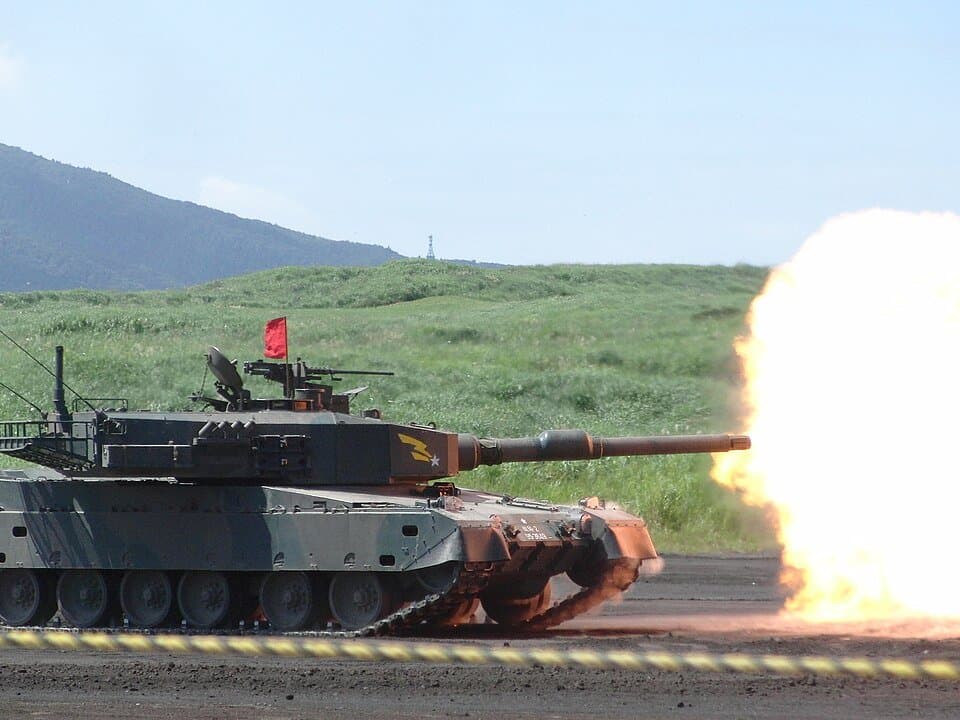
Type 80/88 main battle tanklarger figure on 0 of 3
True scale
Side by side. From every angle. A human reference for perspective.
3.15 MB · Loads when you open it| Model | Length | Width / span | Height |
|---|---|---|---|
| Type 80/88 main battle tank | ≈ 8.67 m | ≈ 3.37 m (Width) | ≈ 2.84 m |
| Type 90 tank | ≈ 9.76 m | ≈ 3.43 m (Width) | ≈ 2.76 m |
Scaled uniformly so that the hull matches the sourced 6.325 m vehicle hull length. The width was fitted to the sourced 3.372 m. Not an official model or a measured survey.
ForceTally · All rights reserved
Scaled uniformly to the sourced length of 9.76 m. The width was fitted to the sourced 3.43 m. Not an official model or a measured survey.
ForceTally · All rights reserved
The human reference is a generic 1.75 m figure. Models describe external size, not combat performance.
Measured figures
gun forward; Type 80/88
Single sourcegun forward; Type 85-III
Single sourceConfiguration
| Specification | Type 80/88 main battle tank | Type 90 tank |
|---|---|---|
| Type | Main battle tank[source] | Main battle tank[source] |
| Place of origin | China[source] | Japan[source] |
| In service | 1988–present[source] | — |
| Used by | See Operators[source] | — |
| Wars | See Operational history |
Type 90 tanklarger figure on 3 of 3
Counts only measures both sources give with the same scope. A larger figure is not a better system.
vehicle hull
Single source6.325 m (vehicle hull) 9.336m (gun forward; Type 80/88) 10.369m (gun forward; Type 85-III)[source]
Length
Single source9.76 m[source]
Bars compare reported quantities only. A larger figure does not make a system better; configurations and test conditions differ.
| — |
| Designed | 1978 (Type 80) 1981–1987 (Type 88)[source] | — |
|---|
| Manufacturer | Norinco[source] | Mitsubishi Heavy Industries[source] |
|---|
| Variants | Type 80 Type 85 Type 88[source] | — |
|---|
| Armor | Type 80: Cast Steel Turret Type 85II/Type 88: Welded Steel/Composite Armor Turret. May be fitted with Explosive Reactive Armor[source] | Modular ceramic composite armour[source] |
|---|
| Main armament | ZPL-79 105mm rifled gun (Type 80) ZPL-83 105mm rifled gun (Type 88) ZPL-83A 105mm rifled gun (Type 85/88B) ZPL-94 105mm rifled gun (Type 88A) ZPT-88C 125mm smoothbore gun (Type 85IIA/Type 88C)[source] | Rheinmetall 120mm L/44 smoothbore gun with automatic loader[source] |
|---|
| Secondary armament | Type 59 7.62 mm coaxial machine gun Type 59 12.7 mm air-defence machine gun[source] | M2HB 12.7 mm machine gun Type 74 7.62 mm machine gun[source] |
|---|
| Power/weight | 18.9hp/ton (Type 80/85/88)[source] | 30 hp/tonne[source] |
|---|
| Fuel capacity | 1433L[source] | — |
|---|
| Role | family of Chinese second-generation main battle tanks (MBTs)[source] | main battle tank (MBT) of the Japan Ground Self-Defense Force (JGSDF)[source] |
|---|
| Source measurement | In a trial between the Type 80-II and the AMX-32 , the Type 80-II required 8 hours to change its engine, while the AMX-32 only required an hour.[source]Type 80/88 main battle tank · History / Type 80 and Type 85 development; only the objects and conditions stated in this passage Due to export restrictions, the Chinese were unable to use an imported 105mm gun on the Type 85 tank.[source]Type 80/88 main battle tank · History / Type 80 and Type 85 development; only the objects and conditions stated in this passage This led to the development of the first locally designed 105mm gun.[source]Type 80/88 main battle tank · History / Type 80 and Type 85 development; only the objects and conditions stated in this passage This led to further upgrades in the Type 85 to its engine from 730 hp to 800 hp and changing to a semi-auto transmission.[source]Type 80/88 main battle tank · History / Type 80 and Type 85 development; only the objects and conditions stated in this passage The Type 80 inherited the design philosophy of the Type 69/79 which combined a Soviet-style chassis and turret with Western technology. Like the Type 69 series, the initial Type 80 design possessed a hemispherical turret similar to the T-54/55 . Another similarity was that the driver sat in the left forward section of the hull. However, the Type 80 used a licence-built L7 rifled gun instead of the Soviet 100 mm rifled gun .[source]Type 80/88 main battle tank · Design / Overview; only the objects and conditions stated in this passage The Type 85-I (Storm-1) series had a new welded turret design that was angular instead of the familiar bowl-shape. The Type 85IIAP/M was the first tank in the series to be equipped with a 125 mm smoothbore gun.[source]Type 80/88 main battle tank · Design / Overview; only the objects and conditions stated in this passage Type 80 served as a testbed for the imported ZPL-79 105 mm rifled gun. On Type 88 and Type 88B, the main armament is a dual-axis stabilized ZPL-83 and ZPL-83A 105 mm rifled gun with a fume extractor at its midway point. On Type 88A, the main gun is replaced by a longer, 62-caliber ZPL-94 , offering longer range, higher accuracy, and capability to launch laser-guided gun-launched missiles. The main gun has an elevation of -5 to 18 degrees and an electronic turret drive of 20°/s for horizontal control and 6°/s for vertical. The main gun on Type 80 is loaded manually and has a rate of fire of approximately 7 rounds per minute. On Type 88B, a form of assist loader is introduced for quicker and easier reload operations with a reportedly 13 rounds per minute maximum rate of fire.[source]Type 80/88 main battle tank · Design / Armaments; only the objects and conditions stated in this passage Secondary armaments for all variants are the same, including one Type 59 12.7 mm heavy machine gun mounted on the turret roof, and one Type 59 7.62 mm coaxial machine gun. The Type 80 and Type 88 can store 44 rounds of ammunition for the main gun. On Type 88B and Type 88A, the tank features redesigned ammo racks with 48 rounds of ammunition. The 12.7 mm heavy machine gun has 300 rounds of ammo, while the coaxial machine gun has 2250 rounds.[source]Type 80/88 main battle tank · Design / Armaments; only the objects and conditions stated in this passage All versions of the Type 80/85/88 tanks are fitted with thermal suppression camouflage paint, a collective NBC protection system, an air filtration and ventilation system, an automatic fire/after-effect suppression system, and 2 sets of four 76mm smoke grenade dischargers.[source]Type 80/88 main battle tank · Design / Protection; only the objects and conditions stated in this passage Type 80 and Type 88 tanks are powered by 12150ZL diesel engine developing 730 hp (537 kW). The maximum road speed is 57 km/h and the average off-road speed is 32 km/h. The power-to-weight ratio is about 18.9 hp/ton. The transmission has 5 forward gears and 1 reverse gear. It has a maximum cruising range of 500 km and can negotiate a gradient of 61% and a side slope of 58%. It can cross a vertical obstacle of 0.8 m and a trench of 2.7m.[source]Type 80/88 main battle tank · Design / Mobility; only the objects and conditions stated in this passage Prototype Chinese second-generation tank design which did not enter production. Uses an older-style round steel cast turret with a new chassis. Four-man crew. Came with NBC protection. The vehicle served as a testbed for the imported ZPL-79 105mm rifled gun. Main difference between Type 80 and Type 80-I was in the fire control system with the original range finding laser mounted on the gun mantlet incorporated into the tank commander's gun sight.[source]Type 80/88 main battle tank · Variants / Type 80; only the objects and conditions stated in this passage Type 80 was developed for export purposes. Type 80-II had a new 12150ZL(G) engine developing 790 hp (588 kW), new transmission, air ventilation system, improved vehicle radio system, and thermal smoke generator.[source]Type 80/88 main battle tank · Variants / Type 80; only the objects and conditions stated in this passage Type 80-II chassis with welded turret. Also known as Storm-I. Had a 730 hp engine.[source]Type 80/88 main battle tank · Variants / Type 85/Storm; only the objects and conditions stated in this passage Type 80/88 chassis with welded turret. Also known as Storm-II. Featured a locally developed ZPL-94 105mm gun, 800 hp engine and semi-automatic transmission.[source]Type 80/88 main battle tank · Variants / Type 85/Storm; only the objects and conditions stated in this passage Upgraded variant of the Type 85-II/Storm-2 to suit Pakistan's specifications. The 105mm gun was changed to a 125 mm smooth-bore gun with an autoloader. The original four-man crew was reduced to a three-man crew. Pakistan had originally wanted a 1000 hp engine, but this was not available in China at the time. Export designation to Pakistan was Type 85-IIM or Type 85-IIAP (The "P" standing for "Pakistan").[source]Type 80/88 main battle tank · Variants / Type 85/Storm; only the objects and conditions stated in this passage Developed in 1993. Upgrade for the Storm-II/Type 85-IIM with 1000 hp engine, ERA, improved FCS, and thermal night sight. It used the transmission from the T-72 tank. In 1994, when China competed against the Ukrainian T-84 for export to a tropical country, the Type 85-III performed better but suffered a higher number of faults and was thus not chosen.[source]Type 80/88 main battle tank · Variants / Type 85/Storm; only the objects and conditions stated in this passage Despite the name, Type 88B was the first mass-produced Type 88 variant. The Type 80 underwent further development and was accepted into PLA service in 1988, hence its designation was changed to Type 88. It was mounted with ZPL-83A 105mm gun which could fire all 105mm NATO gun ammunition.[source]Type 80/88 main battle tank · Variants / Type 88; only the objects and conditions stated in this passage Later variant of the Type 88B. Distinguished from Type 88B by type of 105 mm gun mounted. The Type 88A mounts a 62 caliber ZPL-94 105mm gun that is longer than the NATO L7 cannon and is capable of firing ATGMs .[source]Type 80/88 main battle tank · Variants / Type 88; only the objects and conditions stated in this passage Type 85-III was produced for domestic service in the PLA. Uses an angular welded turret. Armed with a 125 mm ZPT-98 smoothbore gun with an autoloader. Equipped with JSFCS-212 fire control system (FCS) (with laser rangefinder, ballistics computer, stabilized gunner's sight and dual-axis gun stabilization), and Type 889B radio with range of up to 30 km. Later renamed to Type 96 .[source]Type 80/88 main battle tank · Variants / Type 88C; only the objects and conditions stated in this passage Type 85-IIM variant with 125mm gun[source]Type 80/88 main battle tank · Variants / Type 88C; only the objects and conditions stated in this passage | A first series of two prototypes of the Type 90 were developed, both armed with a Japanese 120 mm smoothbore gun (produced by Japan Steel Works Limited) firing Japanese ammunition (produced by Daikin Industries Limited).[source]Type 90 tank · History; only the objects and conditions stated in this passage A second series of four prototypes was built between 1986 and 1988, incorporating changes resulting from trials with the first two prototypes. These were armed with the Rheinmetall 120 mm smoothbore gun also fitted to the German Leopard 2 and, in a modified version, the US M1A1/M1A2 Abrams main battle tanks. These second prototypes were used for development and then user trials, all of which were completed by December 1989, before Japan formally introduced the Type 90 in August 1990. Mass production began in 1990, and 30 vehicles were produced by the end of the year.[source]Type 90 tank · History; only the objects and conditions stated in this passage With the exception of the 120 mm smoothbore gun, which is made under license from Rheinmetall of Germany , the Type 90 and its subsystems are all designed and built in Japan, leading to higher per unit costs than comparable models from NATO countries such as the M1 Abrams and the Challenger 2 . Development of upgrades to the Type 90 suffered both as a result of limited budget, which caused procurement delays, and funding prioritization in favor of the Type 10 main battle tank . Due to a perception that Type 90s are unsuited to operations in the tight confines of Japan's urban areas, they are preferentially assigned to the JGSDF Fuji School Brigade and the 7th Armored Division based in Hokkaido , where there is sufficient room for maneuver.[source]Type 90 tank · History; only the objects and conditions stated in this passage The Type 90 mounts a Rheinmetall L44 120 mm smoothbore cannon licensed produced by Japan Steel Works Limited. This is the same gun that is mounted on the German Leopard 2 , the American Abrams , and the South Korean K1A1 tank. Before Rheinmetall's gun was selected, Japan had successfully produced a domestic version of the 120 mm smoothbore for testing, but the lower cost of the Rheinmetall gave it an advantage over the domestic version. . |
|---|
| Country of origin | China[source]Inventory Origin column; table 8, row 6, cell 4; revision 1373722962; retrieved 2026-10-02 | — |
|---|
| Designer | — | Mitsubishi Heavy Industries / Japan Ministry of Defense Technology Research and Development Institute[source] |
|---|
| Unit cost | — | JPY¥800 Million (2009)[source] |
|---|
| Produced | — | 1990–2009[source] |
|---|
| No. built | — | 341[source] |
|---|
| Transmission | — | Mitsubishi MT1500 automatic transmission (4 forward gears, 2 reverse gears )[source] |
|---|
| Suspension | — | hydropneumatic[source] |
|---|
Since its introduction there have been several upgrades to the fire-control system , including the addition of a Yttrium-Aluminium-Garnet laser rangefinder with a range of 300 to 5,000 meters, a 32-bit ballistics analysis computer, improved thermal imaging and Automated-tracking systems, and improved gun stabilization. The FCS also has an automated tracking system, and is capable of engaging moving or stationary targets while moving in day or night. The automatic target tracking system uses a thermal image display which can be controlled by either the tank gunner or commander. It is capable of tracking soldiers, vehicles and helicopters. The targeting computer can also calculate lead on moving targets.[source]Type 90 tank · Design / Armament; only the objects and conditions stated in this passage
The commander's sight consists of a 3× / 10× (day-only sight). The sight can track vertically from −29 to +29 degrees, as well as track horizontally through 180 degrees. The gunners sight has a 10 x magnification.[source]Type 90 tank · Design / Armament; only the objects and conditions stated in this passage
The gun is armed and loaded by a mechanical bustle autoloader (conveyor-belt type) developed by Mitsubishi of Japan. As with autoloader-equipped Russian main battle tanks, the French Leclerc , and the Swedish Strv 103 , the Type 90 achieves manpower savings by reducing the crew to three. Its ability to operate without a loader also allows the use of a smaller turret. The practical auto-loading and firing cycle for one target is around 4–6 seconds.[source]Type 90 tank · Design / Armament; only the objects and conditions stated in this passage
Mounted in front of the gunner's hatch on the turret is the ubiquitous Browning M2 machine gun , manufactured under license by Sumitomo Heavy Industries , part of the Sumitomo Group . In addition to the .50-caliber machine gun, a Japanese-built 7.62 mm machine gun is mounted coaxially to the left of the main gun.[source]Type 90 tank · Design / Armament; only the objects and conditions stated in this passage
The Type 90 is smaller than most main battle tanks with a height of 2.33 metres (7.6 ft), a width of 3.33 metres (10.9 ft), and a weight of 50.2 metric tons (55.3 short tons). It was designed with a distinctive low-slung turret with boxy, vertical sides and a long overhanging bustle . In comparison, the Leopard 2A4's dimensions are 2.48 metres (8.1 ft) high and 3.70 metres (12.1 ft) wide with a weight of 55.2 metric tons (60.8 short tons).[source]Type 90 tank · Design / Armor; only the objects and conditions stated in this passage
The powerpack of the Type 90 tank has the Mitsubishi 10ZG32WT 10-cylinder two-stroke cycle diesel engine providing 1500 hp, coupled with Mitsubishi MT1500 automatic transmission with four forward and two reverse gears, manufactured by Mitsubishi Heavy Industries (designated 10ZG32WT, MT1500). The development of the 10ZG32WT prototype was started in 1972 and was finished in 1982. It can attain a top output of 1,120 kW (1,500 horsepower @15min).[source]Type 90 tank · Design / Mobility; only the objects and conditions stated in this passage
According to the Japanese Ministry of Defense official data report, the acceleration of the type is 0–200 m in 20 seconds.[source]Type 90 tank · Design / Mobility; only the objects and conditions stated in this passage
Being 12 tonnes heavier than its predecessor, the Type 74, the Type 90 was found to be more challenging to operate around Japan, with the exception of Hokkaido. Some politicians therefore criticized the effectiveness of Type 90 due to difficulty in transportation. In fact, more than 65% of major bridges in Japan were still considered passable for the Type 90, while overseas main battle tanks, such as Challenger 2 and Leopard 2, could only use 40% of bridges in Japan.[source]Type 90 tank · Design / Transportation; only the objects and conditions stated in this passage