

Credit
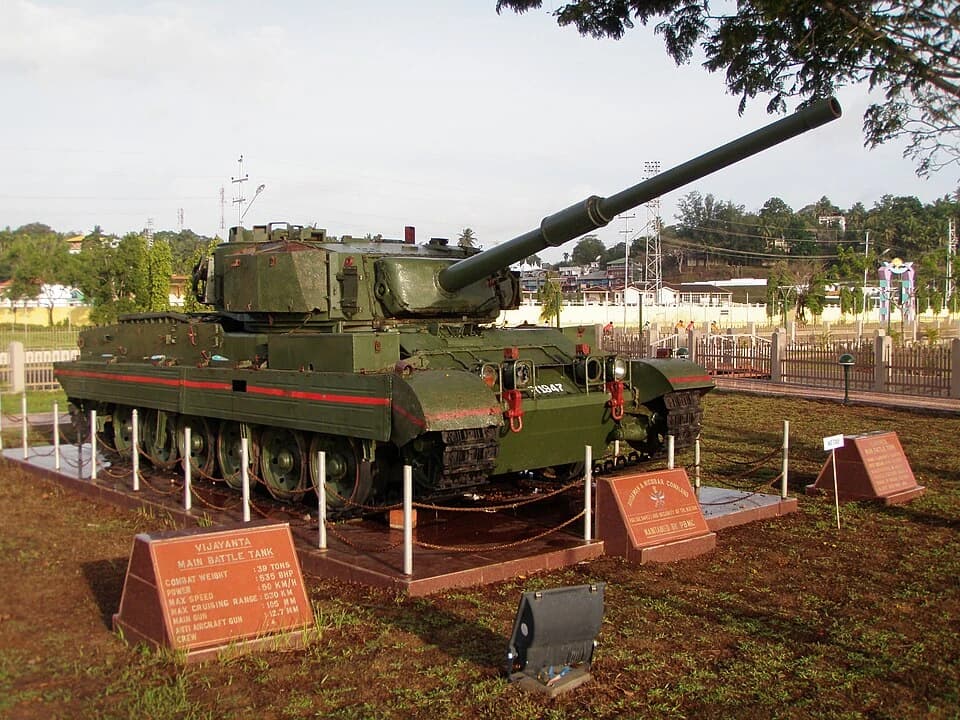
Shadman Samee from Dhaka, Bangladesh · CC BY-SA 2.0 · Resized · CC BY-SA 2.0 · Source ↗ · Modified


Preparing your view.

At a glance
Type 69 tanklarger figure on 2 of 3
Vickers MBTlarger figure on 1 of 3
Counts only measures both sources give with the same scope. A larger figure is not a better system.
True scale
Side by side. From every angle. A human reference for perspective.
3.64 MB · Loads when you open it| Model | Length | Width / span | Height |
|---|---|---|---|
| Type 69 tank | ≈ 9.42 m | ≈ 3.3 m (Width) | ≈ 2.79 m |
| Vickers MBT | ≈ 9.73 m | ≈ 3.17 m (Width) | ≈ 3.05 m |
Scaled uniformly so that the hull matches the sourced 6.24 m hull length. Thin antennas or poles standing above the body were pressed down to it, so they do not set the height; the width was fitted to the sourced 3.3 m. Not an official model or a measured survey.
ForceTally · All rights reserved
Scaled uniformly to the sourced length of 9.73 m. The width was fitted to the sourced 3.17 m. Not an official model or a measured survey.
ForceTally · All rights reserved
The human reference is a generic 1.75 m figure. Models describe external size, not combat performance.
Measured figures
Hull
Single source6.24 m (Hull)[source]
overall gun forward
Single sourceConfiguration
| Specification | Type 69 tank | Vickers MBT |
|---|---|---|
| Type | Main battle tank[source] | Main battle tank[source] |
| Place of origin | China[source] | United Kingdom[source] |
| In service | 1972–present (Type 69) 1982–present (Type 69-II) 1984–present (Type 79)[source] | 1965–2008[source] |
| Used by | See Operators[source] | See Operators |
9.73 m (31 ft 11 in) overall gun forward[source]
12150L-7 V-12 diesel engine
Single source12150L-7 V-12 diesel engine 580 hp (430 kW)[source]
Leyland L60 (multi-fuel 2-stroke opposed-piston compression-ignition ) 6 cyl, 19 litres
Single sourceLeyland L60 (multi-fuel 2-stroke opposed-piston compression-ignition ) 535 hp (399 kW) 6 cyl, 19 litres[source]
Bars compare reported quantities only. A larger figure does not make a system better; configurations and test conditions differ.
| Wars | Iran–Iraq War Gulf War Iraq War Syrian civil war War in Iraq (2013–2017)[source] | Indo-Pakistani War of 1965 Indo-Pakistani War of 1971 Iraqi invasion of Kuwait 2019 India–Pakistan standoff[source] |
|---|
| Designer | No. 60 Research Institute[source] | Vickers[source] |
|---|
| Designed | 1963–1972[source] | — |
|---|
| Manufacturer | First Inner Mongolia Machinery Factory ( Inner Mongolia First Machinery Group Corporation )[source] | Vickers Defence Systems[source] |
|---|
| Armor | 203 mm[source] | — |
|---|
| Main armament | 100mm smoothbore/105 mm rifled tank gun[source] | 1 x 105 mm L7A1 gun (44 rounds)[source] |
|---|
| Secondary armament | 7.62 mm coaxial and bow machine guns, 12.7 mm antiaircraft machine gun[source] | 1 x 12.7 mm L6A1 ranging machine gun with 700 rounds 1 x 7.62 mm MG (pintle mount) with 1,300 rounds 1 x 7.62 mm MG (coax) with 1,300 rounds[source] |
|---|
| Power/weight | 15.8 hp/tonne[source] | 13.79 bhp/t[source] |
|---|
| Suspension | torsion-bar[source] | Torsion bars[source] |
|---|
| Produced | — | 1964–1994[source] |
|---|
| Armour | — | Gun mantlet : 80 mm Turret front: 60 mm Turret sides: 40 mm Glacis: 60 mm Lower hull front: 80 mm Hull sides: 30 mm[source] |
|---|
| Transmission | — | Merrit-Wilson TN-12 (6 fwd / 2 rev) with a triple differential steering system[source] |
|---|
| Former operator · India | — | India[source] |
|---|
| Former operator · Kuwait | — | Kuwait[source] |
|---|
| Former operator · Iraq | — | Iraq[source] |
|---|
| Former operator · Boko Haram | — | Boko Haram[source] |
|---|
| Role | — | series of main battle tanks (MBTs)[source] |
|---|
| Source measurement | — | The Vickers MBT followed on from a 24-tonne 20-pdr gunned tank design intended for export. This would be as well equipped as a Centurion but substantially cheaper and with eight Vickers Vigilant anti-tank missiles it would be as effective. However, with the introduction of the 105 mm L7 gun into the British, US and German tank designs, this light tank would have been less powerful while too large for the reconnaissance role, and so a new design was required. With armour twice that of the light tank design, it would still be 12 tonnes lighter than Centurion and hence more mobile. The design would use the new engine and transmission of the Chieftain tank then being developed. The development coincided with an agreement with India in 1961 to produce a tank design and help set up a factory there to produce it.[source]Vickers MBT · Design and development; only the objects and conditions stated in this passage The Vickers was made of welded rolled homogeneous armour plates. It weighed 38,600 kg, carried a 105 mm gun with 44 rounds and had a top speed of 48 km/h. 70 tanks were sold to Kuwait and many of a modified version were made in India where the tank was called Vijayanta .[source]Vickers MBT · Design and development; only the objects and conditions stated in this passage The 1968 proposal for a vehicle specification that differed from the Mark 1 in the following respects:[source]Vickers MBT · Other developments / Vickers Main Battle Tank Mark 2; only the objects and conditions stated in this passage Improved track, suitable for 56 km/h (35 mph) continuously.[source]Vickers MBT · Other developments / Vickers Main Battle Tank Mark 2; only the objects and conditions stated in this passage Provision for fitting four Swingfire wire-controlled anti-tank missiles (intended as a response to weapons of greater range, such as the 120 mm L11 tank gun.[source]Vickers MBT · Other developments / Vickers Main Battle Tank Mark 2; only the objects and conditions stated in this passage The Mk. 3 was introduced in 1975 for the export market. It was the last of the Vickers tanks to see sales in numbers abroad. In 1974, Vickers pressed on with development of a Mark 3 version. This stems from Design No. 51400 T and differs from the Mark 1 mainly in having a turret with a well-shaped cast front welded to a fabricated armour plate body. It also has a cast gun mantlet which is better shaped from the point of view of its resistance to armour-piercing projectiles than the flat mantlet of the Mark. 1. The Mark 3 embodies various other improvements, such as an increase in the depression of its main gun from -7 to -10 degrees below the horizontal and an increase in the ammunition from 44 to 50 rounds. The first production order for Mk. 3 tanks was placed in 1977 by the Government of Kenya[source]Vickers MBT · Other developments / Vickers Main Battle Tank Mark 3; only the objects and conditions stated in this passage In 1977, Vickers produced a design for a vehicle that incorporated Chobham composite armour protection within a battle weight of 43 tonnes. This first prototype, designated the Vickers Main Battle Tank Mark 4.[source]Vickers MBT · Other developments / Vickers Main Battle Tank Mark 4 (Valiant); only the objects and conditions stated in this passage Equipped with the Marksman turret, as well as a self-propelled 155mm howitzer with the GBT 155 turret. The GBT 155 was unveiled in 1982 and was armed with the same 155mm ordnance as the AS-90 . It was designed primarily for existing tank chassis.[source]Vickers MBT · Other developments / Vickers Anti-aircraft Tank; only the objects and conditions stated in this passage |
|---|
| Country of origin | — | United Kingdom[source]Inventory Origin column; table 12, row 5, cell 5; revision 1377602121 |
|---|
| Reported operators |
|
|---|