

Credit
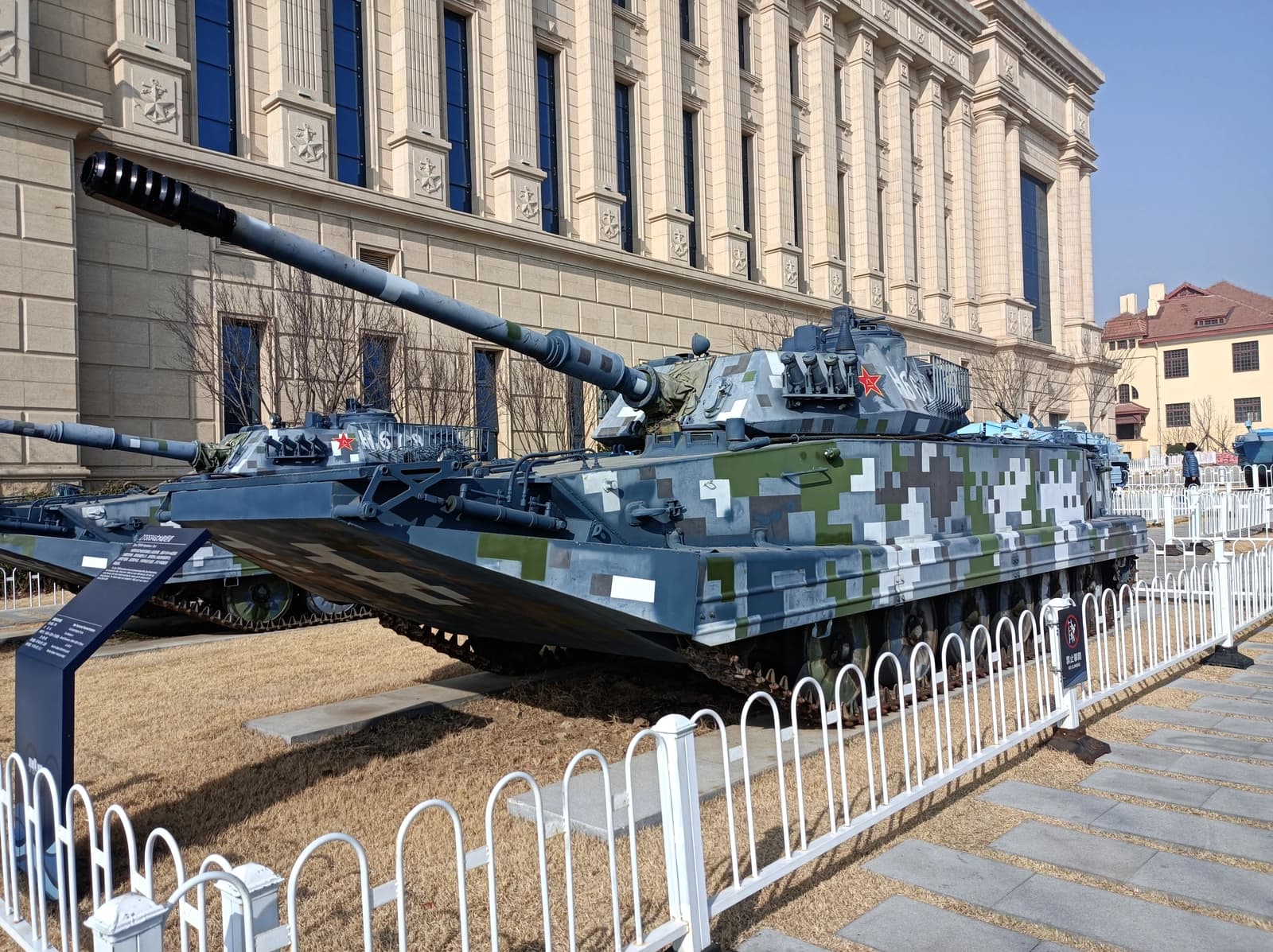
Max Smith, release all rights but a photo credit would be nice · Public domain · Resized · Public domain · Source ↗ · Modified


Preparing your view.
At a glance
True scale
Side by side. From every angle. A human reference for perspective.
3.32 MB · Loads when you open it| Model | Length | Width / span | Height |
|---|---|---|---|
| Type 63 (tank) | ≈ 7.69 m | ≈ 3.2 m (Width) | ≈ 3.32 m |
| Type 63A light tank | ≈ 9.6 m | ≈ 3.2 m (Width) | ≈ 2.97 m |
Scaled uniformly so that the hull matches the sourced 7.15 m hull length. Thin antennas or poles standing above the body were pressed down to it, so they do not set the height; the width was fitted to the sourced 3.2 m. Not an official model or a measured survey.
ForceTally · All rights reserved
Scaled uniformly to the sourced length of 9.6 m. Thin antennas or poles standing above the body were pressed down to it, so they do not set the height; the width was fitted to the sourced 3.2 m. Not an official model or a measured survey.
ForceTally · All rights reserved
The human reference is a generic 1.75 m figure. Models describe external size, not combat performance.
Measured figures
Hull
Single sourceLength
Single sourceConfiguration
| Specification | Type 63 (tank) | Type 63A light tank |
|---|---|---|
| Type | Amphibious light tank[source] | Amphibious light tank[source] |
| Place of origin | China[source] | People's Republic of China[source] |
| In service | 1963–present[source] | — |
| Used by | See Operators[source] | — |
| Wars | See Combat History[source] |
8.44 m 7.15 m (hull only)[source]
Gun forward
Single sourceGun forward: 9.6 m (31 ft)[source]
Operational; Cross-country
Single sourceOperational; road
Single sourceOperational; water
Single source370 km (road) 340 km (cross country) 120 km (water)[source]
Operational; Land Sea
Single sourceOperational; Operational range
Single sourceBars compare reported quantities only. A larger figure does not make a system better; configurations and test conditions differ.
| — |
| Designer | Military Engineering Institute (MEI) and the No. 60 Research Institute of Fifth Ministry of Machine Building[source] | — |
|---|
| Designed | 1960 - 1963[source] | — |
|---|
| Manufacturer | Norinco Factory 615 Shaanxi Weiyang Diesel Engine Plant (陕西渭阳柴油机厂) and Factory 256 Southwest Vehicles Factory (西南车辆制造厂)[source] | Norinco[source] |
|---|
| Produced | 1963 - ? (ended)[source] | 1997[source] |
|---|
| No. built | More than 1,550[source] | — |
|---|
| Variants | See Variants[source] | — |
|---|
| Armor | Welded rolled steel 11 mm hull front 14 mm hull upper side 10 mm hull rear 10 mm hull bottom 10 mm hull top[source] | Welded steel[source] |
|---|
| Main armament | 85 mm Type 62-85TC rifled gun (47 rounds)[source] | 105mm rifled gun[source] |
|---|
| Secondary armament | 7.62 mm Type 59T coaxial medium machine gun (2,000 rounds) 12.7 mm Type 54 anti-aircraft heavy machine gun (500 rounds) 7.62 mm Type 59T anti-aircraft medium machine gun (optional)[source] | 12.7mm anti-aircraft machine gun, 7.62mm coaxial machine gun[source] |
|---|
| Power/weight | 20.3 hp/tonne (15.1 kW/tonne)[source] | 26.4hp/tonne[source] |
|---|
| Transmission | Manual, planetary[source] | — |
|---|
| Suspension | torsion bar[source] | torsion bar[source] |
|---|
| Ground clearance | 400 mm[source] | — |
|---|
| Fuel capacity | 545 litres[source] | — |
|---|
| Role | — | amphibious light tank upgraded[source] |
|---|
| Source measurement | — | Before the mid-1990s, Chinese ground forces relied on the Type 63 amphibious light tank developed in the early 1960s. The low swimming speed and weak firepower of the Type 63 were insufficient for the needs of modern maritime amphibious assault operations that the PLA would conduct. The PLA demanded a replacement for the Type 63 in the early 1990s, which led to the development of the Type 63A in 1997. Reports indicate that over 300 examples have been delivered to the PLA by the end of 2000.[source]Type 63A light tank · Development; only the objects and conditions stated in this passage Compared to the Type 63, the Type 63A featured five major improvements: enhanced sea-traveling performance, increased swimming speed, improved fire-control system, ATGM capability, and a larger 105 mm rifled gun with dual stabilizers.[source]Type 63A light tank · Development; only the objects and conditions stated in this passage Type 63A introduces an enlarged welded turret replacing the original Type 63 turret, the modernized Type 63A utilizes a two-axis stabilized ZPL-98 105 mm (4.1 in) rifled gun replacing the 85 mm (3.3 in) gun. The 105 mm (4.1 in) rifled gun fires armor-piercing fin-stabilized discarding sabot (APFSDS), high explosive (HE), and high-explosive anti-tank (HEAT) ammunition, and GP105 laser beam riding guided missiles. A total of 45 rounds can be carried inside the vehicle. APFSDS round can penetrate 400 mm (16 in) RHA armour or destroy a reinforced concrete bunker at a distance of 2,000 m.[source]Type 63A light tank · Design / Armament; only the objects and conditions stated in this passage To overcome the inaccuracy of firing when swimming, the GP105 gun-launched missile uses laser- beam riding guidance, which is not affected by wave motion while swimming. The missile has a maximum firing range of 4–5 km (2.5–3.1 mi) with a first hit probability of +90% against stationary targets. It can also engage low-flying helicopters. Secondary weapons include QJC-88 roof-mounted machine gun and Type 63 coaxial machine gun.[source]Type 63A light tank · Design / Armament; only the objects and conditions stated in this passage The Type 63A enhances Type 63 amphibious capability, allowing the vehicle to conduct amphibious operations from its host amphibious warfare ships at distances from 10 km (5.4 nmi) to the shore at a speed of 14 km/h (7.6 kn).[source]Type 63A light tank · Design / Mobility; only the objects and conditions stated in this passage |
|---|
| Reported operators | — |
|---|
Land: 400 km (250 mi), Sea 120 km (65 nmi)[source]