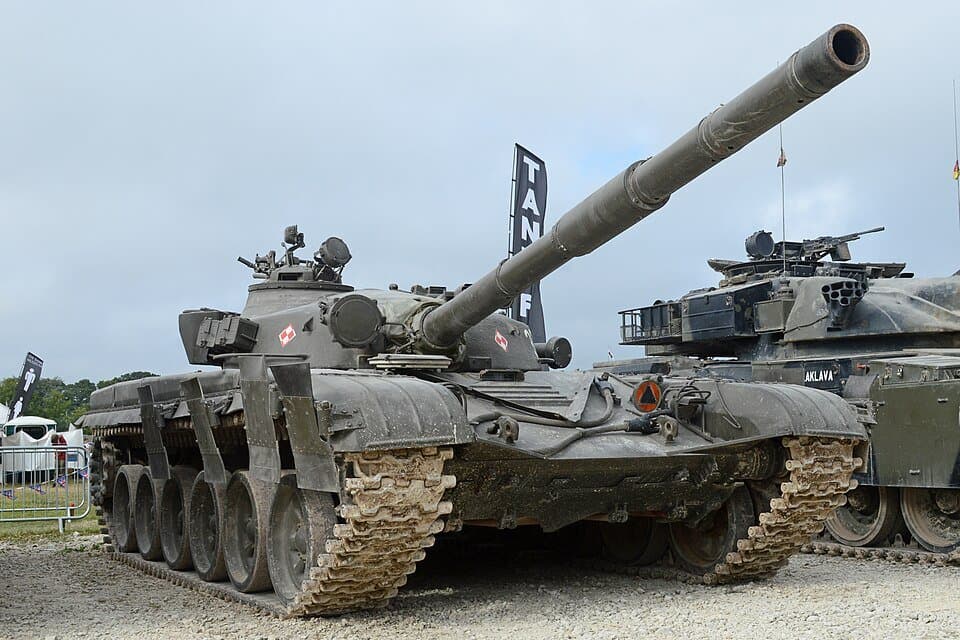
Credit
Alan Wilson from Stilton, Peterborough, Cambs, UK · CC BY-SA 2.0 · Resized · CC BY-SA 2.0 · Source ↗ · Modified


Preparing your view.

At a glance
T-72larger figure on 1 of 4
Tanque Argentino Medianolarger figure on 3 of 4
Counts only measures both sources give with the same scope. A larger figure is not a better system.
Measured figures
Length
Single sourceGun forward
Single sourceConfiguration
| Specification | T-72 | Tanque Argentino Mediano |
|---|---|---|
| Type | Main battle tank[source] | Light main battle tank / Medium tank[source] |
| Place of origin | Soviet Union[source] | Argentina / West Germany[source] |
| In service | 1969–present[source] | 1983–present[source] |
| Used by | See Operators[source] | Argentina |
) hull
Single sourceto
Single source9.73 m (31 ft 11 in) gun forward 6.67 to 6.86 m (21 ft 11 in to 22 ft 6 in) hull[source]
Length
Single source6.75 m (22 ft 2 in)[source]
Operational; Operational range
Single sourceOperational; with fuel drums
Single source500 km (310 mi), 650 to 700 km (400 to 430 mi) with fuel drums[source]
Operational; Operational range
Single sourceOperational; with auxiliary fuel tanks
Single sourceV12 diesel V-46-4 (T-72 Ural), V-46-6 (T-72A), V-84-1 (T-72B), V-92S2F (T-72B3 & T-72B3M) V-46-4/V-46-6
Single sourceV-84-1
Single sourceV-92S2F
Single sourceV12 diesel V-46-4 (T-72 Ural), V-46-6 (T-72A), V-84-1 (T-72B), V-92S2F (T-72B3 & T-72B3M) 780 hp (580 kW) (V-46-4/V-46-6) 840 hp (630 kW) (V-84-1) 1,130 hp (840 kW) (V-92S2F)[source]
MTU -MB 833 Ka-500 6-cylinder 22.4 L (1,370 cu in) diesel
Single sourceMTU -MB 833 Ka-500 6-cylinder 22.4 L (1,370 cu in) diesel 540 kW (720 hp)[source]
Bars compare reported quantities only. A larger figure does not make a system better; configurations and test conditions differ.
| Wars | List Iran–Iraq War 1982 Lebanon War 1982 Ethiopian–Somali Border War Sri Lankan Civil War First Nagorno-Karabakh War Gulf War 1991 Iraqi uprisings Georgian Civil War Civil war in Tajikistan Sierra Leone Civil War Yugoslav Wars Algerian Civil War Rwandan Civil War First Chechen War Kargil War Second Chechen War 2003 invasion of Iraq Russo-Georgian War First Libyan Civil War Syrian Civil War South Sudanese Civil War War in Iraq (2013–2017) Second Libyan Civil War Boko Haram insurgency 2016 Nagorno-Karabakh clashes 2020 Nagorno-Karabakh war Tigray War Russo-Ukraine War 2023 Sudan conflict[source] | — |
|---|
| Designer | Leonid Kartsev-Valeri Venediktov[source] | — |
|---|
| Designed | 1967–1972[source] | — |
|---|
| Manufacturer | Uralvagonzavod , Heavy Vehicles Factory[source] | Tanque Argentino Mediano Sociedad del Estado[source]TAM family · TAMSE production |
|---|
| Unit cost | US$0.5–1.2 million in 1994–1996, US$1–2 million (30,962,000–61,924,000 rubles) in 2009, US$0.5 million in 2011[source] | 1,500,000 USD (1983 export price)[source] |
|---|
| Produced | 1973-present[source] | 1979–1991, 1994–1995[source] |
|---|
| No. built | approx. 25,000[source] | 280[source] |
|---|
| Armour | Steel and composite armour with ERA[source] | — |
|---|
| Main armament | 125 mm 2A26M2/2A46/ 2A46M /2A46M-5 smoothbore gun[source] | 105 mm (4.13 in) FM K.4 Modelo 1L[source] |
|---|
| Secondary armament | 7.62 mm PKT coax. machine gun 12.7 mm NSVT[source] | 2×7.62 mm (0.30 in) machine gun[source] |
|---|
| Power/weight | 19.0 hp/tonne (T-72 Ural), 18.8 hp/tonne (T-72 A/B)[source] | 24 hp/tonne[source] |
|---|
| Transmission | Synchromesh , hydraulically assisted, with 7 forward and 1 reverse gears[source] | — |
|---|
| Suspension | Torsion bar[source] | Torsion-bar[source] |
|---|
| Ground clearance | 0.49 m (19 in)[source] | — |
|---|
| Fuel capacity | 1,200 L (320 U.S. gal; 260 imp gal)[source] | — |
|---|
| Armor | — | 50 mm (hull front and sides) 50 mm (turret front)[source] |
|---|
| Role | — | family of armoured vehicles[source] |
|---|
| Source measurement | — | The TAM series includes seven different variants, such as a 155 mm (6.1-inch) self-propelled howitzer and a mortar carrier vehicle. In total, over 280 such vehicles were built, including armored personnel carriers, artillery and mortar pieces. The TAM and VCTP (Infantry Fighting Vehicles based on the TAM chassis) were manufactured for the Peruvian Army , only to be integrated into the Argentine Army when Peru canceled the contract. The TAM also competed for other export orders, but the TAM was ultimately not exported.[source]Tanque Argentino Mediano · Lead; only the objects and conditions stated in this passage The armored vehicle would weigh no more than 30 tonnes (29.5 long tons; 33.1 short tons), move at a maximum speed of 70 km/h (43 mph), and cover at least 500 km (310 mi) on roads.[source]Tanque Argentino Mediano · Development; only the objects and conditions stated in this passage It would be armed with a modern 105 mm main gun, two machine guns , and grenade launchers.[source]Tanque Argentino Mediano · Development; only the objects and conditions stated in this passage Two prototypes were manufactured in late 1976 and early 1977, which were put through extensive testing for two years and over a road range of 10,000 km (6,200 mi).[source]Tanque Argentino Mediano · Development; only the objects and conditions stated in this passage The new tank's firepower requirements were met by fitting a British Royal Ordnance L7 A1 105 mm (4.13-inch) main gun.[source]Tanque Argentino Mediano · Development; only the objects and conditions stated in this passage This gun was later replaced by the modified L7A2 and finally by Rheinmetall 's Rh-105-30 105 mm (4.13-inch) gun.[source]Tanque Argentino Mediano · Development; only the objects and conditions stated in this passage The locally built cannon can be elevated to 18 degrees or depressed to -7 degrees on the TAM.[source]Tanque Argentino Mediano · Development; only the objects and conditions stated in this passage The gun's hydraulic recoil mechanism has an extended length of 580 mm (22.8 inches) to absorb the 34-tonne (33-long-ton; 37-short-ton) recoil force.[source]Tanque Argentino Mediano · Development; only the objects and conditions stated in this passage It is designed to fire the M735A1 armor-piercing fin-stabilized discarding sabot , which can penetrate a maximum of 370 mm (14.6 inches) at 1,000 meters (1,100 yd).[source]Tanque Argentino Mediano · Development; only the objects and conditions stated in this passage The tank's secondary armaments include a co-axial 7.62 mm (0.30-inch) FN MAG 60-40 general purpose machine gun and a second FN MAG 60-20 mounted on the TAM's turret roof as an anti-aircraft machine gun.[source]Tanque Argentino Mediano · Development; only the objects and conditions stated in this passage The fire control system includes a Nd:YAG laser with a range of 9,900 meters (32,480 ft) and a FLER-HG ballistic computer to compute the gun's fire solutions—helping the gunner aim and hit the target.[source]Tanque Argentino Mediano · Development; only the objects and conditions stated in this passage The TAM's engine requirements included low weight and volume, but with a fast rate of acceleration and high reliability. The program chose MTU 's MB-833 Ka 500 diesel engine, producing 540 kW (720 hp) at 2,400 rpm . This gives the TAM a power-to-weight ratio of 24 horsepower per tonne and a maximum speed of 75 km/h (47 mph) on road and 40 km/h (25 mph) off-road. With a 680-liter (180-U.S.-gallon; 150-imperial-gallon) internal fuel tank, the TAM can travel 500 km (310 mi). Its range is extended to 900 kilometers (560 mi) if the vehicle is equipped with two 200-liter (53 U.S. gal; 44 imp gal) external fuel tanks. The TAM's transmission is a Renk HSWL-204 automatic, with a hydrodynamic torque converter . A double brake system includes hydraulic disk brakes on the roadwheels, and the suspension is a torsion bar .[source]Tanque Argentino Mediano · Development; only the objects and conditions stated in this passage The TAM's survivability is related to its low profile turret, based on that of the Leopard 1A4s and the Leopard 2 , and its physical armor array. It has 50 mm (1.97 inches) at 75 degrees on the glacis plate and 32 degrees on the vehicle's sides. This offers protection against anti-armor shells from up to 35 mm (1.38-inch) guns. The turret front is protected by 50 mm (1.97 in) of steel armor at an angle of 32 degrees. Although the tank's weight and armor protection are light compared to other main battle tanks, it has the advantage of better tactical mobility over the nation's terrain.[source]Tanque Argentino Mediano · Development; only the objects and conditions stated in this passage As a private venture, Thyssen-Henschel built a fourth prototype designated TH 301. Completed in 1978, it added a PERI R12 periscope, originally designed for the Leopard 1 A4, for the tank commander. The gunner and loader each received a day periscope as well. To enable the crew to fire effectively at night, a low light level television (LLLTV) camera, which moved in elevation with the main gun, was fitted to the mantlet . Furthermore, the tank received a more powerful 550 kW (750 metric horsepower) engine. The improvement program also made provisions to increase the thickness of the armor for additional protection.[source]Tanque Argentino Mediano · Development; only the objects and conditions stated in this passage The squad leader is situated in the turret of the vehicle; one rifleman sits behind him and another six are seated in the chassis, the eighth manning the hull machine gun and the ninth situated in the turret with the gunner.[source]Tanque Argentino Mediano · Variants; only the objects and conditions stated in this passage All personnel can fire their weapons from inside the vehicle, and the VCTP's turret is armed with Rheinmetall's Rh-202 20 mm (0.79-inch) autocannon .[source]Tanque Argentino Mediano · Variants; only the objects and conditions stated in this passage It is also armed with a 7.62 mm FN MAG 60-20 machine gun mounted on the turret roof.[source]Tanque Argentino Mediano · Variants; only the objects and conditions stated in this passage Variants also include the Vehículo de Combate de Artillería de 155 mm (155 mm Artillery Combat Vehicle), or VCA 155, and the Vehículo de Combate Transporte de Mortero (Mortar Transport Combat Vehicle), or VCTM. The VCA-155 is an elongated TAM chassis fitted with Oto Melara 's Palmaria 155 mm (6.1-inch) self-propelled howitzer turret . It carries 28 projectiles, 23 of which are stored in the turret bustle. The VCTM carries an AM-50 120 mm (4.7-inch) internal mortar, which has a range of 9,500 meters (31,167.98 ft) and a rate of fire of 8 to 12 shots per minute. Based on the TAM chassis, the Vehículo de Combate Puesto de Mando (command combat vehicle), or VCPC , is another variant designed in 1982. The Vehículo de Combate Lanzacohetes (Rocket launcher combat vehicle), or VCLC , designed in 1986, is also based on the TAM chassis and can be fitted with both 160 mm (6.3-inch) and 350 mm (13.8-inch) rockets. A combat ambulance, Vehículo de Combate Ambulancia ( VCA ), and an armored recovery vehicle , Vehículo de Combate de Recuperación ( VCRT ) are other combat variants of the tank.[source]Tanque Argentino Mediano · Variants; only the objects and conditions stated in this passage In 2010, a modernization program was announced. Israeli defense contractor Elbit Systems was chosen to provide 3-axis gyro-stabilization. The first TAM unit upgraded by Elbit Systems was delivered in March 2013. The TAM 2C was upgraded with many features, mainly revolving around electronics and other secondary features. The upgrades included a thermal imager for the gunner and commander, a thermal sleeve for the barrel, and an auxiliary power unit to provide power to critical systems when the main engine is off and reduce fuel consumption while idling. The TAM 2C also had numerous firepower upgrades, including new APFSDS shells and a new HEAT shell, and the capability to fire LAHAT anti-tank guided missiles, with over 800 mm of penetration and 8 km range. It is not known whether or not the Argentinian government will purchase such missiles. The TAM 2C also received a new turret storage basket.[source]Tanque Argentino Mediano · Variants / TAM 2C; only the objects and conditions stated in this passage |
|---|
| Origin reported by inventory | — | Argentina West Germany[source]Inventory Origin column; table 1, row 7, cell 3; revision 1374043591; retrieved 2026-10-02 |
|---|
590 km (370 mi), 800 km (500 mi) with auxiliary fuel tanks[source]