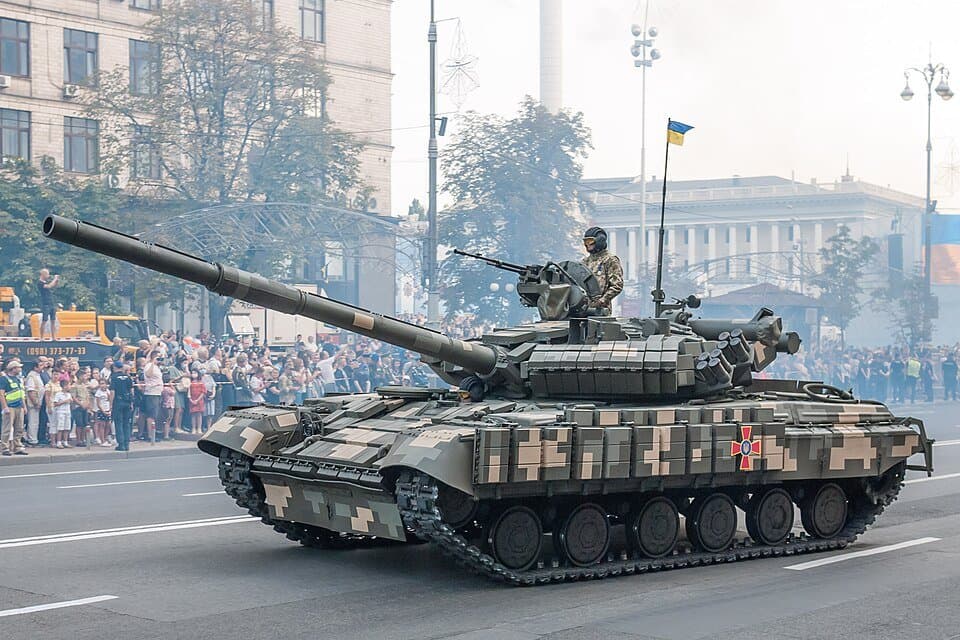
Credit
VoidWanderer · CC BY-SA 4.0 · Resized · CC BY-SA 4.0 · Source ↗ · Modified


Preparing your view.

At a glance
T-64larger figure on 2 of 4
Tanque Argentino Medianolarger figure on 2 of 4
Measured figures
Gun forward
Single source9.225 m (30 ft 3.2 in) (gun forward)[source]
Length
Single sourceConfiguration
| Specification | T-64 | Tanque Argentino Mediano |
|---|---|---|
| Type | Main battle tank[source] | Light main battle tank / Medium tank[source] |
| Place of origin | Soviet Union[source] | Argentina / West Germany[source] |
| In service | 1966–present[source] | 1983–present[source] |
| Used by | See Operators[source] | Argentina |
Counts only measures both sources give with the same scope. A larger figure is not a better system.
6.75 m (22 ft 2 in)[source]
Operational; Operational range
Single sourceOperational; with external tanks
Single source500 km (310 mi), 700 km (430 mi) with external tanks[source]
Operational; Operational range
Single sourceOperational; with auxiliary fuel tanks
Single sourceBars compare reported quantities only. A larger figure does not make a system better; configurations and test conditions differ.
| Wars | Transnistria War Angolan Civil War Russo-Ukrainian War War in Donbas Russo-Ukrainian war Kamwina Nsapu rebellion[source] | — |
|---|
| Designer | KMDB[source] | — |
|---|
| Designed | 1951–1962[source] | — |
|---|
| Manufacturer | Malyshev Factory[source] | Tanque Argentino Mediano Sociedad del Estado[source]TAM family · TAMSE production |
|---|
| Produced | 1963–1987[source] | 1979–1991, 1994–1995[source] |
|---|
| No. built | ≈13,000[source] | 280[source] |
|---|
| Armour | Glass-reinforced plastic sandwiched between layers of steel. ERA plates on later versions Hull & turret – 370 mm to 440 mm vs APFSDS 500 mm to 575 mm vs HEAT[source] | — |
|---|
| Main armament | 125 mm smoothbore gun 2A26(M/M-1) (T-64A), 125 mm smoothbore gun D-81T (aka 2A46)[source] | 105 mm (4.13 in) FM K.4 Modelo 1L[source] |
|---|
| Secondary armament | 7.62 mm PKMT coaxial machine gun, 12.7 mm NSVT anti-aircraft machine gun[source] | 2×7.62 mm (0.30 in) machine gun[source] |
|---|
| Power/weight | 18.4 hp/tonne (13.7 kW/ton)[source] | 24 hp/tonne[source] |
|---|
| Suspension | Torsion bar[source] | Torsion-bar[source] |
|---|
| Former operator · UNITA | UNITA[source] | — |
|---|
| Former operator · Soviet Union | Soviet Union[source] | — |
|---|
| Former operator · Belarus | Belarus[source] | — |
|---|
| Former operator · Kazakhstan | Kazakhstan[source] | — |
|---|
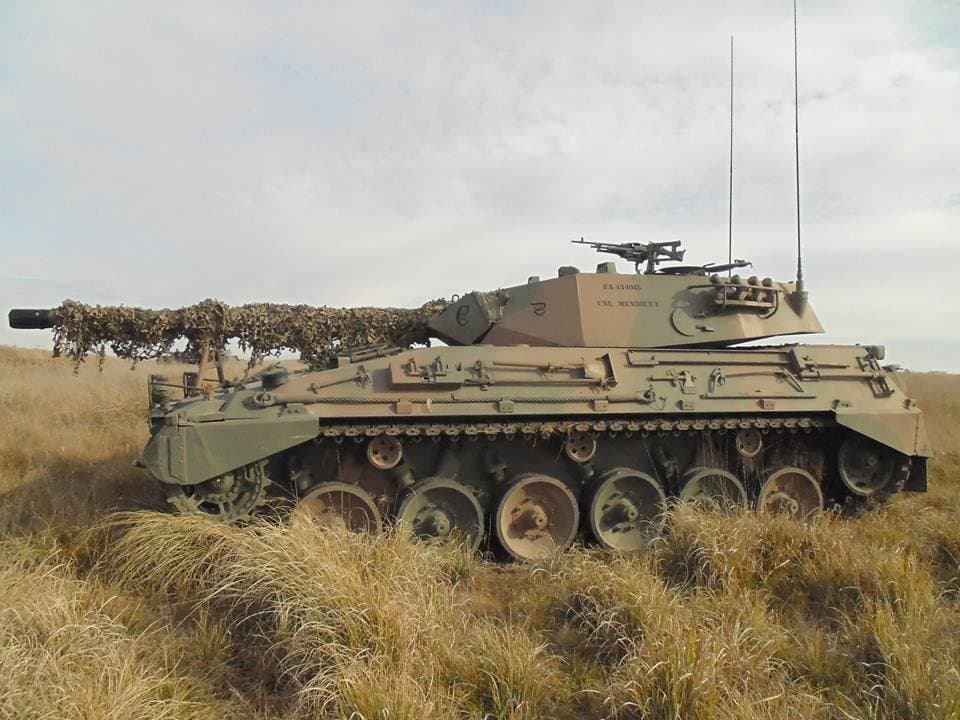
| Source measurement | The T-64 is a Soviet tank manufactured in Kharkiv , and designed by Alexander Morozov . The tank was introduced in the early 1960s. It was a more advanced counterpart to the T-62 : the T-64 served in tank divisions, while the T-62 supported infantry in motor rifle divisions. It introduced advanced features for its time such as composite armour , a compact engine and transmission, and a 125-mm smoothbore gun equipped with a carousel type autoloader to allow the crew to be reduced to three so the tank could be smaller and lighter. In spite of being armed and armoured like a heavy tank , the T-64 weighed only 38 tonnes (42 short tons ; 37 long tons ).[source]T-64 · Lead; only the objects and conditions stated in this passage The T-64 was the first Soviet tank to use an autoloader for its 125-mm gun, allowing one crew member's position to be omitted and helping to keep the size and weight of the tank down. Tank crewmen would joke that the designers had finally caught up with their unofficial hymn, Three Tankers , a song written to commemorate the crewmen fighting in the Battle of Khalkhin Gol , in 3-man BT-5 tanks in 1939.[source]T-64 · Overview; only the objects and conditions stated in this passage The T-64 also pioneered other Soviet tank technology: the T-64A model of 1967 introduced the 125-mm smoothbore gun, and the T-64B of 1976 would be able to fire an anti-tank guided missile through its gun barrel. Soviet military planners considered the T-64 the first of the third-generation tanks and the first main battle tank .[source]T-64 · Overview; only the objects and conditions stated in this passage Studies for the design of a new battle tank started in 1951. The KB-60M team was formed at the Kharkiv design bureau of the Kharkiv transport machine-building factory No. 75 named for Malyshev ( Russian : конструкторское бюро Харьковского завода транспортного машиностроения No. 75 им. Малышева ) by engineers coming back from Nizhniy Tagil , with Morozov at its head.[source]T-64 · Development history / Object 430; only the objects and conditions stated in this passage The tank would be armed with the D-54TS and would have frontal armour of 120 mm. As it did not present a clear superiority in combat characteristics when compared to the T-55 , which was entering active service, Morozov decided that production was not yet ready given the project's drawbacks. However, studies conducted on the Object 430U, featuring a 122 mm gun and 160 mm of armour, demonstrated that the tank had the potential to carry the firepower and armour of a heavy tank on to a medium tank chassis. A new project was consequently started, the Object 432.[source]T-64 · Development history / Object 430; only the objects and conditions stated in this passage The gun fitted on this new tank was a 115 mm D-68 (2A21). This was a potentially risky decision to replace the human loader by an electro-hydraulic automatic system, since the technology was new to Russian designers. The crew was reduced to three, which allowed a considerable reduction in internal volume and external visible silhouette, and consequently in weight, from 36 tonnes (obyekt 430) to 30.5 tonnes. The height dropped by 76 mm.[source]T-64 · Development history / Object 432; only the objects and conditions stated in this passage The arrival of the British 105 mm L7 gun and the US M68 variant of it, fitted to the Centurion and M60 tanks, forced the team to adopt composite armour. The recently created process was called "K combination" by Western armies: this protection consisted of an aluminium alloy layer between two high strength steel layers. As a consequence, the weight of the prototype rose eventually to 34 tonnes. But, as the engine was now a 700 hp (515 kW) 5TDF (also locally designed), its mobility remained superior to that of the T-62 . The obyekt 432 was ready in September 1962 and production started in October 1963 in the Kharkiv plant. On 30 December 1966, it entered service as the T-64.[source]T-64 · Development history / Object 432; only the objects and conditions stated in this passage The new 125 mm D-81T gun, from the Perm weapons factory, was fitted to the tank.[source]T-64 · Development history / T-64A; only the objects and conditions stated in this passage This gun was a scaled-up version of the 115 mm smoothbore cannon from the T-62.[source]T-64 · Development history / T-64A; only the objects and conditions stated in this passage The larger size of the 125 mm ammunition meant that less could be carried inside the T-64, and with a fourth crewman loader taking up space as well, the tank would only have a 25-round capacity.[source]T-64 · Development history / T-64A; only the objects and conditions stated in this passage the radio by mounting a R-123M[source]T-64 · Development history / T-64A; only the objects and conditions stated in this passage night vision with a TBN-4PA for the driver and a TNP-165A for the tank leader. His post was transformed by mounting a small stabilised turret with an anti-aircraft NSVT 12.7 mm × 108 machine gun, electrically guided through an optical PZU-5 sight, and fed with 300 rounds. It could be used from within the tank so that the tank leader could avoid being exposed (as on previous tanks). The possibility of mounting a KMT-6 anti-mine system was also added.[source]T-64 · Development history / T-64A; only the objects and conditions stated in this passage A derived version appeared at the same time, designed for the commanding officer and named T-64AK. It comprised a R-130M radio with a 10 m telescopic antenna, which could be used only in a static position as it required shrouds, an artillery aiming circle PAB-2AM and TNA-3 navigation station; all of these could be powered by an auxiliary petrol generator.[source]T-64 · Development history / T-64A; only the objects and conditions stated in this passage The majority of T-64As were further modernised after 1981, by mounting a six smoke grenade -launcher 81 mm 902A on each side of the gun, and by replacing the gill plates by a rubber skirt for a longer life. Some of them seem to have been fitted with reactive bricks (as the T-64AV) after 1985, or even with laser TPD-K1 telemeters instead of the optical TPD-2-49 optical coincidence rangefinder (1981). Almost all T-64s were modernised into T-64R, between 1977 and 1981, by reorganising external storage and snorkels, similar to the T-64A.[source]T-64 · Development history / T-64A; only the objects and conditions stated in this passage From 1961, an alternative to the Object 432 was studied, with a 12 V-cylinder V-45 engine: the Object 436. Three prototypes were tested in 1966 in the Chelyabinsk factory. The order was to develop a model derived from the 434 with the same engine given to the Object 438, later renamed as the Object 439. Four tanks of this type were built and tested in 1969, which showed the same mobility as the production version, but mass production was not started. They served as a basis for the design of the T-72 engine compartment.[source]T-64 · Development history / T-64B; only the objects and conditions stated in this passage At the beginning of the 1970s, the design team was trying to improve the tank further. The T-64A-2M study in 1973, with its more powerful engine and its reinforced turret, served as a basis for two projects:[source]T-64 · Development history / T-64B; only the objects and conditions stated in this passage Object 476 with a 6TD 1000 hp (735 kW) engine which served as a model for the T-80 combat compartment.[source]T-64 · Development history / T-64B; only the objects and conditions stated in this passage Its ford capacity reaches 1.8 m without equipment. The T-64B had the ability to fire the new 9M112 "Kobra" radio-guided missile (NATO code " AT-8 Songster "). The vehicle then carries 8 missiles and 28 shells. The missile control system is mounted in front of the commander's small turret and has many changes. The T-64B1 carries only 37 shells and has 2,000 7.62 mm rounds, against 1,250 for the T-64B.[source]T-64 · Development history / T-64B; only the objects and conditions stated in this passage T-64BM2 with a 57DFM 850-hp (625 kW) engine, a new 1A43U fire control, a new 6ETs43 loader and the ability to fire the 9M119 missile (NATO code " AT-11 Sniper ").[source]T-64 · Development history / Modernisation in Ukraine; only the objects and conditions stated in this passage The two variants are also protected by Kontakt-5 modular reactive armour , able to resist kinetic energy projectiles, as opposed to the first models which were efficient only against high-explosive anti-tank (HEAT) shaped charge ammunition. Those two variants could also be fitted with the 6TDF 1,000 hp (735 kW) engine.[source]T-64 · Development history / Modernisation in Ukraine; only the objects and conditions stated in this passage T-64BM Bulat Ukrainian army on use modernization, incorporating Nizh (Knife) reactive armour that offers better performance dealing with tandem warheads than the Soviet Kontakt-5, new Ukrainian-made 125 mm KBA3 gun, TO1-KO1ER night sight and capability of firing the Ukrainian Kombat tandem-warhead anti-tank guided missile.[source]T-64 · Development history / Modernisation in Ukraine; only the objects and conditions stated in this passage In 2010, the Kharkiv Malyshev Factory upgraded ten T-64B tanks (originally produced in Kharkiv in 1980) to T-64BM Bulat standard, and a further nineteen were delivered in 2011. These twenty-nine tanks were upgraded under a ₴200 million ($25.1M) contract signed in April 2009. As of October 2011, the Ukrainian Army has 76 T-64BM Bulat in service. According to Malyshev Factory chief engineer Konstantin Isyak, the T-64BM Bulat is armoured to the level of modern tanks. It has Nizh (Knife) reactive armour, and Varta active protection system. The Bulat weighs 45 tonnes (44 long tons), and with its 850 hp (630 kW) 5TDFM multi-fuel diesel engine can travel at 70 km/h (43 mph), with a range of 385 km (239 mi). It retains the 125 mm smoothbore gun with an autoloader for 28 rounds, some of which can be guided missiles. It has a 12.7 mm AA machinegun, and a 7.62 mm coaxial machinegun.[source]T-64 · Development history / Modernisation in Ukraine; only the objects and conditions stated in this passage A 2019 modernization program with TPN-1TPV thermal sight, 1A43U fire-control system, 1H46M sight for the Kombat ATGM, Lybid-2 radios, Basalt battlefield information system, raised turret ring, improved KhSChVK Nizh reactive armour, armour shield above the commander's cupola, 12 mm armour for external fuel tanks, anti-RPG screens beside the engine compartment, and new 1000-hp 6TD-1 engine and transmission (new 5TD engines were no longer manufactured). This was conducted at the Kharkiv Armoured-Vehicle Plant (KhBTZ), with the engine compartment enlarged for the new engine by the Malyshev Factory (ZIM). Upgraded tanks were field tested in April 2021, and several were paraded in the August Independence Day parade.[source]T-64 · Development history / Modernisation in Ukraine; only the objects and conditions stated in this passage In 2019, Ukroboronprom reported that the Kharkiv Armoured Plant (KhBTZ) had delivered over 100 updated tanks to the Ukrainian Armed Forces. The upgraded tanks included new thermal imaging for all crew, remove Luna infrared searchlight, include TPN-1-TPV Ukrainian night sight in place of TPN1-49-23, Nizh reactive armour modules designed for bolt-on replacement on T-64BV turrets, SN-4215 networked satellite navigation unit, and Lybid K-2RB digital radio (under license from Motorola) providing secure communications with a 70 km range. In August 2019, Ukroboronprom announced the Lviv Armoured Plant (LBTZ) had also started modernizing T-64s to the 2017 standard.[source]T-64 · Development history / Modernisation in Ukraine; only the objects and conditions stated in this passage In early 2022 Ukroboronprom was reported to be testing another modernization of the T-64BV, ordered by the Ministry of Defence of Ukraine. The tank has "new third-generation surveillance and sighting units" and is equipped with a new 12.7mm Snipex Laska K-2 heavy machine gun. It features "new up-to-date radio stations" and additional "navigation, internal and external communication systems which fully meets NATO standards." The exterior fuel tanks are now also protected by 12mm steel plates.[source]T-64 · Development history / Modernisation in Ukraine; only the objects and conditions stated in this passage Sources differ on the initial production date of the tank that is set between 1963 and 1967, but it is established that the T-64 formally entered service with the Soviet army in 1967 and was publicly revealed in 1970. The T-64 was KMDB's high-technology offering, intended to replace the IS-3 and T-10 heavy tanks in independent tank battalions. Meanwhile, the T-72 was intended to supersede the T-55 and T-62 in equipping the bulk of the Soviet tank and mechanised forces, as well as for export partners and east-block satellite states.[source]T-64 · Production history; only the objects and conditions stated in this passage The T-64 introduced a new autoloader, which is still used on all T-64s currently in service, as well as all variants of the T-80 except the Ukrainian T-84 -120. T-64 prototypes and the first several hundred examples produced had the same 115 mm smoothbore gun as the T-62; the T-64A and subsequent full-scale production variants had the 125 mm gun.[source]T-64 · Production history; only the objects and conditions stated in this passage Ob'yekt 430 (1957) – Prototype with D-10T 100-mm gun, 120 mm armour , 4TPD 580 hp (427 kW) engine, 36 tonnes.[source]T-64 · Production history / Models; only the objects and conditions stated in this passage Ob'yekt 430U – Project, equipped with a 122-mm gun and 160 mm of armour.[source]T-64 · Production history / Models; only the objects and conditions stated in this passage T-64 or Ob'yekt 432 (1961) – Prototype with a D-68 115-mm gun, then initial production version with the same features, about 600 tanks produced.[source]T-64 · Production history / Models; only the objects and conditions stated in this passage T-64R ( remontirniy , rebuilt) or Ob'yekt 432R – T-64s rebuilt between 1977 and 1981 with equipment from the T-64A. Retained 115-mm gun.[source]T-64 · Production history / Models; only the objects and conditions stated in this passage T-64A or Ob'yekt 434 – 125-mm gun, "gill" armour skirts, a modified sight, and suspension on the fourth road wheel.[source]T-64 · Production history / Models; only the objects and conditions stated in this passage T-64T (1963) – Experimental version with a GTD-3TL 700 hp (515 kW) gas turbine .[source]T-64 · Production history / Models; only the objects and conditions stated in this passage T-64AK or Ob'yekt 446 (1972) – Command version, with a R-130M radio and its 10 m (33 ft) telescoping antenna, a TNA-3 navigation system, without antiaircraft machine gun, carrying 38 rounds of main gun ammunition.[source]T-64 · Production history / Models; only the objects and conditions stated in this passage T-64B or Ob'yekt 447A (1976) – Fitted with redesigned armour, 1A33 fire control system, 9K112-1 "Kobra" ATGM system (NATO code "AT-8 Songster"), TPN-1-49-23 sight, 2A46-2 gun, 2E26M stabiliser and 6ETs40 loader. Later B/BV models have more modern systems 1A33-1, TPN-3-49, 2E42 and a 2A46M-1 gun. From 1985 the T-64B was fitted with stronger glacis armour; older tanks were upgraded with a 16-mm armour plate. Tanks equipped with the 1,000 hp 6TD engine are known as T-64BM .[source]T-64 · Production history / Models; only the objects and conditions stated in this passage T-64BV – Features "Kontakt-1" reactive armour and "Tucha" 81-mm smoke grenade launchers on the left of the turret.[source]T-64 · Production history / Models; only the objects and conditions stated in this passage T-64BM2 or Ob'yekt 447AM-2 – "Kontakt-5" reactive armour, rubber protection skirts, 1A43U fire control, 6ETs43 loader and able to fire the 9K119 missile (NATO code "AT-11A Sniper"), 5TDFM 850 hp (625 kW) engine.[source]T-64 · Production history / Models; only the objects and conditions stated in this passage T-64U , T-64BM Bulat , or Ob'yekt 447AM-1 – Ukrainian modernisation, bringing the T-64B to the standard of the T-84 . Fitted with Nizh reactive armour, 9K120 Refleks missile (NATO code AT-11 Sniper), 1A45 Irtysh fire control, TKN-4S commander's sight, PZU-7 antiaircraft machine-gun sight, TPN-4E Buran-E night vision, 6TDF 1,000-hp (735 kW) engine. T-64U is one of 2 variants of the modernization program in 1990s, while Bulat is the most recent modernization from 2004.[source]T-64 · Production history / Models; only the objects and conditions stated in this passage T-64B1M – T-64B1 equipped with the 1,000-hp 6TD engine, redesigned turret and improved armour. Modernization program from 1970s (resulted in T-64AM, AKM, BM and B1M; BM is not the same as T-64BM "Bulat" from 2004). Never entered mass production.[source]T-64 · Production history / Models; only the objects and conditions stated in this passage T-64BK and T-64B1K or Ob'yekt 446B – Command versions, with an R-130M radio and its 10-m telescoping antenna, a TNA-3 navigation system and AB-1P/30 APU, without antiaircraft machine gun, carrying 28 shells.[source]T-64 · Production history / Models; only the objects and conditions stated in this passage BREM-64 or Ob'yekt 447T – Armoured recovery vehicle with a light 2.5-tonne crane, dozer blade, tow bars, welding equipment, etc. Only a small number were built.[source]T-64 · Production history / Models; only the objects and conditions stated in this passage 1972 redesign, fire control improvement (TPD-2-49 and TPN-1-49-23), inclusion of the NSVT machine gun on an electrical turret, R-123M radio.[source]T-64 · Production history / Models / Modernisations; only the objects and conditions stated in this passage BMPV-64 – Heavy infantry fighting vehicle, based on the chassis of the T-64 but with a completely redesigned hull with a single entry hatch in the rear. Armament consists of a remote-controlled 30mm autocannon and 7.62 mm machine gun. Combat weight is 34.5 tons. The first prototype was ready in 2005.[source]T-64 · Production history / Models / Variants; only the objects and conditions stated in this passage BMPT-K-64 – This variant is not tracked but has a new suspension with 4 axles, similar to the Soviet BTR series. The vehicle is powered by a 5TDF-A/700 engine and has a combat weight of 17.7 tons. It is fitted with a RCWS and can transport 3+8 men. Prototype only.[source]T-64 · Production history / Models / Variants; only the objects and conditions stated in this passage BMPT-64 "Strazh" (Cyrillic: Страж , translates to guardian) – Fire support vehicle armed with 2 30mm autocannons , 2 PK machine guns , 4 ATGM-launchers and one AG-17 grenade launcher, developed by Zhytomyr Armoured Plant .[source]T-64 · Production history / Models / Variants; only the objects and conditions stated in this passage BMPT Azovets – One-off Ukrainian heavy infantry fighting vehicle equipped with Stugna ATGMs and 23mm GSh-23 autocannons. It was built by the Azov Engineering Group in 2015.[source]T-64 · Production history / Models / Variants; only the objects and conditions stated in this passage BAT-2 – Fast combat engineering vehicle with the engine, lower hull and "small roadwheels" suspension of the T-64. The 40-ton tractor sports a very large, all axis adjustable V-shaped hydraulic dozer blade at the front, a single soil ripper spike at the rear and a 2-ton crane on the top. The crew compartment holds 8 persons (driver, commander and radio operator, plus a five-man sapper squad for dismounted tasks). The BAT-2 was designed to replace the old T-54 /AT-T based BAT-M , but Warsaw Pact allies received only small numbers due to its high price and the old and new vehicles served together during the late Cold War.[source]T-64 · Production history / Models / Variants; only the objects and conditions stated in this passage UMR-64 – Ukrainian development using surplus T-64s to create a Heavy APC/IFV design, which in turn is intended as the basis of a new family of combat and support vehicles. The basic conversion includes moving the engine compartment forward, and at the same time removing the turret and normal crew compartment. This allows the installation of any one of 15 different 'functional modules', weighing up to 22 tons. One resulting option is the Heavy IFV, designated BMP-64E , which combines accommodation for up to 10 troops (not including the driver) with a remote weapons system . The Heavy APC version is designated the BTR-64E , and can not only carry more troops (at the cost of the RWS) but comes with large armoured double hatches at the rear for rapid loading and disembarkation. Other options include a universal supplies carrier ( UMBP-64 ), a 'highly secure command and staff car with a weight up to 41 tons', and a 120 mm mortar carrier. The Kharkiv Armour Repair Plant ( Zavod 311 ) is behind the project. Current status of the program is unclear as of early 2014.[source]T-64 · Production history / Models / Variants; only the objects and conditions stated in this passage In June 1992, 18 former Soviet T-64BV tanks from the Odesa Military District 's 59th Guards Motor Rifle Division were taken over by the Transnistrian Army , fighting in the Transnistria War . Two T-64s were disabled by Moldovan Ground Forces troops near Bender during Transnistrian counterattacks, one of which was knocked out by an MT-12 100mm anti-tank gun. These actions were the first combat use of the tank.[source]T-64 · Service history / Post-Soviet period; only the objects and conditions stated in this passage The crews of T-64s have been called upon to act as artillery leading to shortages in 125 mm ammunition. Crews of the T-64 tanks rely on attack helicopters and drones; after firing at a target they move positions and fire again. If the Russian forces send infantry directly onto the battle field then the T-64 crews are required to directly support the infantry. On 21 December 2022 the Biden administration announced an aid package with an extra 100,000 rounds of 125 mm tank ammunition for the first time.[source]T-64 · Service history / Post-Soviet period / Ukraine; only the objects and conditions stated in this passage This increases the time of loading of the T-72 by approximately one second.[source]T-64 · Capabilities and limitations / Firepower; only the objects and conditions stated in this passage It also has a "sequence" fire mode that feeds the gun with shells of the same type in less than five seconds.[source]T-64 · Capabilities and limitations / Firepower; only the objects and conditions stated in this passage Because of a lower weight than T-72 (by ~3 tonnes), T-64 has slightly superior strategic and operational mobility (less wear and tear on tank transportation equipment, and lower fuel consumption per distance traveled).[source]T-64 · Capabilities and limitations / Movement; only the objects and conditions stated in this passage Basket-type autoloader stores, as stated previously, propellant charges vertically, the rear ends almost the same height as the roof of the hull. Combined with greater diameter of the complete autoloader assembly, the overall greater size of this type compared to the cazette significantly increases chance of ammunition being ignited by direct hit of any weapon penetrating into the crew compartment. The problem is largely irrelevant if a full ammunition load outside autoloader is carried, but T-72 carrying only autoloader ammunition is far more survivable than a T-64 in a similar situation thanks to the compact dimensions of Cazette-type ammunition storage.[source]T-64 · Capabilities and limitations / Protection; only the objects and conditions stated in this passage Because of the small-diameter roadwheels and vertical placement of propellant charges in the autoloader, charges are dangerously exposed against hits penetrating the 85mm hull side armour, and are located at such height that they are too high to be protected by the roadwheels, yet too low to be fully protected by the sideskirt armour panels.[source]T-64 · Capabilities and limitations / Protection; only the objects and conditions stated in this passage Counter to the benefit of leaving the fourth crew man in favour of using an automatic loader, this also creates difficulties in immediately replacing an injured crewman while in combat. In comparison with 4-man tanks, there exists a possibility of an injured crewman being dragged from his seat and into the loader's space for immediate treatment of injury while the tank retreats. In more cramped 3-man designs such empty space is not immediately available and moving between the turret and hull may be more difficult in the first place. There is also an argument that a fourth crewman can replace any other of the three in case of injury, however, this possibility can also exist in 3-man designs if redundancy of weapon controls allows for temporary 1-man operation of turret.[source]T-64 · Capabilities and limitations / Protection; only the objects and conditions stated in this passage Length (gun to the front): 9.225 m[source]T-64 · Specifications (T-64BV) / Dimensions; only the objects and conditions stated in this passage Length (without the gun): 6.54 m[source]T-64 · Specifications (T-64BV) / Dimensions; only the objects and conditions stated in this passage Breadth: 3.6 m[source]T-64 · Specifications (T-64BV) / Dimensions; only the objects and conditions stated in this passage Height: 2.17 m[source]T-64 · Specifications (T-64BV) / Dimensions; only the objects and conditions stated in this passage Engine: 5TDF multifuel ( diesel , kerosene and petrol) with 5 opposed cylinders, 10 piston, 13.6 L. Developing 700 hp (515 kW) at 2,800 rpm, consumption of 170 to 200 litres per 100 km.[source]T-64 · Specifications (T-64BV) / Propulsion; only the objects and conditions stated in this passage Three internal tanks for a 740 litres fuel capacity, two on the mudguards with 140 litres and two droppable 200 litres tanks on the aft end of the chassis.[source]T-64 · Specifications (T-64BV) / Propulsion; only the objects and conditions stated in this passage Max. road speed: 60.5 km/h.[source]T-64 · Specifications (T-64BV) / Performance; only the objects and conditions stated in this passage Max off-road speed: 35 km/h.[source]T-64 · Specifications (T-64BV) / Performance; only the objects and conditions stated in this passage Range: 500 km, 700 km with additional tanks.[source]T-64 · Specifications (T-64BV) / Performance; only the objects and conditions stated in this passage Able to ford in 1.8 m of water without preparation and 5 m with snorkels .[source]T-64 · Specifications (T-64BV) / Performance; only the objects and conditions stated in this passage Crosses a 2.8 m wide trench.[source]T-64 · Specifications (T-64BV) / Performance; only the objects and conditions stated in this passage Crosses a 0.8 m high obstacle.[source]T-64 · Specifications (T-64BV) / Performance; only the objects and conditions stated in this passage Max. slope 30°.[source]T-64 · Specifications (T-64BV) / Performance; only the objects and conditions stated in this passage 125 mm smoothbore 2A46M-1 gun (D-81TM) with carousel 6ETs40 loader, 28 shots, fire rate 8 shots per minute, 36 embedded shots (8 x 9M112M "Kobra" (NATO code "AT-8 Songster"), 28 shells). Available shells are all fin-stabilised: anti-personnel (APERS) version of the 3UOF-36, 3OVF-22, with several perforating abilities. armour-piercing shells (APFSDS) 3UBM-17 or 3UBM-19 or older ones with a supplementary charge giving them an initial speed of about 1800 m/s. hollow charge shells, 3VUK-25 or 3UBK-21.[source]T-64 · Specifications (T-64BV) / Armament; only the objects and conditions stated in this passage coaxial machine gun 7.62 mm PKT with 1,250 rounds.[source]T-64 · Specifications (T-64BV) / Armament; only the objects and conditions stated in this passage remote-controlled air-defence machine gun 12.7 mm NSVT "Utyos" with 300 rounds.[source]T-64 · Specifications (T-64BV) / Armament; only the objects and conditions stated in this passage 4+4 (T-64B) or 6+6 (T-64A) 81 mm smoke mortars 902B "Tucha-2".[source]T-64 · Specifications (T-64BV) / Armament; only the objects and conditions stated in this passage The tank commander's cupola is equipped with: The PKN-4S combined day and night sight which allows a 360° vision and to fire the main weapons. The PZU-6 AA sight. The 2Z20 2-axis electrical stabiliser (vertical range −3° to +70°).[source]T-64 · Specifications (T-64BV) / Equipment; only the objects and conditions stated in this passage An R-173M radio.[source]T-64 · Specifications (T-64BV) / Equipment; only the objects and conditions stated in this passage Two snorkels for crossing rivers with a depth up to 5 m.[source]T-64 · Specifications (T-64BV) / Equipment; only the objects and conditions stated in this passage 3-layer composite armour ( K formula ), with a thickness between 450 and 20 mm: Front: 120 mm steel, 105 mm glass fibre, 40 mm steel. Sides: 80 mm steel. Front of the turret: 150 mm steel, 150 mm glass fibre, 40 mm steel[source]T-64 · Specifications (T-64BV) / Protection; only the objects and conditions stated in this passage | The TAM series includes seven different variants, such as a 155 mm (6.1-inch) self-propelled howitzer and a mortar carrier vehicle. In total, over 280 such vehicles were built, including armored personnel carriers, artillery and mortar pieces. The TAM and VCTP (Infantry Fighting Vehicles based on the TAM chassis) were manufactured for the Peruvian Army , only to be integrated into the Argentine Army when Peru canceled the contract. The TAM also competed for other export orders, but the TAM was ultimately not exported.[source]Tanque Argentino Mediano · Lead; only the objects and conditions stated in this passage The armored vehicle would weigh no more than 30 tonnes (29.5 long tons; 33.1 short tons), move at a maximum speed of 70 km/h (43 mph), and cover at least 500 km (310 mi) on roads.[source]Tanque Argentino Mediano · Development; only the objects and conditions stated in this passage It would be armed with a modern 105 mm main gun, two machine guns , and grenade launchers.[source]Tanque Argentino Mediano · Development; only the objects and conditions stated in this passage Two prototypes were manufactured in late 1976 and early 1977, which were put through extensive testing for two years and over a road range of 10,000 km (6,200 mi).[source]Tanque Argentino Mediano · Development; only the objects and conditions stated in this passage The new tank's firepower requirements were met by fitting a British Royal Ordnance L7 A1 105 mm (4.13-inch) main gun.[source]Tanque Argentino Mediano · Development; only the objects and conditions stated in this passage |
|---|
| Unit cost | — | 1,500,000 USD (1983 export price)[source] |
|---|
| Armor | — | 50 mm (hull front and sides) 50 mm (turret front)[source] |
|---|
| Role | — | family of armoured vehicles[source] |
|---|
| Origin reported by inventory | — | Argentina West Germany[source]Inventory Origin column; table 1, row 7, cell 3; revision 1374043591; retrieved 2026-10-02 |
|---|
| Reported operators |
| — |
|---|
590 km (370 mi), 800 km (500 mi) with auxiliary fuel tanks[source]
This gun was later replaced by the modified L7A2 and finally by Rheinmetall 's Rh-105-30 105 mm (4.13-inch) gun.[source]Tanque Argentino Mediano · Development; only the objects and conditions stated in this passage
The locally built cannon can be elevated to 18 degrees or depressed to -7 degrees on the TAM.[source]Tanque Argentino Mediano · Development; only the objects and conditions stated in this passage
The gun's hydraulic recoil mechanism has an extended length of 580 mm (22.8 inches) to absorb the 34-tonne (33-long-ton; 37-short-ton) recoil force.[source]Tanque Argentino Mediano · Development; only the objects and conditions stated in this passage
It is designed to fire the M735A1 armor-piercing fin-stabilized discarding sabot , which can penetrate a maximum of 370 mm (14.6 inches) at 1,000 meters (1,100 yd).[source]Tanque Argentino Mediano · Development; only the objects and conditions stated in this passage
The tank's secondary armaments include a co-axial 7.62 mm (0.30-inch) FN MAG 60-40 general purpose machine gun and a second FN MAG 60-20 mounted on the TAM's turret roof as an anti-aircraft machine gun.[source]Tanque Argentino Mediano · Development; only the objects and conditions stated in this passage
The fire control system includes a Nd:YAG laser with a range of 9,900 meters (32,480 ft) and a FLER-HG ballistic computer to compute the gun's fire solutions—helping the gunner aim and hit the target.[source]Tanque Argentino Mediano · Development; only the objects and conditions stated in this passage
The TAM's engine requirements included low weight and volume, but with a fast rate of acceleration and high reliability. The program chose MTU 's MB-833 Ka 500 diesel engine, producing 540 kW (720 hp) at 2,400 rpm . This gives the TAM a power-to-weight ratio of 24 horsepower per tonne and a maximum speed of 75 km/h (47 mph) on road and 40 km/h (25 mph) off-road. With a 680-liter (180-U.S.-gallon; 150-imperial-gallon) internal fuel tank, the TAM can travel 500 km (310 mi). Its range is extended to 900 kilometers (560 mi) if the vehicle is equipped with two 200-liter (53 U.S. gal; 44 imp gal) external fuel tanks. The TAM's transmission is a Renk HSWL-204 automatic, with a hydrodynamic torque converter . A double brake system includes hydraulic disk brakes on the roadwheels, and the suspension is a torsion bar .[source]Tanque Argentino Mediano · Development; only the objects and conditions stated in this passage
The TAM's survivability is related to its low profile turret, based on that of the Leopard 1A4s and the Leopard 2 , and its physical armor array. It has 50 mm (1.97 inches) at 75 degrees on the glacis plate and 32 degrees on the vehicle's sides. This offers protection against anti-armor shells from up to 35 mm (1.38-inch) guns. The turret front is protected by 50 mm (1.97 in) of steel armor at an angle of 32 degrees. Although the tank's weight and armor protection are light compared to other main battle tanks, it has the advantage of better tactical mobility over the nation's terrain.[source]Tanque Argentino Mediano · Development; only the objects and conditions stated in this passage
As a private venture, Thyssen-Henschel built a fourth prototype designated TH 301. Completed in 1978, it added a PERI R12 periscope, originally designed for the Leopard 1 A4, for the tank commander. The gunner and loader each received a day periscope as well. To enable the crew to fire effectively at night, a low light level television (LLLTV) camera, which moved in elevation with the main gun, was fitted to the mantlet . Furthermore, the tank received a more powerful 550 kW (750 metric horsepower) engine. The improvement program also made provisions to increase the thickness of the armor for additional protection.[source]Tanque Argentino Mediano · Development; only the objects and conditions stated in this passage
The squad leader is situated in the turret of the vehicle; one rifleman sits behind him and another six are seated in the chassis, the eighth manning the hull machine gun and the ninth situated in the turret with the gunner.[source]Tanque Argentino Mediano · Variants; only the objects and conditions stated in this passage
All personnel can fire their weapons from inside the vehicle, and the VCTP's turret is armed with Rheinmetall's Rh-202 20 mm (0.79-inch) autocannon .[source]Tanque Argentino Mediano · Variants; only the objects and conditions stated in this passage
It is also armed with a 7.62 mm FN MAG 60-20 machine gun mounted on the turret roof.[source]Tanque Argentino Mediano · Variants; only the objects and conditions stated in this passage
Variants also include the Vehículo de Combate de Artillería de 155 mm (155 mm Artillery Combat Vehicle), or VCA 155, and the Vehículo de Combate Transporte de Mortero (Mortar Transport Combat Vehicle), or VCTM. The VCA-155 is an elongated TAM chassis fitted with Oto Melara 's Palmaria 155 mm (6.1-inch) self-propelled howitzer turret . It carries 28 projectiles, 23 of which are stored in the turret bustle. The VCTM carries an AM-50 120 mm (4.7-inch) internal mortar, which has a range of 9,500 meters (31,167.98 ft) and a rate of fire of 8 to 12 shots per minute. Based on the TAM chassis, the Vehículo de Combate Puesto de Mando (command combat vehicle), or VCPC , is another variant designed in 1982. The Vehículo de Combate Lanzacohetes (Rocket launcher combat vehicle), or VCLC , designed in 1986, is also based on the TAM chassis and can be fitted with both 160 mm (6.3-inch) and 350 mm (13.8-inch) rockets. A combat ambulance, Vehículo de Combate Ambulancia ( VCA ), and an armored recovery vehicle , Vehículo de Combate de Recuperación ( VCRT ) are other combat variants of the tank.[source]Tanque Argentino Mediano · Variants; only the objects and conditions stated in this passage
In 2010, a modernization program was announced. Israeli defense contractor Elbit Systems was chosen to provide 3-axis gyro-stabilization. The first TAM unit upgraded by Elbit Systems was delivered in March 2013. The TAM 2C was upgraded with many features, mainly revolving around electronics and other secondary features. The upgrades included a thermal imager for the gunner and commander, a thermal sleeve for the barrel, and an auxiliary power unit to provide power to critical systems when the main engine is off and reduce fuel consumption while idling. The TAM 2C also had numerous firepower upgrades, including new APFSDS shells and a new HEAT shell, and the capability to fire LAHAT anti-tank guided missiles, with over 800 mm of penetration and 8 km range. It is not known whether or not the Argentinian government will purchase such missiles. The TAM 2C also received a new turret storage basket.[source]Tanque Argentino Mediano · Variants / TAM 2C; only the objects and conditions stated in this passage