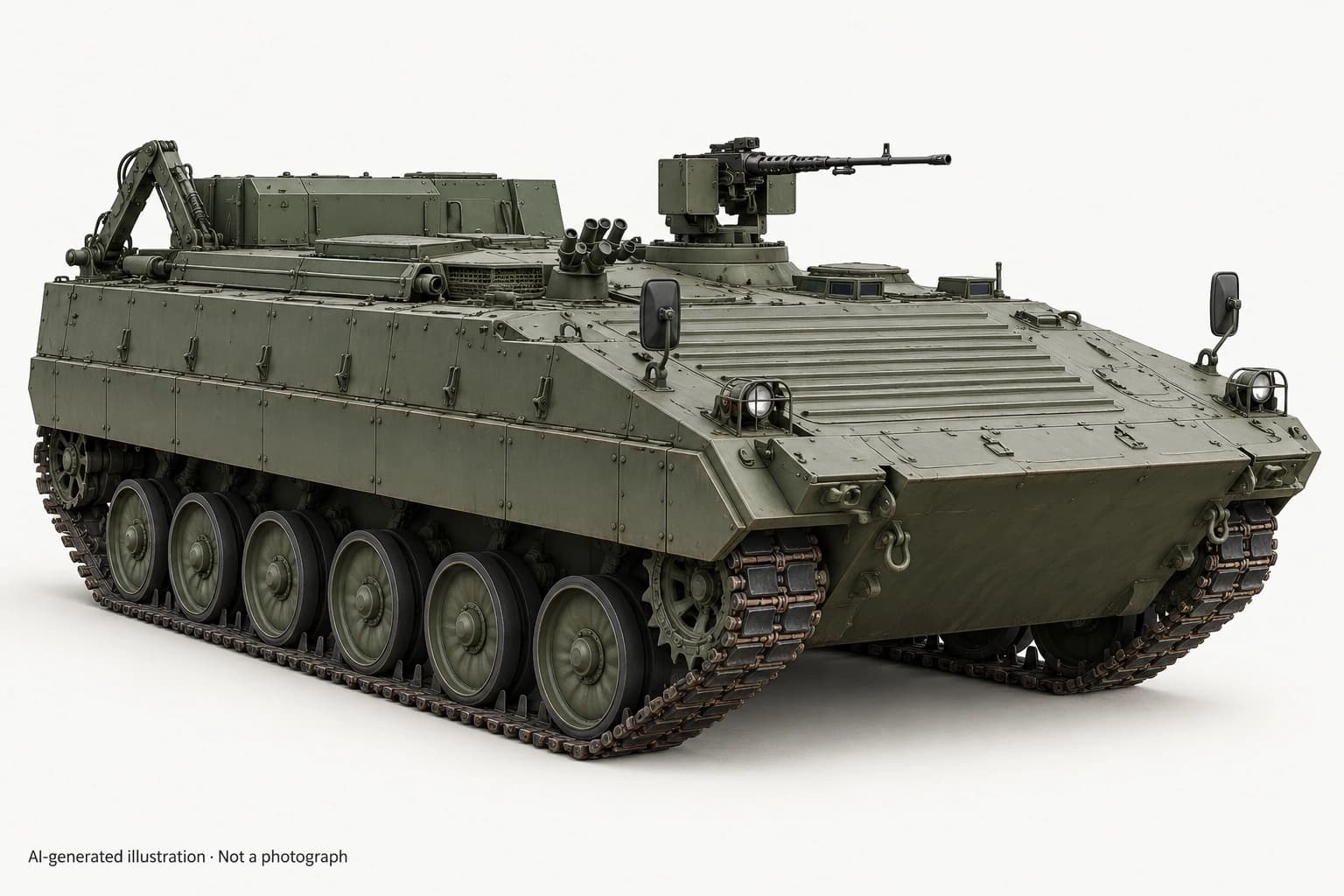

AI-generated illustration · Not a photograph
Credit
ForceTally · AI-generated illustration · Not a photograph · AI-generated · OpenAI output terms · Source ↗ · Modified


Preparing your view.

At a glance
SPG Kalinalarger figure on 2 of 3
True scale
Side by side. From every angle. A human reference for perspective.
3.31 MB · Loads when you open it| Model | Length | Width / span | Height |
|---|---|---|---|
| SPG Kalina | ≈ 10.41 m | ≈ 2.87 m (Width) | ≈ 3.08 m |
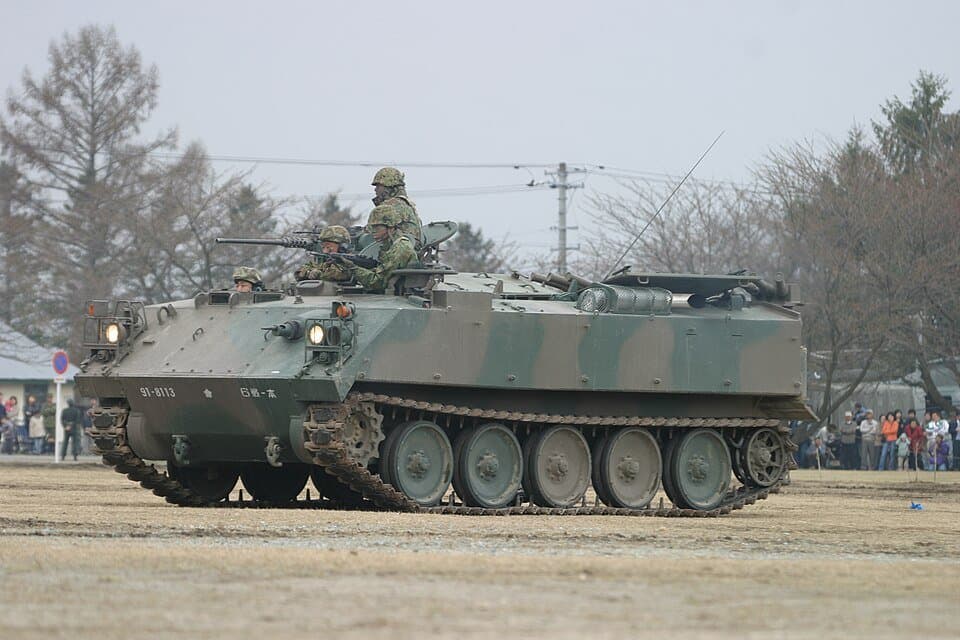
| Type 73 armored personnel carrier | ≈ 5.8 m | ≈ 2.9 m (Width) | ≈ 2.24 m |
Scaled uniformly to the sourced length of 10.41 m. Thin antennas or poles standing above the body were pressed down to it, so they do not set the height; the width was fitted to the sourced 2.87 m. Not an official model or a measured survey.
ForceTally · All rights reserved
Scaled uniformly to the sourced length of 5.8 m. The width was fitted to the sourced 2.9 m. Not an official model or a measured survey.
ForceTally · All rights reserved
The human reference is a generic 1.75 m figure. Models describe external size, not combat performance.
Measured figures
Length
Single source10.41 m[source]
Length
Single sourceConfiguration
| Specification | SPG Kalina | Type 73 armored personnel carrier |
|---|---|---|
| Type | Armored personnel carrier[source] | Armored personnel carrier[source] |
| Place of origin | Poland[source] | Japan[source] |
| Used by | Poland[source] | Japan Ground Self-Defense Force[source] |
| Main armament | 12.7mm NSVT machine-gun[source] |
Type 73 armored personnel carrierlarger figure on 1 of 3
Counts only measures both sources give with the same scope. A larger figure is not a better system.
5.80 m (19.0 ft)[source]
Bars compare reported quantities only. A larger figure does not make a system better; configurations and test conditions differ.
12.7 mm M2HB heavy machine gun[source] |
| Suspension | Torsion bar[source] | Torsion bar[source] |
|---|
| Manufacturer | Bumar Łabędy[source] | Mitsubishi Heavy Industries , Komatsu Limited[source] |
|---|
| Source measurement | N-21 radar is a three-dimensional radar used to detect targets at low altitudes (up to 5 km) at ranges up to 100 km. The radar was designed by Polish company Radwar . Radar is using SPG-1, non armored carrier vehicle.[source]SPG Kalina · Variants / N-21; only the objects and conditions stated in this passage Self propelled Minelayer ) is a tracked minelayer developed from SPG-1M specifically for the rapid laying of surface and buried anti-tank mines.[source]SPG Kalina · Variants / SUM Kalina; only the objects and conditions stated in this passage The minelaying system is carried at the rear of the vehicle with mines being automatically fed into the system from two magazines carried within the armoured superstructure; each magazine can hold up to 125 anti-tank mines of the TM-62M or TM-62M Wierzba type.[source]SPG Kalina · Variants / SUM Kalina; only the objects and conditions stated in this passage The mine magazines are replenished or replaced using a K10 crane mounted at the rear of the vehicle which has a lifting capacity of 2,800 kg.[source]SPG Kalina · Variants / SUM Kalina; only the objects and conditions stated in this passage When burying mines the vehicle can travel at a speed between 6 and 10 km/h.[source]SPG Kalina · Variants / SUM Kalina; only the objects and conditions stated in this passage When laying surface mines the speed range is from 6 to 20 km/h.[source]SPG Kalina · Variants / SUM Kalina; only the objects and conditions stated in this passage It is possible to lay mines in water up to 900 mm deep at a speed of 6 km/h.The vehicle is armed with a 12.7 mm NSW machine gun; 902A smoke grenade launchers are also provided.[source]SPG Kalina · Variants / SUM Kalina; only the objects and conditions stated in this passage Infantry fighting vehicle based on SPG-1M.[source]SPG Kalina · Variants / BWP-2000; only the objects and conditions stated in this passage It protects the vehicle against APFSDS-T projectiles of up to 35 mm in calibre over the frontal arc.[source]SPG Kalina · Variants / BWP-2000; only the objects and conditions stated in this passage The roof and sides protect it against 12.7 mm rounds fired from a range of 100 m.[source]SPG Kalina · Variants / BWP-2000; only the objects and conditions stated in this passage The other parts of the armour protect it against 7.62 mm rounds from any distance and angle.[source]SPG Kalina · Variants / BWP-2000; only the objects and conditions stated in this passage The turret is the Italian Oto Melara T60/70A which is normally armed with a stabilized 60 mm rifled autocannon, a 7.62 mm coaxial machine gun and 12.7 mm anti-aircraft heavy machine gun.[source]SPG Kalina · Variants / BWP-2000; only the objects and conditions stated in this passage The 60 mm autocannon can be replaced by a variety of guns from 25 mm autocannons to 105 mm guns.[source]SPG Kalina · Variants / BWP-2000; only the objects and conditions stated in this passage A 155mm howitzer on UPG chassis. UPG (UPG for Uniwersalne Podwozie Gąsiennicowe – lit. Universal Tracked Chassis) is a heavy APC that is using technologies from SPG Kalina and PT-91 Twardy .[source]SPG Kalina · Variants / Krab; only the objects and conditions stated in this passage | In 1967, the Defense Agency 's Technical Research and Development Institute issued a requirement for a new armored personnel carrier to replace the Type 60 . Concerns were raised that the Type 60 cannot be equipped with nuclear, biological, and chemical protection equipment. The requirements included a maximum speed of over 60 km/h (37 mph), ability to carry 12 men including the crew, being fully amphibious, having all-welded aluminium armor, provision for the infantry to use their small arms from inside the vehicle, and being armed with a 20 mm autocannon , a 12.7 mm heavy machine gun , and a 7.62 mm machine gun .[source]Type 73 armored personnel carrier · Development; only the objects and conditions stated in this passage Developing the engine began before the vehicle prototyping efforts. Mitsubishi developed the ZF series air-cooled diesel engines with the aim of increasing parts commonality between Japan Ground Self-Defense vehicles. Depending on the platform power requirements, an engine with the appropriate number of cylinders was selected. For example, the Type 74 tank used the 10-cylinder 10ZF, the Type 75 155 mm self-propelled howitzer utilised the 6-cylinder 6ZF, and the 4-cylinder 4ZF was mounted on the Type 73 and the Type 74 105 mm self-propelled howitzer .[source]Type 73 armored personnel carrier · Development; only the objects and conditions stated in this passage Mitsubishi's aluminium model was chosen for operational use and standardised as the Type 73 in December 1973. Mitsubishi was the prime contractor and the tracks were made by Komatsu, while Hitachi was in charge of manufacturing the vehicle's transmission system.[source]Type 73 armored personnel carrier · Development; only the objects and conditions stated in this passage During development, mounting a 20 mm autocannon was also tested. The autocannon would have been produced under licence from Rheinmetall . However, plans to install an autocannon on production vehicles were postponed and eventually cancelled due to associated costs. |
|---|
| Source manufacturer statement | Special-purpose Tracked Chassis ; Kalina is Polish for guelder rose ) is a heavy, multi-purpose armoured personnel carrier designed at the OBRUM ( OBRUM stands for Ośrodek Badawczo-Rozwojowy Urządzeń Mechanicznych – Polish for Research and Development Centre for Mechanical Appliances ) and is produced by the Bumar Łabędy company - part of Polish military consortium - Bumar Group.[source]Only the subject, component or variant named in this passage; unresolved names do not create a manufacturer identity | — |
|---|
| In service | — | 1973 –…[source] |
|---|
| Designer | — | Technical Research and Development Institute[source] |
|---|
| Designed | — | 1967 –1973[source] |
|---|
| Unit cost | — | ¥ 100 million[source] |
|---|
| Produced | — | 1973 –1994[source] |
|---|
| No. built | — | 338[source] |
|---|
| Variants | — | See Variants[source] |
|---|
| Passengers | — |
|---|
| Armor | — | Aluminium[source] |
|---|
| Secondary armament | — | 7.62 mm Type 74 bow machine gun[source] |
|---|
| Power/weight | — | 22.56 hp/t (16.82 kW/t)[source] |
|---|
| Transmission | — | Automatic (4 forward, 1 reverse gear)[source] |
|---|
| Ground clearance | — | 0.4 m (16 in)[source] |
|---|
| Fuel capacity | — | 450 L (120 US gal)[source] |
|---|
| Role | — | Japanese tracked armored personnel carrier[source] |
|---|
| Reported operators | — |
|---|
Serial production of the Type 73 started in 1973. By 1994, a total of 338 vehicles had been produced. The Type 96 armored personnel carrier is slowly replacing the Type 73 in Japan Ground Self-Defence Force service , although 220 vehicles remain in use by 2024.[source]Type 73 armored personnel carrier · Development; only the objects and conditions stated in this passage
The Type 73 has a 12.7 mm M2HB heavy machine gun with 600 rounds of ammunition and a 7.62 mm Type 74 bow machine gun with 4,500 rounds available. The M2HB heavy machine gun can be operated remotely from within the vehicle, but it has little elevation as a consequence and is of limited use against aerial threats. The gunner's cupola can traverse a full 360°, but the bow gunner's weapon can only traverse, elevate, and depress 30°. The mounted infantry can fire their personal weapons from inside the vehicle through six T-shaped firing ports . The eight troops are seated on four folding seats on both sides of the rear of the vehicle facing each other.[source]Type 73 armored personnel carrier · Design; only the objects and conditions stated in this passage
While the Type 73 is amphibious , it requires additional equipment for travelling on water. Preparation for amphibious operations takes about 30 minutes, after which the Type 73 is able to traverse water bodies propelled by its tracks at 6 km/h (3.7 mph). The Type 73 is fitted with infra-red driving lights, can be equipped with a passive periscope for night driving , and has a nuclear, biological, and chemical protection system as standard equipment.[source]Type 73 armored personnel carrier · Design; only the objects and conditions stated in this passage
The Type 74 105 mm self-propelled howitzer , produced by Komatsu, which used a version of the Type 73 chassis that shared components with Komatsu's SUB 2 prototype.[source]Type 73 armored personnel carrier · Variants; only the objects and conditions stated in this passage
The Type 75 130 mm multiple rocket launcher , manufactured by Komatsu, with a chassis that utilised components from Komatsu's SUB 2 prototype.[source]Type 73 armored personnel carrier · Variants; only the objects and conditions stated in this passage
The Type 75 155 mm self-propelled howitzer , which was produced by Mitsubishi.[source]Type 73 armored personnel carrier · Variants; only the objects and conditions stated in this passage
The Type 75 wind measurement vehicle , manufactured by Komatsu, which supported the Type 75 130 mm multiple rocket launcher in service.[source]Type 73 armored personnel carrier · Variants; only the objects and conditions stated in this passage
In addition, the Type 76 counter-battery radar system includes a vehicle built by Komatsu that uses a modified Type 74 105 mm self-propelled howitzer chassis, itself a derivative of the Type 73. The Acquisition, Technology & Logistics Agency has also adapted a Type 73 chassis for testing hybrid electric propulsion.[source]Type 73 armored personnel carrier · Variants; only the objects and conditions stated in this passage
Mitsubishi 's SUB 1 prototype with a turret for a 20 mm autocannon at Camp Kasumigaura[source]Type 73 armored personnel carrier · Gallery; only the objects and conditions stated in this passage
Komatsu 's SUB 2 prototype with a turret for a 20 mm autocannon at Camp Tsuchiura[source]Type 73 armored personnel carrier · Gallery; only the objects and conditions stated in this passage
A close-up view of the 7.62 mm bow machine gun mount on Komatsu's SUB 2 prototype at Camp Tsuchiura[source]Type 73 armored personnel carrier · Gallery; only the objects and conditions stated in this passage
A close-up view of the turret for a 20 mm autocannon on Komatsu's SUB 2 prototype at Camp Tsuchiura[source]Type 73 armored personnel carrier · Gallery; only the objects and conditions stated in this passage