
ACombat aircraft
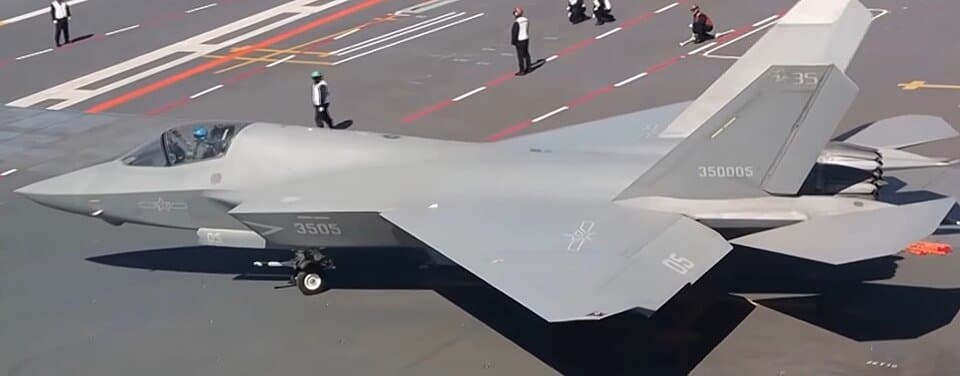
Shenyang J-35
J-35 Blue Shark: Carrier-based multirole stealth fighter J-35A Cloud Dragon: Multirole stealth fighter


Preparing your view.
ACombat aircraft
J-35 Blue Shark: Carrier-based multirole stealth fighter J-35A Cloud Dragon: Multirole stealth fighter

At a glance
True scale
Side by side. From every angle. A human reference for perspective.
3.10 MB · Loads when you open it| Model | Length | Width / span | Height |
|---|---|---|---|
| Shenyang J-35 | ≈ 17.3 m | ≈ 11.5 m (Wingspan) | ≈ 4.44 m |
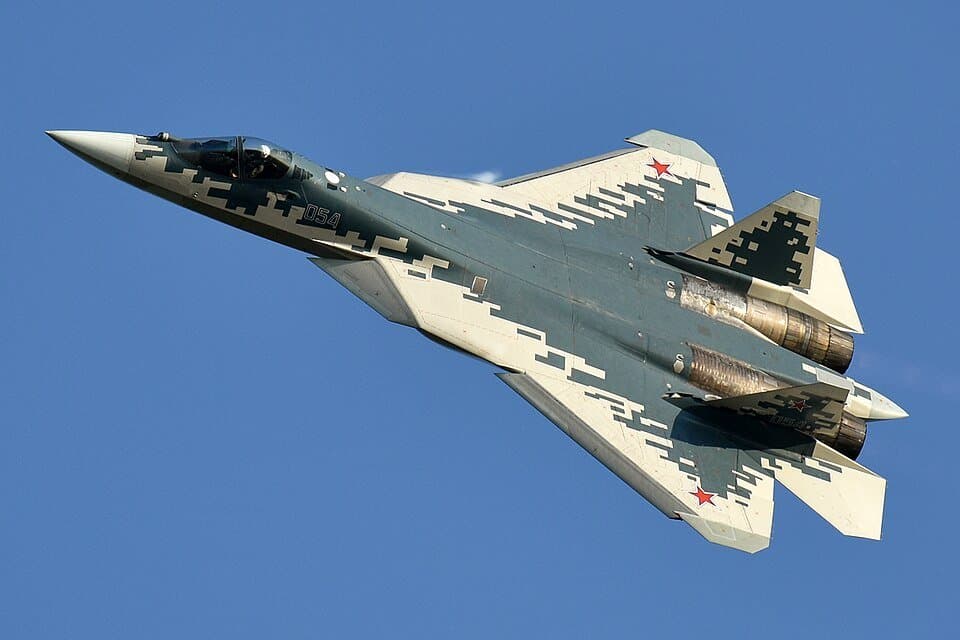
| Sukhoi Su-57 | ≈ 20.1 m | ≈ 14.1 m (Wingspan) | ≈ 4.6 m |
Scaled uniformly to the sourced length of 17.3 m. The width was fitted to the sourced 11.5 m wingspan. Not an official model or a measured survey.
ForceTally · All rights reserved
Scaled uniformly to the sourced length of 20.1 m. The nose wheel was added by copying a main-gear leg and wheel at 70% size, and the width and height were fitted to the sourced 14.1 m wingspan and 4.6 m height. Not an official model or a measured survey.
ForceTally · All rights reserved
The human reference is a generic 1.75 m figure. Models describe external size, not combat performance.
Measured figures
J-35 · Length
Single source17.3 m (56 ft 9 in)[source]
Su-57E · Length
Configuration
| Specification | Shenyang J-35 | Sukhoi Su-57 |
|---|---|---|
| Type | J-35 Blue Shark: Carrier-based multirole stealth fighter J-35A Cloud Dragon: Multirole stealth fighter[source] | Stealth multirole fighter[source] |
| National origin | China[source] | Russia[source] |
| Manufacturer | Shenyang Aircraft Corporation[source] | United Aircraft Corporation[source] |
| Designer | 601st Design Institute[source] | Sukhoi |
20.1 m (65 ft 11 in)[source]
Gross; J-35 · Gross weight
Single sourceMaximum take-off; J-35 · Max takeoff weight
Single source17,500 kg (38,581 lb)[source]
28,000 kg (61,729 lb)[source]
17.500 kg (38.581 lb)[source]
Empty; Su-57E · Empty weight
Single sourceGross; Su-57E · at full load
Single sourceMaximum; J-35 · Mach 1.8 Mach 1.14 at sea level
Single sourceMach 1.8 Mach 1.14, 1,400 kilometres per hour (870 mph; 756 kn) at sea level[source]
Maximum; Su-57E · at sea level
Single sourceMaximum; Su-57E · Mach 2.0 at high altitude Mach 1.1
Single sourceMach 2.0, 2,135 km/h (1,153 kn; 1,327 mph) at high altitude Mach 1.1, 1,350 km/h (729 kn; 839 mph) at sea level[source]
J-35 · (radius) on internal fuel
Single sourceJ-35 · (radius) with air refueling
Single sourceJ-35 · (radius) with external fuel tanks
Single source1,250 km (780 mi, 670 nmi) (radius) on internal fuel 1,900 kilometres (1,200 mi) (radius) with air refueling 2,000 kilometres (1,200 mi) (radius) with external fuel tanks[source]
Su-57E · Combat range
Single source1,250 km (780 mi, 670 nmi)[source]
J-35 · 2 × Guizhou WS-21 (J-35) afterburning turbofans with afterburner
Single source2 × Guizhou WS-21 (J-35) afterburning turbofans , 87.2–93.2 kN (19,600–21,000 lbf) with afterburner[source]
Su-57E · 2 × Saturn AL-41F-1 afterburning turbofan thrust each dry
Single sourceSu-57E · in emergency power
Single sourceSu-57E · with afterburner
Single source2 × Saturn AL-41F-1 afterburning turbofan , 88.3 kN (19,900 lbf) thrust each dry, 142.2 kN (32,000 lbf) with afterburner, 147.1 kN (33,100 lbf) in emergency power[source]
J-35 · external, and up to
Single sourceJ-35 · Hardpoints: 6 × internal hardpoints inside weapons bay, 6 × external hardpoints on wings with a capacity of internal
Single sourceJ-35 · total weapons payload, with provisions to carry combinations of
Single sourceHardpoints: 6 × internal hardpoints inside weapons bay, 6 × external hardpoints on wings with a capacity of 2,000 kilograms (4,400 lb) internal, 6,000 kilograms (13,000 lb) external, and up to 8,000 kilograms (18,000 lb) total weapons payload, with provisions to carry combinations of:[source]
Su-57E · Hardpoints: 12 hardpoints (6 × internal, 6 × external) with a capacity of maximum payload
Single sourceHardpoints: 12 hardpoints (6 × internal, 6 × external) with a capacity of 7,500 kilograms (16,500 lb) maximum payload[source]
Su-57E · Wing area
Single source78.8 m 2 (848 sq ft)[source]
Bars compare reported quantities only. A larger figure does not make a system better; configurations and test conditions differ.
| Status | In service[source] | In production[source] |
|---|
| Primary user | People's Liberation Army Air Force People's Liberation Army Naval Air Force[source] | — |
|---|
| Number built | 57+ as of October 2025[source] | 44+ as of 2026 (including 10 test aircraft)[source] |
|---|
| Manufactured | 2012–2016 (FC-31) 2021–present (J-35)[source] | 2019–present[source] |
|---|
| Introduction date | 3 September 2025 (J-35/J-35A)[source] | 2020[source] |
|---|
| First flight | 31 October 2012 (FC-31) 29 October 2021 (J-35) 26 September 2023 (J-35A)[source] | 29 January 2010 ( 2010-01-29 )[source] |
|---|
| Developed from | Shenyang FC-31[source] | — |
|---|
| Fuel capacity | 7,200 kg (15,900 lb)[source] | 9,700 kg (21,385 lb) internal, 12,900 kg (28,440 lb) with 2× PTB-2000 2,000 L (528 US gal) drop tanks[source] |
|---|
| Guns | Unknown (Reportedly)[source] | 1 × 30 mm Gryazev-Shipunov GSh-30-1 autocannon[source] |
|---|
| Hardpoints | 6 × internal hardpoints inside weapons bay, 6 × external hardpoints on wings with a capacity of 2,000 kilograms (4,400 lb) internal, 6,000 kilograms (13,000 lb) external, and up to 8,000 kilograms (18,000 lb) total weapons payload, with provisions to carry combinations of:[source] | 12 hardpoints (6 × internal, 6 × external) with a capacity of 7,500 kilograms (16,500 lb) maximum payload[source] |
|---|
| g limits | +9/-3[source] | +9.0[source] |
|---|
| Missiles | Air-to-air missiles : 6 × air-to-air missile (internally carried) and 6 × air-to-air missile (externally carried) PL-10 short-range infrared homing PL-15 long range active radar homing PL-17 long-range active radar homing (planned) PL-21 long-range active radar homing (in development) Air-to-ground missiles : 4 × air-to-surface missile (internally carried) and 4 × air-to-surface missile (externally carried) 8 × supersonic land attack missiles 8 × supersonic anti-radiation missiles LD-8A 8 × supersonic anti-ship missiles[source] | Air-to-air missiles : R-77 M R-74M2 R-37 (missile) Air-to-surface missiles : 4 × Kh-38 M 4 × Kh-69 S-71K Kovyor Anti-ship missiles : 2 × Kh-35 U 2 × Kh-31 Anti-radiation missiles : 4 × Kh-58 UShK[source] |
|---|
| Bombs | 4 × 500 kg (1,100 lb) class bombs (internally carried) and 4 × 500 kg (1,100 lb) class bombs (externally carried) 12 × small bombs (internally carried) and 18 × small bombs (externally carried)[source] | KAB-250 guided bomb KAB-500 guided bomb "Drill" anti-tank 500 kg cluster bomb with active homing[source] |
|---|
| Role | series of Chinese single-seater, twin-engine , all-weather , stealth multirole combat aircraft[source] | — |
|---|
| Source measurement | There were also persistent rumors of the FC-31 being developed into a carrier-based naval fighter . In 2015, the FC-31's chief designer Sun Cong suggested that FC-31 would succeed Shenyang J-15 in operating on China's aircraft carriers.[source]Shenyang J-35 · Development / Shenyang FC-31; only the objects and conditions stated in this passage Inside the cockpit, there is a side stick controller on the FC-31 and J-35A, or an integrated center stick for the naval J-35, a conventional heads up display , and a large single-piece multi-function touchscreen display (MFD) of 20 in × 8 in (510 mm × 200 mm) in size. The pilot is also provided with a helmet-mounted display and sight (HMD/S) system, comparable to that of Striker system made by BAE Systems . The flight control system is fully digitalized, with triple redundancy modules and twin data bus . The aircraft is intended to serve as a node in the network of elements with other platforms, playing a key role in Chinese military's kill chain.[source]Shenyang J-35 · Design / Avionics; only the objects and conditions stated in this passage The second FC-31 prototype is fitted with the domestic Guizhou WS-13E engine, an improved variant of the Guizhou WS-13 that powered the JF-17 , providing 87.2 kN (19,600 lbf; 8,890 kgf) of maximum thrust. The WS-13E engine is smokeless and more efficient than the RD-93.[source]Shenyang J-35 · Design / Engines; only the objects and conditions stated in this passage The further developed Shenyang J-35 was initially powered by the Guizhou WS-21 engine, also known as the WS-13X, a derivative and upgrade of the WS-13E. The WS-21 provides 93.2 kN (21,000 lbf; 9,500 kgf) of thrust, and served as an interim powerplant for the early production J-35.[source]Shenyang J-35 · Design / Engines; only the objects and conditions stated in this passage The final production powerplant for the J-35 is the Guizhou WS-19 , an engine capable of producing approximately 110–116 kN (25,000–26,000 lbf; 11,200–11,800 kgf) of thrust with a higher thrust-to-weight ratio. The J-35 was expected to be capable of supercruise with the WS-19 engines fitted; however As of 5 November 2024 there has been no confirmation this was achieved.[source]Shenyang J-35 · Design / Engines; only the objects and conditions stated in this passage The J-35 is equipped with a retractable refueling probe for inflight refueling. The aircraft can achieve a short-take off distance of 450 m (1,480 ft) and a landing distance of 700 m (2,300 ft).[source]Shenyang J-35 · Design / Engines; only the objects and conditions stated in this passage The Shenyang FC-31 has a lengthened centerline internal weapons bay with a dimension similar to that of Chengdu J-20 . The weapons bay has six internal hardpoints. Externally, the fighter has six hardpoints on the wings. The first FC-31 prototype can reportedly carry 8,000 kg (18,000 lb) of payload in total, split between the internal carrying capabilities of 2,000 kg (4,400 lb) and external carrying capacity of 6,000 kg (13,000 lb). Under the regular combat load, the fighter has a combat radius of 648 nmi (746 mi; 1,200 km) and maximum take-off weight of 25,000 kg (55,000 lb). On the second prototype, the maximum take-off weight is increased to 28,000 kg (62,000 lb) along with a modified fuselage.[source]Shenyang J-35 · Design / Armaments and payload; only the objects and conditions stated in this passage Inside the weapons bay, the J-35 can carry six air-to-air missiles , such as PL-10 , PL-15 and PL-21 . Apart from air-superiority loadouts, the internal bay can also carry precision-strike munitions, with maximum provisions for twelve small diameter bombs, four large deep-penetration bombs of 500 kg (1,100 lb), four supersonic land-attack missiles, or four anti-radiation/anti-ship missiles. Externally, the wings allow the maximum provisions of six air-to-air missiles, 18 small bombs, four large bombs of 500 kg (1,100 lb), or four land-attack missiles. Presumably, the operator can mix the combinations of armaments according to the missions. Aside from underslung weapons, speculative observations also believe an autocannon is located above the port-side air intake.[source]Shenyang J-35 · Design / Armaments and payload; only the objects and conditions stated in this passage The prototype conducted a high-speed taxiing test and briefly became airborne. On 31 October 2012, prototype No. 31001 conducted the model's maiden flight. It was accompanied by two J-11 fighters in a ten-minute test flight with its landing gear lowered.[source]Shenyang J-35 · Operational history / Flight testing; only the objects and conditions stated in this passage On 23 December 2016, the second prototype of the FC-31, No. 31003, took its maiden flight. The second prototype featured a modified airframe, with different engines, cockpit, wings, avionics, electronics, and overall dimensions. The aircraft length was increased from 16.8 m (55 ft) to 17.3 m (57 ft) and the maximum take-off weight was increased from 25 t (25,000 kg; 55,000 lb) to 28 t (28,000 kg; 62,000 lb). Due to the major design change, it's commonly referred to as the FC-31 V2 due to major differences from the first prototype.[source]Shenyang J-35 · Operational history / Flight testing; only the objects and conditions stated in this passage At the end of May 2025, the Chinese aircraft carrier Fujian carried out its eighth sea trial, with ship-borne Shenyang J-35 stealth fighters, fitted for catapult launch, carrying out tests and flights at the same time.[source]Shenyang J-35 · Operational history / Flight testing; only the objects and conditions stated in this passage Length: 17.3 m (56 ft 9 in)[source]Shenyang J-35 · Specifications (J-35); only the objects and conditions stated in this passage Wingspan: 11.5 m (37 ft 9 in)[source]Shenyang J-35 · Specifications (J-35); only the objects and conditions stated in this passage Height: 4.8 m (15 ft 9 in)[source]Shenyang J-35 · Specifications (J-35); only the objects and conditions stated in this passage Gross weight: 17,500 kg (38,581 lb)[source]Shenyang J-35 · Specifications (J-35); only the objects and conditions stated in this passage Max takeoff weight: 28,000 kg (61,729 lb)[source]Shenyang J-35 · Specifications (J-35); only the objects and conditions stated in this passage Fuel capacity: 7,200 kg (15,900 lb)[source]Shenyang J-35 · Specifications (J-35); only the objects and conditions stated in this passage Powerplant: 2 × Guizhou WS-21 (J-35) afterburning turbofans , 87.2–93.2 kN (19,600–21,000 lbf) with afterburner[source]Shenyang J-35 · Specifications (J-35); only the objects and conditions stated in this passage Powerplant: 2 × Guizhou WS-19 afterburning turbofans , 116 kN (26,000 lbf) thrust each[source]Shenyang J-35 · Specifications (J-35); only the objects and conditions stated in this passage Maximum speed: Mach 1.8 Mach 1.14, 1,400 kilometres per hour (870 mph; 756 kn) at sea level[source]Shenyang J-35 · Specifications (J-35); only the objects and conditions stated in this passage Combat range: 1,250 km (780 mi, 670 nmi) (radius) on internal fuel 1,900 kilometres (1,200 mi) (radius) with air refueling 2,000 kilometres (1,200 mi) (radius) with external fuel tanks[source]Shenyang J-35 · Specifications (J-35); only the objects and conditions stated in this passage Service ceiling: 16,000 m (52,000 ft)[source]Shenyang J-35 · Specifications (J-35); only the objects and conditions stated in this passage Bombs: 4 × 500 kg (1,100 lb) class bombs (internally carried) and 4 × 500 kg (1,100 lb) class bombs (externally carried) 12 × small bombs (internally carried) and 18 × small bombs (externally carried)[source]Shenyang J-35 · Specifications (J-35); only the objects and conditions stated in this passage | — |
|---|
| Built by | — | Komsomolsk-on-Amur Aircraft Plant[source] |
|---|
| Primary users | — | Russian Aerospace Forces Algerian Air Force[source] |
|---|
| Variant | — | Sukhoi/HAL FGFA (cancelled)[source] |
|---|
| Supercruise | — | Mach 1.3, 1,400 km/h (756 kn; 870 mph) supercruise at high altitude[source] |
|---|
| Wing loading | — | 371 kg/m 2 (76 lb/sq ft) normal takeoff weight[source] |
|---|
| Thrust/weight | — | 1.09 at normal takeoff weight (0.97 at loaded weight with full fuel)[source] |
|---|
| Reported operators |
| — |
|---|
Gross; Su-57E · normal takeoff weight
Single sourceMaximum take-off; Su-57E · Max takeoff weight
Single source