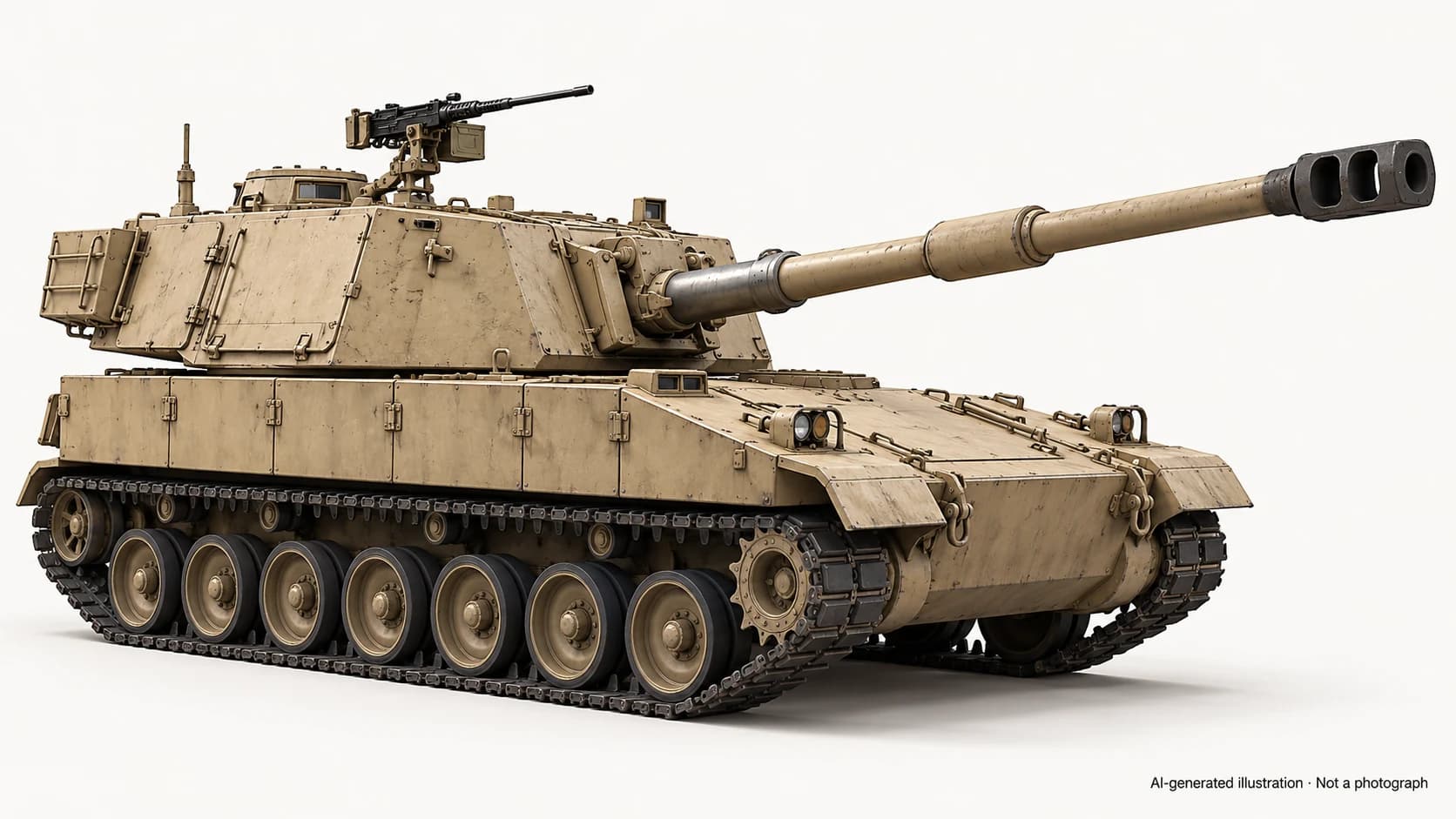

AI-generated illustration · Not a photograph
Credit
ForceTally · AI-generated illustration · Not a photograph · AI-generated · OpenAI output terms · Source ↗ · Modified


Preparing your view.

At a glance
Raad-2larger figure on 2 of 5
Measured figures
without the gun
Single source6.72 m (without the gun)[source]
Length
Single sourceConfiguration
| Specification | Raad-2 | Type 19 155 mm wheeled self-propelled howitzer |
|---|---|---|
| Type | Self-propelled howitzer[source] | Self-propelled howitzer[source] |
| Place of origin | Iran[source] | Japan[source] |
| In service | 1997–present[source] | 2020–…[source] |
| Used by | Iran[source] |
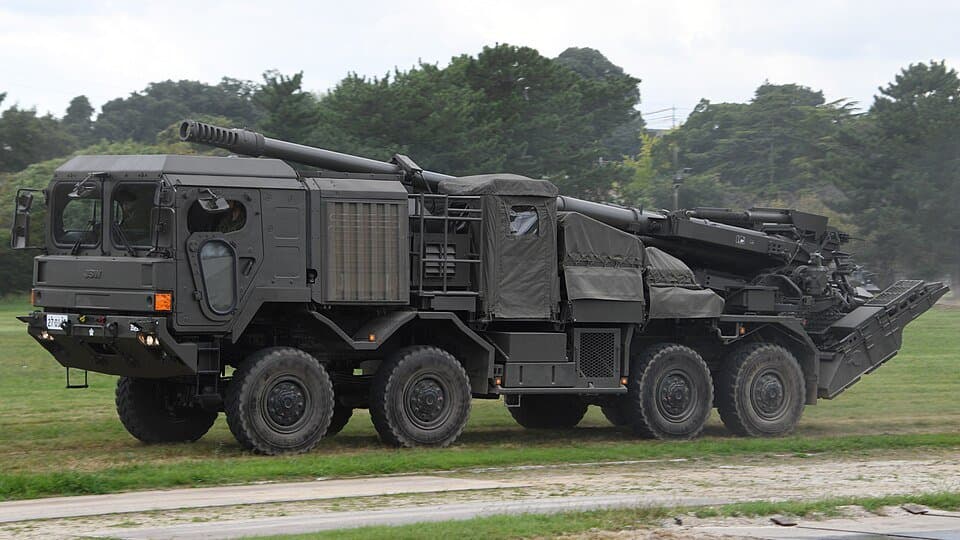
Type 19 155 mm wheeled self-propelled howitzerlarger figure on 3 of 5
Counts only measures both sources give with the same scope. A larger figure is not a better system.
11.21 m (36.8 ft)[source]
commander, driver and gunner
Single sourceCrew
Single sourceKommandant, Fahrer, Richtschütze, zwei Ladeschützen
Single sourceラード2
Single source3 (commander, driver and gunner)[source]
Экипаж (расчёт), чел. 3 (командир, механик-водитель и наводчик)[source]Raad-2 / Thunder-2
5 (Kommandant, Fahrer, Richtschütze, zwei Ladeschützen)[source]Kommandant, Fahrer, Richtschütze, zwei Ladeschützen
3名[source]ラード2
driver, gunner, commander, 2 loaders
Single source5 (driver, gunner, commander, 2 loaders)[source]
Operational; Operational range
Single sourceEffective; Effective firing range
Single sourceetwa
Single sourceRange
Single source30 km (19 mi)[source]
500 km[source]
Запас хода, км 500[source]Raad-2 / Thunder-2
etwa 500 km[source]etwa
500 km[source]
Operational; Operational range
Single sourceEffective; base bleed
Single sourceBars compare reported quantities only. A larger figure does not make a system better; configurations and test conditions differ.
Japan[source] |
| Designer | Defense Industries Organization[source] | Acquisition, Technology & Logistics Agency[source] |
|---|
| Designed | September 1997[source] | 2013–2018[source] |
|---|
| Produced | 1997–present[source] | 2019–…[source] |
|---|
| No. built | at least 36[source] | 70 (2026)[source] |
|---|
| Variants | Raad-2M[source] | — |
|---|
| Main armament | 155 mm HM44 howitzer[source] | 155 mm/L52 howitzer gun[source] |
|---|
| Secondary armament | 12.7 mm HMG[source] | — |
|---|
| Suspension | Torsion bar[source] | — |
|---|
| Role | Iranian self-propelled howitzer[source] | Japanese wheeled 155 mm self-propelled howitzer[source] |
|---|
| Source manufacturer statement | The Iranian Defense Industries Organization claimed that the 155 mm HM44 howitzer manufactured by the Hadid facility of the Iranian Defense Industries Organization had a high firing rate and accuracy.[source]Only the subject, component or variant named in this passage; unresolved names do not create a manufacturer identity | — |
|---|
| Source measurement | It uses a turret that has a similar layout to the M109A1 155mm/39-cal self-propelled howitzer . The Iranian Defense Industries Organization claimed that the 155 mm HM44 howitzer manufactured by the Hadid facility of the Iranian Defense Industries Organization had a high firing rate and accuracy. The gun's range was reported as 30 km (19 mi), and it also includes features such as a laser range-finder and a semi-automatic loading system.[source]Raad-2 · Development; only the objects and conditions stated in this passage The Raad-2 is crewed by 5 persons, with the driver stationed at the left with the power pack at the right.[source]Raad-2 · Development; only the objects and conditions stated in this passage Raad-2 - basic SPG version with a Russian V12-type V-84MS diesel engine Raad-2M Raad-2M - Raad-2 upgraded with a Ukrainian-made 5TDF engine instead of a V-8 Diesel engine.[source]Raad-2 · Variants; only the objects and conditions stated in this passage | The Type 19 155 mm wheeled self-propelled howitzer ( 19式装輪自走155mmりゅう弾砲 , Hitokyuu-shiki-sourin-jisou-155mm-ryuudan-hou ) is a Japanese wheeled 155 mm self-propelled howitzer . The vehicle is designed to replace Japan's inventory of FH70 towed howitzers. The Type 19 continues to serve exclusively in the Japan Ground Self-Defense Force as a more affordable counterpart of the Type 99 155 mm self-propelled howitzer .[source]Type 19 155 mm wheeled self-propelled howitzer · Lead; only the objects and conditions stated in this passage In 2011, the Japanese Ministry of Defence evaluated a proposal to develop a vehicle capable of networking with other systems and performing shoot-and-scoot tactics to replace the FH70 towed 155 mm howitzer. The evaluation concluded in 2012 and the ministry requested 6.4 billion yen to be invested into the development of the vehicle in the fiscal year (FY) 2012 defence budget. The initial request was declined, only to be approved the following year. Research and development funds for the 155 mm wheeled howitzer were granted in the FY 2013 defence budget, although the budget was lowered to 1.4 billion yen. That marks the official beginning for the development of the Type 19 155 mm self-propelled howitzer.[source]Type 19 155 mm wheeled self-propelled howitzer · Development; only the objects and conditions stated in this passage The new self-propelled howitzer was to make use of off-the-shelf technologies. To reduce development costs, the initial plan was to mount the howitzer gun from the Type 99 155 mm self-propelled howitzer on a heavy recovery vehicle chassis. As the limitations of that option became clear during development and Japan had no other suitable chassis available – developing a proprietary chassis was deemed financially unfeasible –, an existing foreign 8×8 chassis was chosen instead. Rheinmetall MAN Military Vehicles ' HX44M became the chassis of the Type 19, which was produced under licence by Japan Steel Works .[source]Type 19 155 mm wheeled self-propelled howitzer · Development; only the objects and conditions stated in this passage On 31 May 2018, the Acquisition, Technology & Logistics Agency (ATLA) received 5 prototypes from Japan Steel Works for testing and evaluation. Testing concluded in 2019, when the Type 19 155 mm wheeled self-propelled howitzer was accepted into Japan Ground Self-Defense Force Service. Seven wheeled howitzers were procured for training purpose in the FY 2019 defence budget for a total of 5.1 billion yen.[source]Type 19 155 mm wheeled self-propelled howitzer · Development; only the objects and conditions stated in this passage The Type 19 155 mm self-propelled howitzer uses Rheinmetall MAN Military Vehicles' HX44M 8×8 chassis from the company's HX2 series of tactical military trucks. Japan Steel Works produces the chassis under licence domestically.[source]Type 19 155 mm wheeled self-propelled howitzer · Design / Chassis; only the objects and conditions stated in this passage The howitzer gun is a modified version of the 155 mm 52- calibre gun used on the Type 99 155 mm self-propelled howitzer. As the gun is externally mounted, it was modified to remove the smoke extractor of the propellant gasses (present on the Type 99).[source]Type 19 155 mm wheeled self-propelled howitzer · Design / Gun; only the objects and conditions stated in this passage The Type 19 uses the same shells and propellant charges as the Type 99. Having the same howitzer gun also implies that the effective firing range is very similar – 30 km (19 mi) using standard shells and 40 km (25 mi) when using base bleed shells. In September 2024, Japan placed an order for Leonardo 's guided long-range Vulcano 155 GLR shells, received the first batch in December, and began the integration process into the Type 19.[source]Type 19 155 mm wheeled self-propelled howitzer · Design / Ammunition; only the objects and conditions stated in this passage HE shell: Range: ≤ 30 km (19 mi)[source]Type 19 155 mm wheeled self-propelled howitzer · Design / Ammunition; only the objects and conditions stated in this passage Type 93 base bleed shell: Range: ≤ 40 km (25 mi)[source]Type 19 155 mm wheeled self-propelled howitzer · Design / Ammunition; only the objects and conditions stated in this passage Vulcano GLR : Range: ≤ 70 km (43 mi) Guidance: autonomous IMU + GPS Combined with a quadcopter drone for targeting in Japan Ground Self-Defense Force service.[source]Type 19 155 mm wheeled self-propelled howitzer · Design / Ammunition; only the objects and conditions stated in this passage Procurement of the Type 19 155 mm self-propelled howitzer started in 2019. Prototypes were first revealed to the public in 2019 during the annual live fire exercises held at the East Fuji Maneuver Area. The first production vehicle belonging to an artillery training unit appeared a year later during the 2020 live fire exercises. Type 19s are expected to arm units that operate the FH70 towed howitzer, as the latter are gradually phased out of service.[source]Type 19 155 mm wheeled self-propelled howitzer · Operational history; only the objects and conditions stated in this passage In 2025, the Japan Ground Self-Defense Force tested long-range shells and propellant charges for the Type 19 in the Yuma Proving Ground . It was not possible to test the long-range ammunition in Japan. For the same reason, Japan is going to dispatch Type 19s to the United Kingdom for testing Vulcano GLR shells in QinetiQ 's MOD Aberporth testing range.[source]Type 19 155 mm wheeled self-propelled howitzer · Operational history; only the objects and conditions stated in this passage |
|---|
| Manufacturer | Defense Industries Organization (DIO)[source] | Japan Steel Works[source] |
|---|
| Unit cost | — | see Operators[source] |
|---|
| Breech | — | interrupted screw[source] |
|---|
| Power/weight | — | 17.6 hp/t (13.1 kW/t)[source] |
|---|
| Transmission | — | ZF 12 AS 23010D AS-Tronic ( AMT ) (12 front/ 2 rear) MAN G172 transfer case (high/low range) with engageable front axles[source] |
|---|
Effective; standard
Single source