
FORCETALLY
Loading the evidence…
Preparing your view.


Preparing your view.

At a glance
Measured figures
Prithvi I
Single sourcePrithvi II, Prithvi III
Single sourceConfiguration
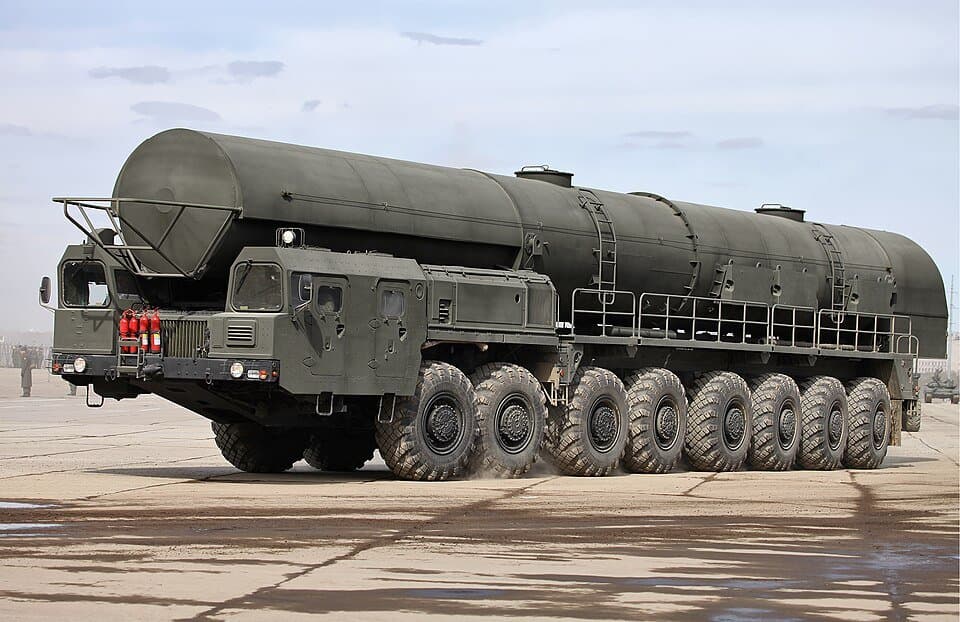
| Specification | Prithvi (missile) | RS-24 Yars |
|---|---|---|
| Type | Short-range ballistic missile[source] | Intercontinental Ballistic Missile[source] |
| Place of origin | India[source] | Russia[source] |
| In service | 1994 (Prithvi I)[source] | 2010–present[source] |
| Used by | Strategic Forces Command[source] | Russian Strategic Missile Troops |
9 m (Prithvi I) 8.56 m (Prithvi II, Prithvi III)[source]
Length
Single source22,500 mm[source]
Maximum; Mach 25 (
Single sourceMaximum; Maximum speed · source measurement 2
Single sourceMaximum; Maximum speed · source measurement 3
Single sourceMach 25 (30,600 km/h; 19,000 mph; 8,510 m/s)[source]
Operational; Prithvi I
Single sourceOperational; Prithvi II
Single sourceOperational; Prithvi III
Single source150 km (Prithvi I) 250–350 km (Prithvi II) 350–750 km (Prithvi III)[source]
Operational; Operational range
Single source11,000 km (6,800 mi) - 12,000 km (7,500 mi)[source]
Warhead weight
Single source500 kg (1,100 lb) - 1,000 kg (2,200 lb)[source]
Bars compare reported quantities only. A larger figure does not make a system better; configurations and test conditions differ.
| Designer | Defence Research and Development Organisation[source] | Moscow Institute of Thermal Technology[source] |
|---|
| Manufacturer | Bharat Dynamics Limited[source] | Votkinsk Machine Building Plant[source] |
|---|
| Produced | 25 February 1988 (Prithvi I) 27 January 1996 (Prithvi II) 23 January 2004 (Prithvi III)[source] | 2009[source] |
|---|
| No. built | 30 (2017 est.)[source] | — |
|---|
| Warhead | High explosives , penetration, cluster munition , fragmentation , thermobaric , chemical weapon and tactical nuclear weapon[source] | 3 x 200 kiloton MIRV warheads[source] |
|---|
| Engine | Single-stage liquid rocket (Prithvi I, Prithvi II), Two-stage solid rocket (Prithvi III)[source] | Three-stage Solid-fuel rocket[source] |
|---|
| Propellant | Liquid fuel (Prithvi I, Prithvi II), Solid fuel (Prithvi III)[source] | — |
|---|
| Guidance system | Strap-down INS[source] | Inertial with Glonass[source] |
|---|
| Accuracy | 50 m CEP (Prithvi I, Prithvi II) <10 m CEP (Prithvi II upgrade) 25 m CEP (Prithvi III)[source] | — |
|---|
| Launch platform | 8 x 8 Tata transporter erector launcher[source] | Silo , road-mobile TEL MZKT-79221[source] |
|---|
| Source measurement | The aerodynamic characterization research was conducted at the National Aerospace Laboratories ' 1.2m Trisonic Wind Tunnel Facility.[source]Prithvi (missile) · Development and history; only the objects and conditions stated in this passage Prithvi I (SS-150) – Army version (150 km (93 mi) range with a payload of 1,000 kg (2,200 lb))[source]Prithvi (missile) · Development and history / Variants; only the objects and conditions stated in this passage Prithvi II (SS-250) – Air Force version (350 km (220 mi) range with a payload of 500 kg (1,100 lb))[source]Prithvi (missile) · Development and history / Variants; only the objects and conditions stated in this passage Prithvi III (SS-350) – Naval version (350 km (220 mi) range with a payload of 1,000 kg (2,200 lb))[source]Prithvi (missile) · Development and history / Variants; only the objects and conditions stated in this passage Prithvi I is a single-stage liquid-fuelled surface-to-surface ballistic missile having a maximum warhead mounting capability of 1,000 kg, with a range of 150 km (93 mi). It has an accuracy of 10–50 m (33–164 ft) and can be launched from transporter erector launchers . This class of Prithvi missile was inducted into the Indian Army in 1994. As per DRDO 's former chief Avinash Chander , the tactical 150 km-range Prithvi missile will be replaced with the Prahaar missile, which is more capable and has more accuracy. According to Chander, the Prithvi I missiles withdrawn from service would be upgraded to be used for longer ranges.[source]Prithvi (missile) · Description / Prithvi I; only the objects and conditions stated in this passage Prithvi II is a single-stage liquid-fuelled missile. Initially, it was developed for an extended range of 250 km (160 mi) and maximum warhead capacity of 500 kg. This was gradually enhanced to a range of 350 km (220 mi) and 500–1000 kg payload. It was developed with the Indian Air Force being the primary user.[source]Prithvi (missile) · Description / Prithvi II; only the objects and conditions stated in this passage It was first test-fired on 27 January 1996 and the developmental trials were completed in 2004. In a test, the missile was launched with an extended range of 350 km (220 mi) and had improved navigation due to an improvement in inertial navigation system . The missile features measures to deceive anti-ballistic missiles .[source]Prithvi (missile) · Description / Prithvi II; only the objects and conditions stated in this passage The missile was inducted into India's Strategic Forces Command in 2003. After a failed test on 24 September 2010, two more missiles aimed at two different targets were launched on 22 December 2010 and were successful. According to reports, the range has been increased to 350 km (220 mi) and the payload capacity now ranges between 500 – 1000 kg. On 2 June, India successfully test-fired another Prithvi-II missile from the Integrated Test Range at Chandipur, Odisha at 9:50 am.[source]Prithvi (missile) · Description / Prithvi II; only the objects and conditions stated in this passage On 20 November 2019, Strategic Forces Command carried out 2 night user trials of Prithvi-II missiles as part of its annual training cycle to test the combat readiness of its missile forces. Two Prithvi-II tactical surface-to-surface short-range ballistic missiles were test fired from the Integrated Test Range (ITR) on Abdul Kalam Island in the Bay of Bengal off the coast of Odisha, according to government sources cited in local media reports. The trial of the surface-to-surface missile with a strike range of 350 km was carried out from a mobile launcher from Launch Complex III of the ITR between 7:00 pm and 7:15 pm.[source]Prithvi (missile) · Description / Prithvi II; only the objects and conditions stated in this passage Prithvi III is a two-stage surface-to-surface missile. The first stage is solid fueled with a 16 metric ton force (157 kN ) thrust motor. The second stage is liquid-fuelled. The missile can carry a 1,000 kg warhead to a distance of 350 km (220 mi) and a 500 kg warhead to a distance of 600 km (370 mi) and a 250 kg warhead up to a distance of 750 km (470 mi).[source]Prithvi (missile) · Description / Prithvi III; only the objects and conditions stated in this passage Prithvi III was first tested in 2000 from INS Subhadra , a Sukanya -class patrol vessel . The missile was launched from the updated reinforced helicopter deck of the vessel. The first flight test of the 250 km (160 mi) variant was only partially successful. The full operational testing was completed in 2004.[source]Prithvi (missile) · Description / Prithvi III; only the objects and conditions stated in this passage Dhanush ( lit. ' Bow ' ) is a variant of the surface-to-surface or ship-to-ship Prithvi III missile for the Indian Navy . It is capable of carrying both conventional as well as nuclear warheads with pay-load capacity of 500 kg-1000 kg and can strike targets in the maximum range of 750 km (470 mi). Dhanush is a system consisting of a stabilization platform and the missile. It is a customized version of the Prithvi and is certified for sea worthiness. Dhanush has to be launched from a hydraulically stabilized launch pad. Its low range acts against it and thus it is seen as a weapon either to be used to destroy an aircraft carrier or an enemy port. The Dhanush missile can be used as an anti-ship weapon as well as for destroying land targets depending on the range. The missile has been tested from surface ships of the navy multiple times.[source]Prithvi (missile) · Dhanush (missile); only the objects and conditions stated in this passage The missile was successfully tested-fired from INS Subhadra , which was anchored about 35 km (22 mi) offshore from the Integrated Test Range at Chandipur on 13 December 2009. It was the sixth test of the missile.[source]Prithvi (missile) · Dhanush (missile) / Trial history; only the objects and conditions stated in this passage | — |
|---|