FORCETALLY
Loading the evidence…
Preparing your view.


Preparing your view.
BCommunications & electronic warfare
Measured figures
Configuration
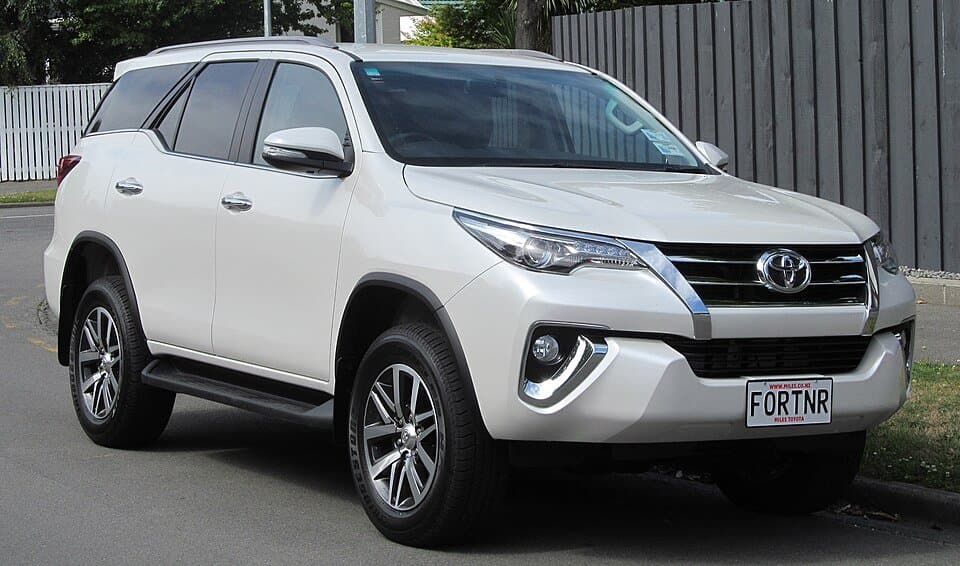
| Specification | Praetorian DASS | Toyota Fortuner |
|---|---|---|
| Type | defensive Aid Sub-System (DASS)[source] | — |
| Role | threat assessment, aircraft protection and support measures in extremely hostile and severe environments[source] | — |
| Architecture | antennas for electronic countermeasures (ECM), electronic support measures (ESM), missile approach warning systems (MAW), laser warning receivers (LWR) and Towed radar decoy (TRD)[source] | — |
| Control | fully automatic, which greatly relieves the workload for the pilot in combat but the pilot can manually override[source] | — |
| Countermeasure dispenser | two Saab BOL-510 dispensers and two Cobham plc / Elettronica Aster 55mm flare dispensers[source] |
Width
Single source1,840 mm (72.4 in)[source]
ECM GaAs-MMIC transmitter/receiver modules · Frequency
Single sourceMissile-approach-warning radar component · Frequency
Single sourcePassive radar-warning receiver antennas · Frequency
Single sourcePassive radar-warning receiver antennas · up to
Single source100 MHz up to 10 GHz[source]Passive radar-warning receiver antennas
6–18 GHz[source]ECM GaAs-MMIC transmitter/receiver modules
32–38 GHz[source]Missile-approach-warning radar component
Bars compare reported quantities only. A larger figure does not make a system better; configurations and test conditions differ.
| — |
| Countermeasure capacity | Each dispenser can be loaded with 160 packets of chaff/flares giving the Eurofighter a total of 320 chaff/flare cartridges (total weight 7–9 kg)[source]BOL-510 dispenser / installed aircraft chaff-flare cartridge total, not complete DASS mass | — |
|---|
| Decoy deployment | one or two Ariel Mk II TRD from Leonardo will be carried in the rear of starboard wingtip pod, and deployed from the pod on a 100 m long Kevlar cable containing a FibreOptic link and a separate power line[source]Ariel Mk II deployed cable, not DASS equipment length | — |
|---|
| Manufacturer | — | Toyota[source] |
|---|
| Also called | — | Toyota Hilux SW4 (2004–2015) Toyota SW4[source] |
|---|
| Production | — | November 2004 – present[source] |
|---|
| Model years | — | 2005–present[source] |
|---|
| Class | — | Mid-size SUV[source] |
|---|
| Body style | — | 5-door SUV[source] |
|---|
| Layout | — | Front-engine, rear-wheel-drive Front-engine, four-wheel-drive[source] |
|---|
| Platform | — | Toyota IMV platform[source] |
|---|
| Chassis | — | Body-on-frame[source] |
|---|
| Related | — | Toyota Hilux Toyota Innova[source] |
|---|
| Predecessor | — | Toyota 4Runner Toyota Hilux Sport Rider (Thailand)[source] |
|---|
| Model code | — | AN50 (4WD models) AN60 (2WD models)[source] |
|---|
| Assembly | — | Argentina: Zárate ( TASA ) Egypt: Cairo (AAV: from 2012) India: Bidadi ( TKM ) Indonesia: Karawang , West Java ( TMMIN ) Kazakhstan: Kostanay (from June 2014) Malaysia: Shah Alam ( UMW ) Thailand: Ban Pho ; Samrong Tai ( TMT ) Venezuela: Cumaná Vietnam: Vĩnh Phúc Pakistan: Karachi ( IMC )[source] |
|---|
| Designer | — | Satoshi Yokoi, Hideo Morita and Hiroyuki Kawagishi Satoshi Yokoi, Shigetoshi Kouzai and Naoto Furukado (2008 facelift)[source] |
|---|
| Engine | — | Petrol : 2.7 L 2TR-FE I4 (TGN51/61) 4.0 L 1GR-FE V6 (GGN50/60) Petrol flex-fuel : 2.7 L 2TR-FBE I4 (TGN51/61) Diesel : 2.5 L 2KD-FTV D-4D turbo I4 (KUN50/60) 3.0 L 5L-E I4 (LAN50) 3.0 L 1KD-FTV D-4D turbo I4 (KUN51/61)[source] |
|---|
| Transmission | — | 5-speed manual 4-speed automatic 5-speed automatic[source] |
|---|
| Wheelbase | — | 2,750 mm (108.3 in)[source] |
|---|
| Curb weight | — | 1,710–1,980 kg (3,770–4,365 lb)[source] |
|---|
| Design and production context | — | While the first-generation Fortuner was developed in Thailand by Thai and Japanese engineers, its facelifted version, as well as the Hilux and Innova , was designed in Australia by Toyota Australia , which is also responsible for developing the second-generation model.[source] |
|---|