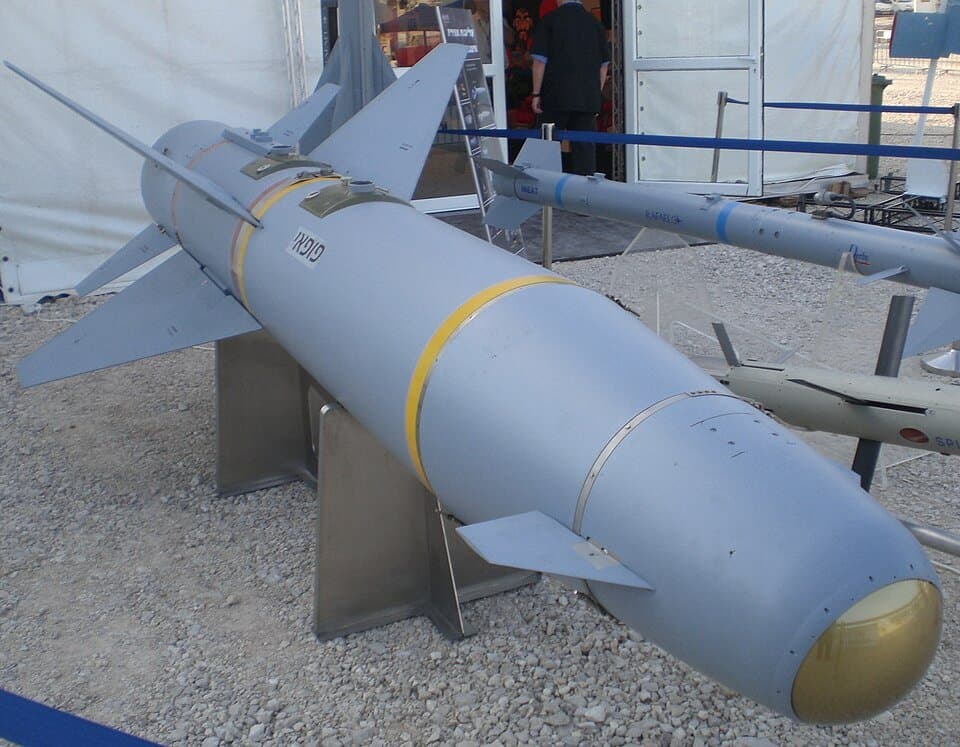

Credit
Tal Inbar (טל ענבר) · CC BY-SA 3.0 · Resized · CC BY-SA 3.0 · Source ↗ · Modified


Preparing your view.

Measured figures
Configuration
| Specification | Popeye (missile) | Rudram (missile) |
|---|---|---|
| Type | Air-to-surface missile SLCM[source] | Air-to-surface anti-radiation missile[source] |
| Place of origin | Israel[source] | India[source] |
| In service | 1985–present[source] | Rudram-1: 2022 to present[source] |
| Used by | See Operators[source] | Indian Air Force |
Wingspan
Single source198 cm (78 in)[source]
Bars compare reported quantities only. A larger figure does not make a system better; configurations and test conditions differ.
| Designer | Rafael Advanced Defense Systems[source] | Defence Research and Development Laboratory[source] |
|---|
| Manufacturer | Rafael Advanced Defense Systems Lockheed Martin[source] | Adani Defence & Aerospace[source] |
|---|
| Warhead | 340 kg (750 lb) blast fragmentation or 360 kg (790 lb) I-800 penetrating[source] | — |
|---|
| Engine | Single-stage Solid-fuel rocket[source] | — |
|---|
| Guidance system | Inertial plus IIR or TV[source] | — |
|---|
| Launch platform | Fixed-wing aircraft, Dolphin class submarine (Popeye Turbo SLCM)[source] | MiG-29UPG Dassault Mirage 2000 Su-30MKI Tejas Mk.1/1A HAL Tejas Mk2 (Planned) AMCA (Planned) TEDBF (Planned)[source] |
|---|
| Guidance | Inertial plus imaging infrared or TV[source] | — |
|---|
| Designed | — | 2012–present[source] |
|---|
| Produced | — | Under Development[source] |
|---|
| Variants | — | See Specifications[source] |
|---|
| Accuracy | — | ≤ 5 m CEP[source] |
|---|
| Source measurement | — | DRDO ARM, now Rudram 1, has a range of 100–250 km which is made to be integrated with Sukhoi Su-30MKI as its primary test platform, although can be used with Dassault Mirage 2000 , SEPECAT Jaguar , HAL Tejas and HAL Tejas Mark 2 in future.[source]Rudram (missile) · Description; only the objects and conditions stated in this passage Mid-course guidance is accomplished through inertial navigation system and two-way datalink combined with Global Positioning System / NavIC satellite guidance through digital filtering as fall back to correct accumulated errors and a passive homing head (PHH) seeker which is developed by Defence Electronics Research Laboratory that can detect radio frequency emissions from 100 km away.[source]Rudram (missile) · Description; only the objects and conditions stated in this passage The missile is a single-stage, approximately 5.5-metre in length and 600 kg of weight with cruciform wing surface to increase high maneuverability and to give constant aerodynamic characteristics similar to Astra beyond-visual-range missile . It uses pre-fragmented warhead with optical proximity fuze and is powered by a dual- pulsed solid rocket motor made by Premier Explosives Limited under technology transfer from DRDO. The dual-pulsed solid rocket motor produces variable thrust within a range of Mach 0.6 to 2 that reduces the overall reaction time while widening the targeting envelope as well as the engagement capability. DRDO ARM can target mobile integrated air-defence system as well as radar station that shutdown to avoid detection.[source]Rudram (missile) · Description; only the objects and conditions stated in this passage The Captive Flight Trial–1 of DRDO ARM was completed in April/May 2016 by No. 20 Squadron of IAF which checked the performance of seeker, navigation and control system , structural capability and aerodynamic vibrations while the Drop Flight Trial was completed by December 2016 with the missile released by Sukhoi Su-30MKI at a speed of 0.8 Mach , from 6.5 km altitude.[source]Rudram (missile) · Trials / Rudram-1; only the objects and conditions stated in this passage The missile achieved an accuracy within 10 m CEP covering a range of 100 km.[source]Rudram (missile) · Trials / Rudram-1; only the objects and conditions stated in this passage The release flight trial was conducted in 2022 from Sukhoi Su-30MKI . The first test of the anti radiation of the RudraM-II was reported in July 2023. It has a range of 300 km and has an additional Imaging Infrared (IIR) seeker . The missile can be fired from Sukhoi Su-30MKI and Mirage 2000 .[source]Rudram (missile) · Trials / Rudram-2; only the objects and conditions stated in this passage The RudraM-II missile was successfully flight-tested from a Sukhoi-30MKI fighter off the coast of Odisha on 29 May 2024. The propulsion system and control & guiding algorithm were validated by the test. It will replace Kh-31s in IAF inventory. The missile can be launched from a range of altitudes and can identify signals from radars and enemy radio frequencies at ranges more than 100 km. It has Lock-On-Before/After-Launch systems installed, which allow for flexible targeting. The missile also has an internal guidance system that allows it to find its way to the target on its own after launch.[source]Rudram (missile) · Trials / Rudram-2; only the objects and conditions stated in this passage The flight trials of RudraM-II missiles were conducted successfully from a Sukhoi-30MKI fighter off the coast of Odisha on 2 June 2026. The tests were conducted under extreme release conditions with critical flight trajectory to validate all the subsystems. The target was pre-defined and struck with high accuracy. Flight data captured via instruments deployed at the Integrated Test Range confirmed all test objectives were met. At least three flight trials of the missile has been conducted with the one in May 2024 being the first full-configuration trial.[source]Rudram (missile) · Trials / Rudram-2; only the objects and conditions stated in this passage DRDO successfully tested Rudram-3 in captive flight on Su-30MKI in March 2026. The technical team was able to assess the system's structural limitations, airflow dynamics, and electronic compatibility without carrying out a real launch. The missile maintained total structural soundness over a broad range of operational altitudes, velocities, and aerial maneuvers.[source]Rudram (missile) · Trials / Rudram-3; only the objects and conditions stated in this passage DRDO is planning to bring further software improvements to handle a larger variety of targets under various operational conditions while developing a separate ground-based variant to be launched from mobile launcher. DRDO is developing Rudram-2 with a range of 350 km and air to ground version Rudram-3 with 550 km range. A number of Rudram-3 subsystems have been built by 2023. Aircraft adaption tests for electrical and mechanical systems were finished.[source]Rudram (missile) · Future development / Rudram-3; only the objects and conditions stated in this passage As per DRDO Chief Samir V. Kamat, Rudram-4 will be a lightweight, long-range standoff weapon (LRSOW) for increased operational flexibility. It will integrate with Dassault Mirage 2000 , Sukhoi Su-30 MKI , and Dassault Rafale with speed exceeding Mach 5. In 2023, the Defense Acquisition Council authorized the acceptance of necessity for Rudram-4. It will use inertial and satellite navigation with imaging infrared or passive homing head for precision strikes against command centers , radar sites, and hardened bunkers . Rudram-4 will have 1,000–1,500 km range. It will use maneuverable flight routes at low altitudes to evade air defense systems .[source]Rudram (missile) · Future development / Rudram-4 (LRSOW); only the objects and conditions stated in this passage |
|---|
| Reported operators |
| — |
|---|