


Preparing your view.

At a glance
True scale
Side by side. From every angle. A human reference for perspective.
3.11 MB · Loads when you open it| Model | Length | Width / span | Height |
|---|---|---|---|
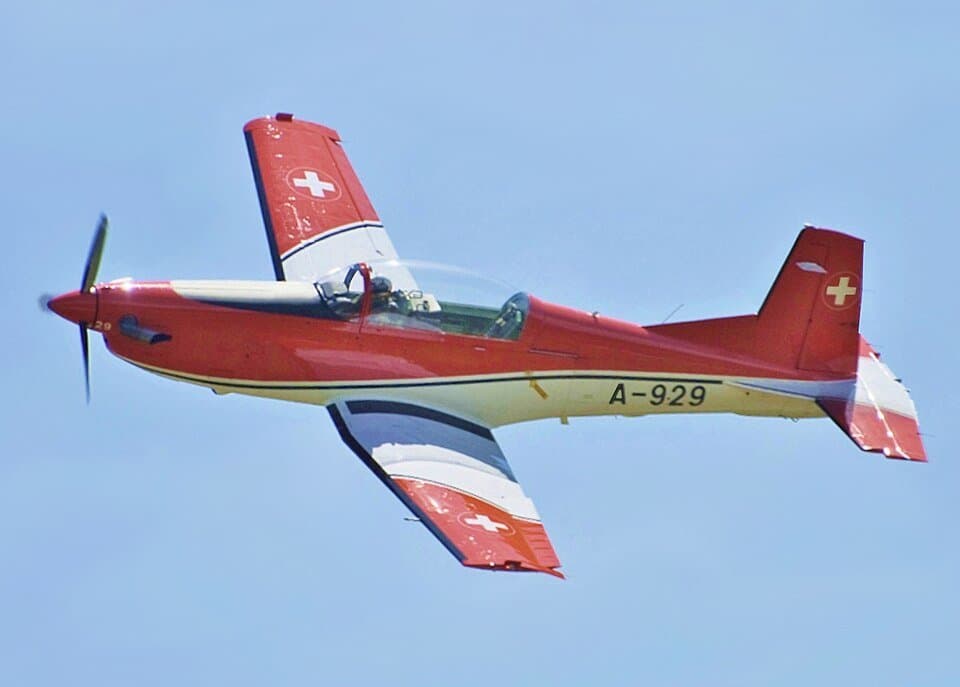
| Pilatus PC-7 | ≈ 9.78 m | ≈ 10.4 m (Wingspan) | ≈ 3.48 m |
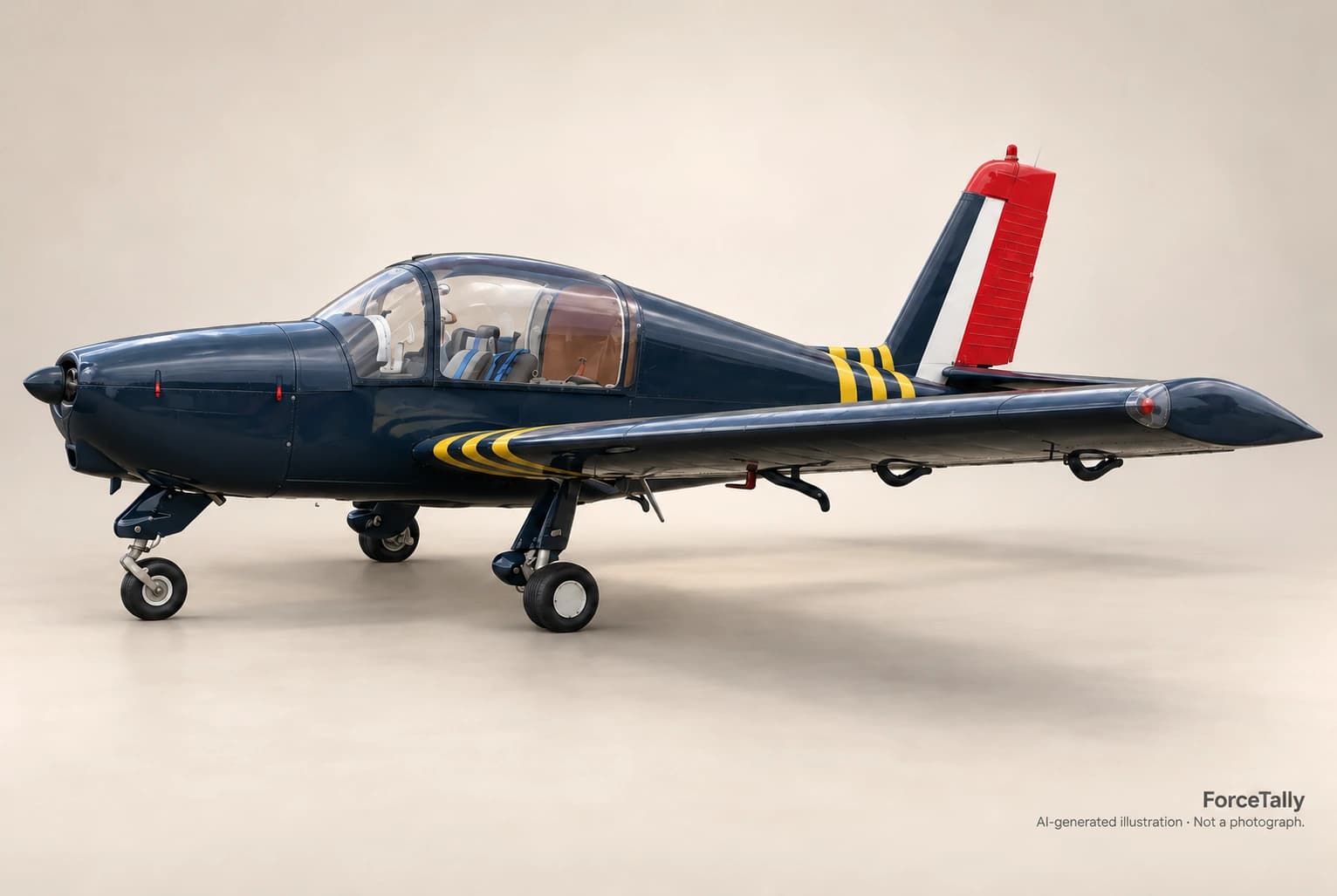
| SOCATA Rallye family | ≈ 7.24 m | ≈ 9.74 m (Wingspan) | ≈ 2.8 m |
Scaled uniformly to the sourced length of 9.78 m. The width was fitted to the sourced 10.4 m wingspan. Not an official model or a measured survey.
ForceTally · All rights reserved
Scaled uniformly to the sourced length of 7.24 m. The shape was turned square to the axes; the height was fitted to the sourced 2.8 m; the width was fitted to the sourced 9.74 m wingspan. Not an official model or a measured survey.
ForceTally · All rights reserved
The human reference is a generic 1.75 m figure. Models describe external size, not combat performance.
Measured figures
PC-7 · Length
Single source9.78 m (32 ft 1 in)[source]
180 GT · Length
Configuration
| Specification | Pilatus PC-7 | SOCATA Rallye family |
|---|---|---|
| Crew | two, pilot instructor and student pilot[source] | one[source] |
| Type | Trainer aircraft[source] | Tourer/trainer aircraft[source] |
| Manufacturer | Pilatus Aircraft[source] | SOCATA[source] |
| Status | In service[source] | — |
| Primary users |
7.24 m (23 ft 9 in)[source]
Cruise; PC-7 · (econ. cruise at 6,095 m (19,997 ft))
Single sourceMaximum; PC-7 · (max cruise at 6,095 m (19,997 ft))
Single source412 km/h (256 mph, 222 kn) (max cruise at 6,095 m (19,997 ft))[source]
316 km/h (196 mph, 171 kn) (econ. cruise at 6,095 m (19,997 ft))[source]
Cruise; 180 GT · Cruise speed
Single sourceMaximum; 180 GT · Maximum speed
Single sourceFerry; PC-7 · Ferry range
Single sourcePC-7 · standard range without external drop tanks, ferry range with external drop tanks, (cruise power, at 5,000 m (16,000 ft) - 20 min reserves)
Single source1,200 km (750 mi, 650 nmi) standard range without external drop tanks, ferry range with external drop tanks, (cruise power, at 5,000 m (16,000 ft) - 20 min reserves)[source]
2,630 km (1,630 mi, 1,420 nmi)[source]
180 GT · Range
Single source1,300 km (810 mi, 700 nmi)[source]
PC-7 · 1 × Pratt & Whitney Canada PT6A -25A turboprop derated from
Single sourcePC-7 · 650 shp
Single source1 × Pratt & Whitney Canada PT6A -25A turboprop , 410 kW (550 hp)(derated from 485 kW (650 shp))[source]
180 GT · × Lycoming O-360-A3A 4-cylinder air-cooled horizontally-opposed piston engine
Single source× Lycoming O-360-A3A 4-cylinder air-cooled horizontally-opposed piston engine, 134 kW (180 hp)[source]
PC-7 · Endurance
Single source4 hr 22 min[source]
PC-7 · (2,150 ft/min) climb to 5,000 m in 9 min 0 sec take-off run 780 m at max take-off weight, landing run 505 m at max landing weight
Single source10.9 m/s (2,150 ft/min) climb to 5,000 m in 9 min 0 sec take-off run 780 m at max take-off weight, landing run 505 m at max landing weight[source]
180 GT · 758 ft/min
Single source3.85 m/s (758 ft/min)[source]
Bars compare reported quantities only. A larger figure does not make a system better; configurations and test conditions differ.
Mexican Air Force Indian Air Force South African Air Force Royal Malaysian Air Force[source] |
| — |
| Number built | >618[source] | ~3,300[source] |
|---|
| Manufactured | 1966–present[source] | 1961–1982[source] |
|---|
| Introduction date | PC-7 : 1978 PC-7 Mk.II M : 1994 PC-7 MKX : 2021[source] | 1961[source] |
|---|
| First flight | PC-7 : 12 April 1966 ( 1966-04-12 ) (prototype) 18 August 1978 ( 1978-08-18 ) (production) PC-7 Mk.II M : 28 September 1992 ( 1992-09-28 )[source] | 10 June 1959[source] |
|---|
| Developed from | Pilatus P-3[source] | — |
|---|
| Developed into | Pilatus PC-9[source] | — |
|---|
| Capacity | two[source] | three passengers[source] |
|---|
| Fuel capacity | 474 L (104 imp gal; 125 US gal) usable internal fuel, 2x 240 L (53 imp gal; 63 US gal) external fuel drop tanks • Max landing weight: 2,565 kg[source] | — |
|---|
| Hardpoints | 6 × underwing hardpoints for bombs and rockets with a capacity of 1,040 kg (2,294 lb)[source] | — |
|---|
| Aspect ratio | 6.5:1[source] | — |
|---|
| Airfoil | NACA 64 2 A-415 at root, 64 1 A-612 at tip[source] | NACA 63A416[source] |
|---|
| Propellers | 3-bladed Hartzell HC-B3TN-2 / T10173C-8 constant-speed propeller , 2.36 m (7 ft 9 in) diameter[source] | 2-bladed variable-pitch propeller[source] |
|---|
| Stall speed | 119 km/h (74 mph, 64 kn) (flaps and gear down, power off)[source] | 92 km/h (57 mph, 50 kn)[source] |
|---|
| Never exceed speed | 500 km/h (310 mph, 270 kn) EAS[source] | — |
|---|
| g limits | -3 / +6[source] | — |
|---|
| Alternative designation | Pilatus PC-7 Turbo Trainer[source] | — |
|---|
| Country of origin | Switzerland[source] | — |
|---|
| National origin | — | France[source] |
|---|
| Wing loading | — | 85.4 kg/m 2 (17.5 lb/sq ft)[source] |
|---|
| Power/mass | — | 0.13 kW/kg (0 hp/lb)[source] |
|---|
| Role | — | light aircraft[source] |
|---|
| Source measurement | — | On 10 June 1959, the prototype Rallye, powered by a 90 hp (67 kW) engine, conducted its maiden flight . On 21 November 1961, the first production versions of the aircraft, designated as the MS.880B and more powerful MS.885 , received their type certification , clearing them to perform operational flights. Thereafter, a range of improvements and alterations were progressively made upon the design as new models of the Rallye were introduced; typical advances included the adoption of more powerful engines, improved payload capability, and strengthened structure, the addition of wheel fairings, increased ground clearance for the propeller, expanded rudder and ailerons , and changes to the cockpit canopy arrangement.[source]SOCATA Rallye family · Development; only the objects and conditions stated in this passage In the late 1960s, SOCATA pursued the development of an enlarged 7-seat version powered by a 300 hp (220 kW) Lycoming IO-540-K engine, the ST.60 Rallye 7. Two prototypes were constructed: a version with retractable tricycle landing gear , first flown on 3 January 1969, and an otherwise similar aircraft with fixed landing gear. However, SOCATA was not confident that a sufficient market for the aircraft existed, and no further production ensued. SOCATA subsequently introduced the enlarged MS.890 Rallye Commodore series with a heavier airframe and four seats; production and development of the MS.880 and MS.890 series continued in parallel, and the enlarged and strengthened empennage of the MS.890 was adapted to MS.880 variants using more powerful engines and those approved for spins .[source]SOCATA Rallye family · Development; only the objects and conditions stated in this passage Also in the late 1960s, United States aviation entrepreneur Alexander Berger—whose Allied Aero Industries holding company owned the Franklin Engine Company and Jacobs Aircraft Engine Company —formed a new venture to market European light aircraft under the banner of the defunct Waco Aircraft Company . Based in Pottstown, Pennsylvania , Waco made arrangements to market, sell, and service the Rallye throughout the sizable and attractive North American market, and introduced a licensed American-built version of the Rallye Commodore badged as the Waco MS.294A Minerva , powered by a 220 hp (160 kW) Franklin engine. Waco also sold the 150ST, 180CT and 235CT in the United States. However, the Rallye had little time to prove itself prior to Waco winding up its aviation activities following Berger's death in 1971. As a consequence of Waco's dissolution, third party aviation companies purchased the various leftover assets and continued to provide spare parts and services to American owners of the Rallye.[source]SOCATA Rallye family · Development; only the objects and conditions stated in this passage The aircraft's power was provided from one of a range of progressively more powerful air-cooled engines; such as the early Rallye Cub model, which was powered by a 100 hp (75 kW) Continental O-200-A engine, while the newer Rallye 235 variant was furnished with a 235 hp (175 kW) Lycoming O-540 engine.[source]SOCATA Rallye family · Design; only the objects and conditions stated in this passage The Rallye was fitted with a bulbous cockpit, which was capable of accommodating two/three people in the basic lower-powered variants and up to four personnel within the more powerful models of the aircraft, some of which were designed to function as glider tugs and banner bearers . The canopy slides rearwards to provide access to and from the cockpit, aided by a step located just underneath the wing's trailing edge; on the ground. On the ground, the canopy should remain slightly open when occupied to allow for adequate airflow; in flight, the canopy can be left open at speed up to a maximum of 94 knots.[source]SOCATA Rallye family · Design; only the objects and conditions stated in this passage Two-seat prototype powered by 90 hp (67 kW) Continental C90-14F , conventional landing gear , 1 built.[source]SOCATA Rallye family · Variants / French production / Lightweight airframe (MS.880 series); only the objects and conditions stated in this passage Production version of MS.880B with 100 hp (75 kW) Continental O-200-A , 1,100 built.[source]SOCATA Rallye family · Variants / French production / Lightweight airframe (MS.880 series); only the objects and conditions stated in this passage 105 hp (78 kW) Potez engine. 12 built. Two-seat aircraft.[source]SOCATA Rallye family · Variants / French production / Lightweight airframe (MS.880 series); only the objects and conditions stated in this passage 115 hp (86 kW) Lycoming engine. 77 built. Two-seat aircraft.[source]SOCATA Rallye family · Variants / French production / Lightweight airframe (MS.880 series); only the objects and conditions stated in this passage Two/three-seat version; first flight 1 January 1961. 145 hp (108 kW) Continental O-300 engine. 212 built.[source]SOCATA Rallye family · Variants / French production / Lightweight airframe (MS.880 series); only the objects and conditions stated in this passage 150 hp (110 kW) Lycoming engine. Three built.[source]SOCATA Rallye family · Variants / French production / Lightweight airframe (MS.880 series); only the objects and conditions stated in this passage Two-seat trainer powered by 100 hp (75 kW) Rolls-Royce Continental O-200-A , 55 built.[source]SOCATA Rallye family · Variants / French production / Lightweight airframe (MS.880 series); only the objects and conditions stated in this passage 100T with three or four seats, 45 lb (20 kg) gross weight increase, 45 built.[source]SOCATA Rallye family · Variants / French production / Lightweight airframe (MS.880 series); only the objects and conditions stated in this passage Four-seat version of 100-T, powered by 125 hp (93 kW) Lycoming O-235 .[source]SOCATA Rallye family · Variants / French production / Lightweight airframe (MS.880 series); only the objects and conditions stated in this passage Four-seat Rallye 100ST, increased gross weight, enlarged tail, 150 hp (110 kW) Lycoming 0-320-E2A , 25 built.[source]SOCATA Rallye family · Variants / French production / Lightweight airframe (MS.880 series); only the objects and conditions stated in this passage Improved Rallye 100ST powered by 110 hp (82 kW) Lycoming O-235-L2A , 76 built. Can be operated as a three/four-seat aircraft if spins are prohibited.[source]SOCATA Rallye family · Variants / French production / Lightweight airframe (MS.880 series); only the objects and conditions stated in this passage Improved version of Rallye 150ST with 155 hp (116 kW) Lycoming O-320-D2A , 5 built.[source]SOCATA Rallye family · Variants / French production / Lightweight airframe (MS.880 series); only the objects and conditions stated in this passage Improved version of Rallye 150T with 180 hp (130 kW) Lycoming O-360-A3A , 5 built, sold by Waco in US.[source]SOCATA Rallye family · Variants / French production / Lightweight airframe (MS.880 series); only the objects and conditions stated in this passage The first version to incorporate four-place seating. 145 hp (108 kW) Continental engine. Eight built.[source]SOCATA Rallye family · Variants / French production / Heavy airframe (MS.890 series); only the objects and conditions stated in this passage Similar to the MS.890 but with 150 hp (110 kW) Lycoming 0-320 engine. Later designated Rallye 150 .[source]SOCATA Rallye family · Variants / French production / Heavy airframe (MS.890 series); only the objects and conditions stated in this passage 180 hp (130 kW) Lycoming O-360 engine. Later designated Rallye 180 . Further redesignated SOCATA Gaillard or SOCATA Galérien (glider towing version).[source]SOCATA Rallye family · Variants / French production / Heavy airframe (MS.890 series); only the objects and conditions stated in this passage 220 hp (160 kW) Franklin 6A-350 engine. Later designated Rallye 220 . Some assembled and sold as Waco Minerva in US. 211 built.[source]SOCATA Rallye family · Variants / French production / Heavy airframe (MS.890 series); only the objects and conditions stated in this passage Powered by 235 hp (175 kW) Lycoming O-540 . Redesignated SOCATA Gabier .[source]SOCATA Rallye family · Variants / French production / Heavy airframe (MS.890 series); only the objects and conditions stated in this passage Enlarged 7-seat version, 300 hp (220 kW) Lycoming IO-540-K engine, two prototypes built.[source]SOCATA Rallye family · Variants / French production / Heavy airframe (MS.890 series); only the objects and conditions stated in this passage Initial licence production version powered by PZL licensed 116 hp (87 kW) Franklin 4A-235 , based on Rallye 100 ST. Production 32 aircraft.[source]SOCATA Rallye family · Variants / Polish production; only the objects and conditions stated in this passage 150 hp (110 kW) Lycoming O-320 engine.[source]SOCATA Rallye family · Variants / Polish production; only the objects and conditions stated in this passage 160 hp (120 kW) Lycoming O-320 engine.[source]SOCATA Rallye family · Variants / Polish production; only the objects and conditions stated in this passage 235 hp (175 kW) Lycoming O-540 engine.[source]SOCATA Rallye family · Variants / Polish production; only the objects and conditions stated in this passage Capacity: three passengers[source]SOCATA Rallye family · Specifications (180 GT); only the objects and conditions stated in this passage Length: 7.24 m (23 ft 9 in)[source]SOCATA Rallye family · Specifications (180 GT); only the objects and conditions stated in this passage Wingspan: 9.74 m (31 ft 11 in)[source]SOCATA Rallye family · Specifications (180 GT); only the objects and conditions stated in this passage Height: 2.8 m (9 ft 2 in)[source]SOCATA Rallye family · Specifications (180 GT); only the objects and conditions stated in this passage Wing area: 12.3 m 2 (132 sq ft)[source]SOCATA Rallye family · Specifications (180 GT); only the objects and conditions stated in this passage Empty weight: 570 kg (1,257 lb)[source]SOCATA Rallye family · Specifications (180 GT); only the objects and conditions stated in this passage Max takeoff weight: 1,050 kg (2,315 lb)[source]SOCATA Rallye family · Specifications (180 GT); only the objects and conditions stated in this passage Powerplant: × Lycoming O-360-A3A 4-cylinder air-cooled horizontally-opposed piston engine, 134 kW (180 hp)[source]SOCATA Rallye family · Specifications (180 GT); only the objects and conditions stated in this passage Maximum speed: 240 km/h (150 mph, 130 kn)[source]SOCATA Rallye family · Specifications (180 GT); only the objects and conditions stated in this passage Cruise speed: 225 km/h (140 mph, 121 kn)[source]SOCATA Rallye family · Specifications (180 GT); only the objects and conditions stated in this passage Stall speed: 92 km/h (57 mph, 50 kn)[source]SOCATA Rallye family · Specifications (180 GT); only the objects and conditions stated in this passage Range: 1,300 km (810 mi, 700 nmi)[source]SOCATA Rallye family · Specifications (180 GT); only the objects and conditions stated in this passage Service ceiling: 3,600 m (11,800 ft)[source]SOCATA Rallye family · Specifications (180 GT); only the objects and conditions stated in this passage Rate of climb: 3.85 m/s (758 ft/min)[source]SOCATA Rallye family · Specifications (180 GT); only the objects and conditions stated in this passage |
|---|