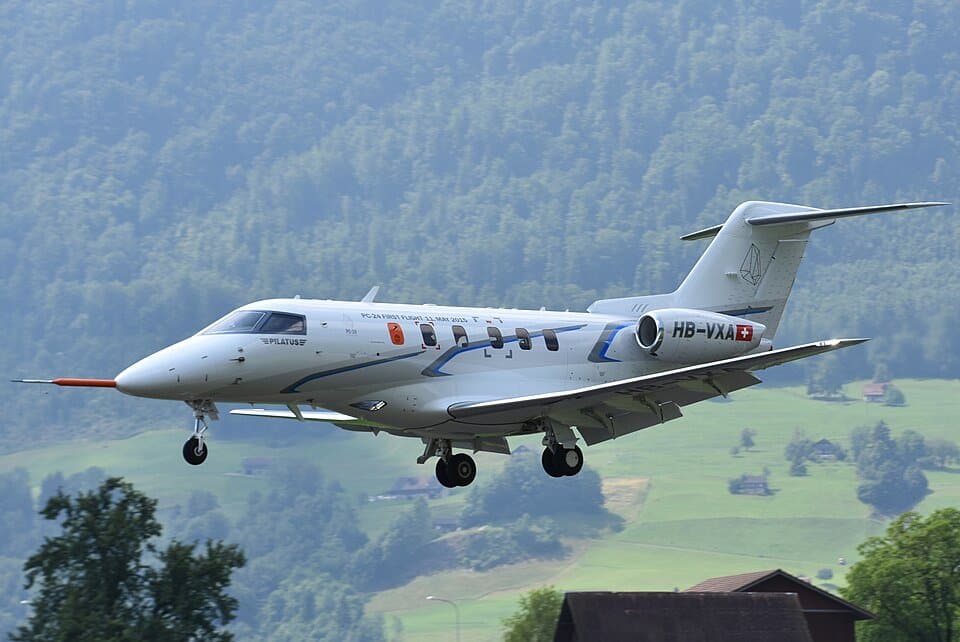

Credit
Stephan Widmer · CC BY-SA 2.0 · Resized · CC BY-SA 2.0 · Source ↗ · Modified


Preparing your view.

At a glance
Pilatus PC-24larger figure on 0 of 1
Shaanxi KJ-2000larger figure on 1 of 1
Counts only measures both sources give with the same scope. A larger figure is not a better system.
Measured figures
Maximum take-off; Max takeoff weight
Single sourceEmpty; Empty weight
Single sourceMaximum take-off; Max ramp weight
Single source5,244 kg (11,561 lb)[source]
8,500 kg (18,739 lb) Max ramp weight: 8,545 kg (18,839 lb)[source]
Maximum take-off; Max takeoff weight
Single source175,000 kg (385,809 lb)[source]
6 passengers (1,200 lb payload)
Single sourceFerry; Ferry range
Single source3,700 km (2,300 mi, 2,000 nmi) , 6 passengers (1,200 lb payload)[source]
3,932 km (2,443 mi, 2,123 nmi)[source]
Range
Single sourcerange of
Single source5,500 km (3,400 mi, 3,000 nmi)[source]
range of 470 km (290 mi)[source]Shaanxi KJ-2000 · Design · It is designed to detect and track airborne and surface targets, operating in the frequency range of 1200–1400 MHz, and has a maximum aerial detection range of 470 km (290 mi).
2 × Williams FJ44-4A turbofans thrust each
Single source2 × Williams FJ44-4A turbofans , 15 kN (3,400 lbf) thrust each[source]
Wing area
Single source30.91 m 2 (332.6 sq ft)[source]
Maximum payload
Single source1,406 kg (3,100 lb)[source]
Service ceiling
Single source14,000 m (45,000 ft)[source]
(3,960 ft/min) MTOW, at Sea level
Single source20.1 m/s (3,960 ft/min) MTOW, at Sea level[source]
Bars compare reported quantities only. A larger figure does not make a system better; configurations and test conditions differ.
Configuration
| Specification | Pilatus PC-24 | Shaanxi KJ-2000 |
|---|---|---|
| Crew | one or two[source] | — |
| Type | Light business jet[source] | Airborne early warning and control[source] |
| National origin | Switzerland[source] | China[source] |
| Manufacturer | Pilatus Aircraft[source] | Shaanxi Aircraft Corporation CETC (avionics) NRIET (radar)[source] |
| Status | In production[source] | Active[source] |
| Primary users | Qatar Emiri Air Force PlaneSense Royal Flying Doctor Service[source] | — |
| Number built | 212 (Q1 2024)[source] | 5 estimated as of 2008[source] |
| Manufactured | 2015–present[source] | — |
| Introduction date | 1 April 2018[source] | — |
| First flight | 11 May 2015[source] | March 23, 2003[source] |
| Capacity | 10 passengers[source] | — |
| Aspect ratio | 9.35[source] | — |
| Fuel capacity | 2,705 kg (5,964 lb), 888.5 US gal (3,363 L)[source] | — |
| Cabin | 7.01 m × 1.69 m × 1.55 m long × wide × high ( 23 ft 0 in × 5 ft 7 in × 5 ft 1 in)[source] | — |
| Cabin altitude | 2,438 m at 13,716 m (8,000 ft at 45,000 ft), 8.78 psi (0.605 bar)[source] | — |
| Stall speed | 154 km/h (96 mph, 83 kn)[source] | — |
| Time to altitude | 45,000 ft (14,000 m) 27.1 mins[source] | — |
| Wing loading | 259 kg/m 2 (53 lb/sq ft)[source] | — |
| Fuel consumption | 0.58 kg/km (2.1 lb/mi) Mach 0.72/416 kn (770 km/h) cruise, 15,375 lb (6,974 kg) weight, FL 450, ISA+3C[source] | — |
| Thrust/weight | 0.36[source] | — |
| Take-off | 942 m; 3,091 ft (MTOW, ISA, sea level, dry paved runway)[source] | — |
| Landing | 734 m; 2,408 ft (Over 50 ft obstacle, MLW, ISA, sea level, dry paved runway)[source] | — |
| Primary user | — | People's Liberation Army Air Force (PLAAF)[source] |
| Developed from | — | Ilyushin Il-76[source] |
| Successors | — | KJ-3000[source] |
| Range against fighter sized targets | — | 470 km (290 mi; 250 nmi)[source] |
| Range against ballistic missiles | — | 1,200 km (750 mi; 650 nmi)[source] |
| Max simultaneous targets tracked | — | 60–100[source] |
| Source measurement | — | The Chinese AWACS has a phased array radar (PAR) system carried in a disc-shaped radome . Unlike the American E-3 Sentry and the Russian Beriev A-50 , two AWACS aircraft comparable in size and both with a 9-metre-diameter (30 ft) rotating radome (rotodome) to provide 360‑ degree scanning, the radome of the Chinese AWACS is stationary. Instead, the three PAR modules are placed in an equilateral triangle configuration inside the 14-metre-diameter (46 ft) round radome, each covering a 120-degree spherical sector to provide full 360‑degree coverage.[source]Shaanxi KJ-2000 · Design; only the objects and conditions stated in this passage The radar is designated K/LLQF01 active electronically scanned array (AESA) radar. The multi-function, three-dimensional pulse-Doppler radar was developed by the Nanjing Research Institute of Electronics Technology (NRIET), a subsidiary of the China Electronics Technology Group Corporation (CETC). It is designed to detect and track airborne and surface targets, operating in the frequency range of 1200–1400 MHz, and has a maximum aerial detection range of 470 km (290 mi).[source]Shaanxi KJ-2000 · Design; only the objects and conditions stated in this passage The PLAAF's first AWACS regiment was established at a small and remote airfield in southern China, for security reasons, during late 2004. The commander appointed to the regiment was Zhang Guangjian (张广建), a pilot with over 6,000 hours of flight time on various aircraft including the Il-76. The base was re-built and re-equipped for handling the KJ-2000, the first of which reached the base in 2005. A mixed fleet of KJ-2000 and the smaller KJ-200 have been operated at the base.[source]Shaanxi KJ-2000 · Operational history; only the objects and conditions stated in this passage In 2013, a 24-hour coverage drill was held using three KJ-2000s that covered northwest China, the East China Sea, and the South China Sea.[source]Shaanxi KJ-2000 · Operational history; only the objects and conditions stated in this passage Max takeoff weight: 175,000 kg (385,809 lb)[source]Shaanxi KJ-2000 · Specifications; only the objects and conditions stated in this passage Maximum speed: 850 km/h (530 mph, 460 kn)[source]Shaanxi KJ-2000 · Specifications; only the objects and conditions stated in this passage Range: 5,500 km (3,400 mi, 3,000 nmi)[source]Shaanxi KJ-2000 · Specifications; only the objects and conditions stated in this passage Endurance: 7 hours and 40 minutes[source]Shaanxi KJ-2000 · Specifications; only the objects and conditions stated in this passage Range against fighter sized targets: 470 km (290 mi; 250 nmi)[source]Shaanxi KJ-2000 · Specifications; only the objects and conditions stated in this passage Range against ballistic missiles: 1,200 km (750 mi; 650 nmi)[source]Shaanxi KJ-2000 · Specifications; only the objects and conditions stated in this passage |
| Frequency range | — | frequency range of 1200–1400 MHz[source]Shaanxi KJ-2000 · Design · It is designed to detect and track airborne and surface targets, operating in the frequency range of 1200–1400 MHz, and has a maximum aerial detection range of 470 km (290 mi). |